SECOND SUNDAY OF ADVENT
Prayer of the Day: Stir up our hearts, Lord God, to prepare the way of your only Son. By his coming strengthen us to serve you with purified lives; through Jesus Christ, our Savior and Lord, who lives and reigns with you and the Holy Spirit, one God, now and forever.
“Prepare the way of the Lord,
make his paths straight” Mark 1:3.
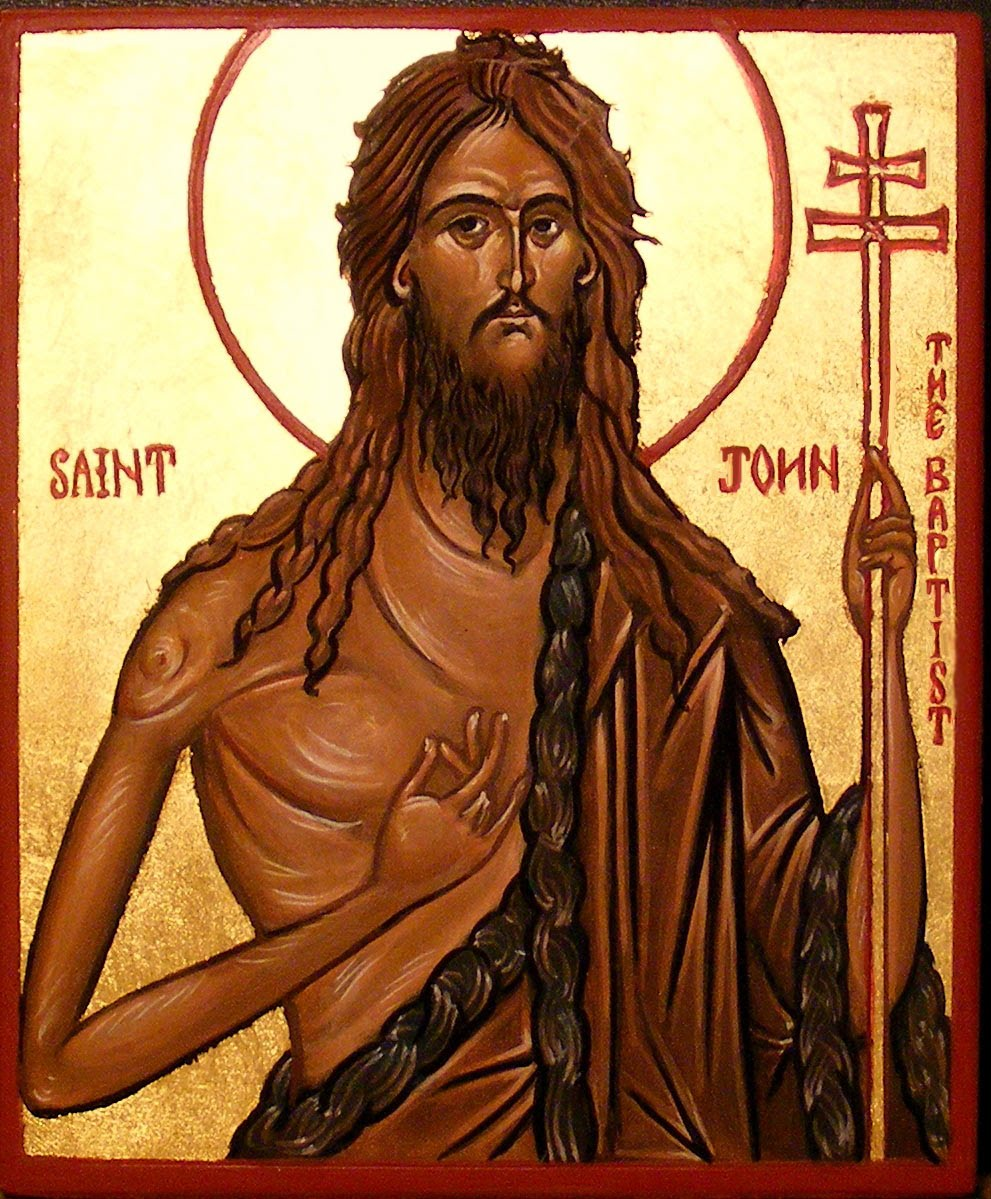
As with Mark the Evangelist’s gospel generally, the account of John the Baptizer’s appearance and message is tersely stated. In the illustrative words of the Prophet Isaiah, John comes to “prepare the way of the Lord,” to proclaim a “baptism of repentance for the forgiveness of sins.” The other gospels tell us more about John’s preaching and ministry, but I prefer to stick with Mark’s stark portrayal. Mark’s gospel frequently leaves us plenty of space to ponder the mysteries recorded on its pages, room for the imagination to fill in the blanks.
The story spills out of an ancient proclamation by the prophet who saw in the turbulent geopolitical clash of empires in the sixth century the hand of Israel’s God working liberation for his exiled people in Babylon, creating for them the opportunity for return to their ancestral land, opening up the way into a new beginning. That good news might not have seemed particularly good to many of the Babylonian exiles. They had been living in Babylon for half a century. To the younger generation, Babylon was the only home they had ever known. Over time, these captive peoples had become accustomed to living in a foreign land that was gradually becoming less foreign. Many of the exiles had settled into a comfortable existence. Some had even attained a degree of prominence in Babylonian society. Why leave the comfort and security of an established existence only to start over again in a land full of ruined cities and inhabited by peoples who would be none to happy about their arrival?
Clearly, the people would need a change of heart. That is where the preaching of repentance comes in. In common parlance, the word “repent” conjures up images of sorrow, remorse and breast beating. While repentance might indeed invite such a response, that is not what it is. To repent, in simplest terms, is to “turn around.” It involves a radical change of direction as the result of being confronted with a completely new reality. The prophet would have Israel know that history is not finally driven solely by the emperors and their armies. God is at work in the clash of superpowers causing even human wrath and malice to serve God’s purpose and rebound to God’s praise. Psalm 76:10. John would have us know that, under the shadow of Rome’s cruelty and brutal occupation of Israel, God is working yet another act of liberation for God’s oppressed people, the “least” of humanity.
John’s call to repentance is therefore more than a plea for personal moral and spiritual reform. It is an invitation to turn away from life lived under the fear of tyrants, a life lived in a state of compromise with the machinery of oppression and acceptance of the status quo as inevitable. It is a call to begin living into the reality that God, not Caeser, is Lord; that God is the God who choses and liberates slaves and brings great empires and their privileged beneficiaries to naught; that the power vaunted by the kingdoms of this world is finally impotent. Living as though all of this were true will likely place one on a collision course with the imperial forces that maintain order by the threat of crucifixion. But as Mark’s gospel will show us as his story unfolds, that threat is as empty as the tomb on Easter morning.
Volumes have been written by scholars and critics about how alien the Bible is to the modern mind. Whereas we view events through the lens of news media obsessed with real time reporting and getting the facts straight, the biblical authors and editors were chiefly concerned with getting the meaning of events right and fitting them into the grand narrative of God’s redemptive work for Israel and the Church. We scrupulously divide our libraries into fiction and nonfiction sections. Biblical authors recognized that truth is more than the sum of the facts. They did not draw such fine distinctions between truth as revealed in historical recollection and that expressed through hymns, poems, preaching, parable and fable. We, by contrast, find it hard to imagine living without those distinctions.
All that being said, I do not believe our difficulty with the Bible arises from the historical and cultural distance between the Biblical writers and ourselves. Our chief difficulty is the sociological distance between us. The Hebrew scriptures grew out of the ashes of a nation militarily crushed and whose people were driven off their ancestral land into exile. The New Testament was the product of small communities on the margins of society practicing an illegal religion in the shadow of an oppressive empire. These people worshiped a God who chose slaves over the sons of empire, “sinners” over the moral authorities, outcasts over the pillars of society, the poor and vulnerable over the wealthy and privileged. The power of their God was made known not by the strength of its patron’s armies, but in the “weakness” of God’s love for the poor, vulnerable and persecuted. I Corinthians 1:18-31.
Since the time of the Roman Emperor Constantine, the larger part of the church has served as the official religion of empires and nation states. As such, it has been tasked with grounding the nation in divine mandate, aligning faith in God with allegiance to country and enforcing national/community standards of morality. In so doing, the church has all too often morphed into precisely the kind of institutional machinery that crucified its Lord. Such was the cost of institutional success. But there was just one problem: the Bible. This book testifying to God through the struggles of slaves, outcasts, the impoverished and persecuted was a poor fit for the religion of empire designed to protect wealth and privilege. That is why the church’s imperial career was forever being punctuated with various monastic movements, sectarian schisms and sporadic efforts to return it to its life of discipleship.
The most remarkable testimony to the Bible’s heart and soul resides in the Black church in the United States. It is hard to imagine an enslaved people showing any interest in or desire to know the religion of their enslavers. Yet African American persons brought to this country as human cargo and born here into slavery, despite their being forbidden from learning to read and write, internalized the Bible and recognized in it, not a religious tome sanctifying the status quo, but a revolutionary text on liberation from oppression. They were able to see themselves and their struggles in the biblical saga in a way that their white contemporaries could never have done. For more on that, see Bowens, Lisa M., African American Readings of Paul: Reception, Resistance and Transformation, (c. 2020, Erdmans Publishing Co.).
I believe that those of us who have known only privilege, who have never been driven out of our homes at gunpoint, who have never faced forced labor or starvation, who have never known a day of homelessness, who have never been discriminated against, who watch the carnage occurring throughout the world on televisions and computer screens have a difficult time seeing ourselves in the biblical drama. I think perhaps that is what lies behind the Sunday School material with which I grew up showing Jesus as white and his disciples as bearded, white guys in bathrobes. We needed this religious artwork to see ourselves in the biblical story because we could not recognize ourselves in the text. Praying for daily bread hardly makes sense when you already have bread for the next month in the pantry. Turning the other cheek hardly registers where nobody is throwing any punches at you. Praying for persecutors is hard when you do not have any. So we spiritualized the Sermon on the Mount. We turned salvation into a private individual matter of accepting Jesus as one’s personal savior, an event having nothing to do with outside “worldly” matters. We transformed bearing the cross of Christ from suffering persecution for one’s witness to the reign of God into a mere metaphor for a nagging relative, a bothersome neighbor or a bad back. How else can you make the Bible’s message relevant to the privileged?
Well then preacher, are you saying that the Bible has nothing to say to those of us you call “privileged”? Are you telling us that God has no interest in us? No. Quite the contrary. John’s message is focused on us with laser sharpness. “Prepare the way of the Lord”-means for those of us who know only privilege, dismantling the structures of oppression that keep those people for whom God has a special concern in misery. Relinquishing privilege is the way in which we repent, turn around, go in a radically new direction. There are many concrete ways to go about this, both individually and corporately. For example, see Open Letter to the ELCA Presiding Bishop and Synodical Bishops: A Modest Proposal for Reparational Tithe. By becoming attentive to the Bible’s witness to the One we confess as God, even more opportunities for repentance will reveal themselves.
Here is a poem by Paul Laurence Dunbar recognizing in the Exodus the struggle of his people in America.
An Ante-Bellum Sermon
We is gathahed hyeah, my brothahs,
In di howlin’ wildaness,
Fu’ to speak some words o comfo’t
to each othah in distress.
An’ we choose fu’ ouah subjic’
Dis—-we’ll ‘splain it by an’ by;
“An’ de Lawd said, “Moses, Moses,”
An’ de man said, Hyeah am I.'”
Now ole Pher’oh, down in Egypt
Was de wuss man evah bo’n,
An’ he had de Hebrew chillun
Down dah wukin’ in his co’n;
‘Twell de Lawd got tiahed o’ his foolin’,
an’ sez he: “I’ll let him know’
Look hyeah, Moses, go tell Pher’oh
Fu’ to let dem chillun go.”
“An’ ef he refuse do it,
I will make him rue de houah,
fu’ I’ll empty down on Egypt
All de vials of my powah.”
Yes, he did—-an’ Pher’oh’s ahmy
Wasn’t wurth a ha’f a dime;
Fu’ de Lawd will he’p his chillum,
You kin trust him evah time.
An’ you’ enemies may ‘sail you
In de back an’ in de front;
But de Lawd is all aroun’ you,
Fu’ to ba’ de battle’s brunt.
Dey kin fo’ge yo’chains an’ shackles
F’om de mountains to de sea;
But de Lawd will sen’ some Moses
Fu’ to set his chilun free.
An’ de lan’ shall hyeah his thundah,
Lak a blas’ f’om Gab’el’s ho’n,
Fu’ de Lawd of hosts is mighty
When he girds his ahmor on.
But fu’ feah some one mistakes me,
I will pause right hyeah to say,
Dat I’m still a-preachin’ ancient,
I ain’t talkin’ bout to-day.
But I tell you, fellah christuns,
Things’ll happen mighty strange;
Now, de Lawd done dis fu’ Isrul,
An’ his ways don’t nevah change,
An’ de love he showed to Isrul
Wasn’t all on Isrul spent;
Now don’t run an’ tell yo’ mastahs
Dat I’s preachin’ discontent.
‘Cause I isn’t; I’se a-judgin’
Bible people by dier ac’s;
I’se a-givin’ you de Scriptuah,
I’se a-handin’ you de fac’s.
Cose ole Pher’or b’lieved in slav’ry,
But de Lawd he let him see,
Dat de people he put bref in,
Evah mothah’s son was free.
An’ dah’s othahs thinks lak Pher’or,
But dey calls de Scriptuah liar,
Fu’ de Bible says “a servant
Is worthy of his hire,”
An’ you cain’t git roun’ nor thoo dat,
An’ you cain’t git ovah it,
Fu’ whatevah place you git in,
Dis hyeah Bible too’ll fit.
So you see de Lawd’s intention,
Evah sence de worl’ began,
Was dat His almight freedom
Should belong to evah man,
But I think it would be bettah,
Ef I’d pause agin to say,
Dat I’m talkin’ ’bout ouah freedom
In a Bibleistic way.
But de Moses is a-comin’,
An’ he’s comin’, suah and fas’
We kin hyeah his feet a-trompin’,
We kin hyeah his trumpit blas’.
But I want to wa’n you people,
Don’t you git too brigity;
An’ don’t you git to braggin’
“Bout dese things, you wait an’ see.
But when Moses wif his powah
Comes an’ sets us chillun free,
We will praise de gracious Mastah
Dat has gin us liberty;
An’ we’ll shout ouah halleluyahs,
On dat mighty reck’nin’ day,
When we’se reco’nised ez citiz’
Huh uh! Chillun, let us pray!
Source: Johnson, James Weldon, The Book of American Negro Poetry (c. 1922 by Harcourt Brace & Company). Paul Laurence Dunbar (1872–1906) was one of America’s first influential African American poets. He grew up in Dayton, Ohio where he lived with his widowed mother. His poetic skill became evident already in high school. The only black student in his class, he was elected class president and class poet. Though he was never able to obtain a college education, he read voraciously. His early poetry gained the admiration and respect of influential poets such as James Whitcomb Riley. With the support of Orville Wright, then in the publishing business, Dunbar was able to publish his first book of poetry. His popularity continued to grow and in 1896 he was invited for a six month reading tour in England to present his poetry. He returned in 1897, married fellow writer Alice Ruth Moore and took a clerkship position in the U.S. Library of Congress, a job that left him time to continue his writing career. Tragically, Dunbar’s physical and psychological health began to deteriorate in 1902, leading to his eventual divorce. He became fatally ill in 1905 and died in February of the following year.
You can find out more about Paul Laurence Dunbar and sample more of his poetry at the Poetry Foundation Website.
 Peter's Outer Cape Portico