Monthly Archives: January 2024

Stars, Healing and Being Healed

FIFTH SUNDAY AFTER EPIPHANY

Isaiah 40:21-31

Psalm 147:1-11, 20c

1 Corinthians 9:16-23

Mark 1:29-39

Prayer of the Day: Everlasting God, you give strength to the weak and power to the faint. Make us agents of your healing and wholeness, that your good news may be made known to the ends of your creation, through Jesus Christ, our Savior and Lord.

“[God] heals the broken-hearted,
   and binds up their wounds.
He determines the number of the stars;
   he gives to all of them their names.
Great is our Lord, and abundant in power;
   his understanding is beyond measure.
The Lord lifts up the downtrodden;
   he casts the wicked to the ground.” Psalm 147:3-6

“That evening, at sunset, they brought to him all who were sick or possessed with demons. And the whole city was gathered around the door. And he cured many who were sick with various diseases, and cast out many demons…” Mark 1:32-34.

The International Star Registry (ISR) is an organization founded in 1979 for the purpose of giving the general public an opportunity to name stars in honor or memory of a loved one. The company claims to have named about two million stars since its formation. These christened stars are then copyrighted and published in a series of books. I don’t know what legal effect, if any, attaches to naming a star through the ISR. Nor do I understand quite how one can be certain that his or her star is not being resold under numerous different names and dedicated to any number of different individuals. But perhaps my concern is misplaced. After all, there are probably more stars in the heavens than we mortals can begin to count. Moreover, it is my understanding that the millions of stars we can see with the naked eye are but the tip of the iceberg. Our powerful space based telescopes reveal millions of galaxies filled with billions of stars that lie beyond our vision. It does not appear that we will be running out of stars anytime soon.

There is something reassuring about God’s knowing and even having names for each of these billions of stars, most of which we will never see. God knows intimately the stars beyond reach of our most powerful telescopes; stars that went dark ages before our planet was born but whose light continues to adorn our night sky; stars that will be born after our sun has gone dark-all of these stars and the worlds circling them are individually known and loved by the One who calls them into existence. Of course, that observation cuts both ways. When I made this same point in a prior post, an atheist with whom I occasionally correspond, one of the most thoughtful and compassionate people I have had the pleasure of meeting, replied as follows: “Why would a god who presides over the creation of such a vast and complex universe care whether a bunch of advanced apes on a single planet circling a single star in one of millions of galaxies worships him?”

My friend’s question zeros in on a critical point. The debate over God’s existence is pointless if God is unconcerned with the minutia of the universe God created. If God is indifferent to our worship, our prayers and our treatment of one another, then God might just as well not exist. Applying our best thinking can disclose much about the principles governing the world in which we live. Who can know and why should anyone care whether those principles are divinely established or just are? We could just as profitably debate the existence of unicorns on planets in the Andrameda galaxy. We will likely never know one way or the other and it doesn’t matter anyway.

But the remarkably good news Jesus proclaims is that the God he knows as “abba” is concerned with the minutia and does get involved with what God has made. No part of the universe is so small, so insignificant or so hopelessly broken to escape God’s notice and the reach of God’s healing love. That God so loved this one speck of air, water and mud floating in the arm of just one of a million galaxies of innumerable stars and existing for only a blink of an eye measured in cosmic time is the core of what we call gospel. This God who knows every star stoops down to “heal the broken hearted,” “bind up the wounds” of the sick, injured and oppressed and “lift up the downtrodden” in this one tiny corner of God’s vast universe. God puts God’s “skin in the game” by infusing Godself into our very DNA, reaching out to embrace us with human arms and to love us with a human heart. Moreover, this God’s love remains undeterred even when those embracing arms are nailed to a cross and that compassionate heart broken.

Healing is central to Jesus’ ministry. It is an extension of God’s character as the One whose creative activity is not limited to a single and discrete act at the dawn of time, but continues in the throbbing of every wave and particle of this expanding universe, redeeming what is lost, restoring what is broken and drawing the whole toward its proper end where, to use Paul’s language, “God is all in all.” I Corinthians 15:28.

Jesus’ healing work was intensely political. In the First Century, it was generally assumed that illnesses, injuries and physical impairments were inflicted as divine punishment for sin. Knowing this, we can better understand Jesus’ words to the paralytic lowered down to him on a stretcher through the roof of the house where he was staying. “Your sins are forgiven,” Jesus tells the paralytic. This, I believe, is not an absolution as much as a proclamation. Jesus is saying, in effect, “this paralysis is not your fault and you do not deserve it.” That is a word the man needed very much to hear. Naturally, Jesus’ critics who assume the contrary are deeply offended. “Who are you, Jesus, to question the wisdom of God in afflicting this man? Who are you to say that the sin obviously bringing this illness upon him is forgiven?” Jesus’ subsequent act of healing further reinforces the point. God is not the source of human sickness and suffering. God’s will is for people to be made whole. Thus, the sick, the blind, the lame and the injured are not under a harsh judgment for sin. They are God’s objects of compassion and, for the disciple, an invitation to “share in the works of God.” John 9:1-4.

I would like to believe that, given our deeper understanding of disease processes, we have left behind the notions of blame, fault and punishment formerly associated with sickness. But I am not sure that is the case. Though we generally manage to leave God out of the equation these days, it is not uncommon to place responsibility for illness, injury and disease upon the shoulders of the sufferer. People who suffer from Type II diabetes are frequently shamed for obesity, poor diet and lack of exercise. Cancer patients are often led to believe that their disease stems from lifestyles, diet and habits. That might be true in part, but it is hardly the rule. Serious illness strikes down otherwise healthy people in the prime of life and frequently leaves the profligate unmolested into old age. to A young woman I met during my seminary years was diagnosed with breast cancer. “I don’t understand it,” she said through tears. “I’ve been a vegetarian all my life. I exercise. I do meditation. I drink only distilled water. Why is this happening to me!” We seem to have an unwritten, unarticulated belief that if we eat well, exercise and stay away from unhealthy habits, we will remain healthy and live to a great old age. We reinforce this belief by telling ourselves stories about eighty year olds who run marathons, ninety year old business executives and hundred year old folks who still do New York Times crossword puzzles, as though such healthy longevity can be ours as well-as long as we follow the rules.  

Illness does not affect the sufferer alone. One’s family and friends are also involved in the disease process as caregivers and providers. The financial and emotional toll of caring for a chronically sick loved can be overwhelming. We are only human and the stress of being on duty 24/7 with little or no support leaves precious little opportunity to recharge our own battery. People who are sick and hurting are not their best selves. Caring for them can try one’s patience to the breaking point. Over and over in my ministry I have heard caregivers share feelings of anger and frustration adding, “Pastor, I know I shouldn’t feel this way.” Of course, I remind them that feelings are not right or wrong, they just are. Caregivers need support and care for their own needs-something that is frequently lacking.  

Sufferers are generally aware of stress facing their caregivers and carry their own load of guilt in these situations. None of us wants to be a “burden” on our families and friends. None of us wants to be in a position in which we cannot contribute to the household and feel we are taking more than we give. All of this is exacerbated or perhaps caused by flaws in our nation’s health care system-such that it is. Illness is hard enough to endure without having to negotiate the complex and confusing phone menus required simply to reach a genuine human being in a medical practice, to say nothing of the layers of byzantine procedural obstacles one must clear to obtain authorization from insurers for treatment. It is hardly surprising that people afflicted with chronic illness frequently suffer depression as well. It is hard to escape the feeling that you are useless, a burden on your family, a nuisance to your medical providers and an expense to society. We don’t need God to inflict guilt upon those who suffer. We are perfectly capable of doing that all by ourselves.

Attitudes toward the ill and impaired were not always so heartless. In the church of the middle ages, care for the poor was not merely a civic responsibility. To the faithful, it was a spiritual exercise. So far from being a burden, the blind, lame and lepers were considered holy opportunities for practicing compassion, patience and mercy. Caring for them was sacramental, for in their broken bodies and wounded flesh the sufferings of Christ became visible. The sick and suffering were not merely social problems to be solved, but icons in whom the face of Jesus could be seen.

The sick, the impaired and the dying face some formidable challenges in our culture beyond those inflicted by their infirmities. Reforming our inhumane and inadequate health care system can do much to alleviate such suffering. The burden of caring for chronically ill family members can be reduced significantly through improving and making more widely available and affordable home health care services. Anxiety over financial ruin can be eliminated where adequate health care is made available to everyone regardless of one’s ability to pay. Simplifying the methods by which medical care is provided and financed also reduces anxiety and ensures that no one falls through the cracks.

Nevertheless, while health care reform is critical, that alone cannot cure our culture’s ostracizing approach to the ill and infirm. Those of us who identify as disciples of Jesus are uniquely positioned to open the eyes of our world to the wealth of wisdom and understanding suffering people have to share with us. We need to recapture the message Jesus sends us in the gospels. We need to learn once more what we have forgotten, namely, that the sick and the dying have gifts to offer us. Living as they do on the frontiers of eternity, they can school us in recognizing our own mortality, our own frailty and the fragility of life itself. Like the most distant stars, they live their lives near to the line were our universe expands into its Maker. In the practice of healing the bodily sick, we are confronted with our own spiritual sickness, our failure to treat reverently every day as though it were our last, our arrogant presumption that our health is a sign of God’s blessing and approval, our coldness and indifference to the call of Jesus coming to us from the injured, disabled and chronically ill.   

Here is a poem by James Dicky bridging the gulf between illness and health and taking us near the frontiers of life.

The Hospital Window

I have just come down from my father.

Higher and higher he lies

Above me in a blue light

Shed by a tinted window.

I drop through six white floors

And then step out onto pavement.

Still feeling my father ascend,

I start to cross the firm street,

My shoulder blades shining with all

The glass the huge building can raise.

Now I must turn round and face it,

And know his one pane from the others.

Each window possesses the sun

As though it burned there on a wick.

I wave, like a man catching fire.

All the deep-dyed windowpanes flash,

And, behind them, all the white rooms

They turn to the color of Heaven.

Ceremoniously, gravely, and weakly,

Dozens of pale hands are waving

Back, from inside their flames.

Yet one pure pane among these

Is the bright, erased blankness of nothing.

I know that my father is there,

In the shape of his death still living.

The traffic increases around me

Like a madness called down on my head.

The horns blast at me like shotguns,

And drivers lean out, driven crazy—

But now my propped-up father

Lifts his arm out of stillness at last.

The light from the window strikes me

And I turn as blue as a soul,

As the moment when I was born.

I am not afraid for my father—

Look! He is grinning; he is not

Afraid for my life, either,

As the wild engines stand at my knees

Shredding their gears and roaring,

And I hold each car in its place

For miles, inciting its horn

To blow down the walls of the world

That the dying may float without fear

In the bold blue gaze of my father.

Slowly I move to the sidewalk

With my pin-tingling hand half dead

At the end of my bloodless arm.

I carry it off in amazement,

High, still higher, still waving,

My recognized face fully mortal,

Yet not; not at all, in the pale,

Drained, otherworldly, stricken,

Created hue of stained glass.

I have just come down from my father.

Source:The Whole Motion: Collected Poems 1945-1992 (c. 1992 by James Dicky; pub. by Wesleyan University Press). James L. Dicky (1923-1997) was an American poet and novelist. He is best known for his novel Deliverance, which was adapted into the acclaimed 1972 film of the same name, but he also authored several other novels and books of poetry. Dickey was born in Atlanta, Georgia. After graduating high school, he completed a postgraduate year at Darlington School in Rome, Georgia. Unhappy with that institution, he dropped out and enrolled a year later at Clemson Agricultural College of South Carolina. But after just one semester, he left school to enlist in the military. Dickey served with the U.S. Army Air Forces during the Second World War where he flew thirty-eight missions in the Pacific. He later served in the U.S. Air Force during the Korean War. Between these periods of service, he attended Vanderbilt University where he graduated with degrees in English and philosophy and a minor in astronomy. He also received an M.A. in English from Vanderbilt. Dicky’s teaching career was tumultuous. He began teaching English at Rice University in 1950, but left his position to serve his second stint with the Air Force. Following his discharge, he took a teaching position at the University of Florida. Dicky resigned from that position following a protest by the American Pen’s Women’s society over his reading of a poem deemed offensive, effectively ending his academic career for several years during which he worked as a copy writer for several corporations. Dicky returned to academic life seven years later, working as a visiting lecturer from 1963 to 1968 at several schools including Reed College, California State University, Northridge, University of Wisconsin–Madison, University of Wisconsin–Milwaukee, Washington University in St. Louis and Georgia Institute of Technology. Dickey accepted a position in1969 as professor of English and writer-in-residence at University of South Carolina where he continued to teach full time for the rest of his life. You can read more about James Dicky and sample more of his poetry at the Poetry Foundation website.
Demons, Exorcism and Trump Derangement Syndrome

FOURTH SUNDAY AFTER EPIPHANY

Deuteronomy 18:15-20

Psalm 111

1 Corinthians 8:1-13

Mark 1:21-28

Prayer of the Day: Compassionate God, you gather the whole universe into your radiant presence and continually reveal your Son as our Savior. Bring wholeness to all that is broken and speak truth to us in our confusion, that all creation will see and know your Son, Jesus Christ, our Savior and Lord.

“And the unclean spirit, throwing him into convulsions and crying with a loud voice, came out of him.” Mark 1:26.

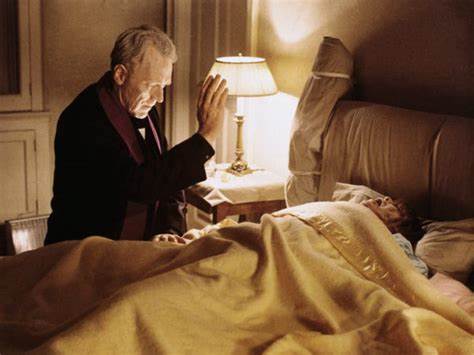
“Pastor, I think we have evil spirits in our house,” said Carlos. “I hear voices at night calling me to ‘come with us.’ The children say they are seeing ghosts in their rooms. My wife says that there is an old woman watching her from the stairway while she is working in the kitchen, but whenever she goes to the stairs, she disappears. Is there anything you can do to get rid of them?” Carlos and his family were recent immigrants to the United States. In his culture, unlike ours, spirits and demons were not just the stuff of horror movies and occult classics. Our enlightenment skepticism over the supernatural had not penetrated the village in which Carlos grew up. The presence of supernatural evil beings and the mischief of which they were capable was taken for granted.

I took a walk with Carlos and his family over to his house-which was next to the church office. We walked through the house and I said a prayer for each room. I prayed that God would make the kitchen a place of bodily and spiritual nourishment, the living room a place of family togetherness and fellowship, the bedrooms places of sanctuary, refreshment and peace. I even blessed the basement-though I can’t remember what I said about that. Anyway, this is as close as I have ever come to performing an exorcism. No blood curdling scream of departing demons rent the air. For that I am thankful. I don’t know where I would have sent them, there being precious few herds of pigs in northern New Jersey. But I will say that, a week or so later, Carlos told me that he and the family got the best night’s sleep ever after my visit and that the spirits had not been troubling them since. Make whatever you will of that. For my part, I am not convinced that there were evil spirits afoot in Carlos’ house. But I am convinced of God’s power to confer peace where there is anxiety, faith where there is fear and joy in the face of despair.

So what are we to make of the evil spirits Jesus confronts in his ministry? Can we dismiss them as primitive explanations for diseases we now know as epilepsy or certain psychiatric disorders? That would make gospel narratives, such as our lesson for this Sunday, a lot more palatable to our modernist tastes. But I am always suspicious of interpretations that make Jesus more palatable. Moreover, as Lance B. Pape[1] reminds us, the foundational assumptions of modernism are crumbling fast, leading us to question the supposed infallibility of our empirical methodologies. We are slowly coming to the realization that the insights and world views of non-western cultures we enlightenment folk cavalierly dismiss as primitive superstition actually illuminate ecological and cosmic realities our colonialist regimes have neglected to the peril of us all. Hence, while I saw nothing to convince me that there were demons in Carlos’ house, I am too well aware of my cultural blind spots simply to dismiss them.

In his book, The Historical Jesus,[2] John Dominic Crossan discusses the phenomenon of demon possession in the context of colonial domination and military occupation. Citing the work of anthropologist Mary Douglas, Crossan points to her insight that a person’s physical body is a microcosm of the society of which s/he is a member. While the human body is common to us all, our social condition varies. An individual’s body is presented to the individual by instruction through society generally and, more specifically, through education and inculturation by family. It takes little in the way of imagination to understand how a people subjected to military occupation by a hostile power or a colonial government bent on converting its subjects to its religion, values and priorities might begin to view itself as “possessed.” When this powerful dialectic between one’s cultural self understanding and the occupying power’s determination to erase it collide within the microcosm of the oppressive circumstance which is the body, this possession manifests as an individual affliction.

Crossan further points out “the somewhat schizophrenic implications of demonic control: it indicates a power admittedly greater than oneself, admittedly ‘inside’ oneself, but that one declares to be evil and therefore beyond any collusion or cooperation. Yet one must surely, at some level, envy it or at least desire its power in order to destroy it.” p. 314. That goes a long way toward helping us understand the depraved violence serial killers who were frequently victims of abuse as children. It helps to understand the unspeakable violence recently inflicted upon Israeli civilians by Hamas terrorists. How long can a people go on living under a regime that denies their existence as a people, exercises suffocating control over every aspect of their lives and wields lethal power they can never hope to match? Oppression generates hatred and hatred transforms haters into the image of what they hate. When one becomes so thoroughly possessed by the object of one’s hatred, it is hardly surprising to find oneself out among the tombs bruising oneself with stones. How else can you get at this enemy inside you? That is what happens when your enemy manages to “get into your head.”

So now we come to “Trump Derangement Syndrome,” abbreviated “TDS.” The term has mainly been used by Trump supporters to discredit criticism of him. Instead of responding to such criticism, Trump’s supporters resort to ad hominem attacks on the mental stability of his critics. It is a typical “gas lighting technique.” Repeat the lie with consistency and regularity and before long, the hearers cease to doubt your word and instead begin to doubt their sanity. All that being said, I think Fox News & Co. might actually be onto something here. (Even a blind squirrel finds a nut every now and then.) It is admittedly maddening to view the flagrancy and frequency with which Donald Trump flat out lies about important matters. More maddening still is witnessing the ease with which his lies are accepted, excused and explained away by the Republican party[3] that he owns. Having to hear again and again about the stolen election, the armies of terrorists crossing our borders, the crime rampant in our cities streets, the crashing economy, WOK propaganda in our schools, to say nothing of the Satan worshiping pedophile cult run by Hillary Clinton and George Soros as though all of this malarky were credible-it is enough to make one a little crazy.

But I think that in this respect, us white liberals might finally be getting a little of our own medicine. What we have endured for less than a decade, Black Americans have been living with for centuries. Young black males know the indignity of being pulled over, stopped and frisked and asked to leave high end stores for no good reason. They know, too, the dangers they face should they question or fail to comply. People of color live daily with the awkwardness of being told that they are surprisingly articulate, unusually hard working or amazingly successful-for people of their kind. They learned in school, as did I, that America is a place of limitless opportunity for anyone who studies and works hard. Like me, they studied and worked hard, but unlike me they met with racial profiling, discriminatory hiring practices and limited housing choices. To add insult to injury, they are told repeatedly that such discrimination does not exist. Slavery ended when Lincoln freed the slaves. Jim Crow ended with the civil rights movement. All is now right with the world. People of color are reminded in so many ways that their failures are their fault, that racism is a thing of the past, that the daily indignities they experience are all in their head. In short, they are told that they are deranged.

Though I have a hard time integrating evil spirits into the world as I understand it, I believe in demonic possession. I believe that many of us are possessed by the myth of the “white race” and delusions about its superiority, fears of its being “replaced” and the malevolence of peoples of color. I believe that people of color are injured in body and soul by these ideologies and the systemic oppression they spawn and support. I believe it is possible for these ideologies and the lies upon which they are based to become internalized and make us sick. In extreme cases, they can get so thoroughly ensconced in our heads that they shape our character and drive our conduct. They can drive us to hateful acts of violence toward others. They can also drive us to violence against ourselves. It is no accident, I think, that so many mass shooters wind up killing themselves before they can be apprehended.

I think that individual instances of demonic violence are symptomatic of systemic racial hatred woven into the fabric of American culture. What we need is a collective exorcism. I am hardly an expert on that topic. But here are a few things that seem to be implied by the gospel lesson:

  1. Do not let the demons speak. I am all for freedom of expression, meaning that I believe all should be able to preach whatever they wish, however vile or offensive. That, however, does not translate into an obligation on society’s part to build them a pulpit. I was appalled when years ago NPR granted white nationalist leader Richard B. Spencer an interview and an opportunity to spew his sewage over the airwaves. I do not believe we need to remain discretely silent when Uncle Ned pops a racist joke at Thanksgiving dinner. The long discarded pseudoscience of racism, baseless racially charged claims and thinly veiled dog whistling should not be admitted into serious discourse. Spencer needs to be told to preach his garbage in whatever slimy hole he can find enough fellow sewer rats to listen, but that he will not be heard on any reputable media. Uncle Ned needs to be told to shut up or pack his bags and go home.
  2. Do not let the demons into your head. We are not Jesus. We cannot cast demonic ideology and racial bigotry out of anyone’s head. If we waste our energies trying to do that, we risk letting the poison of demonic anger and hatred poison us. The only weapon we have is the truth as we know it in Jesus. The Holy Spirit must do the rest. Truth requires only our witness, not our defense. So speak the truth, but do not be drawn into heated arguments. There is nothing to be gained by getting lured down rabbit holes of conspiracy theories, junk science and unsubstantiated claims. There are times when you simply have to say, “I am sorry. But it is obvious you lack the information, conceptual tools and capacity for learning to engage in the sort of discussion you want to have with me.” Do it as unabrasively as you can, but do it firmly and decisively.  
  3. Do not confuse the possessed with the demon. Saint Paul reminds us that “we do not contend with flesh and blood.” The devil would have us believe otherwise. The devil would have us at each other’s throats, killing each other and wounding ourselves in a vain effort to get at him. But our fight is with “the rulers, against the authorities, against the cosmic powers of this present darkness, against the spiritual forces of evil in the heavenly places.” Ephesians 6:12. The necessity of firmness and resolve toward the evil words and acts of the possessed does absolve us from the duty of love we owe them as neighbors. The Richard Spencers, Donald Trumps and Uncle Neds of the world are as much victims as they are predators. They have been consumed-possessed-by hateful myths and ideologies infecting nations, rulers and governments the world over. These demonic forces have twisted their characters, bent their minds and poisoned their souls. They are in the worst sort of bondage. They need our pity. They need our prayers. They, too, need Jesus.
  4. Exorcism begins with me. By now it should be clear that we are all caught up with the spiritual forces of wickedness that infect our government, schools, workplaces and justice system. Those of us who have benefited from racial injustice and exploitation built on the foundation of white supremacy and privilege need all the help we can get to extradite ourselves and begin dismantling the machinery of oppression. As a member and minister of one of the whitest churches in the United States, I count myself among this number. Saint Peter reminds us that “judgment is to begin with the household of God.” I Peter 4:17. So, too, does exorcism.

According to the gospels, casting out demons was central to Jesus’ ministry and a task entrusted to his disciples. Demonic forces are no less real today than they were in the First Century and so the commission to cast them out is no less urgent. The disciple’s task might aptly be described in the words of poet Sonia Sanchez as “hold[ing] oneself like a sliver to the heart of the world, to interrupt if necessary the rhythm of the world, to upset if necessary the chain of command but…to stand up to the world…do battle for the creation of a human world that is a world of reciprocal recognition.” Below is the poem in full.

Progress Report

In this country

where history and herstory stretches

in aristocratic silence,

our Black, white, brown activists

have come at the beginning

of the twenty-first century carrying

the quiet urgency of a star.

 And the country is not the same.

i say, who are these people singing down

the lids of the cities with color?

i say, i say, who are these people always

punctual with their eyes, their hearts, their hands?

i say, i say, i say, who are these

singers who resurrect summer

language on our winter landscape?

They remind each other

of what Fann said: “what is needed is to hold

one’s life like a sliver to the heart of the world, to

interrupt if necessary the rhythm of the world, to

upset if necessary the chain of command but…

to stand up to the world; I do battle for the

creation of a human world that is a world of

reciprocal recognition.”

What does honor taste like?

Does honor have a long memory?

What is the color of honor?

Jose Marti wrote: “in the world there must

be a certain degree of honor just as there must be

a certain amount of light. When there are many men

without honor, there will always be some others who

bear in themselves the honor of many men.”

i turn the corner

 of these honor-driven activists

find memory beneath their doors

taste the blessings of their midwifery

their miracle songs giving birth

to un-ghosted wounds

their words coming to us

glittering like silver stars,

and I catch them in mid-flight,

swallow them whole.

i say, behold our sisters and brothers

questioning the flesh of national monuments

peeling them down to waste of bones.

i say, behold our sisters and our brothers

shaking dew from their eyes, as they remember

Brother Floyd’s last words:

i can’t breathe, i can’t breathe, i can’t breathe…

And we greet him,

his body submerged with no air

and we anoint his eyes

with ancestral light

and we breathe…     

Source: The 1619 Project, edited by Nicole Hannah-Jones (c. 2021 by New York Times Co.; pub. by Penguin Random House) p. 479-480. Sonia Sanchez (born Wilsonia Benita Driver in 1934) is an American poet, writer and professor. She is a leading figure in the Black Arts Movement. Sanchez has written several books of poetry. She has also authored short stories, critical essays, plays and children’s books. She received Pew Fellowship in the Arts in 1993. In 2001 she was awarded the Robert Frost Medal for her contributions to American poetry. You can read more about Sonia Sanchez and sample more of her poetry at the Poetry Foundation website.


[1] The Scandal of Having Something To Say, Pape, Lance B. (c. 2013 pub. by Baylor University Press).

[2] Crossan, John Dominic, (c. 1991; pub. by HarperCollins Publishers).

[3] Please don’t tell me that Trump’s base is not all there is to the Republican party. There is little doubt that, criminal conviction or no, he will be the party’s presidential nominee. And there is less doubt that, as they have done every single time, the rest of the Republican leadership, including those who offered tepid criticism of him, will kneel to kiss his ring. For more on that, see “Unmasking the Republican Party.”

When God Repents

THIRD SUNDAY AFTER EPIPHANY

Jonah 3:1-5, 10

Psalm 62:5-12

1 Corinthians 7:29-31

Mark 1:14-20

Prayer of the Day: Almighty God, by grace alone you call us and accept us in your service. Strengthen us by your Spirit, and make us worthy of your call, through Jesus Christ, our Savior and Lord.

“When God saw what they did, how they turned from their evil ways, God changed his mind about the calamity that he had said he would bring upon them; and he did not do it.” Jonah 3:10.

The old RSV version of the Bible translates the Hebrew verb, “Nacham” as “repent” rather than to “change one’s mind” as is the case in NRSV. Perhaps the translators were concerned that, because the common understanding of repentance is so closely identified with sorrow over one’s sins, associating it with an act of God might create confusion in the minds of readers. Whatever the merits of the NRSV’s interpretive decision, I think the old RSV got it right. God repented of God’s intent to punish Nineveh for its many sins. The biblical word “Nacham,” it should be noted, has many shades of meaning. But in this case, according to my lexicon, it means to “to be sorry, suffer grief or repent of one’s own doings.”[1]

No matter which translation you choose, however, for many believers such language is clearly problematic. Many believers have learned, as I did in Sunday School and confirmation, that God is not only perfectly infallible, but “omnipotent, omniscient and omnipresent.”[2] So if God is infallible, how can God make a decision that God later regrets and must reverse? If God is omniscient, how could God not know in advance that the Ninevites would repent at the preaching of Jonah and that its destruction would not be required-unless Jonah’s dire warning was merely an idle threat God knew would bring about the necessary response. But then God would not really be repenting or changing God’s mind as the text clearly states that God does. Furthermore, Jonah would be justified in feeling that he had been “used” by God who gave him a word that God knew would not come to pass. Theologians, including such great minds as Augustine and Aquinas, have undergone numerous metaphysical gymnastics and theoretical contortions to get around this problem-with but limited success.

One might be tempted simply to dismiss all this consternation as ivory tower sophism, except that the stakes here are real. If God changes God’s mind, how can God’s word be trusted? If God does not know and control the outcome of future events, how can the hopes passed down to us by the prophets inspire hope in our hearts? If God is not in control, who is? An impotent God is hardly a God at all. On the other hand, if God possesses each of the three “omnies,” wherein lies human freedom? If God is “all” powerful, it follows that we have no power-or at least not enough to make any real difference in our lives or in the world. So why try to end world hunger, overcome injustice or address climate control? Why attempt anything significant if history is locked into a calendar of biblically determined events leading up to the great tribulation, the rapture and the final judgment? As one individual I know was heard to say, “climate change is good news! It means Jesus is coming soon.”

Most of us would be repelled by either extreme, but the problem remains. If God is not all powerful, how powerful is God? Powerful enough to save us? Then why isn’t God saving the victims of war and starvation who are dying as I compose this article? It is all well and good to say that God respects our free will, but are there not limits to that rationale? As a parent, I tried to respect my children’s agency and freedom of choice even when they were small. But when I saw them running headlong toward a busy street, I intervened to restrain them without much regard for their will to the contrary. Is it unreasonable to expect God to intervene when genocide is being conducted?

Though I would not call myself a process theologian by any stretch, I will say that the philosophies of Alfred North Whitehead and Charles Harthshorne have given me some valuable conceptual tools for understanding the scriptures and their multifaceted witness to God’s saving acts. The following passage from Whitehead’s Process and Reality has been particularly helpful:

“The consequent nature of God is his judgement on the world. He saves the world as it passes into the immediacy of his own life. It is the judgement of tenderness which loses nothing that can be saved. It is also the judgement of a wisdom which uses what in the temporal world is mere wreckage.

“Another image which is also required to understand [God’s] consequent nature is that of his infinite patience. The universe includes a threefold creative act composed of (i) the infinite conceptual realization, (ii) the multiple solidarity of free physical realizations in the temporal world, (iii) the ultimate unity of the multiplicity of actual fact. If we conceive the first term and the last term in their unity over against the intermediate multiple freedom of physical realizations in the temporal world, we conceive of the patience of God, tenderly saving the turmoil of the intermediate world by the completion of his own nature. The sheer force of things lies in the intermediate physical process: this is the energy of production. God’s role is not the combat of productive force with productive force, of destructive force with destructive force; it lies in the patient operation of the overpowering rationality of his conceptual harmonization. He does not create the world, he saves it; or, more accurately, he is the poet of the world, with tender patience leading it by his vision of truth, beauty, and goodness.”[3]

I cannot begin to unpack fully this dense and nuanced passage which can only be fully appreciated after first reading the prior chapters of Whitehead’s work. But I believe enough comes through to illustrate the point, namely, that God’s interrelationship with the world is persuasive rather than coercive. God’s power is God’s patient determination to bring to fruition what St. Augustine calls the City of God in and through participation in the universe’s processes, inviting it, prodding it, cajoling it to become more than what it is. One need not (and I do not) buy into Whitehead’s metaphysics hook line and sinker to recognize in it echoes of St. Paul’s insistence that this “weakness of God” is actually the power of God revealed in the cross of Christ.[4] The cross and Jesus’ subsequent resurrection demonstrate that our most depraved act of rebellion is not powerful enough to evoke a retributive response from God or deter God from bringing to fruition through God’s continued dance with creation the new heaven and earth to which John of Patmos testifies in the Book of Revelation.

Such an understanding of God’s interaction with the universe leaves room for human agency and responsibility. The decisions we make and the actions we take make a real difference. We cannot, by our own reason or strength usher in the reign of God. But our actions in conformity with God’s reign contribute to its growth and its richness. Similarly, our acts of violence, indifference and greed result in the destruction of opportunities for God’s reign to grow, prosper and flower. We cannot stop the kingdom from coming, but we can frustrate its progress, delay its coming and rob it of some of the richness it might have had, if only we had acted differently.

Because the creation has a degree of free agency, God’s actions are, of necessity, contingent upon those of its creatures. When creation throws God a curve ball, acts in a manner novel and unanticipated or presents God with a new opportunity for or a new threat to God’s purpose, God must change course, “repent” of God’s plan and respond in a new way. God’s acts are not, however, capricious. God always acts in furtherance of the end God has in mind for the universe-that God may finally be all in all. I Corinthians 15:28. To that extent, we can say that the end is predestined. God will complete what God has in store for creation through patient, compassionate persuasion, working for as long as it takes.

In sum, God changes God’s mind, but never God’s heart. God changes God’s approach but never God’s goal of bringing all things to completion in God’s self. God changes course, but never God’s redemptive purpose. Because God repents, we have the opportunity and freedom to do the same.  

Here is a poem by Jane Kenyon suggesting how God’s gentle, persuasive love might be at work under our noses.

Briefly It Enters, and Briefly Speaks

I am the blossom pressed in a book,

found again after two hundred years. . . .

I am the maker, the lover, and the keeper….

When the young girl who starves

sits down to a table

she will sit beside me. . . .

I am food on the prisoner’s plate. . . .

I am water rushing to the wellhead,

filling the pitcher until it spills. . . .

I am the patient gardener

of the dry and weedy garden. . . .

I am the stone step,

the latch, and the working hinge. . . .

I am the heart contracted by joy. . . .

the longest hair, white

before the rest. . . .

I am there in the basket of fruit

presented to the widow. . . .

I am the musk rose opening

unattended, the fern on the boggy summit. . . .

I am the one whose love

overcomes you, already with you

when you think to call my name. . . .

SourceOtherwise: New and Selected Poems, (c. 2005 by Estate of Jane Kenyon; pub. by Graywolf Press). Jane Kenyon (1947-1995) was born in Ann Arbor, Michigan. She attended the University of Michigan in her hometown and completed her master’s degree there in 1972. It was there also that she met her husband, the poet Donald Hall, who taught there. Kenyon moved with Hall to Eagle Pond Farm, in New Hampshire where she lived until her untimely death in 1995 at age 47. You can read more of Jane Kenyon’s poetry and find out more about her at the Poetry Foundation Website.


[1] A Hebrew and English Lexicon of the Old Testament, (Edited, Francis Brown; pub. by Oxford University Press, c.1907 reprinted 1953 and most recently edited in 1978).

[2] It should be noted that none of these three words are biblical.

[3] Process and Reality: An Essay in Cosmology, Whitehead, Alfred North, (c. 1978 by The Free Press) p. 346.

[4] Some of the theologians who have made creative use of process thought are John Cobb (A Christian Natural Theology c. 1975 by W.L. Jenkins, pub. Westminster Press; God and the World c. 1969 by Westminster Press) and David Ray Griffin (God, Power, and Evil, c. 1976 by Westminster Press). See also a fine collection of essays in Handbook of Process Theology (edited and c. 2006 by Jay McDaniel and Donna Bowman, pub. by Chalice Press).


What Is A Disciple?

SECOND SUNDAY AFTER EPIPHANY

1 Samuel 3:1-20

Psalm 139:1-6, 13-18

1 Corinthians 6:12-20

John 1:43-51

Prayer of the Day: Thanks be to you, Lord Jesus Christ, most merciful redeemer, for the countless blessings and benefits you give. May we know you more clearly, love you more dearly, and follow you more nearly, day by day praising you, with the Father and the Holy Spirit, one God, now and forever.

“Come and see.” John 1:46.

What is a disciple? For most of my life and ministry, I have turned to preacher, professor and martyr Dietrich Bonhoeffer’s answer in his book, The Cost of Discipleship:

“When the Bible speaks of following Jesus, it is proclaiming a discipleship which will liberate mankind from all man-made dogmas, from every burden and oppression, from every anxiety and torture which afflicts the conscience. If they follow Jesus, men escape from the hard yoke of their own laws, and submit to the kindly yoke of Jesus Christ. But does this mean that we ignore the seriousness of his commands? Far from it. We can only achieve perfect liberty and enjoy fellowship with Jesus when his command, his call to absolute discipleship, is appreciated in its entirety. Only when the man who follows the command of Jesus single-mindedly, and unresistingly lets his yoke rest upon him, finds his burden easy, and under its gentle pressure receives the power to persevere in the right way.” Bonhoeffer, Dietrich, The Cost of Discipleship, (c. 1963 SCM Press, Ltd.) p. 40 (emphasis supplied).

I still agree with Bonhoeffer in the main. But with some caveats. In Sunday’s gospel, the disciples responding to Jesus’ call seem to have mixed motives at best. Jesus is brought to the attention of Philip and Andrew by John the Baptizer. Whatever they might have thought about Jesus, it was clear to them that John recognized in him “The Lamb of God,” the one on whom the Spirit not only descended, but “remained.” That was enough to convince them at least to “check Jesus out.” Peter came to Jesus through the influence of his brother, Andrew. Nathaniel, though highly skeptical that “anything good” could come out of Nazareth, nevertheless gave Philip, and by extension Jesus, the benefit of the doubt.

As we travel through John’s gospel narrative, we get the impression that the body of Jesus’ disciples was in flux. It seems that this company included his brothers at some point, though they later seem to be skeptical of him. In the sixth chapter of John, a crowd of over five thousand was drawn to Jesus and ready to acclaim him king. But by the end of the chapter, it appears that all but the twelve had withdrawn from him. Nicodemus came to Jesus, albeit covertly and by night. Joseph of Arimathea, too, thought enough of Jesus to oppose his arrest and conviction. Yet neither of these men, so far as we know, ever publicly identified with Jesus. They were among the ones the Evangelist castigates because “they did not confess [their belief in Jesus], for fear that they would be put out of the synagogue; for they loved human glory more than the glory that comes from God.” Nevertheless, these two men took the risk of seeking leave from Pilate to give Jesus a proper burial while the disciples deserted him and left his body to rot on the cross. John 12:42-43.

Who, then, are the true disciples? Those who follow Jesus to the bitter end? No one in the gospels actually did that. Those who forsake family, possessions and livelihood to live a life solely devoted to prayer, mission, witness and service? Some communities, such as monastic fellowships, approximate such a life. But most of us are not suited to it. What about the movers and shakers in our churches who actually “get” Jesus and the reign of God he proclaims? What about the ones who may not have a well articulated faith, but are always there when the plumbing breaks down, the parking lot needs shoveling or the furnace goes on the blink? And where does that leave those who are content to make modest donations and attend infrequently? What about the folks who never attend, never contribute but think of our church as “their” church and show up when they need a baptism, confirmation or burial? Disciple might be too strong a word for these latter folks, but they are nonetheless drawn to Jesus in some measure for some reasons-however mixed, misguided or shallow.  

It is temping to look for true disciples at the core of the church where Jesus is publicly and unapologetically proclaimed as Lord. But even that is problematic. Again, Judas was one of the twelve and that is about as close to the core as one ever gets. Furthermore, as Jesus himself points out, even people who are not literally following him might still be following him. Mark 9:38-41. Then there was the women I will simply call Kim who I met in college. Kim was an exchange student from Tiawan and a Buddhist. As a then eager evangelical, I was keen to convert her. Instead, she captivated my imagination with her rich and beautiful faith. In one of our last conversations, she told me “there is a lot about the Christian idea of God I don’t understand. But I think that learning about Jesus has made me a better Buddhist.” Is Kim a disciple?

I still agree with Dietrich Bonhoeffer that discipleship is grounded in knowing, following and being formed by Jesus. I still believe we are tasked with calling our members, both at the core of our congregations and on the fringes, to a deeper and more concrete commitment to Jesus. But I also believe that it is finally the Holy Spirit who, through our witness, draws people into discipleship. Sometimes, that happens through mentorship and guidance. Some people are drawn by chance or mere curiosity which may or may not blossom into mature faith. Others are drawn for reasons that seem altogether unrelated to faith in Jesus. But they still come and I believe Jesus draws them, whether they know it or not, for his own reasons. I also believe that the Spirit is at work outside the church leading people into what is the way of Jesus among people of other faiths and those of no faith. That should not surprise us. If we take seriously what Paul tells us about Jesus being the one in whom all things hold together, there is no place we should expect him not to be working redemptively for the world God loves.

I think that one thing preventing the church from becoming a cult is the recognition that the borders of the church are undefined and that God is active both in our midst and well outside of our sanctuaries and institutions. You never know when or where you will meet a fellow disciple or someone hearing, however distantly, Jesus’ invitation to come with him. Here is a poem by Robert Frost with an invitation to follow and share a stretch of the poet’s life.

The Pasture

I’m going out to clean the pasture spring;

I’ll only stop to rake the leaves away

(And wit to watch the water clear, I may);

I shan’t be gone long-You come too.

I’m going out to fetch the little calf

That’s standing by the mother. It’s so young

It totters when she licks it with her tongue.

I shan’t be gone long-You come too.

Source: The Poetry of Robert Frost, (c. 1969 by Holt, Rinehart and Winston, Inc.) p. 255. Born in 1874, Robert Frost held various jobs throughout his college years. He was a worker at a Massachusetts mill, a cobbler, an editor of a small town newspaper, a schoolteacher and a farmer. By 1915, Frost’s literary acclaim was firmly established. On his seventy-fifth birthday, the U.S. Senate passed a resolution in his honor. The State of Vermont named a mountain after him and he was given the unprecedented honor of being asked to read a poem at the inauguration of John F. Kennedy in 1961. Through the lens of rural life in New England, Frost’s poetry ponders the metaphysical depths. His poems paint lyrical portraits of natural beauty, though ever haunted by shadow and decay. You can learn more about Robert Frost and sample more of his poetry at the Poetry Foundation website.

To My Guy Friends Who Voted For Donald Trump

To my guy friends who voted for Donald Trump: (circa 2016)

Guys, I love you all and I wouldn’t be writing this piece if I didn’t. If I didn’t care about you, if I didn’t believe you are all decent people who are trying to do the right thing, if I didn’t believe that you all want the very best for your country, it wouldn’t matter to me what you think or why. But I do care and so let me give it to you straight. Your vote for Donald Trump insulted me and, more importantly, it insulted the many, many women in my life, including my wife, my two daughters, my granddaughter, and many of my friends and colleagues. This is a man who bragged about grabbing young girls by the genitals, kissing and fondling them for no better reason than because he could. This is a man who belittles women with epitaphs like “dog” and “fat pig.” This is a man prepared to use the power of the presidency to retaliate against the women who came out and identified themselves as people to whom he did exactly what he said he did. This goes way beyond personal morality. Nobody expects moral perfection from a president or anyone else for that matter. But here we are talking criminal acts against women that are physically and emotionally crippling-and joking about it.

“It’s just a distraction,” you say. “I voted for Trump because of where he stood on the real issues, the economy, immigration, national defense, etc.,” “The locker room banter is no big deal,” “It’s the biased media focusing on unimportant trivia.” “Let’s stay focused on the real issues.” Excuse me. Sexual assault against women damn well is a real issue. Half the people in this country are women. One in four of them will be sexually assaulted before she reaches eighteen. One in five American college women are sexually assaulted during their time on campus. If that isn’t an important issue for you, if you don’t think it matters that the president of the United States, the one entrusted with the enforcement of our laws, boasts of being a sexual predator, if you think joking about sexually assaulting girls is just harmless “guy talk,” then I pray to God for your daughters. I pray that they have some other wholesome influences in their lives to assure them that they are valued people in their own right so they don’t grow up thinking they have to be sex toys for any rich, famous and politically powerful man who can’t seem to keep his hands in his pockets. I pray that they will not learn the lesson taught to all young girls by the outcome of this election: If a man wants your body, he is entitled to take it and there isn’t a thing you can do about it.

There it is. You might choose to unfriend me after this. That’s your prerogative. But I am hoping you will instead catch just a glimpse of how the women in your life experience the world. I hope you will get an inkling of what it is like to be insulted, abused and violated in the most hurtful and humiliating way imaginable and, on top of that, to be publicly shamed for it. I am hoping that you will go home tonight and look into the eyes of the women you love. If I can’t convince you that women deserve dignity and respect, that our girls deserve a world where they don’t have to fear men grabbing at their genitals and that these are important issues, perhaps they can.

What I Learned From Walking On The Beach

BAPTISM OF OUR LORD

Genesis 1:1-5

Psalm 29

Acts 19:1-7

Mark 1:4-11

Prayer of the Day: Holy God, creator of light and giver of goodness, your voice moves over the waters. Immerse us in your grace, and transform us by your Spirit, that we may follow after your Son, Jesus Christ, our Savior and Lord, who lives and reigns with you and the Holy Spirit, one God, now and forever.

“In the beginning when God created the heavens and the earth, the earth was a formless void and darkness covered the face of the deep, while a wind from God swept over the face of the waters.” Genesis 1:1-2.

“The voice of the Lord is over the waters;
   the God of glory thunders,
   the Lord, over mighty waters.
The voice of the Lord is powerful;
   the voice of the Lord is full of majesty.” Psalm 29:3-4.

“And just as [Jesus] was coming up out of the water, he saw the heavens torn apart and the Spirit descending like a dove on him. And a voice came from heaven, ‘You are my Son, the Beloved; with you I am well pleased.’” Mark 1:10-11.

One of the many benefits of living here on the Outer Cape is having immediate access to some of the most remarkable ocean beaches on the east coast. I am a beach lover, but not in the sunbathing sense. For me, a perfect beach day is cold, cloudy, windy and accented with mist or rain. I love the beach most on days everyone else avoids it. There is nothing to compare with walking miles on a stretch of ocean shore below dune cliffs on the one side and restless waters breathing silky foam on the other without meeting another human soul. The only sounds you hear are the crashing breakers and the cries of seagulls overhead. An hour’s walk on the beach is worth a week of therapy in my opinion.

The ocean is a parable of creative power. Just as one never steps into the same river twice, no one ever walks on the same beach twice. The wind and the waters are forever re-arranging the contours of the land, shifting the position of sandbars, which, in turn, influences the breaking of waves, formation of tide pools and the flow of rip currents.

The ocean spews up rocks, driftwood and shells creating colorful and unique mosaics never before seen and which, after the next high tide, will never be seen again. Waters, sometimes breaking with ferocious might upon the sand, sometimes lapping the shore with the gentle affection of a puppy, stretch far beyond the power of human sight and melt into the sky in one fine line defining the horizon. The ocean wields the mighty power to make and to unmake. It reminds anyone who gives it undivided attention for more than a moment how fragile, finite and momentary is one’s small existence. 

The Hebrew Scriptures open with a lyrical tale about how the wind of God’s breath acting upon the waters brought all things into being. The Gospel of Mark announces the “beginning of the good news about Jesus” with an account of Jesus coming forth from the waters of the Jordan, the sky being rent apart, the Spirit of God descending upon Jesus and God declaring that this Jesus is God’s beloved Son. The wind and the waters are once again at work creating something new.

I am thankful for my proximity to the ocean. In its presence, I am reminded of what these biblical witnesses are trying to tell us. The power of water and wind is clearly dangerous and destructive.  Yet they hold the secret of renewal, life and creation. Too often, I think we are prone to see only the destructive side of these elements. That is hardly surprising. Whether we get our news from radio, television, internet or social media, the focus is usually on hot winds fanning destructive wildfires over acres of forest and into the heart of towns and villages. There is plenty of news about hurricanes, tornados and floods. Gentle rains bringing lifegiving water to crops, oceans cradling millions of unseen species from blue whales to plankton, cold fall air triggering the advent of spectacular fall foliage seldom make headlines because, well, none of that is really news, is it?

By the same token, the life of a preacher from the backwoods neighborhood of a backwoods territory far away from the movers and shakers of history in Rome does not seem to register as newsworthy. But Mark’s gospel tells us that this is, in fact, where the real news is happening. While emperors, kings and dictators flaunt their exalted titles, armies march across the globe leaving trails of blood, destruction and suffering, nations rise, fret and strut their moment upon the stage and with their glorious capitals, monuments and flags fade into the mist of archeological ruins with tedious regularity, something really new and revolutionary is taking place. God is weaving God’s self into the fabric of creation, infusing God’s self into our very human DNA. Henceforth, Emmanuel. God is with us. To use a Lutheran term, God is “in, with and under” every transaction occurring in the universe from the movement of the tiniest subatomic particle to the rotation of galaxies. Good news is here. You just need to look past the headlines to find it.

In this Sunday’s New York Times, columnist Nicholas Kristof points out that the human race actually made some significant progress in 2023, despite the overall consensus of media, left and right, that it has been an abysmally terrible year. For example, the United Nations Population Division reports that the global infant mortality rate for this past year reached an all time low of 3.6 percent. Extreme poverty has likewise reached an all time low of 18 percent, meaning that one hundred thousand people are emerging from extreme poverty each day. Their lifestyles are hardly comparable to what we middle class Americans expect, but it is no small thing for persons formerly on the verge of starvation are now able to access clean water, adequate food, medicine and basic education for their children. Two of the most deadly diseases afflicting poorer communities have been all but eradicated, these being polio and Guinea worm disease. Advances have been made against sickle cell disease and vaccines are on the horizon for R.S.V. and malaria-both chief causes of death among infants and children. None of this makes headlines, but it is news just the same. For eyes to see and hears to hear, it is news that our compassionate God is laboring with the persistence of the ocean tides to birth a new creation in the midst of the old.

My purpose here is not to minimize the dangers we are confronting and that have manifested themselves in particularly graphic ways this last year. If the patterns of global warming and climate change continue unabated, if global leaders make a serious miscalculation in managing one of the world’s many conflicts such that a nuclear exchange takes place, if we are overtaken by another pandemic more severe than covid-19 in our present state of unpreparedness, all of the above advances could easily be erased. What cannot be erased is God’s persistent determination to be with us. Should our choices lead us to yet another dark age of ruin and barbarism, God will be there to pick up the pieces and begin again-and again and again. As the wind and the waves wipe away the foot prints we leave on the beach each day, replacing them with fresh sand, fresh mosaics and new sand formations, so God is at work in our world taking up the broken pieces left over from all of the poor decisions, selfish actions and destructive movements we spew out into the world and weaving them into something new and beautiful. God will continue doing so for as long as it takes.

As Luther’s Small Catechism reminds us, God’s kingdom comes without our prayers-or anything else we do or do not do. But why make things harder on God and ourselves than we have to? Why not work at looking past the fearful headlines to the news that matters? Why not align ourselves with those who, far from the cameras, the press conferences and the documentaries, are doing God’s work of caring for, healing and renewing creation? Why be dragged down by the undertow of fear and foreboding when you can ride the breath of God and be carried by the living waters? To be baptized into Christ is just that.

Here is a poem by Marjorie Meeker about the symbolic power of the Ocean. Proud and mighty though it may be, it can be seen in a small brook-for those with eyes to see and ears to hear. A fine parabolic image of the Incarnation!

Certainly Oceans

Certainly oceans, proud with their manifold

Rythms of rainy silver or sullen gold,

Hold fires celestial variously glowing,

All heaven in hues forever ebbing and flowing

With their praised prismatic tides: yet even a brook

Has a heart of sky, should any stop to look-

Should any stop to look, a brook may keep

Colors of time, of lovers’ tears, of sleep.

Source: Poetry, November, 1927. Marjorie Meeker was born in Bradford, England where her father was an American ambassador. She came with her family to the United States at the age of five, living alternatively in New York and Ohio throughout her childhood. She was awarded Poetry’s Young Writer’s Prize in 1924. Unfortunately, I have found nothing else on this remarkable poet. The above information was gleaned from Modern American Poetry, A Critical Anthology, by Louis Untermeyer (c. 1919 by Harcourt, Brace and Howe, Inc.).