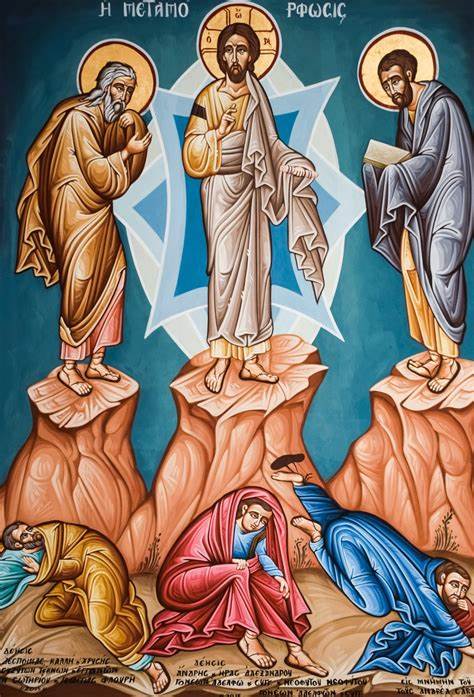
TRANSFIGURATION OF OUR LORD
Prayer of the Day: Almighty God, the resplendent light of your truth shines from the mountaintop into our hearts. Transfigure us by your beloved Son, and illumine the world with your image, through Jesus Christ, our Savior and Lord, who lives and reigns with you and the Holy Spirit, one God, now and forever.
“And [Jesus] was transfigured before [his disciples], and his clothes became dazzling white, such as no one on earth could bleach them. And there appeared to them Elijah with Moses, who were talking with Jesus.” Mark 9:2-3.
As I enter upon my sixty-nineth year, it is beginning to dawn on me at last that the time I have left and the bodily vitality remaining to me are insufficient to do all I imagined doing with my life. There are books I will not get around to reading, places I hoped to visit/revisit that I will never see, friends with whom I have been meaning to get together but won’t, skills I meant to acquire at some point that will never be mine-and the list goes on. But I am happy to say that I have been able to pursue at least one activity on my rapidly diminishing bucket list, that being photography. When Sesle and I retired and move up to the Cape, I decided it was finally time to follow this one desire of my heart. So, I purchased a Panasonic Lumix and the rest, as they say, is history.
I have been interested in photography since the age of eleven when I inherited my older brother’s Kodak Brownie box camera. It was a big black box with a primitive view finder, single lens and a leather holding strap on top. It took grainy, black and white photos using bulky rolls of film. It had no flash attachments and so most of my pictures were taken outdoors. I did not take many pictures back then. Film was expensive and getting my shots developed even more so. On my allowance, photography was simply not a sustainable hobby; thus, I soon lost interest. Though I upgraded to a Kodak instamatic that I used throughout the 70s and early 80s, my picture taking was sporadic and infrequent. Film, flashcubes and the cost of developing photographs were still deterrents.
Shortly after my first daughter was born, Sesle and I invested in a high end Minolta complete with an adjustable flash attachment and telescopic lens. It was as far removed from the Brownie as was the space shuttle from the Wright brother’s first airplane. With it we were able to document our family’s growth through events like baptisms, confirmations, birthdays, vacations and instances when I felt inspired to capture endearing moments in our lives. The price of film and the cost of developing it was still a limiting factor. But by this time, we were both working and felt that the preservation of our most precious memories and the images of our children throughout their years with us was well worth the cost.
I faithfully preserved the photos we took in albums, numbering in the double digits, which are now sitting in our attic. I take a volume down to the coffee table every now and then. I find that pictures are a little like icons. They are portholes into our past-and only portholes. They do not tell the whole story of our family. Photo albums never do. How many families take pictures of their two year old having a tantrum? How many parents have pictures of their surly teenagers being surly? How many couples photographically document their fierce marital spats? Like a porthole through which you can view only a limited amount of the horizon, a photo gives you only as much as the camera can take in and whatever the photographer wishes for you to see, all compressed within a couple seconds. The space outside the reach of the lens, the ages before and the years to follow are not included in this one dimensional slice of life.

A photograph is a brief instant in the vast ocean of eternity that the photographer deems worthy of preservation. What is preserved can tell you a lot about what the photographer deems true, beautiful and good. It might be the carefree play of children at sunset on the beach. It might be a butterfly settling on a golden blossom, an osprey breaking into flight or just a mosaic of smooth stones spewed onto the sands by the ocean waves. These fragments of time, preserved like insects in amber, have a story to tell. They challenge us to apply our imaginations in order to hear what they have to say.

I think the gospels are rather like photo albums. They are not histories-nor were they intended to be. We can best understand the gospels as albums of preaching, stories and parables by and about Jesus woven together into a narrative illustrative of his faithful life, obedient death and glorious resurrection. They do not tell the whole story. As the closing remarks in John’s gospel remind us, if all that Jesus said and did were written down, “the world itself could not contain the books that would be written.” John 21:25. But what is written has been preserved “so that you may come to believe that Jesus is the Messiah, the Son of God, and that through believing you may have life in his name.” John 20:31.

That brings me, at long last, to this week’s Transfiguration story from Mark’s gospel. Mark is deemed by most scholars to be the first gospel composed and the one upon which Matthew and Luke relied in composing their own gospels. The prevailing opinion, with which I agree, is that Mark’s gospel ends at the eighth verse of the sixteenth chapter, where we read that the women who came to the tomb on Easter Sunday find it empty. A young man dressed in white informs them that Jesus has risen and is going before them to Galilee. The women then flee from the empty tomb in terror and say nothing to anyone about what they have seen and heard. There is, therefore, no encounter with the resurrected Christ in Mark’s gospel.

Or maybe there is. The renowned New Testament scholar, Rudolf Bultmann, is convinced that the Transfiguration story is an ancient resurrection account transposed in the gospel for literary reasons. Bultmann, Rudolf, History of the Synoptic Tradition, (c. 1963 by Basil Blackwell, pub. 1976 by Harper & Row) p. 259. However that might be, there is no denying the story has a resurrection glow to it. We are told that Moses, Elijah and Jesus appear “in glory.” In some manner beyond our capacity to comprehend, eternity is impinging on time, bending it into a single point where the beginning is fused with the end, the promise meets fulfilment and the line of demarcation between life and death dissolves. We get a foretaste of the Resurrection and a fleeting glance at what it means for God to be “all in all.” I Corinthians 15:28.
This is what Hollywood would call a “spoiler.” The Transfiguration of Jesus betrays the climactic end of creation’s story in the middle of the narrative. It is as though Mark had taken a photo from the end of history’s album and stuck it smack dab in the middle. A photograph misplaced within an album is disorientating. It disrupts the orderly flow of chronological time by projecting an instant from the future into the settled past.[1] Of course, the Resurrection is nothing if not disorienting and disruptive. It compels us to re-evaluate our understanding of the past, shatters our expectations for the future and opens our eyes to new possibilities for our present day lives.
If my reading is correct, Mark is turning our observance of Lent, Holy Week and Easter on its head. He is placing the Resurrection before the cross. Maybe that is where it belongs. After all, that is where we are all living. The guns of war, the ravages of climate change, the rise of fascism and the daily occurrence of gun violence in our communities remind us that we live in a creation that is, as Paul would say, “groaning in labor pains.” Romans 8:22. Those of us on the far side of sixty cannot help but know that “our outer nature is wasting away.” But the story of the Transfiguration, this snapshot from the future, reminds us that such pains as creation is enduring are indeed “labor pains,” not death throws. So, too, we take comfort in Paul’s assurance that, even as our “outer nature” is wasting away, we are nonetheless being transformed into something altogether new. II Corinthians 4:16. We who follow the messiah who poured out his life in love for the world are on the right side of history. We who are called to bear Christ’s cross are destined to share in Christ’s resurrection life. In this case, the camera doesn’t lie.
Here is a poem about the iconic power of pictures to invoke memories.
Taking Pictures
Two swings hang from the arms of the old oak,
perpendicular to the ground,
motionless unless by chance a breeze should come
to shatter the stillness
and cause them to sway
be it ever so slightly.
Yet another reminder, these,
that you are gone, though only for a little while.
The day is coming
when these swings will launch you,
my children, up into the air
and fill it with your laughter
as you plunge toward the turquoise sky
glimpsed through a matrix of ancient limbs
laden with jade green foliage.
And I’ll keep that moment,
along with so many others,
holding it against the day
when this yard is healed
of its scars from little children’s feet,
the weary oak has rest from bearing your weight
and every other trace of you has gone away.
Source: Anonymous
[1] The New Testament uses two words translated into English as “time.” There is the Greek word “chronos” denoting chronological time. This is time as we typically experience it. It can be measured in minutes, hours, days, years and centuries. The other word for time is “Chiros.” This word refers to a time within which transformative events take place. One example is in first chapter of Mark’s gospel where Jesus proclaims: “The time is fulfilled, and the kingdom of God has come near” Mark 1:15. The Transfiguration clearly qualifies as Chiros time.
 Peter's Outer Cape Portico