SECOND SUNDAY OF EASTER
Prayer of the Day: Almighty God, with joy we celebrate the day of our Lord’s resurrection. By the grace of Christ among us, enable us to show the power of the resurrection in all that we say and do, through Jesus Christ, our Savior and Lord, who lives and reigns with you and the Holy Spirit, one God, now and forever.
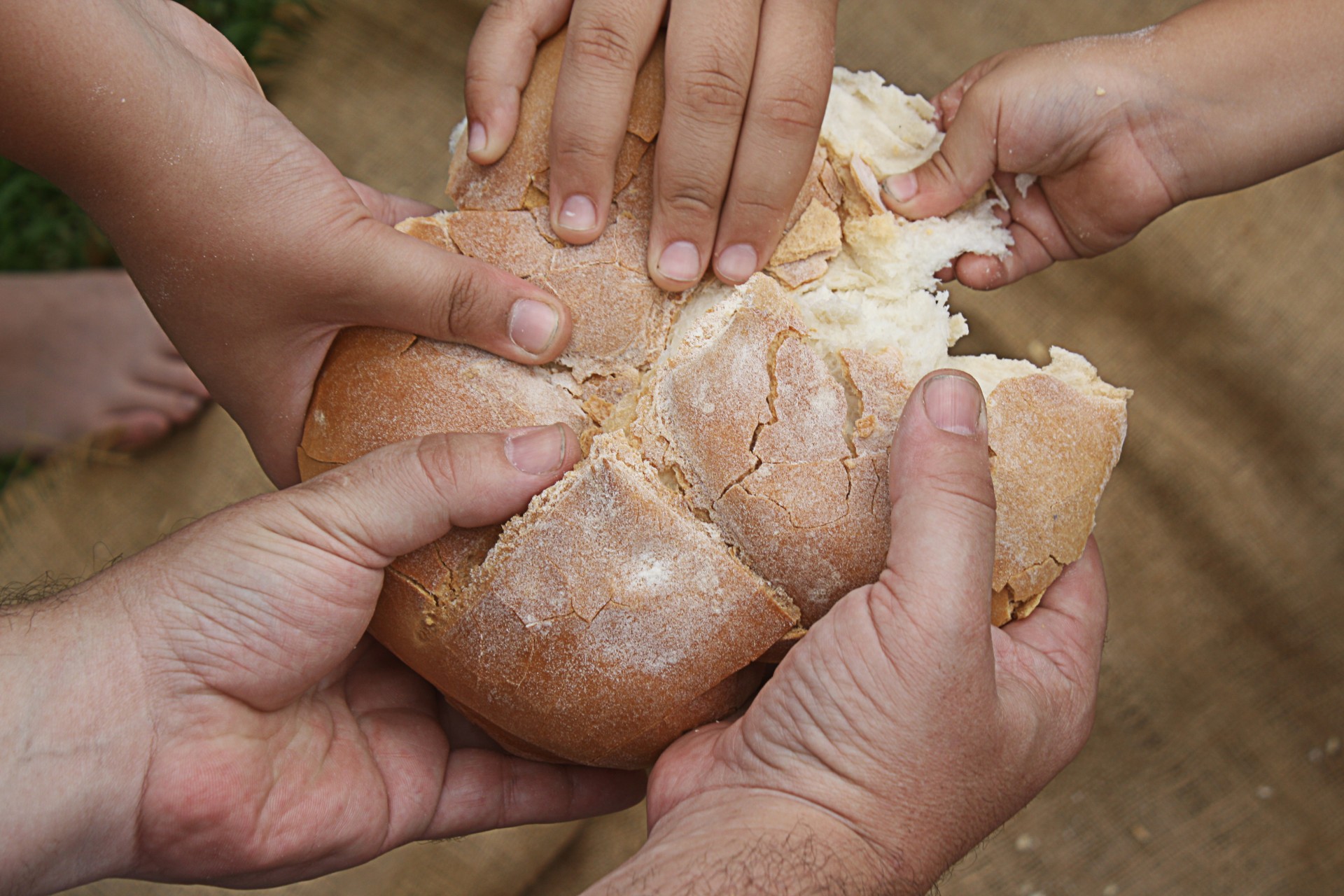
“Now the whole group of those who believed were of one heart and soul, and no one claimed private ownership of any possessions, but everything they owned was held in common.” Acts 4:32.
Along with Jesus’ urging the rich young man to “sell all that you have and distribute to the poor” and his command to the disciples generally to “sell your possessions and give alms,” this account of the early church’s disregard for private ownership is one of the most difficult for American Christians to digest. That is because it runs contrary the most sacred tenant of our religion of capitalism. Without private ownership, the argument goes, there can be no commerce, trade, economic growth or production of wealth. History has demonstrated repeatedly that command economies do not work. Efforts to construct national economic systems or religious communities on the basis of common ownership have failed repeatedly.[1] Thus, whatever the early church in Jerusalem may have done in its infancy cannot be taken as a model for imitation.
While the failures of command economies and “common purse” communities are lifted up repeatedly in defense of capitalism, capitalism’s own failures are frequently underplayed or flatly denied. Yet if the test for an economic system’s success is whether it “works,” then the next question must be, “for whom does it work?” Clearly, capitalism did not work for the indigenous communities in the Americas driven off their land by industrial hunger for land, water, minerals, petroleum and timber. It did not work for thousands brought to this country as slaves, whose labor turned the United States into an economic powerhouse, but who have been systematically excluded from the resulting benefits. Capitalism did not work to preserve the world’s forests, oceans, rivers and lakes from ruthless exploitation and environmental harm. It did not protect communities throughout the rust belt from collapse into poverty when their labor skills became obsolete or could be purchased more cheaply overseas by the industries around which those communities were built and upon which their livelihood came to depend. Capitalism does nothing for those among us who are too impaired, too sick or too old to be “gainfully employed” as that term is variously defined in terms of marketability. Capitalism is about one thing: profit. If the financial statements are in the black and the shareholders happy, nothing else matters.
Though I have taken a couple of graduate level courses in economics, I am hardly an authority on the subject.[2] Nonetheless, the Bible has a few things to say about economics-and they do not support the unfounded claims of sovereignty made by modern nation states or the claims of individuals to any absolute right of property ownership. First and foremost, “the earth is the Lord’s and all that is in it.” Psalm 24:1. When Adam and Eve were placed in the garden of Eden, they were not endowed with ownership. They were simply given the job of “tilling and keeping it.” Genesis 2:15. So, too, the people of Israel were not given sovereign control over the land of Canaan. They were given the privilege-and the accompanying responsibilities-of dwelling in it.[3] This privilege was not a “right.” It could be, and was for a time, revoked.[4] That surely throws into doubt the purported “rights” of modern nation states to regulate into non-personhood those who seek to share the land they claim as “theirs.”
Second, it follows that an individual’s possession of land or personal property is contingent. As the hymn says, “All that we have is Thine alone, a trust, O Lord from thee.” Or, as Saint Paul says, “What have you that you did not receive? If then, you received it, why do you boast as if it were not a gift.?” I Corinthians 4:7. Despite what prosperity gospel preachers would have us believe, wealth is not a sign of God’s favor or approval. Saint James reminds us in graphic terms that wealth and privilege are the result of ruthless exploitation of one’s fellow human beings. James 5:1-6. So what can be said of us who are rich? Those of us who have benefited from systemic racism, segregation and oppression? What is to be said for people like me who have managed to live well and accumulate enough wealth to retire comfortably? The answer lies in our lesson from Acts. Our wealth can be deemed a blessing only if it is put to the use of blessing others. The fact that we have within the Body of Christ people who struggle to put food on the table, people who cannot obtain adequate medical care, people who lack adequate shelter more than suggests that people like me are not doing an adequate job of managing what has come into our possession. I think the biggest impediment to the church’s witness is the fact that the church remains a microcosm of the rest of the world’s huge disparities between haves and have nots.
You might be asking why it is that I confine my analysis to the Body of Christ, the church. Does not any of this apply to society as a whole? It does. The parable of the Last Judgment makes clear that “the nations” as well as individuals will be judged by how well or poorly they have treated the most vulnerable persons in their midst. Matthew 25:31-46. The church in Acts understood that very well. But they did not proclaim that word to the nations by way of preachy-screechy social statements condemning poverty, racism and injustice. They did it by practicing distributive justice, inclusion and care for the vulnerable within their midst. By their very existence they demonstrated that living under the reign of terror imposed by the empire, racial/cultural animosity, hunger and poverty is not the only way to be human. The church in Acts, by its very being, cried out “Hey world, it doesn’t have to be this way!”
Mark Twain is credited with observing that, “To be good is noble. To teach another to be good is more noble still-and a lot less trouble.” I do not believe that press statements from bishops, social statements adopted by church assemblies or campaigns to generate cookie cutter letters to congress move the societal needle much. Particularly is this so when their origin is a largely white, slightly left of center, upper middle class denomination from which such activities are expected. But what if the church were to begin being the kind of change it likes to advocate? What if American churches like my own Lutheran Church in America took the affirmative step of making reparations to Black churches doing ministry in communities hard hit by systemic racism?[5] What if our larger, suburban, wealthier churches began subsidizing the staff of smaller, poorer urban and rural congregations? What if our churches made a commitment to ensure that no family in any of our congregations would ever be without shelter, no individual would ever go hungry, no elderly person left abandoned in an institution, no one baptized in our church would ever die alone? If the Book of Acts is any indication, such action would lend “great power” to our “testimony to the resurrection of the Lord Jesus.” Acts 4:33. Maybe, just maybe our world might catch a glimpse of the reign God desires for us and begin to understand that the way of unrestrained greed and consumption that is capitalism is not the way things have to be.
Here is a poem by Roberta Hill Whiteman posing the question: “what makes property so private?” Who owns what and by what right?
Philadelphia Flowers
I
In the cubbyhole entrance to Cornell and Son,
a woman in a turquoise sweater
curls up to sleep. Her right arm seeks
a cold spot in the stone to release its worry
and her legs stretch
against the middle hinge.
I want to ask her in for coffee,
to tell her go sleep in the extra bed upstairs,
but I’m a guest,
unaccustomed to this place
where homeless people drift along the square
bordering Benjamin Franklin Parkway.
From her portrait on the mantel,
Lucretia Mott asks when
will Americans see
how all forms of oppression blight
the possibilities of a people.
The passion for preserving Independence Square
should reach this nameless woman, settling
in the heavy heat of August,
exposed to the glare of every passerby.
What makes property so private? A fence?
No trespassing signs? Militia ready to die for it
and taxes? Lights in the middle storeys
of office buildings blaze all night above me.
Newspapers don’t explain how wealth
is bound to these broken people.
North of here, things get really rough.
Longshoremen out of work bet on eddies
in the Schuylkill River.
Factories collapse to weed
and ruptured dream. Years ago, Longhouse sachems
rode canoes to Philadelphia,
entering these red brick halls.
They explained how
the law that kept them unified
required a way to share the wealth.
Inside the hearths of these same halls,
such knowledge was obscured,
and plans were laid to push all Indians ,
west. This city born of brotherly love
still turns around this conflict.
Deeper in the dusk,
William Penn must weep
from his perch on top of City Hall.
Our leaders left this woman in the lurch.
How can there be democracy
without the means to live?
II
Every fifteen minutes
a patrol car cruises by. I jolt awake
at four a.m. to sirens screeching
and choppers lugging to the hospital heliport
someone who wants to breathe.
The sultry heat leads me
to the window. What matters? This small
square of night sky and two trees
bound by a wide brick wall.
All around, skyscrapers
are telling their stories
under dwindling stars. The girders
remember where Mohawk ironworkers stayed
that day they sat after work
on a balcony, drinking beer.
Below them, a film crew caught
some commercials. In another room above
a mattress caught fire and someone flung it
down into the frame. A woman in blue
sashayed up the street
while a flaming mattress,
falling at the same speed as a flower,
bloomed over her left shoulder.
Every fifteen minutes
a patrol car cruises by. The men inside
mean business. They understood the scene.
A mattress burning in the street
and business deadlocked. Mohawks
drinking beer above it all.
They radioed insurrection,
drew their guns, then three-stepped
up the stairs. Film crews caught the scene,
but it never played. The Mohawks
didn’t guess a swat team had moved in.
When policemen blasted off their door,
the terrified men shoved a table
against the splintered frame.
They fought it out.
One whose name meant Deer got shot
again and again. They let him lie
before they dragged him by his heels
down four flights of stairs. At every step,
he hurdled above his pain
until one final leap
gained him the stars.
The news reported one cop broke his leg.
The film’s been banished to a vault. There are
no plaques. But girders whisper at night
in Philadelphia. They know the boarding house,
but will not say. They know as well what lasts
and what falls down.
III
Passing Doric colonnades of banks
and walls of dark glass,
passing press-the-button-visitors-please
Liberty Townhouses, I turned
up Broad Street near the Hershey Hotel
and headed toward the doorman
outside the Bellevue. Palms and chandeliers inside.
A woman in mauve silk and pearls stepped into the street.
I was tracking my Mohawk grandmother
through time. She left a trace
of her belief somewhere near Locust and Thirteenth.
I didn’t see you, tall, dark, intense,
with three bouquets of flowers in your hand.
On Walnut and Broad, between the Union League
and the Indian Campsite, you stopped me,
shoving flowers toward my arm.
“At least, I’m not begging,” you cried.
The desperation in your voice
spiraled through my feet while I fumbled the few bucks
you asked for. I wanted those flowers—
iris, ageratum, goldenrod and lilies—
because in desperation
you thought of beauty. I recognized
the truth and human love you acted on,
your despair echoing my own.
Forgive me. I should have bought more
of those Philadelphia flowers, passed hand
to hand so quickly, I was stunned a block away.
You had to keep your pride, as I have done,
selling these bouquets of poems
to anyone who’ll take them. After our exchange,
grandmother’s tracks grew clearer.
I returned for days, but you were never there.
If you see her — small, dark, intense,
with a bun of black hair and the gaze of an orphan,
leave a petal in my path.
Then I’ll know I can go on.
IV
Some days you get angry enough
to question. There’s a plan out east
with a multitude of charts and diagrams.
They planned to take the timber, the good soil.
Even now, they demolish mountains.
Next they’ll want the water and the air.
I tell you they’re planning to leave our reservations
bare of life. They plan to dump their toxic
wastes on our grandchildren. No one wants to say
how hard they’ve worked a hundred years.
What of you, learning how this continent’s
getting angry? Do you consider what’s in store for you?
Source: Philadelphia Flowers (c. by Roberta Hill Whiteman; pub. Holy Cow! Press, 1996). Roberta Hill Whiteman (b.1947) is an Oneida poet from Wisconsin. She lived with her family on the reservation and also in Green Bay, Wisconsin. Hill earned a BA in creative communication from the University of Wisconsin-Green Bay, an MA in fine arts from the University of Montana, and a PhD in American Studies from the University of Minnesota. Hill married Ernest Whiteman, an artist, who illustrated her first collection of poetry. They have three children. Hill is currently an Associate Professor of English and American Studies at the University of Wisconsin-Madison. She is a recipient of the 1991 Wisconsin Idea Foundation’s Excellence Award. You can read more about Roberta Hill Whiteman and sample more of her poetry at the Poetry Foundation website.
[1] There are some notable exceptions. Monastic orders have existed for millennia holding to the belief that all goods are held by and for the community and its missions. Faith communities such as the Bruderhof have maintained themselves for decades on the basis of shared ownership and corporate responsibility for the sick, elderly and dependent among them. Keeping such communities healthy and intact requires an extraordinary degree of discipline and commitment to a shared vision of life together and agreed upon conventions of conduct and accountability.
[2] For the record, I am not against business, commerce or markets. Markets serve a useful purpose enabling us to employ our skills and knowledge to obtain the goods we need and earn our livings. Capitalism, however, elevates the market to the metaphysical status of a godlike force, insisting that it can, if left to its own devices, deliver a just, prosperous and livable society. It teaches that the engine of greed can fuel the best possible good for all people. That, according to Saint Paul, Saint Augustine and Martin Luther, to mention just a few, is madness.
[3] Though the command given to the human race in Genesis to “fill the earth and subdue it” has been the source of much mischief, we need to recall that the Hebrew word “CABASH” translated in Genesis 1:28 as “subdue” is the same word employed in God’s command for Israel to subdue the land of Canaan. Numbers 32:22; Numbers 32:29; Joshua 18:1. The subjugation of the land meant more than merely driving out Israel’s enemies. Very specific commands were given to Israel directing the people to care for the land and its non-human inhabitants. For example, trees were to be spared from the ravages of war. Deuteronomy 20:19-20. Egg producing birds were to be spared from slaughter. Deuteronomy 22:6-7. The sabbath rest, mandated for all human beings from king to servant, extended also to animals. Exodus 23:12. Moreover, the land itself was to be given a year’s sabbath rest from cultivation every seven years. Exodus 23:10-11. God was worshiped not only as the provider for human beings, but for all living creatures. Psalm 104:10-23. The Bible is big on ecology. In fact, insofar as the New Testament declares that God’s goal for the universe is the reconciliation of the world in Christ (II Corinthians 5:19), you could say that the Bible is all about ecology.
[4] It is worth noting that, following their return from exile in Babylon to the promised land, an event attributed to God’s mercy and forgiveness, the people of Israel were once again allowed to live in the land of Canaan. Israel was not, however, permitted to exercise sovereignty there. The privilege of dwelling in the land does not come with the power to dominate it.
[5] See Open Letter to the ELCA Presiding Bishop and Synodical Bishops: A Modest Proposal for Reparational Tithe.
 Peter's Outer Cape Portico