FIFTH SUNDAY OF EASTER
Prayer of the Day: O God, you give us your Son as the vine apart from whom we cannot live. Nourish our life in his resurrection, that we may bear the fruit of love and know the fullness of your joy, through Jesus Christ, our Savior and Lord, who lives and reigns with you and the Holy Spirit, one God, now and forever.
“I am the true vine, and my Father is the vine-grower. He removes every branch in me that bears no fruit. Every branch that bears fruit he prunes to make it bear more fruit.” John 15:1-2.
John Haig lived across the alley from the house in which I grew up. He was a tall, strong, dower man who mostly kept to himself. John took great pride in his house and yard. His hedges were always trimmed, the lawn mown and God help any weed that might dare poke up its head in John’s garden. In addition to his impressive stands of azaleas, rhododendrons and rose bushes, John grew grapes. That was quite a feat in my western Washington home. The weather, the soil and everything else about our climate is wrong for grapes. Though neither my folks nor, I suspect, anyone else in the neighborhood would ever have told John to his face, we were convinced that his vineyard project was doomed to failure. But we were wrong. Somehow, John got his grapes to grow and to yield a fruitful harvest each year.
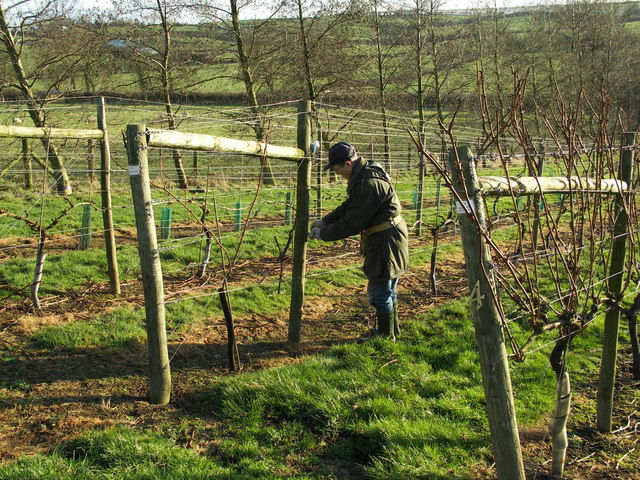
One of my earliest memories of John Haig was watching him tend his grapes. Each fall in October or early November he would come out carrying a pair of shears that looked for all the world like medieval torture implements. With these fearful tools he cleared away the dead vines and cut the live ones down to a fraction of their original length. There was not a hint of gentleness in John’s pruning. To the contrary, there was a certain ruthless determination in his work. One could almost pity the poor vines facing the coming winter wounded, diminished and bare. For that reason, I am not so sure Jesus’ words in Sunday’s gospel are all that reassuring. It is no fun getting pruned, not for grape vines and not for the church.
Early this year I learned that the church in which I was baptized and spent my early childhood closed its doors. The church from which I received my first call and served for my first five years of ministry met the same fate in the mid nineties. Four congregations within my conference closed during the last ten years of my ministry. In the United States of America, the church as we have known it is vanishing. My own Evangelical Lutheran Church in America recently established a “Commission on a Renewed Lutheran Church,” the purpose of which is to reconsider statements of purpose for the church and its organizational structure. Finally, reality is setting in. Our leaders are at last acknowledging that our denomination, as currently constituted, is no longer sustainable. This is all very sad. The congregations to which I refer were once vital communities of discipleship, witness and service. They bore much good fruit in their time. Over the last century, our church has developed global ministries that have provided disaster relief, anti-hunger programs, immigration assistance to refugees and many other important mission initiatives. Given our diminishing membership and support, it is possible that we might not be able to conduct these ministries in the near future or that the levels of our support for them will be drastically reduced. This season of pruning is a painful one.
I must admit that I do not much like the idea of having a God like John Haig coming after us with his iron shears. The only consolation here is that John Haig loved his grape vines just as God loves the church. John knew, as did Jesus, that grape vines left untended and unpruned are unlikely to survive the winter cold and probably will not bear fruit worth harvesting. In order to be fruitful in the coming year, the vines need to be pruned back. Unfruitful branches have to be loped off. Dead wood must be cut out. If the vine is to live, thrive and be fruitful, it must be cut down to within an inch of its life.
I believe that, too often, the church has measured its worth and success in terms of its influence within society, its ability to build and expand its institutions and its membership growth. In reality, however, these very markers of success point to areas of potential spiritual weakness. The exalted status enjoyed for much of the last century by the church in American culture is due in no small part to our willingness to play the role of upholding white middle class morality, blessing our nation’s wars and promoting patriotism as a spiritual virtue. Our pride in our institutions has often led to a reluctance to criticize, reform and re-center them on the good news of Jesus’ Christ. Our lust for growth has often led to our selling the church and all the programs, perks and benefits it can bestow rather than calling people to the privilege and challenge of discipleship with Jesus. As a result, we have ended up with a lot of unfruitful branches and dead wood. We need a good pruning and, if my instincts are correct, that is exactly what we are getting. Perhaps when we have been shorn of everything except the good word of the gospel, we will finally be small enough, poor enough and weak enough for God to make good use of us.
What makes Jesus’ unnerving words about the season of pruning hopeful is the fact that this season is, after all, a season. As such, it points invariably forward. There is for the pruned vine a “whither.” The day will come when, warmed by the sun, fed by the soil and watered with the spring rains, the vine will spring up renewed, strengthened and ready to bear fruit. We can know with certainty, then, that whatever shape, size and makeup the church may have in coming generations, it will be precisely the church God needs to proclaim the good news of Jesus and the reign of God for which he lived, died and continues to live.
Here is poem by Robert Frost speaking to the melancholy of a season’s end, yet offers a faint hint of promise.
Reluctance
Out through the fields and the woods
And over the walls I have wended;
I have climbed the hills of view
And looked at the world, and descended;
I have come by the highway home,
And lo, it is ended.
The leaves are all dead on the ground,
Save those that the oak is keeping
To ravel them one by one
And let them go scraping and creeping
Out over the crusted snow,
When others are sleeping.
And the dead leaves lie huddled and still,
No longer blown hither and thither;
The last lone aster is gone;
The flowers of the witch hazel wither;
The heart is still aching to seek,
But the feet question ‘Whither?’
Ah, when to the heart of man
Was it ever less than a treason
To go with the drift of things,
To yield with a grace to reason,
And bow and accept the end
Of a love or a season?
Source: The Poetry of Robert Frost, (c. 1969 by Holt, Rinehart and Winston, Inc.) pp.29-30. Born in 1874, Robert Frost held various jobs throughout his college years. He was a worker at a Massachusetts mill, a cobbler, an editor of a small town newspaper, a schoolteacher and a farmer. By 1915, Frost’s literary acclaim was firmly established. On his seventy-fifth birthday, the U.S. Senate passed a resolution in his honor. The State of Vermont named a mountain after him and he was given the unprecedented honor of being asked to read a poem at the inauguration of John F. Kennedy in 1961. Through the lens of rural life in New England, Frost’s poetry ponders the metaphysical depths. His poems paint lyrical portraits of natural beauty, though ever haunted by shadow and decay. You can learn more about Robert Frost and sample more of his poetry at the Poetry Foundation website.
 Peter's Outer Cape Portico