THIRTEENTH SUNDAY AFTER PENTECOST
Prayer of the Day: Ever-loving God, your Son gives himself as living bread for the life of the world. Fill us with such a knowledge of his presence that we may be strengthened and sustained by his risen life to serve you continually, through Jesus Christ, our Savior and Lord.
“Be careful then how you live…” Ephesians 5:15.
Something deeply American in my bones wants to cry out, “How I live my life is my own damned business!” No church can tell me how or whether to worship God, what I should or should not believe or what is right and wrong. No government has the right to tell me to wear a seatbelt when I drive, a life jacket when I Kayak or tell me where I can and cannot carry my gun. What I do with my life is my own concern.
Of course, a moment’s reflection dispels that notion. The way I live does have an impact on others, whether or not I recognize it. It matters a great deal to my fellow citizens what I believe about God and how I worship God, especcially if I believe God wants me to destroy God’s enemies and censor literature I believe offensive to my God. I may not care enough about my wellbeing to buckle up, but the family members who depend on me and my fellow Americans whose insurance premiums are driven up by the severity of injuries incurred by careless people like me have good reason to care. The Coast Guard, law enforcement and victims of gun violence all pay heavy prices for the “freedoms” I insist upon. Unless I am a hermit living off the grid-and perhaps even then-my life is inseparably bound up with those of everyone else on the planet. How I live is not my own damned business.
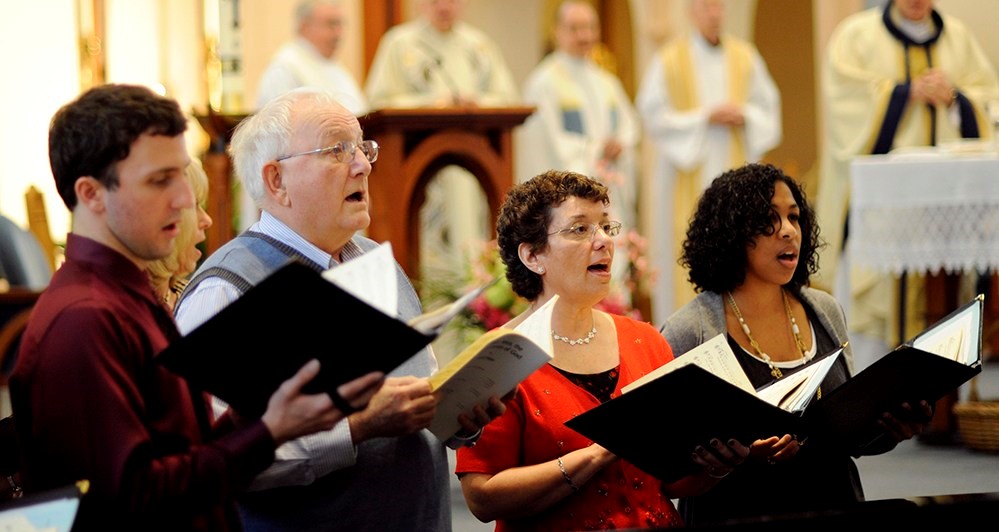
How then should disciples of Jesus live out the kingdom of heaven in service to their neighbors in a self centered world intent on plunging itself into hell? Paul does not answer that question directly. Instead, he gives some pretty down to earth, small scale directions. Don’t waste time. Don’t be stupid. Don’t drink to excess. Instead, be filled with the Spirit. How? By singing. The Spirit is infused into the church through the singing “psalms and hymns and spiritual songs among yourselves, singing and making melody to the Lord in your hearts, giving thanks to God the Father at all times and for everything in the name of our Lord Jesus Christ.” Let singing shape your heart, soul, mind and actions.
Song is a potent antidote to despair, helplessness and apathy. Martin Luther has said of singing:
“Music is hateful and intolerable to the devil. I truly believe, and do not mind saying, that there is no art like music, next to theology. It is the only art, next to theology, that can calm the agitations of the soul, which plainly shows that the devil, the source of anxiety and sadness, flees from the sound of music as he does from religious worship. That is why the Scriptures are full of psalms and hymns, in which praise is given to God. That is why, when we gather round God’s throne in heaven, we shall sing His glory. Music is the perfect way to express our love and devotion to God. It is one of the most magnificent and delightful presents God has given us.”
I wholeheartedly agree with Luther on this point, but with one caveat. I think that music trumps even theology. I know from experience that when I have been too tired, too dispirited, too overwhelmed with doubt to believe, I could still sing. I have often sung my way out of sorrows too deep for thinking through. In my view, talk therapy is overrated, but singing is highly underrated. Moreover, the value of singing is not merely therapeutic. The Civil Rights movement was animated by songs that sustained people of color throughout two centuries of slavery and decades of Jim Crow. The Power of Song, a book written by Guntis Šmidchens, documents the struggle for freedom by people of Estonia, Latvia and Lithuania and how their “Singing Revolution” won their independence from Soviet domination. A song can evoke visions, bring people together and inspire movements for change and transformation. It reaches back to the lives of ancestors, inspires the hearts of those living in the present and turns their gaze toward a better tomorrow. Recall the still potent anthem, We Shall Overcome, derived from a song by the Reverend Charles Tindley in 1903 and sung to the tune of an African American melody.
Saint Peter declares to Jesus in Sunday’s gospel, “Lord, to whom shall we go? You have the words of eternal life.” These words, enshrined and sung in our liturgy, testify to the power of music. Song is indeed the vehicle of lifegiving words, the lifegiving Word. You could almost say that singing is how the Word becomes flesh. Song is the means by which many individual members are united in word, in voice and in expression. Whatever divisions there may be in the congregation, whatever ill feeling between members, whatever divisive issues may be brewing, a good hymn sweeps a singing church into unity of thought and feeling.
In an insightful essay on a passage in Paul’s letter to the church in Colossae similar to our lesson from Ephesians, Amy Whisenand Krall points out that singing “both witnesses to the abundance of the new creation and enacts it. Taking part in singing together allows the congregation to inhabit that abundance and to grow up into the new creation; it gives body to what it means to grow into the maturity Paul desires for the congregation….As they take part in corporate singing, we find the congregation participating in thanksgiving to God in Christ, learning to give thanks together as diverse members who now constitute one community, the church, which is the Body of Christ.” “A Singing Creation: Music Making and Christian Maturity in Colossians 3:16,” published in The Art of New Creation, (C. 2022 and edited by Jeremy Begbie, Daniel Train and W. David O. Taylor; pub. by Intervarsity Press), p. 142.
Can we sing our way out of the hateful ideologies, hurtful caricatures, insults and broken relationships that characterize so much of our common life these days? Consider this. On election day 2020 in Warren, Michigan a group of Donald Trump supporters and backers of Joe Biden started shouting slogans and insults at each other through bullhorns-a none too common occurrence. But then Matthew Woods, a 59-year-old Trump supporter and travelling musician, challenged the Biden supporters to a “sing off.” The opposing groups soon started singing together and even posed for photos. “We shook hands, hugged each other and apologized for saying bad words to one another,” Wood said. Harmony: Opposing “Trump and Biden groups make music together,” CityNews, November 3, 2020. To the cynical spirit of our times, this was but an anomalous island of civility in an ocean of uncivil and bitter acrimony. To people of faith, however, it is tiny flicker of hope, a fleeting glimpse into the better way of being human to which Jesus calls us, a new creation into which the Spirit carries us through song.
Here is a poem by Friedrich von Schiller extoling the power of song and its transformative potential.
The Power of Song
The foaming stream from out the rock
With thunder roar begins to rush,—
The oak falls prostrate at the shock,
And mountain-wrecks attend the gush.
With rapturous awe, in wonder lost,
The wanderer hearkens to the sound;
From cliff to cliff he hears it tossed,
Yet knows not whither it is bound:
‘Tis thus that song’s bright waters pour
From sources never known before.
In union with those dreaded ones
That spin life’s thread all-silently,
Who can resist the singer’s tones?
Who from his magic set him free?
With wand like that the gods bestow,
He guides the heaving bosom’s chords,
He steeps it in the realms below,
He bears it, wondering, heavenward,
And rocks it, ‘twixt the grave and gay,
On feeling’s scales that trembling sway.
As when before the startled eyes
Of some glad throng, mysteriously,
With giant-step, in spirit-guise,
Appears a wondrous deity,
Then bows each greatness of the earth
Before the stranger heaven-born,
Mute are the thoughtless sounds of mirth,
While from each face the mask is torn,
And from the truth’s triumphant might
Each work of falsehood takes to flight.
So from each idle burden free,
When summoned by the voice of song,
Man soars to spirit-dignity,
Receiving force divinely strong:
Among the gods is now his home,
Naught earthly ventures to approach—
All other powers must now be dumb,
No fate can on his realms encroach;
Care’s gloomy wrinkles disappear,
Whilst music’s charms still linger here,
As after long and hopeless yearning,
And separation’s bitter smart,
A child, with tears repentant burning,
Clings fondly to his mother’s heart—
So to his youthful happy dwelling,
To rapture pure and free from stain,
All strange and false conceits expelling,
Song guides the wanderer back again,
In faithful Nature’s loving arm,
From chilling precepts to grow warm.
Source: This poem is in the public domain. Johann Christoph Friedrich von Schiller (1759-1805) was a German poet, playwright, historian, philosopher, physician and lawyer. He was born in Marbach, Germany. His initial goal was the priesthood. But in 1773 he entered a military academy in Stuttgart and ended up studying medicine. After a brief stint as a regimental doctor, he left Stuttgart to accept a post as professor of History and Philosophy at Jena. Schiller developed a close friendship with the already famous Johann Wolfgang von Goethe. Together they formed the Weimar Theater. You can read more about Johann von Schiller and sample more of his poetry at the All Poetry website.
 Peter's Outer Cape Portico