Monthly Archives: January 2025

Speaking Truth to a Lynch Mob

FOURTH SUNDAY AFTER EPIPHANY

Jeremiah 1:4-10

Psalm 71:1-6

1 Corinthians 13:1-13

Luke 4:21-30

Prayer of the Day: Almighty and ever-living God, increase in us the gifts of faith, hope, and love; and that we may obtain what you promise, make us love what you command, through your Son, Jesus Christ, our Savior and Lord.

“When they heard this, all in the synagogue were filled with rage. They got up, drove [Jesus] out of the town, and led him to the brow of the hill on which their town was built, so that they might hurl him off the cliff.” Luke 4:28-29.

How does a worship service turn into a lynching? What could Jesus possibly have said to make the people among whom he grew up want to kill him? According to the account of Luke the Evangelist, everything went sideways when Jesus began speaking about God’s love and attention to outsiders. It was a widow of Zarephath, a city of pagan Phoenicia, that gave sanctuary to the prophet Elijah when he was a refugee fleeing persecution under the reign of the wicked King Ahab. It was Naaman, a general of Israel’s arch enemy Syria, who found healing and faith from the prophet Elisha. To be sure, God is the God of Israel. But God is not the possession of Israel. God’s love is for all people of every tribe and tongue. As Saint Peter would proclaim in Luke’s sequel, the Book of Acts, “I truly understand that God shows no partiality, but in every nation anyone who fears him and does what is right is acceptable to him.” Acts 10:34-35. That message did not go down well with the good people of Nazareth.

Luke the Evangelist portrays Jesus as one who refuses to accept the distinctions of class, blood and soil through which people of his day found their identity. He scandalized the religious and respectable by dining with folks like Levi and Zacheus. But he could just as often be found eating in the home of civil and religious leaders. He had compassion on a leader of the military occupation of his own country and healed his servant. In an age when people feared to touch lepers for fear of being rendered unclean, Jesus touched them in order to make them clean. It is as though Jesus were blind to the “no trespassing” signs we erect to protect our “our people” from the corrupting influence of outsiders.

So, too, the church in the Book of Acts is constantly breaking down ethnic, cultural, religious and class barriers as it expands beyond Galilee and Judea into Samaria and from there into Greece, Macedonia, Asia Minor, Italy and beyond. It was not smooth sailing all the way. Tension and conflicts are reflected throughout the New Testament between Jewish believers and gentile newcomers. Though Paul affirmed that in Christ there is neither male nor female and accepted women as apostolic coworkers with him, it is clear the women struggled to find their voice and place during the formative years of the church. Paul’s pastoral advice on that score was sometimes less than helpful. Still, the church never abandoned its belief in and understanding of itself as a single body with wildly diverse members uniquely gifted for mutual service in pursuit of its mission of reconciling the world to God in Christ.

The church proved to be a destabilizing force, threatening to disrupt the Pax Romana maintained by the Roman Empire through the threat of violence embodied in the cruelest implement of death, the cross. Mary the mother of our Lord sings eloquently about the reversal of the imperial order, the mighty being cast down, the hungry filled with good things and the rich being sent away empty. Luke 1:46-55. Simeon predicts that the infant Jesus “is destined for the falling and the rising of many in Israel, and to be a sign that will be opposed so that the inner thoughts of many will be revealed.” Luke 2:34-35. In the Book of Acts Paul and his associates are accused of having “turned the world upside down.” Acts 17:6. The very existence of this odd community of diverse persons practicing radical equality and showing no regard for rank, status or the emperor’s delusions of godhood threatened the legitimacy, authority and power of the imperial order, built up as it was on distinctions of race, class and citizenship. That accounts for the empire’s vicious and ultimately futile efforts to extinguish the church.

The stability of a hierarchy depends on everyone at every level being content with their place-or at least convinced that trying to rise above it is dangerous and certain to be futile. When those on the lower rungs begin to sense their power, begin to imagine a different arrangement and begin to doubt the religious, ideological and traditional glue that holds the hierarchical pyramid together, the structure begins to wobble. Those nearest the top panic because they have the furthest to fall. Panic breeds hysteria and hysteria produces violence. A lynching is seldom about its individual victims whose only crime is happening to be at the wrong place at the wrong time. It is, rather, a knee jerk reaction against a host of social fears and phobias. Lynching is a frantic effort to hold together a dying regime against a hurricane of change threatening to topple it. Both then and now, Jesus is that hurricane.

So here is the real deal. There are no hordes of lawless migrants made up of criminals and insane people storming across our southern border to invade our country. There is no deep state conspiracy to change the sex of school age children. Haitian immigrants are not eating American’s pets. How could anyone in their right mind believe such malarky? The simple answer is that they need to believe it. These baseless conspiracy theories help fragile people make sense of a world that is changing too fast for them. They see rising prices, more and more black and brown faces in their neighborhoods, schools and workplaces, more stores with signs they cannot read, fewer job opportunities in their communities and decaying towns and cities-and they are mad as hell about it. The lies, propaganda and hysterical rhetoric directed against migrants have been whipped up by our cynical leaders to a give a shape to our deepest fears, put a face on the monsters that terrify us and give us a neck around which to place the noose. Make no mistake about it, that is exactly what this “greatest deportation ever seen” is about. It is a government inspired and sponsored lynching. Migrants are the scapegoats for all that is wrong with America. And you can be sure that when all the undocumented migrants have been deported and America’s problems remain, there will be another scapegoat. There always is.

I read with dismay the pastoral letter from ELCA Bishop, Elizabeth Eaton on President Trump’s Executive Orders calling for mass deportations. To be clear, I appreciate the bishop’s addressing the issue and agree wholeheartedly with her analysis. But we need more than analysis at this point. We need truth telling and fearless preaching. The truth is that the Republican party, now fully controlled by Trump and the MAGA movement, has all the hallmarks of a hate group. See “Time to Declare the Republican Party a Hate Group.” It is time for the church to say so. For my part, I refuse to go on pretending that the GOP, as currently constituted, is just another political party functioning within America’s democratic system. I refuse to allow lies, slander, conspiracy theories and hateful ideology to be invited into serious moral deliberation. I refuse to participate in the normalization of bullying, intimidation and violence under the color of law. It is time to tell the powers that be “We must obey God rather than any human authority” and that we will resist governmental actions that harm our neighbors. Acts 5:29.

To all bishops and pastors, I have a hard word to say: You need tell your people who support Donald Trump and his party, “You are deeply loved by God. You are valued members of our church community. We love you dearly and that is why we need to tell you that by your support for this man and his followers you are grievously injuring your neighbors and scandalizing the Body of Christ. By your association and support, you participate in their hatred and cruelty. For your own sake and for the sake of Christ’s church, you need to repent and renounce your association with this evil movement.” If you are unwilling or unable to say this to your church, then for your sake, for the sake of the church and for the sake of the world, please step aside and make room for someone who can and will.

The gospel of Jesus Christ is good news. Lutheran’s like me are fond of saying that “God loves us just as we are.” However sinful we may be, God accepts us where God finds us. Nevertheless, God loves us too much to leave us there. That is why God’s Word speaks the truth that sets us free. John 8:32. Jesus loved the people of his hometown enough to tell them the truth they needed to hear-even when it turned them against him. This is not the mushy sentimental kind of love. It is what poet Sonia Sanchez calls “love colored with iron and lace.” It is love that seeks repentance, justice and restitution. The complete poem follows:

This Is Not a Small Voice

This is not a small voice

you hear     this is a large

voice coming out of these cities.

This is the voice of LaTanya.

Kadesha. Shaniqua. This

is the voice of Antoine.

Darryl. Shaquille.

Running over waters

navigating the hallways

of our schools spilling out

on the corners of our cities and

no epitaphs spill out of their river

mouths.

This is not a small love

you hear       this is a large

love, a passion for kissing learning

on its face.

This is a love that crowns the feet

with hands

that nourishes, conceives, feels the

water sails

mends the children,

folds   them    inside   our    history

where they

toast more than the flesh

where they suck the bones of the

alphabet

and spit out closed vowels.

This is a love colored with iron

and lace.

This is a love initialed Black

Genius.

This is not a small voice

you hear.

Source: Wounded in the House of a Friend, (c. 1995 by Sonia Sanchez; pub. by Beacon Press, Boston, Massachusetts). Sonia Sanchez (born Wilsonia Benita Driver in 1934) is an American poet, writer and professor. She is a leading figure in the Black Arts Movement. Sanchez has written several books of poetry. She has also authored short stories, critical essays, plays and children’s books. She received Pew Fellowship in the Arts in 1993. In 2001 she was awarded the Robert Frost Medal for her contributions to American poetry. You can read more about Sonia Sanchez and sample more of her poetry at the Poetry Foundation website.

Rev. Jeremiah Wright was Right

For those of you who can still remember the election of 2008, one of the last in which we were assured that, whatever the outcome and however we might feel about it, there would be sanity in the Whitehouse, you will undoubtedly recall the Rev. Jeremiah Wright. Rev. Wright is now, like me, a retired pastor. He was formerly the senior pastor of Trinity United Church of Christ in Chicago and the pastor of then presidential candidate Barak Obama. Trinity is a predominantly African American congregation and the largest one in the United Church of Christ, a predominantly white protestant church. Wright gained national attention in the United States in March of 2008 after ABC News disclosed the following quote from a sermon he preached in 2003 entitled “Confusing God and Government.”

“No, no, no. Not ‘God Bless America’; God Damn America! That’s in the Bible, for killing innocent people. God Damn America for treating her citizen as less than human. God Damn America as long as she keeps trying to act like she is God and she is supreme!”

Back in the days when journalism was a profession and broadcast news was considered a public service rather than an entertainment cash cow, there would have been at least an attempt to place this quotation in its proper context. But ABC news understands that the American attention span is brief and that sensational bites of “breaking news” grab attention and drive up ratings. Consequently, unless you did some investigative work of your own, you might have concluded, as Obama’s opponents clearly hoped you would, that Wright was simply on an anti-American rant and that Barak Obama’s membership at Trinity was proof that he shared Wright’s unpatriotic sentiments. If you have not already done so, I invite you to read the entire sermon of Jeremiah Wright. Below are my own observations.

Rev. Wright’s sermon, as the title suggests, dealt with the idolatry of nationalism. To put it simply, he was making the point that Americans tend to confuse the demands of government, patriotism and blind love of country for godliness and faithful discipleship. I have often preached and written about the same theme, most recently in my article, “Christ the King and the Religion of America.” Though his critics tried to brand Rev. Wright a terrorist, he makes clear in his sermon that violence is never the answer to injustice. He specifically condemned the practice of Muslim extremists who call for the murder of “unbelievers.” “War does not make for peace,” he told his congregation. “Fighting for peace is like raping for Virginity.” Wright was quick to point out, however, that his own country’s use of violence was equally unjustified:

“We can see clearly the confusion in [the Muslim extremist’s] minds, but we cannot see clearly what it is that we do….when we turn right around and say our God condones the killing of innocent civilians as a necessary means to an end.”

Wright went on to point out this country’s use of violence and oppression against the indigenous peoples of this continent, against the enslavement of African’s brought to this country in chains, against American support of notoriously oppressive leaders and their regimes. He then made the point that we blaspheme God, take God’s name in vain and distort God’s image when we invoke God to bless America, bless its wars and sanctify its oppressive acts:

“That we say God understands collateral damage, we say that God knows how to forgive friendly fire, we say that God will bless the Shock and Awe as we take over unilaterally another country – calling it a coalition because we’ve got three guys from Australia. Going against the United Nations, going against the majority of Christians, Muslims and Jews throughout the world, making a pre-emptive strike in the name of God. We cannot see how what we are doing is the same Al-Qaida is doing under a different color flag, calling on the name of a different God to sanction and approve our murder and our mayhem!”

So far, Rev. Wright is spot on. History is not mythology. This country’s genocidal wars against America’s indigenous peoples, the centuries of slavery that produced enormous wealth for the enslaver class, the invasion of Iraq grounded in false claims that it engineered the 9/11 attacks and was harboring weapons of mass destruction, along with the other examples of American violence Wright cites, are historical facts. Efforts to tell the story of our country without them amounts to a flat out lie. Portraying the Unted States as an “exceptional” nation uniquely blessed by God and its crimes as acts of heroism makes of this lie a shameful abuse of God’s name and image. This is the context of the offensive quote from Rev. Jeremiah Wright I cited at the outset.

Did Rev. Wright go too far in damning America? If he did, he was in distinguished company. The prophet Amos, for example, prophesied the destruction of his own country Israel and the violent death of its king. Isaiah warned his nation that it faced defeat and destruction. Jeremiah told his people that their capital city would be destroyed, their centuries old temple burned to the ground and their land taken away from them. Like the United States, Israel understood itself to be “exceptional,” and with far more justification. They were, in fact, chosen by God-but not to privilege, not to special divine treatment, not to blanket “blessing” regardless how they behaved. Israel (as well as far too many Christians) made the mistake of imagining that being chosen by God means being “first,” rather than the least of all and the servant of all. Of course, the United States is not God’s chosen people. But like all nations, it will be judged by how it treated the most vulnerable in its midst, the poor, the hungry, the persecuted, the refugee and the homeless. On that scale, the United States has a damnable record. As offensive, maddening and upsetting as this is, it is true. Rev. Wright is right to say so.

The Hebrew prophets did not hate their nation or their people. To the contrary, they loved them enough to tell them the truth. That is what you always do for someone you love. If Dad has a drinking problem, you don’t make excuses for him. You don’t get on the phone and tell his boss that he has the flu and can’t come in to work when, in fact, he is too hung over to make it to the bathroom to puke. You don’t humor him when he tells you that he just overdid it at the party last night where he tried to grope one of his coworkers in a drunken stupor and that it won’t happen again. You don’t smile and accept his excuses for failing to show up for graduations, weddings and other events important to his loved ones. People who chant “America love or leave it” are like enablers who stubbornly maintain, “My Dad, drunk or sober.” The latter is not love and the former is not patriotism. If you really love your father, you confront him with the truth. You point out to him that he has lost control of his life, that he is hurting the people he says he loves, that he is on a self destructive trajectory. You say what you have to say, however painful it might be, in order to give him the opportunity to change direction before it is too late. You do the same for your country, you tell it the truth it needs to hear to become the nation it claims to be.  

I managed to watch most of the inaugural ceremony of Donald J. Trump. I cannot say that I was overly shocked, angered or dismayed by anything the president or his acolytes said on that occasion. After a decade, my senses have grown accustomed to the stench from that river of sewage overflowing the MAGA cesspool. What I did find disheartening was the parade of well dressed and ornately robed Christian clergy sanctifying this ceremonial obscenity with prayers, scripture and flattery. There was, however, one pastor worthy of that title who stood well above this sorry assembly of clerical clowns. Episcopal Bishop, Rev. Mariann Edgar Budde, publicly called Trump out to his face during a service at the National Cathedral in Washington, DC with these words:

“Let me make one final plea, Mr. President. Millions have put their trust in you, and as you told the nation yesterday, you have felt the providential hand of a loving God. In the name of our God, I ask you to have mercy upon the people in our country who are scared now. There are gay, lesbian, and transgender children in Democratic, Republican, and independent families, some who fear for their lives. The people who pick our crops and clean our office buildings, who labor in poultry farms and meatpacking plants, who wash the dishes after we eat in restaurants and work the night shifts in hospitals, they may not be citizens or have the proper documentation, but the vast majority of immigrants are not criminals. They pay taxes and are good neighbors. They are faithful members of our churches and mosques, synagogues, gurdwara, and temples.

I ask you to have mercy, Mr. President, on those in our communities whose children fear their parents will be taken away, and that you help those who are fleeing war zones and persecution in their own lands to find compassion and welcome here. Our God teaches us that we are to be merciful to the stranger, for we were all once strangers in this land. May God grant us the strength and courage to honor the dignity of every human being, to speak the truth to one another in love, and walk humbly with each other and our God, for the good of all people, the good of all people in this nation and the world. Amen.”

Kudos to you, Bishop, for making the voice of Jesus heard in an arena where it has been altogether excluded, and that in the name of God. And kudos to you, Rev. Wright for having the courage and compassion to tell us the truth we need to hear. God send us more faithful, courageous and compassionate preachers for the sake of the church, for the sake of our nation, for the sake of the world!  

The Unwritten Word

THIRD SUNDAY AFTER EPIPHANY

Nehemiah 8:1-3, 5-6, 8-10

Psalm 19

1 Corinthians 12:12-31a

Luke 4:14-21

Prayer of the Day: Blessed Lord God, you have caused the holy scriptures to be written for the nourishment of your people. Grant that we may hear them, read, mark, learn, and inwardly digest them, that, comforted by your promises, we may embrace and forever hold fast to the hope of eternal life, through your Son, Jesus Christ our Lord.

The heavens are telling the glory of God;
   and the firmament proclaims his handiwork.
Day to day pours forth speech,
   and night to night declares knowledge.
There is no speech, nor are there words;
   their voice is not heard;
yet their voice goes out through all the earth,
   and their words to the end of the world. Psalm 19:1-4.

This psalm is one of my all time favorites. It begins with a lyrical expression of the many and diverse ways God’s glory is reflected in God’s creative handiwork. Each day “pours forth speech” while “night to night declares knowledge.” Yet “though it goes out through all the earth,” theirs is not a speech readily intelligible to human ears. Still, for those who are attentive, the sunrise is not merely a daily occurrence. Each new day is like the beginning of a marriage, filled with joy, promise and hope. It is the starting point of a great race across the heavens by the strong yet benevolent athlete, God’s agent of life and growth whose warmth reaches every corner of the earth.

Creation has a good deal to teach us if only we have ears to listen. As Jesus points out, the flowers of the field and the birds of the air testify to God’s generosity and the confident faith in which God’s good gifts are to be anticipated and received. The mustard seed illustrates the tenacious growth of God’s reign. The wind is a symbol of God’s Spirit that blows where and when it wills with gifts of healing and renewal. The cycle of seedtime, growth and harvest are pregnant with illustrations of faith, patience, hope and resurrection. The world’s wonders do indeed tell the “glory of God” and “proclaim his handiwork.”

Halfway through, the psalm changes its focus from the witness of Creation to God’s self revelation in the Torah. While this might strike modern readers as abrupt and discordant, I believe the poet was intentional here. The psalmist understands the commandments of God to be woven into the very fabric of creation. Just as the sun chases away the darkness of night bringing light and warmth to the earth, so the law of the Lord “is perfect, reviving the soul.” Just as the heavens proclaim the glory of God, so “the commandment of the Lord is clear.” Just as the light of the sun enables one to see one’s way, so God’s law is ever “enlightening the eyes” of all who rely upon it to guide their ways.

The lessons for this Sunday are weighted heavily in favor of the written word. Jesus preaches from a text of Isaiah the prophet announcing the liberation of the poor and oppressed; the healing of the blind and lame. Under Nehemiah and Ezra, the Hebrew exiles returning from Babylon are instructed in Torah with an eye toward establishing a renewed community. As a Lutheran protestant whose tradition has always emphasized the primacy of the written word and which has been suspicious of “natural theology” or knowledge about God derived from the natural world, I have usually made the written word the focus of my preaching on this particular Sunday. But these days I often wonder whether perhaps I have neglected and undervalued creation’s witness to God’s beauty, wisdom and compassion. That is one of the reasons I have sought to bring my reflections into dialogue with the reflections of poets. Too much of our preaching, I believe, is doctrinally correct, theologically sound and analytically coherent but lacking in beauty and imagination.

Much of our worship and hymnody tends to denigrate creation. One of the hymns we used to sing in the church of my childhood begins as follows:

I’m but a stranger here, Heav’n is my home;

Earth is but a desert drear, Heav’n is my home.

Danger and sorrow stand Round me on every hand;

Heav’n is my fatherland, Heav’n is my home.[1]

In some respects, the hymn resonates. Sometimes life feels as though one were living as a stranger in a “desert drear.” To the degree it validates the experience of people struggling through dark times and assures them that they do in fact have a home in God’s infinite love, the hymn is a genuine expression of lament. Nonetheless, equating the entire earth with a lifeless desert through which one regrettably, though necessarily, passes as a stranger in order to reach one’s true heavenly homeland takes things too far. The earth is God’s good creation, a sphere of which we are an integral part and a place where we ought to feel at home. However many scars God’s human creatures have inflicted upon this good earth, it remains good and filled with wonders telling of God’s glory. Who are we to turn our noses up at it?

As children of the Enlightenment, we are engrained with a rationalistic mentality that regards the earth, its oceans, forests and varieties of non-human life as “things.” Mystery, awe and wonder have no place in the lab where nothing that cannot be empirically verified is true. In our economy, only that which can be monetized has value. For the machinery of capitalism, the world is only a ball of resources to be exploited for profit. The sun is neither a bridegroom nor an athlete. It is simply a ball of burning hydrogen. Plants are either crops to be devoured or weeds to be poisoned. Animals are bred for food, pets, game or, if sufficiently exotic, maintained on preserves for the wealthy to view on safari. In this stale, stuffy and confining worldview, poetic imagination languishes.

Our psalm for this Sunday, as well as the Bible as a whole, opens up a deeper understanding of reality. Through metaphor, simile, analogy, parable, song and story a much richer view of creation becomes visible. Through scriptural testimony to the holiness of the earth and its creatures, God’s glory is revealed in all of its wonder, beauty and power. By the power of the Holy Spirit and eyes to see and ears to hear sharpened by attention to the wonders all around us, that glory transforms our hearts and minds.

Here is a poem in which the poet looks beyond dead rationalism and seeks to discern speech that “pours forth” from creation.

Eavesdropping

Long years ago

I stood beneath

A group of firs

And heard the breeze

Whispering secrets that were hers.

For though I strained to comprehend

I couldn’t find within the wind

A single syllable or hint

Of what the hidden language meant.

But as I watched,

The ancient trees

Took up the issues in the breeze

And without words or any speech

Conversed among themselves.

And as each

Shared his sagacious view,

His branches swayed as hands will do

When beings of our race confer

On topics that their souls bestir.

The others rocked as if to bow

In reverence and to say just how

They’d never heard it said so well,

Then turned to hear another tell

Just how he thought the matter stood-

All of this in that darkened wood.

I was then a child of tender years

Eavesdropping on speech

Beyond young ears.

I’m older now with hairs of gray

But none the wiser to this day

Regarding the awful mysteries

Discussed that night by

The ancient trees.

Source: Anonymous


[1] “I’m But a Stranger Here” by Arthur S. Sullivan, published in the The Lutheran Hymnal (c. 1941 by Concordia Publishing House).  

The Body of Christ and the Vanishing Common Good

SECOND SUNDAY AFTER EPIPHANY

Isaiah 62:1-5

Psalm 36:5-10

1 Corinthians 12:1-11

John 2:1-11

Prayer of the Day: Lord God, source of every blessing, you showed forth your glory and led many to faith by the works of your Son, who brought gladness and salvation to his people. Transform us by the Spirit of his love, that we may find our life together in him, Jesus Christ, our Savior and Lord.

“Now there are varieties of gifts, but the same Spirit; and there are varieties of services, but the same Lord; and there are varieties of activities, but it is the same God who activates all of them in everyone. To each is given the manifestation of the Spirit for the common good.” I Corinthians 12:4-7.

In the world at large, it has never been evident that there is such a thing as the common good. The notion has always lived uncomfortably in the American psyche next to our uncritical faith in self interest driven capitalism, whose philosophical father, Adam Smith famously observed:

“It is not from the benevolence of the butcher, the brewer, or the baker, that we expect our dinner, but from their regard to their own interest. We address ourselves, not to their humanity but to their self-love, and never talk to them of our own necessities but of their advantages.”  Wealth of Nations, I:II, p.26,27.

Consequently, society is not governed by a common search for the greatest good for all people, but the quest of each individual seeking their own personal good without regard for others or society as a whole. Indeed former British Prime Minister, Margaret Thatcher went so far as to question whether society even exists, asking rhetorically “….who is society? There is no such thing! There are individual men and women and there are families and no government can do anything except through people and people look to themselves first.” Isabel Paterson, journalist, author, political philosopher and a leading libertarian thinker brings this line of reasoning to its logical conclusion, stating:

“There is no collective good. Strictly speaking, there is not even any common good. There are in the natural order conditions and materials through which the individual, by virtue of his receptive and creative faculties and volition, is capable of experiencing good.”[1]

Saint Paul makes unequivocally clear that, when it comes to the church, the Body of Christ, the opposite is true. Individual good, not the common good, is delusional. Just as it is ridiculous to suggest that a hand or a foot can live independently from the rest of the body, so it is equally implausible that any individual believer can thrive apart from full participation in the community of disciples. I Corinthians 12:14-20. With all due respect and contrary to the above mentioned authorities, community is real, there is a common good and reaching it requires the unique gifts, talents and perspectives of all its members.

Rev. Lester Peter, a seasoned pastor and prison chaplain who preached at my ordination service over four decades ago, gave me the following advice. “Peter, just remember that everybody you see in your congregation on Sunday morning is there because Jesus called them to be there. Each one of them is there because they have a gift, an insight, a talent that the church needs. Each one of them has something to teach you that you cannot learn from anyone else.” I would be less than honest if I were to deny that I have struggled with Lester’s and Saint Paul’s words at times. More than once I have looked at a member of one of my congregations and mused to myself how much easier my job would be without them and their antics. I suspect Paul felt the same way about some members of the Church at Corinth, a congregation with more problems than you could shake a stick at. Nevertheless, Paul can say to this sad puppy of a church, “Now you are the body of Christ.” I Corinthians 12:27. Not, “You should be the body of Christ,” or “If you ever manage to get your act together you might be the body of Christ,” but “You are the body of Christ.” So act like it!

Sometimes, the church gets it right. In the church of my childhood, I was blessed through the ministry of a teenager named Gary. Gary helped with our Sunday School and he was the only teenage boy I knew who showed any interest in kids my age. My church friends and I didn’t think much of Sunday School, a time just slightly more tolerable than the church service. But we lived for the fifteen minutes between the end of Sunday School and the start of the service during which Gary played tag, kick ball and hide and seek with us. He listened to our stories and laughed at our silly jokes. I don’t remember exactly when I learned Gary was what in those days we called “mentally retarded.” (Thankfully, this pejorative term has been removed from polite and civil discourse.) What I do know is that Gary showed to me the care and attention Jesus showed to children. He made me and my friends feel welcome and included. In our congregation, Gary was not a social problem to be solved or a drain on the rest of society. He was a gifted member of the body of Christ building up that body with bonds of friendship. We would not have been the community we were without him. Gary may well be one of the reasons I am still in the church.

Increasingly, we are living in a world that acknowledges no common good, a world in which the only good is my good, a winner takes all world where everyone else’s gain is my loss, a world in which “kitchen table issues” dominate (read my kitchen table), a world too small for people of the wrong race, the wrong accent, the wrong language, the wrong documentation or the wrong religion. In this world dominated by diffuse self interests, disciples of Jesus are called to be a community witnessing to a radically alternative way of being human. We are a community that asks not, “What is wrong with this person that doesn’t seem to fit in here?” but rather, “What is wrong with us that we cannot discern this person’s unique gifts to our community?”

Here is a well known poem by John Donne that serves as the antithesis to individualism, populism, xenophobia and all of the other hateful ideologies that deny the unity of the human family.  

No Man is an Island

No man is an island,
Entire of itself,
Every man is a piece of the continent,
A part of the main.
If a clod be washed away by the sea,
Europe is the less.
As well as if a promontory were.
As well as if a manor of thy friend’s
Or of thine own were:
Any man’s death diminishes me,
Because I am involved in mankind,
And therefore never send to know for whom the bell tolls;
It tolls for thee. 

Source: This poem is in the public domain. John Donne (1571-1631) was an English poet, scholar, soldier and secretary. Despite his great education and poetic talents, Donne lived in poverty for several years, relying heavily on wealthy friends. He spent much of the money he inherited from his family on womanizing and travel. In 1601, Donne secretly married Anne More, with whom he had twelve children. In 1615 he was ordained an Anglican deacon and then, reluctantly, a priest. Donne did not want to take holy orders but did so because the king ordered it. Under Royal Patronage, he was made Dean of St Paul’s Cathedral in London. Donne is considered the preeminent representative of the metaphysical poets. His poetical works include sonnets, love poems, religious poems, Latin translations, epigrams, elegies, songs and satires. He is also known for his sermons. You can read more about John Donne and sample more of his poetry at the Poetry Foundation website.


[1] Paterson, Isabel The God of the Machine, (c. 1943, Van Rees Press, New York, NY)

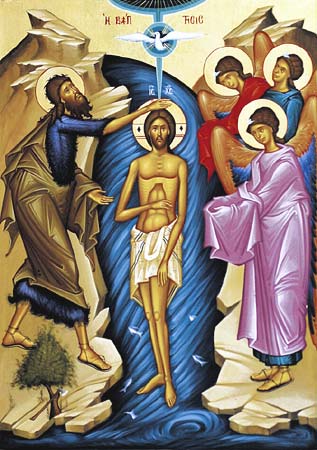
On Baptism

BAPTISM OF OUR LORD

Isaiah 43:1-7

Psalm 29

Acts 8:14-17

Luke 3:15-17, 21-22

Prayer of the Day: Almighty God, you anointed Jesus at his baptism with the Holy Spirit and revealed him as your beloved Son. Keep all who are born of water and the Spirit faithful in your service, that we may rejoice to be called children of God, through Jesus Christ, our Savior and Lord, who lives and reigns with you and the Holy Spirit, one God, now and forever.

“Do not fear, for I have redeemed you;
   I have called you by name, you are mine.
When you pass through the waters, I will be with you;
   and through the rivers, they shall not overwhelm you;
when you walk through fire you shall not be burned,
   and the flame shall not consume you.
For I am the Lord your God,
   the Holy One of Israel, your Savior.” Isaiah 43:1-3.

This passage taken from this Sunday’s first lesson from Isaiah is close to my heart. I first discovered it when I was still a teenager negotiating that stormy patch of water between childhood and the adult world. On days when it seemed as though life was as bleak as life can get (it doesn’t take much to get you there when you are a teen), these words from the prophet seemed to promise light at the end of a very long, dark tunnel. Sometimes, that is all you need.

Sesle and I chose this passage as one of the lessons for our marriage liturgy. By this time, with the benefit of a seminary education, I had a clearer understanding of these words. I knew that they were spoken by a prophet of the sixth century to the people of Israel newly liberated from Babylonian exile and given the opportunity to brave a long and dangerous trek through the desert wilderness back to their homeland. Israel’s position felt similar to the one Sesle and I found ourselves to be in. We each were emerging from a past of life experiences that had formed us. But now we were setting out on a journey into the future that would be shared. I had had enough experience within my own family to know how fragile marriages are, how vulnerable families are to heartache, tragedy and loss. I have known many men and women better than me whose marriages ended in divorce. I figured that the God who saw Israel through its journey across the wilderness to a new existence could be trusted to be with Sesle and me as we embarked on our new life together.

This day of the church year on which we celebrate the Baptism of Jesus is also profoundly significant to me. Both of my two daughters, born just shy of a year apart, were baptized on this feast day. When I baptized my eldest daughter, I began the sermon by announcing that Sesle and I, after prayerful consideration, were putting her up for adoption. It was an acknowledgement that infant baptism amounts to surrendering custody of one’s child to God. As parents of a baptized child, Sesle and I were now simply legal guardians, babysitters if you will, of a child who would be raised, mentored and formed by God’s Spirit. We were releasing any hopes, dreams and plans we might have had for our daughter, knowing that the mystery of her life would now unfold under God’s guidance and direction. Our role as parents would be to provide support and assistance in her discernment.

When my second daughter was baptized, I announced that we had in our midst a hardened, unrepentant sinner and that I would name her. That sinner was, as you may have guessed, my infant daughter. I pointed out that sin is less about acts than it is about our natural inclination to be completely self absorbed, indifferent to the needs of others and wholly fixated on our own. A baby is the quintessential sinner. Through socialization, it learns that its own well being depends on considering the interests of others and sometimes putting those interests ahead of its own. Yet even this is arguably a self interested calculation. Moreover, in spite of my best intentions, my daughter would likely learn, along with everything good I try to teach her, my prejudices, misconceptions and cultural biases. She was destined to inherit a position of unearned privilege in the midst of an inequitable society. That is why baptism begins with a renunciation of “the devil and all the forces that defy God,” “the powers of this world that rebel against God” and “the ways of sin that draw you from God.” Discipleship with Jesus is a life long struggle of resistance against these demonic powers and a continuing practice of learning to trust God, proclaim Christ through word and deed, care for others and the world God made and work for justice and peace.” Liturgy of Holy Baptism, Evangelical Lutheran Worship.

When you are a pastor baptizing your own children, you can get away with shenanigans like these. I wouldn’t recommend as a matter of course springing them on an unsuspecting extended family on the day of a baby’s baptism. Some members of my own family found the above remarks a little unsettling. Still, I think the Baptism of our Lord presents a great opportunity for talking about baptism, a serious matter that suffers from an excess of “cute.” Mary and Joseph got a preview of Jesus’ baptism in last Sunday’s gospel when Jesus, at the tender age of twelve, stayed behind in Jerusalem. After three days of frantic searching, they found him in the Temple about his “Father’s business.” That was a graphic reminder to them that Jesus was not their own, that he was part of something bigger than his family, his community and his nation. He is, as we hear in this Sunday’s gospel, God’s Son.

To remember your baptism is to be reminded that you are not your own. It is to be reminded that life is not supposed to turn out as expected. It is to understand that when your plans and expectations fail, it does not mean that you have failed. Saint Paul tells us that “all things work together for good for those who love God, who are called according to his purpose.” Romans 8:28. Too often we have taken that to mean that all things work together for our own personal good or for what we want or think we need. In fact, however, the “good” to which the apostle refers is the good of God’s redemptive purpose for the world. Jesus’ life unfolded for the good of the world and God’s promised reign of justice and peace, but he was born in a stable to a couple forced to flee as refugees from political persecution and was put to death as a criminal at a young age. That hardly comported with the hopes and dreams of his parents, his people and his disciples. It may not even have comported with Jesus’ own hopes and dreams. Nonetheless, Jesus’ obedient life, faithful death and glorious resurrection worked to complete God’s redemptive purpose for all creation.

As Saint Paul points out, in a culture that worships wealth and power, glorifies violence and equates bullying with strength, the life to which Jesus calls us appears as “foolishness.” I Corinthians 1:25. The way of Jesus paints a stark contrast to the way of the American Dream of wealth, comfort and security. By remembering our baptism, we are reminded by the God who adopts us as beloved children that we are better than what our culture tells us we are. We are more than what our imaginations can conceive. The totality of who we are cannot be known until such time as Christ is all in all and we know as we are known. Suffice to say, our lives, whatever verdict the world might pronounce on them, are each of infinite importance to the God who calls us by name. In them, God is bringing to completion God’s own purpose.  

Here is a poem by teacher and pastor Dietrich Bonhoeffer composed during his imprisonment touching on that point.

Who am I?

Who am I? They often tell me
I stepped from my cell’s confinement
calmly, cheerfully, firmly,
like a Squire from his country-house.

Who am I? They often tell me
I used to speak to my warders
freely and friendly and clearly,
as though it were mine to command.

Who am I? They also tell me
I bore the days of misfortune
equally, smilingly, proudly,
like one accustomed to win.

Am I then really all that which other men tell of?
Or am I only what I myself know of myself?
Restless and longing and sick, like a bird in a cage,
struggling for breath, as though hands were
compressing my throat,
yearning for colors, for flowers, for the voices of birds,
thirsting for words of kindness, for neighborliness,
tossing in expectation of great events,
powerlessly trembling for friends at an infinite distance,
weary and empty at praying, at thinking, at making,
faint, and ready to say farewell to it all?

Who am I? This or the other?
Am I one person to-day and to-morrow another?
Am I both at once? A hypocrite before others,
and before myself a contemptibly woebegone weakling?
Or is something within me still like a beaten army,
fleeing in disorder from victory already achieved?

Who am I? They mock me, these lonely questions of mine.
Whoever I am, Thou knowest, O God, I am Thine!

Source: Letters and Papers from Prison, by Dietrich Bonhoeffer (c. 1953 by SCM Press). Dietrich Bonhoeffer was born in 1906. He studied theology at Union Theological Seminary in New York City and at Berlin University where he became a professor of systematic theology. At the outbreak of World War II, Bonhoeffer was on a lecturing tour in the United States. Against the advice of his friends and colleagues, he answered the call to return to Germany and lead the Confessing Church in its opposition to National Socialism. Bonhoeffer was arrested in 1943 and imprisoned at Buchenwald. He was subsequently transferred to Flossenburg prison where he was hanged by the Gestapo just days before the end of the war. To learn more about Dietrich Bonhoeffer, his books and poems check out this website.