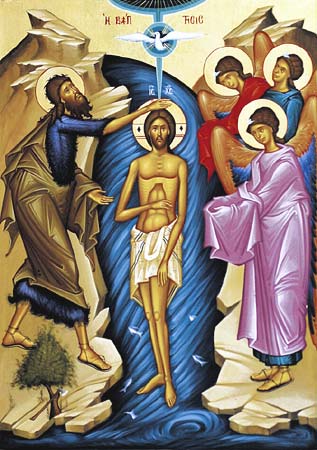
BAPTISM OF OUR LORD
Prayer of the Day: Almighty God, you anointed Jesus at his baptism with the Holy Spirit and revealed him as your beloved Son. Keep all who are born of water and the Spirit faithful in your service, that we may rejoice to be called children of God, through Jesus Christ, our Savior and Lord, who lives and reigns with you and the Holy Spirit, one God, now and forever.
“Do not fear, for I have redeemed you;
I have called you by name, you are mine.
When you pass through the waters, I will be with you;
and through the rivers, they shall not overwhelm you;
when you walk through fire you shall not be burned,
and the flame shall not consume you.
For I am the Lord your God,
the Holy One of Israel, your Savior.” Isaiah 43:1-3.
This passage taken from this Sunday’s first lesson from Isaiah is close to my heart. I first discovered it when I was still a teenager negotiating that stormy patch of water between childhood and the adult world. On days when it seemed as though life was as bleak as life can get (it doesn’t take much to get you there when you are a teen), these words from the prophet seemed to promise light at the end of a very long, dark tunnel. Sometimes, that is all you need.
Sesle and I chose this passage as one of the lessons for our marriage liturgy. By this time, with the benefit of a seminary education, I had a clearer understanding of these words. I knew that they were spoken by a prophet of the sixth century to the people of Israel newly liberated from Babylonian exile and given the opportunity to brave a long and dangerous trek through the desert wilderness back to their homeland. Israel’s position felt similar to the one Sesle and I found ourselves to be in. We each were emerging from a past of life experiences that had formed us. But now we were setting out on a journey into the future that would be shared. I had had enough experience within my own family to know how fragile marriages are, how vulnerable families are to heartache, tragedy and loss. I have known many men and women better than me whose marriages ended in divorce. I figured that the God who saw Israel through its journey across the wilderness to a new existence could be trusted to be with Sesle and me as we embarked on our new life together.
This day of the church year on which we celebrate the Baptism of Jesus is also profoundly significant to me. Both of my two daughters, born just shy of a year apart, were baptized on this feast day. When I baptized my eldest daughter, I began the sermon by announcing that Sesle and I, after prayerful consideration, were putting her up for adoption. It was an acknowledgement that infant baptism amounts to surrendering custody of one’s child to God. As parents of a baptized child, Sesle and I were now simply legal guardians, babysitters if you will, of a child who would be raised, mentored and formed by God’s Spirit. We were releasing any hopes, dreams and plans we might have had for our daughter, knowing that the mystery of her life would now unfold under God’s guidance and direction. Our role as parents would be to provide support and assistance in her discernment.
When my second daughter was baptized, I announced that we had in our midst a hardened, unrepentant sinner and that I would name her. That sinner was, as you may have guessed, my infant daughter. I pointed out that sin is less about acts than it is about our natural inclination to be completely self absorbed, indifferent to the needs of others and wholly fixated on our own. A baby is the quintessential sinner. Through socialization, it learns that its own well being depends on considering the interests of others and sometimes putting those interests ahead of its own. Yet even this is arguably a self interested calculation. Moreover, in spite of my best intentions, my daughter would likely learn, along with everything good I try to teach her, my prejudices, misconceptions and cultural biases. She was destined to inherit a position of unearned privilege in the midst of an inequitable society. That is why baptism begins with a renunciation of “the devil and all the forces that defy God,” “the powers of this world that rebel against God” and “the ways of sin that draw you from God.” Discipleship with Jesus is a life long struggle of resistance against these demonic powers and a continuing practice of learning to trust God, proclaim Christ through word and deed, care for others and the world God made and work for justice and peace.” Liturgy of Holy Baptism, Evangelical Lutheran Worship.
When you are a pastor baptizing your own children, you can get away with shenanigans like these. I wouldn’t recommend as a matter of course springing them on an unsuspecting extended family on the day of a baby’s baptism. Some members of my own family found the above remarks a little unsettling. Still, I think the Baptism of our Lord presents a great opportunity for talking about baptism, a serious matter that suffers from an excess of “cute.” Mary and Joseph got a preview of Jesus’ baptism in last Sunday’s gospel when Jesus, at the tender age of twelve, stayed behind in Jerusalem. After three days of frantic searching, they found him in the Temple about his “Father’s business.” That was a graphic reminder to them that Jesus was not their own, that he was part of something bigger than his family, his community and his nation. He is, as we hear in this Sunday’s gospel, God’s Son.
To remember your baptism is to be reminded that you are not your own. It is to be reminded that life is not supposed to turn out as expected. It is to understand that when your plans and expectations fail, it does not mean that you have failed. Saint Paul tells us that “all things work together for good for those who love God, who are called according to his purpose.” Romans 8:28. Too often we have taken that to mean that all things work together for our own personal good or for what we want or think we need. In fact, however, the “good” to which the apostle refers is the good of God’s redemptive purpose for the world. Jesus’ life unfolded for the good of the world and God’s promised reign of justice and peace, but he was born in a stable to a couple forced to flee as refugees from political persecution and was put to death as a criminal at a young age. That hardly comported with the hopes and dreams of his parents, his people and his disciples. It may not even have comported with Jesus’ own hopes and dreams. Nonetheless, Jesus’ obedient life, faithful death and glorious resurrection worked to complete God’s redemptive purpose for all creation.
As Saint Paul points out, in a culture that worships wealth and power, glorifies violence and equates bullying with strength, the life to which Jesus calls us appears as “foolishness.” I Corinthians 1:25. The way of Jesus paints a stark contrast to the way of the American Dream of wealth, comfort and security. By remembering our baptism, we are reminded by the God who adopts us as beloved children that we are better than what our culture tells us we are. We are more than what our imaginations can conceive. The totality of who we are cannot be known until such time as Christ is all in all and we know as we are known. Suffice to say, our lives, whatever verdict the world might pronounce on them, are each of infinite importance to the God who calls us by name. In them, God is bringing to completion God’s own purpose.
Here is a poem by teacher and pastor Dietrich Bonhoeffer composed during his imprisonment touching on that point.
Who am I?
Who am I? They often tell me
I stepped from my cell’s confinement
calmly, cheerfully, firmly,
like a Squire from his country-house.
Who am I? They often tell me
I used to speak to my warders
freely and friendly and clearly,
as though it were mine to command.
Who am I? They also tell me
I bore the days of misfortune
equally, smilingly, proudly,
like one accustomed to win.
Am I then really all that which other men tell of?
Or am I only what I myself know of myself?
Restless and longing and sick, like a bird in a cage,
struggling for breath, as though hands were
compressing my throat,
yearning for colors, for flowers, for the voices of birds,
thirsting for words of kindness, for neighborliness,
tossing in expectation of great events,
powerlessly trembling for friends at an infinite distance,
weary and empty at praying, at thinking, at making,
faint, and ready to say farewell to it all?
Who am I? This or the other?
Am I one person to-day and to-morrow another?
Am I both at once? A hypocrite before others,
and before myself a contemptibly woebegone weakling?
Or is something within me still like a beaten army,
fleeing in disorder from victory already achieved?
Who am I? They mock me, these lonely questions of mine.
Whoever I am, Thou knowest, O God, I am Thine!
Source: Letters and Papers from Prison, by Dietrich Bonhoeffer (c. 1953 by SCM Press). Dietrich Bonhoeffer was born in 1906. He studied theology at Union Theological Seminary in New York City and at Berlin University where he became a professor of systematic theology. At the outbreak of World War II, Bonhoeffer was on a lecturing tour in the United States. Against the advice of his friends and colleagues, he answered the call to return to Germany and lead the Confessing Church in its opposition to National Socialism. Bonhoeffer was arrested in 1943 and imprisoned at Buchenwald. He was subsequently transferred to Flossenburg prison where he was hanged by the Gestapo just days before the end of the war. To learn more about Dietrich Bonhoeffer, his books and poems check out this website.
 Peter's Outer Cape Portico