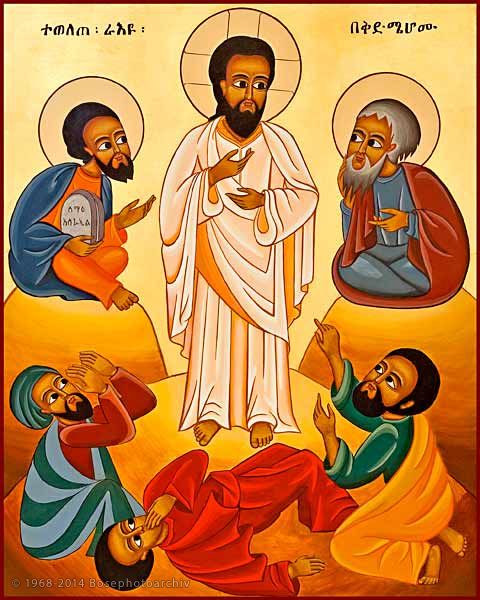
TRANSFIGURATION OF OUR LORD
Prayer of the Day: Holy God, mighty and immortal, you are beyond our knowing, yet we see your glory in the face of Jesus Christ. Transform us into the likeness of your Son, who renewed our humanity so that we may share in his divinity, Jesus Christ our Lord, who lives and reigns with you and the Holy Spirit, one God, now and forever.
This story of Jesus’ Transfiguration is told also in the gospels of Matthew and Mark. It has a close parallel in John’s gospel where Jesus’ prayer to be glorified is answered by a divine voice like thunder. John 12:27-32. Each account is unique in the telling. I am struck by two details given to us in Luke’s account. The first has to do with timing. Matthew and Mark tell us that Jesus and the disciples ascended the mountain “after six days.” Thus, the Transfiguration would have occurred on the seventh day. The number seven is heavy with meaning in both the Hebrew Scriptures and the New Testament. It signifies completion, perfection and wholeness. At the dawn of time, God rested on the seventh day, having completed the work of creation. God commands us to do the same each seventh day or sabbath. The sabbath is a reminder that work has its limits. There will be an end to toil and struggle. Sabbath rest is a foretaste of God’s promised rest for a weary creation, a rest that knows no end.
Luke, however, has the transfiguration occurring “about eight days after these sayings,” these sayings being his admonitions for all who would follow him to “daily take up their cross.” Luke 9:23. One may take the number eight to signify not merely the completion and perfection of creation, but a new creation. We can perhaps hear an echo of the vision imparted to John of Patmos where God declares at the close of the present age, “Behold, I make all things new.” Revelation 21:5. The Transfiguration therefore points forward and back. Its glow reaches back to the dawn of creation and floods the Hebrew scriptural narrative. It also shines forward into the future illuminating the culmination of time where God is finally, “all in all.” I Corinthians 15:28. On the mountain of Transfiguration, time is enfolded into eternity. The lines of demarcation between past, present and future dissolve into God’s eternal now. The universal and seemingly irreversible process of death is universally reversed such that Moses and Elijah, two long dead figures whose lives were lived centuries apart, are seen conversing with Jesus and one another.
Luke’s account is also unique in another respect. Unlike Matthew and Mark, Luke tells us what Jesus, Moses and Elijah were talking about. They were discussing the “departure” Jesus was to accomplish at Jerusalem. The Greek word for “departure” employed by Luke is “exodos,” referring back to the book by that name and the story it tells of God’s liberation of Israel from slavery in Egypt. It is a remarkable story, not merely because it proved formative for Israel and continues to be so for Jews today, but also because it has no peer in ancient religion and mythology. This is not the story of a god who sits at the apex of a divinely ordained hierarchy topped by a king who reigns as the god’s representative through a standing army of subordinates with slaves at the base. The faith of Israel is not merely a metaphysical justification for an oppressive status quo. Exodus is the story of how the God of slaves and refugees turned the hierarchy of empire on its head by making of a people that was no people a nation governed by Torah, by precepts that apply equally to kings and servants. The land of promise was so called because it represented the promise of a different way of being human. It was a land where the poor, the widow, the orphan and the resident alien were not to be left on the margins but shown particular care and sustenance. The measure of this new nation’s greatness was to be its treatment of the most vulnerable in its midst in accordance with Torah.
It is perhaps owing to Luke’s insight that the church’s liturgy and hymnody have from the beginning woven our observance of Lent, Holy Week and Easter into the saga of Exodus and the Passover. Like the Exodus, the ministry of Jesus turns hierarchy on its head ignoring national, social, religious and class distinctions. He turns the imperial notions of glory as power, domination and victory on the field of battle inside out by his identification with the lowest of the low, by being executed as a criminal in the company of criminals. He embodied a preferential option for the “least” and most vulnerable in his life and death. God’s resurrection of Jesus was God’s stamp of approval on all that Jesus was, said and did. The way of taking up the cross is, contrary to historic measures of greatness, the way of life. It is a way now open all.
The feast of the Transfiguration prefigures Jesus’ Resurrection even as it stands at the precipice of our Lenten journey to the cross. It offers us a glimpse of the feast to come beyond lifelong struggles with our urge to dominate and control, our addiction to wealth and privilege, our bondage to the cycles of retribution and violence, our allegiance to the false gods of nation, race, blood and soil. The Transfiguration reminds all who spend their lives standing with LGBQT+ folk, the undocumented living in our midst, the sick insurers have deemed unfit to live and the homeless whose very existence is fast becoming a crime that they are on the right side of history. Though hated for their associations and persecuted by a government driven by racist hate, theirs is nevertheless the Kingdom of Heaven.
The Exodus story as well as the gospel narratives are in many respects Anti-American. They tell a story quite different from the narratives that dominate our American culture’s civil discourse, its politics and too much of its religion these days. Ours is a story that desperately needs retelling and, perhaps more importantly, living. God knows and we should know as well that those of us who claim to follow Jesus have often wandered off course. We have been seduced by ideologies that equate wealth with divine favor, violence with justice, exclusion with holiness, whiteness with rightness, patriotism with faithfulness, privilege with blessing and might with right. Yet somehow, as much in spite of us as because of us, the gospel narrative has survived. The light of the Transfiguration has flared up at critical times throughout history to renew the church, sustain it through difficult times and purify it from corruption. By God’s grace, the faithful witness of saints and martyrs and the power of the Holy Spirit, the “Old, Old Story of Jesus and His Love” remains for us to retell and relive.
Transfiguration
The sky was dark and overcast the day
we began our ascent to the top of that mountain.
Cold mist soaked our garments from without
as did the sweat of our weary bodies from within.
Up and up we followed in His footsteps,
each of us wondering how He knew the way
and how He could see the path through the
impenetrable fog all around us on every side.
Our hearts pumped frantically, our lungs gasped at the thinning air,
our aching limbs longed to fall motionless to the ground.
And so they did at long last when finally we reached the summit.
Broken with fatigue we lay down on the grass,
heedless of the cold and wet, leaving Him to His meditations.
Of what we saw-or thought we saw-when we awoke
I still cannot find words enough to tell the half of it.
His face shone like the sun as he conversed with the ancient ones.
The cloud enveloped us and brought us to our knees
with the power of a mighty ocean wave.
But most terrible of all was that voice driving
like a nail into our very souls these words:
“This is my Son, my Beloved. Listen to him.”
Small wonder we fell to the earth and hid our faces.
When at last we found enough courage to open our eyes
the cloud was once again cold drizzle and fog,
the voice silent, the ancients gone
and only He remained to lead us back to the plain.
Source: Anonymous



 Peter's Outer Cape Portico