FIRST SUNDAY IN LENT
Deuteronomy 26:1-11
Psalm 91:1-2, 9-16
Romans 10:8b-13
Luke 4:1-13
Prayer of the Day: O Lord God, you led your people through the wilderness and brought them to the promised land. Guide us now, so that, following your Son, we may walk safely through the wilderness of this world toward the life you alone can give, through Jesus Christ, our Savior and Lord, who lives and reigns with you and the Holy Spirit, one God, now and forever.
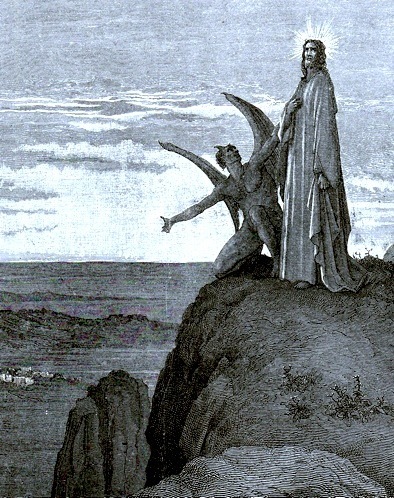
“Then the devil led him up and showed him in an instant all the kingdoms of the world. And the devil said to him, ‘To you I will give their glory and all this authority; for it has been given over to me, and I give it to anyone I please. If you, then, will worship me, it will all be yours.” Luke 4:5-7.
Some time ago I was conversing with a colleague online about the horrific violence in Gaza and the West Bank and all the related issues. Though sympathetic to the suffering of the Palestinians, she was clearly partial to the people of the state of Israel and supportive of its military actions in response to the massacres of October 7th of last year. She asked me point blank, “Do you believe the state of Israel has the right to exist?” I responded, “As much, I suppose, as any nation state has the right to exist.” It was an off the cuff answer to which I had not given much forethought. But I think this might have been one of those rare instances where an unpremeditated response turns out to be more insightful than intended.
I wonder where we got the idea that nation states have the right to control an area of land. I wonder where we got the idea that nations do or should have rights. How did we come by a world order built on the assumption that an existing constellation of nations have rights that supersede those of individual persons? How did we arrive at the absurdity that a person not recognized as a citizen by any state is without rights and without protection, other than some toothless UN conventions. On what grounds can nations claim their right to exist? There are few left on the face of this earth who are not living on land their ancestors took from somebody else. Theft is, to say the very least, a thin reed on which to hang a moral claim of right. And for those few who can claim to be “original” inhabitants of the land they occupy, I wonder whether “getting there first” entitles them to exclude all newcomers and deny them rights?
These ruminations are a lead into our gospel lesson for this coming first Sunday in Lent where the devil offers Jesus “all the kingdoms of the world” and “their glory and all th[eir] authority” in exchange for his worship and devotion. We have all heard (and many of us have preached) sermons pointing out that the reign of God cannot be implemented by military or political might. That is true enough. But I believe there is a stronger point to be made here. The devil emphasizes that the glory of the kingdoms of the world and their authority belong to him. Thus, they are not to be regarded as neutral implements, like a shovel that can be a useful tool or a murder weapon, depending upon whose hands wield it. The glory and authority of the nations are by nature demonic. They amplify the evil of those who seize them with ill intent and corrupt the morals and integrity of those who take hold of them for noble ends.
A good deal of the world’s violence springs from disputes over territory, efforts of one kind or another to defend land we consider our own. Witness the carnage in Gaza and the West Bank; the bloody war between Russia and Ukraine; the tragic destructiveness in Sudan and the cruelty inflicted on refugees at our southern border in the name of “national security” and “defending American culture.” The world is a dangerous place in large part because it is dominated by nation states defending and/or expanding their territory at the expense even of their own people.
The United Nations was formed following the Second Word War to prevent similar conflicts and manage international hostilities. To its credit, the UN is responsible for doing a great deal of good in the world. Many faithful, courageous and dedicated people have and continue to do great humanitarian work through its many agencies. Yet, for all that, I would argue that its chief function is to maintain a ruthlessly unjust status quo. Though made up of six organizational divisions, the National Security Council is by far the dominant center of power, being responsible for recommending the admission of new UN members to the General Assembly. It is also the body holding final authority to approve any changes to the UN Charter. Its powers also include establishing “peacekeeping operations,” enacting international sanctions and authorizing military action. The Security Council is the only UN body with the authority to issue binding resolutions on member states.
Tellingly, the Security Council is made up of the following nation states: China, France, Russia, United Kingdom and the United States. The common denominator here is a military with overwhelming nuclear capability that cannot be matched by anyone outside “the club.” At the same time, it is tacitly admitted that members of “the club” cannot afford to fight an all out war with each other. To do so would amount to mutual annihilation. So they engage each other through carefully managed “proxy wars,” such as the one currently raging in Ukraine. Throughout the years of the Cold War, such conflicts were waged in Africa as well as South and Central America. World wars have thus never been eliminated. They have simply been managed such that their carnage takes place in some distant corner of the world allowing citizens of Security Council members and their close allies to “live in peace.”
Of course, there is more to all of this than military dominance. The Security Council members are also home to the most powerful economies on the planet. The vast disparity in wealth between the northern and southern hemispheres mirrors representation in the UN hierarchy. With their national fates under the military and economic control of Western Europe, North America and China, the countries of Central America, South America, Southern Asia and sub-Saharan Africa, still struggling with the ruinous effects of centuries of colonialism, find themselves still at the mercy of the military strategic and economic interests of the National Security club and its allies.
On the lowest rung of hell are those who have no nation. I speak of refugees whose countries of origin offer nothing but death by starvation or violence. These folks find themselves eking out a miserable hand to mouth existence in refugee camps or traveling long distances over sea and land hoping against hope to find a decent life in one of the many countries that don’t want them. They have absolutely no voice or vote in the global order and no rights of citizenship to invoke. They are, in effect, non persons. These people, so hated and feared that we are prepared to spend billions sealing our border against them, are paying the price for the peace and security we enjoy. World peace in our day is, as it was under the Roman Empire in Jesus’ day, maintained through organized, systemic brutality for the privileged few at the expense of the many.
Against the backdrop of this inhumane world order, Christians confess belief in the one holy, catholic and apostolic church, the Body of Christ that transcends all humanly drawn borders and embraces peoples of every nation, tribe and tongue. Yet, despite that confession on our lips, we are prepared to kill fellow Christians whose lives stand in the way of military operations defending our national interests and bar them when they flee to our land from poverty and violence. That is because, as I have noted before, the religion of America is America. I suspect that, to a large degree, this is true of other nation states as well. Nationalism is the new faith animating the world. Make no mistake about it. The wars being fought today are as much wars of religion as was the Thirty Years War.
I am not advocating anarchy. Government is a gift of God given for the purpose of ensuring peace, security and protection for all people, especially those among us who are most vulnerable. This is the sole reason for any nation to exist and the criteria upon which all nations great and small are judged. A righteous nation is one in which the hungry are fed, the naked clothed, the sick cared for, the prisoners treated with dignity and the alien welcomed. See Matthew 25:31-46. Moreover, nations, like individual people, are mortal. They have no inherent right to exist, nor are they intended to last forever. “Crowns and thrones shall perish, kingdoms wax and wane” as the old hymn says. Or, in the words of the prophet Isaiah, the nations are but “a drop in the bucket.” Isaiah 40:15. A nation focused solely on its own survival, greatness and power has no place in God’s future. However great its wealth and however mighty its armies, its power is illusory. The devil is aware of this. That is why the devil is quite willing to relinquish such power and why Jesus has no interest in taking it.
It is not for the church to prescribe a new world order. But the church must speak out where any governing body exceeds its authority and usurps power over people belonging to God alone. The church must speak out when governments call upon their people to discriminate, persecute and denigrate their neighbors, especially those who lack the ability to defend themselves. The church must speak and act when a nation’s economy enhances the wealth of the rich at the expense of the poor. When the glory of the nation, its supporting mythologies and self defined destiny rise higher in the hearts of believers than Jesus’ call to embrace the neighbor across national, class and tribal boundaries, the church is in dire need of repentance.
Though we mainline churches tend to criticize the Christian right for its unabashed nationalism, our own complicity with the oppressive machinery of the state is not insignificant. Our churches enjoy highly favorable treatment under our tax system. When selective service was in force, clergy were automatically exempt from military service, regardless the position their churches took on the morality of warfare. These privileges do not come without strings attached. Pastors are routinely called upon to offer prayers, blessings, invocations and benedictions at civil ceremonies that glorify our nation rather than the God and Father of Jesus Christ. Our clergy are embedded in all branches of the armed forces with the implicit understanding that they are not to criticize American policy or use of armed force, no matter how morally dubious these may be. Our leaders seem overly fond of national recognition and places of honor. Who can forget the sad parade of clergy at the recent inauguration of Donald Trump offering prayers, blessings and well wishes for a man who makes no secret of his hatred for refugees, contempt for women and discrimination against sexual minorities?
Proximity to power breeds a particularly strong and dangerous temptations. This is particularly true for good people who long to accomplish worthy tasks and are impatient to see them completed. How much might be accomplished if all that power could be harnessed for good! Are a few compromises, a couple of white lies, turning a blind eye to a few abuses too high a price to pay for the ability to make substantial gains for the public good? Do not the ends justify the means? So the devil would argue. But Jesus understood that, rather than the means justifying the ends, the ends are always tainted by the means used to achieve them. The good one seeks to do by aligning oneself with coercive power always becomes distorted in the end.
Over the history of our nation, the church in its misguided do gooding has been quick to assume the role of moral enforcer, enshrining in our teachings and action, not the teachings of the Sermon on the Mount, but the precepts of white middle class morality. We have sided with the supporters of bloody and unjust wars, the proponents of Jim Crow and the persecution of LGBQT+ folk. Our liturgy, hymnody and preaching have too often conflated the reign of God with the American Dream. We have often remained silent and uncritical when biblical images, narratives and language are woven into the fabric of American patriotic mythology. For too long we have criticized only tepidly the systemic injustice imbedded in our schools, workplaces and justice system. Unlike Jesus, we have been too eager to accept the devil’s invitation to seize the levers of power in the name of all that is good, only to find that we have been coopted into supporting a cruel and unjust order, nationally and globally.
Lent is the season of repentance, a word that literally means “changing direction.” We should not look upon repentance as a burden, but as an opportunity. We do not have to repent. We get to repent. The good news is that we do not have to allow the past to define our present existence or cloud our future. There has never been a better time for the church to be the diverse, inclusive and radically catholic community it is called to be. There is no better time to build bridges even as our government is seeking to build walls. There is no better time to hang out banners proclaiming welcome to immigrants and refugees even as the howling MAGA lynch mob calls for their exclusion. Our witness to God’s love for all people and the unity of the human family in one flesh has never been more relevant and critical. As Saint Paul would say, “See, now is the acceptable time; see, now is the day of salvation!” II Corinthians 6:2.
The future is not fixed in stone. On Ash Wednesday the prophet Joel will remind us that, however deserving we might be of the destruction our sins bring upon us and however late the hour,
“Yet even now, says the Lord,
return to me with all your heart,
with fasting, with weeping, and with mourning;
rend your hearts and not your clothing.
Return to the Lord, your God,
for he is gracious and merciful,
slow to anger, and abounding in steadfast love,
and relents from punishing.
Who knows whether he will not turn and relent,
and leave a blessing behind him…” Joel 2:12-14.
Perhaps this year repentance for the church takes the shape of disengaging from our position of societal privilege, refusing to play the role our society has placed upon us, saying a polite “no” to invitations extended for us to bless our nation’s machinery of oppression. Perhaps for us clergy types repentance takes the shape of speaking uncomfortable truths to our congregations and putting the just peace of God ahead of our natural desire to keep peace within the ecclesiastical household. We may have been dupped, hoodwinked and taken to the cleaners by the devil in the past. But today is a new day. Jesus calls us to follow him in the way of the cross-the way of truth, compassion, empathy, justice and reconciliation. Though the powers that be might mock this way as weak, ineffective and foolish, disciples of Jesus know that it is the only way to life. As for the devil and his promises of power, glory and dominion, he can take a hike.
Here is a poem by Haki Madhubuti that poignantly illustrates the tragic futility arising from the exercise of power by nations, tribes and gangs seeking to assert authority over what they regard as their territory. This is, I believe, the power the devil would sell us and the power Jesus categorically calls us to reject.
Rwanda: Where Tears Have No Power
Who has the moral high ground?
Fifteen blocks from the whitehouse
on small corners in northwest, d.c.
boys disguised as me rip each other’s hearts out
with weapons made in china. they fight for territory.
across the planet in a land where civilization was born
the boys of d.c. know nothing about their distant relatives
in Rwanda. they have never heard of the hutu or tutsi people.
their eyes draw blanks at the mention of kigali, byumba
or butare. all they know are the streets of d.c., and do not
cry at funerals anymore. numbers and frequency have a way
of making murder commonplace and not news
unless it spreads outside of our house, block, territory.
modern massacres are intraethnic. bosnia, sri lanka, burundi,
nagorno-karabakh, iraq, laos, angola, liberia, and rwanda are
small foreign names on a map made in europe. when bodies
by the tens of thousands float down a river turning the water
the color of blood, as a quarter of a million people flee barefoot
into tanzania and zaire, somehow we notice. we do not smile,
we have no more tears. we hold our thoughts. In deeply
muted silence looking south and thinking that today
nelson mandela seems much larger
than he is.
Source: Heartlove: Wedding and Love Poems (c. 1969 by Haki R. Madhubuti; pub. by Third World Press, Chicago, IL.) Haki R. Madhubuti (born Don Luther Lee in 1942) is an African-American author, educator and poet. He is also well known as the publisher and operator of a black-themed bookstore. Madhubuti was instrumental in the founding of Third World Press, the oldest independent black publishing house in the United States. He has published twenty-eight books and co-edited two volumes of literary works. Madhubuti has received the Distinguished Writers Award and the American Book Award. He has been honored by the Middle Atlantic Writers Association, African-American Arts Alliance and awarded fellowships from the National Endowment for the Arts and the National Endowment for the Humanities. You can read more about Haki Madhubuti and sample more of his poetry at the Poetry Foundation website.




 Peter's Outer Cape Portico