
Monthly Archives: April 2025

When Being Church is Against the Law

THIRD SUNDAY OF EASTER

Acts 9:1-20

Psalm 30

Revelation 5:11-14

John 21:1-19

 Prayer of the Day: Eternal and all-merciful God, with all the angels and all the saints we laud your majesty and might. By the resurrection of your Son, show yourself to us and inspire us to follow Jesus Christ, our Savior and Lord, who lives and reigns with you and the Holy Spirit, one God, now and forever.

Note: For copyright reasons, the NRSV is not available to Oremus. They are working on obtaining the necessary updated licenses, but until then are offering only the Authorized King James Version. Nevertheless, the texts I cite in this article will be taken from the NRSV.

“Worthy is the Lamb that was slaughtered to receive power and wealth and wisdom and might and honor and glory and blessing!” Then I heard every creature in heaven and on earth and under the earth and in the sea, and all that is in them, singing, “To the one seated on the throne and to the Lamb be blessing and honor and glory and might forever and ever!” Revelation 5:12-13.

Last Friday the FBI arrested Milwaukee, Wisconsin circuit court Judge Hannah Dugan on allegations she helped an undocumented immigrant try to evade arrest. As I am not sure that a complete and reliable factual accounting of this incident has yet been made available, I will not comment on the legality of the act. But, legal or not, using our courts where people come for justice as a trap for arrest and deportation is immoral. Moreover, resisting immoral action, legal or not, is a moral obligation. We hear repeatedly, from both sides of the political spectrum, that “no one is above the law.” That is not quite true. One there is who is above all humanly constructed systems and institutions of authority, civil and religious. Jesus Christ alone is worthy “to receive all power and wealth and wisdom and might and honor and glory and blessing.” To him alone “every creature in heaven and on earth and under the earth and in the sea” owe ultimate allegiance. Therefore, when it comes to an unavoidable choice between honoring Jesus’ command to love God above all else and to love one’s neighbor as oneself and obeying the laws of the land, “we must obey God rather than human authority.” Acts 5:29

I do not mean to say by this that human authority can be disregarded. Generally speaking, government is one of God’s gifts to humanity. By means of it, human society is ordered. Politics, rightly understood, are the means by which we corporately love our neighbors. Obedience to civil law is therefore our default position. That holds true even for laws that seem unnecessary, burdensome or ill conceived. Where there are procedures for repealing or amending bad law, faithful discipleship requires utilizing them to correct injustice, inefficiency and unnecessary aggravation. But laws should not be casually and arbitrarily disregarded.

The 1908 law allegedly violated by Judge Dugan reads as follows:

Subsection 1324(a)(1)(A)(iii) makes it an offense for any person “knowing or in reckless disregard of the fact that an alien has come to, entered, or remains in the United States in violation of law, conceals, harbors, or shields from detection, or attempts to conceal, harbor, or shield from detection, such alien in any place, including any building or any means of transportation.”  

The reach of this law is far from clear. Does a church operating a food pantry whose members know that many of its clients are undocumented and makes no effort to contact federal authorities “shielding them from detection?” Is a social services agency operating a homeless center knowing that many of its residents are undocumented guilty of “harboring” illegal aliens? If a pastor gives a person known or suspected to be undocumented a ride to the bus station, is she shielding an illegal alien from detection by “means of transportation?” “Does “harboring” include a church’s finding shelter for an undocumented family?

The law has not been so construed in the past, though it may be open to such a broad interpretation. Prosecutors have a wide range of discretion with respect interpreting laws and determining the scope of their reach. Law enforcement officers have discretion as to whether they will enforce the law in any given circumstance. The officer that pulls you over for speeding could well give you a ticket bearing a stiff fine and points on your license. But if you are sober, respectful and a first time offender, chances are you will get off with a warning, though there is no guarantee. Up until the present time, federal and state authorities have respected the work of churches, schools, courts and social agencies by refraining from prosecutorial and enforcement action against undocumented persons that would interfere with their operations. Such restraint was based mainly on pragmatism. It is well known that undocumented persons make up about 3.3% of the population. Prior to the tidal wave of hysteria stirred up over the last decade, these folks were not regarded as a threat and the government had no interest in mass deportations.

Things have changed, however, and that is putting it mildly. We now have a government that is committed to carrying out the “greatest deportation in history.” We have a vice president who takes pride in spreading outright lies about nonwhite immigrant communities for the purpose of turning public opinion against them. Global Refuge, a ministry of my Evangelical Lutheran Church in America, which received commendations from both Republican and Democratic administrations for more than half a century, was recently labeled a criminal enterprise by the governments unofficial Department of Governmental Efficiency.

We should have seen this coming. In 2019, during Trump 101, one of our pastors in training was deported. Betty Rendón, who fled from her native Columbia in 2004 as a refugee after guerrillas threatened the school she directed there, was arrested by ICE, detained and deported. At the time of her arrest, she was studying at the Lutheran School of Theology at Chicago and commuting from the city to Racine, Wisconsin, to work part time as a lay minister in one of our churches. Her application for asylum was denied for lack of documentation leaving her with two options. She could either return to Columbia with her husband and daughter where the danger from which she fled still existed, or she could remain in the United States and hope for the best. Technically, Betty Rendón lacked legal standing to remain in the United States and was subject to deportation. But as with all statutes, enforcement is largely discretionary. Prosecutors need not prosecute and the police need not enforce every law every time against everyone under all circumstances. Indeed, they ought not to waste limited public law enforcement resources when so doing serves no public purpose.

To be clear, the government is responsible for ensuring public safety. To that end, arrest and imprisonment/deportation of persons, documented or not, posing a threat to the public is justified. But such authority must be exercised with care, pursuant to law and consistent with due process. The present administration’s fixation on deporting eleven-million people who are, to a greater degree than the general population, law abiding, tax paying and productive members of society is destined to conflict with the church’s ancient ministry of hospitality to strangers and sanctuary for refugees. It seems to me that we have reached a point at which we must decide whether we will be true to our baptismal covenant of discipleship with Jesus, or set that covenant aside and, by our silence and inaction, become complicit in our nation’s crimes against the most vulnerable among us. If, as my own church declares, walking with immigrants and refugees is a matter of faith, the church must be prepared for acts of defiance, civil disobedience-and the consequences that will surely follow.

Perhaps the greatest temptation facing us comes in the form of despair. What difference can an institutional church in decline hope make in a nation driven by big money and dirty politics? What can a small church struggling to meet its budget and take care of its own aging population do for its neighbors living in fear of violent arrest and deportation? What can one person do against systemic evil infecting all of society? These very sentiments are expressed by in the Hebrew Scriptures to the psalmist:

“Flee like a bird to the

mountains,

for look, the wicked have fitted their arrow to

the sting,

to shoot in the dark at the

upright in heart.

If the foundations are destroyed,

what can the righteous do?” Psalm 11:1-3.

The psalmist replies that “the Lord is in his holy temple,” that “His eyes behold, his gaze examines humankind,” that “his soul hates the lover of violence,” that “he loves righteous deeds” and that the “upright shall behold his face.” For this reason, despite the seeming victory of the wicked, the psalmist nevertheless declares, “In the Lord I take refuge.” Psalm 11:1.  

I believe the visions recorded by John of Patmos in the Book of Revelation have never been more relevant than they are for this day. I believe they offer a wealth of spiritual resources for a struggling church living in a hostile environment. Sadly, Revelation has been highjacked by pre-millennial sects fixated on figuring out when and how the world will end. That, however, is not John’s purpose. If you want to understand Revelation, you need to begin where it does, namely, with John’s letters to the seven churches of Asia Minor. There we are introduced to seven faith communities living in legal jeopardy on the margins of society, divided by false teachings and self-proclaimed prophets, discouraged and on the verge of disintegration. John of Patmos reminds them of their importance and assures them that their struggle to follow Jesus is of cosmic significance. His visions rip away the vail of futility shrouding his church’s spiritual vision. In graphic and lurid imagery, John shows his churches that history is not being driven by the brutal imperial regime of Caesar or Rome’s ruthless economy of greed and exploitation, all of which are symbolized by the grotesque predatory beasts described in his visions. To the contrary, the future belongs to Jesus, “the lamb who was slaughtered.” The churches’ struggle to remain faithful in their witness to Jesus through public testimony, mutual love for one another and service to their neighbors puts them on the side of the God whose determination to redeem a wounded and broken world will not be thwarted. That is as true in the twenty-first century today as it was in the first.

Faithful witness might appear to be futile. As poet Adrianne Rich points out, our resistance to evil, our efforts to protect and preserve what matters seems ineffective, weak and bound to fade with time. Still the faithful hold vigils and protests that seem to accomplish nothing, stand with refugees in danger of deportation when the law and public opinion are against them, work food pantries that cannot begin to satisfy the needs of the growing number of food insecure families. We do this because we know that the lamb who was slaughtered for doing the same has been raised and that to him belong all “blessing and honor and glory and might forever and ever!”  

A Mark of Resistance

Stone by stone I pile

this cairn of my intention

with the noon’s weight on my back,

exposed and vulnerable

across the slanting fields

which I love but cannot save

from floods that are to come;

can only fasten down

with this work of my hands,

these painfully assembled

stones, in the shape of nothing

that has ever existed before.

A pile of stones: an assertion

that this piece of country matters

for large and simple reasons.

A mark of resistance, a sign.

Source: Poetry, August 1957. Adrienne Rich (1929-2012) was born in Baltimore, Maryland. She attended Radcliffe College, graduating in 1951. She was selected by W. H. Auden for the Yale Series of Younger Poets prize that same year. Throughout the 1960s, Rich wrote several collections of poetry in which she explored such themes as women’s roles in society, racism and the Vietnam War. In 1974 Rich won the National Book Award which she accepted on behalf of all women. She went on to publish numerous other poetry collections. In addition to her poetry, Rich wrote several books of nonfiction prose, including Arts of the Possible: Essays and Conversations (W. W. Norton, 2001) and What is Found There: Notebooks on Poetry and Politics (W. W. Norton, 1993). You can read more about Adrianne Rich and sample more of her poetry at the Poetry Foundation website.

The Wounded God

SECOND SUNDAY OF EASTER

Acts 5:27-32

Psalm 118:14-29

Revelation 1:4-8

John 20:19-31

Prayer of the Day: Almighty and eternal God, the strength of those who believe and the hope of those who doubt, may we, who have not seen, have faith in you and receive the fullness of Christ’s blessing, who lives and reigns with you and the Holy Spirit, one God, now and forever.

“But [Thomas] said to them, ‘Unless I see the mark of the nails in his hands, and put my finger in the mark of the nails and my hand in his side, I will not believe.’” John 20:25.

“Then [Jesus] said to Thomas, ‘Put your finger here and see my hands. Reach out your hand and put it in my side. Do not doubt but believe.’” John 20:27.

I do not believe my eldest daughter Sarah was more than five when on Easter Sunday, after church and a busy morning of easter egg hunts, I read the Easter story to her from a children’s picture book. As is the case for books of this kind, the pictures overpowered the words. So, not surprisingly, it was the pictures that captured Sarah’s interest more than my reading. Children tend to focus on things we adults deem peripheral and unworthy of our full attention. Such was the case with Sarah. The butterfly perched on a daisy growing in the garden where Jesus was buried proved more interesting to Sarah than the angels, the surprised women and the empty tomb. When we reached the place where Jesus made his appearance, Sarah looked puzzled. “Where are those things on his hands?” she asked. It took me a few seconds to realize that she was talking about his wounds from the nails. This picture book portrayed the resurrected Christ fully healed. He was dressed in a sparking white robe and looked as though he had just had a good, hot shower, a clean change of clothes and a manicure. Sarah knew the story too well not to question this portrayal of the resurrected Christ.

At the tender age of five, Sarah detected in the picture book I was reading to her an ancient heresy that had escaped my notice. It is called “Docetism,” from the Greek word “dοκηταίa,” meaning to “seem” or “appear.” This belief developed early in the life of the church. It took several different forms among various sects, but in general, docetists denied the humanity of Jesus. They taught that Jesus only appeared to have a physical body and that his earthly life, suffering, and death were merely illusions, not real experiences. Such a Christ cannot be wounded or injured and cannot really die. If Jesus really had a body, it was nothing more than a clever disguise, a costume he wore and discarded on the cross. The real Jesus could never be touched by human suffering and so one would hardly expect the resurrected Christ to bring the wounds of his now unnecessary body into his resurrected state.

I am sure the authors of that children’s book I read to Sarah all those years ago had no intention of propagating heresy. Nevertheless, portrayal of the resurrected Christ without his wounds is just that. Both Evangelists Luke and John make a point of telling us that Jesus’ body is a wounded body. The scars from the nails remain in his hands and feet. The wound inflicted by the soldier’s spear is fresh in his side. The glorified Christ is still the wounded, broken and bleeding Jesus of Nazareth. It is important to understand that these wounds were present on Easter Sunday and remain to this day. The Resurrection did not undo the Incarnation. The Word of God is still made flesh. The wounds inflicted upon all human flesh are his own. Jesus’ wounds will never be healed until all of creation is healed. Until then, the Incarnate Word suffers the sickness, loneliness, poverty, homelessness and violence we experience and inflict on one another. That is why Jesus warns us that what we do or fail to do for the least among us, we do or fail to do for him.

Progressive Protestantism, obsessed as it is with accommodating the rationalistic assertions of modernism, has always been at pains dealing with the resurrection narratives. In a world devoid of mystery where nothing exists beyond what can be verified empirically in the lab, how can Jesus’ resurrection be made intelligible? The physicality of the resurrected Christ has ever been an intellectual embarrassment to the Church in this modern world. For that reason, the old heresy of docetism continues to have theological to appeal. It offers a conceptual tool for making the Resurrection intelligible to the modern mind. Without offending our modernist biases, the Resurrection can be and often is preached as though it were a metaphor for some worthy cause or noble aspiration. Like John Brown’s body, Jesus’ body lies “a moldering in the grave,” but his truth goes marching on.

But the gospel narratives will admit of no such reductionist accomodation. There is, after all, the matter of the empty tomb. There is the matter of Jesus being embraced, being touched and sharing a meal with his disciples. To be sure, there is something very different about the body of the resurrected Christ. Jesus appears and disappears. Sometimes he is recognized by his disciples, sometimes not. He passes through closed and locked doors. He ascends to the right hand of God and so is omnipresent in a way that the pre-resurrection Jesus could not have been. The resurrected Christ is not merely a resuscitated corpse. But neither is he a disembodied spirit, a mere idea or the symbol of some great human aspiration. The scandal of our faith is that we believe God has a body. God has become and remains vulnerable to us. We are still capable of inflicting pain on God. Not only did the “Word become flesh,” but the Word remains flesh, suffering flesh, abused flesh, persecuted flesh, imprisoned flesh, starving flesh, dying flesh. That is why the two great commandments: Love God with all the heart, with all the soul, with all the mind and with all the strength; and love the neighbor are actually one commandment. There is no disembodied God who can be served apart from our flesh and blood neighbors.

It is for this reason poet John Updike insists that “if [Jesus] rose at all it was His body…” and that in the absence of such a resurrection, “the Church will fall.” Genuine faith in Jesus, true discipleship and real evangelism always puts the wellbeing of the neighbor, Christian or non-Christian, citizen or foreigner, documented or undocumented, friend, stranger or enemy above all else, because there is no other way to love and serve God than by loving and serving the neighbor. If your faith requires you to injure your neighbor, whether for the sake of religion, family or country, it is not faith in Jesus. The good news of Easter is that, in spite of the many wounds we have inflicted upon God throughout our bloody and violent history, chief of which was the murder of God’s own Son, God continues to abide in our suffering flesh, loving, forgiving and renewing God’s good creation.  

Here is the poem by John Updike cited above.  

Seven Stanzas at Easter

Make no mistake: if He rose at all
it was as His body;
if the cells’ dissolution did not reverse, the molecules
reknit, the amino acids rekindle,
the Church will fall.

It was not as the flowers,
each soft Spring recurrent;
it was not as His Spirit in the mouths and fuddled
eyes of the eleven apostles;
it was as His flesh: ours.

The same hinged thumbs and toes,
the same valved heart
that–pierced–died, withered, paused, and then
regathered out of enduring Might
new strength to enclose.

Let us not mock God with metaphor,
analogy, sidestepping, transcendence;
making of the event a parable, a sign painted in the
faded credulity of earlier ages:
let us walk through the door.

The stone is rolled back, not papier-mâché,
not a stone in a story,
but the vast rock of materiality that in the slow
grinding of time will eclipse for each of us
the wide light of day.

And if we will have an angel at the tomb,
make it a real angel,
weighty with Max Planck’s quanta, vivid with hair,
opaque in the dawn light, robed in real linen
spun on a definite loom.

Let us not seek to make it less monstrous,
for our own convenience, our own sense of beauty,
lest, awakened in one unthinkable hour, we are
embarrassed by the miracle,
and crushed by remonstrance.

Source: Updike, John, Collected Poems, (c. 1993 by John Updike, pub. by Alfred A. Knopf, Inc.). John Updike (1932-2009) was a prolific American author and poet. He grew up in Shillington, Pennsylvania. His early poems and fiction are grounded in the gritty industrial and cultural environment of the rust belt. His awards include the Pulitzer Prize for fiction, the American Book Award for fiction and the National Book Critics Circle Award for both fiction and criticism. You can learn more about John Updike and read more of his poetry at the Poetry Foundation website.
Easter-A Women’s Tale

RESURRECTION OF OUR LORD

Acts 10:34-43

Psalm 118:1-2, 14-24

1 Corinthians 15:19-26

Luke 24:1-12

Prayer of the Day: O God, you gave your only Son to suffer death on the cross for our redemption, and by his glorious resurrection you delivered us from the power of death. Make us die every day to sin, that we may live with him forever in the joy of the resurrection, through your Son, Jesus Christ our Lord, who lives and reigns with you and the Holy Spirit, one God, now and forever.

“But these words of [Mary Magdalene, Joanna, Mary the mother of James, and the other women with them] seemed to [the twelve disciples] an idle tale, and they did not believe them.” Luke 24:11.

Nevertheless, Simon Peter got up and literally ran to the tomb of Jesus to investigate. If Peter had determined, along with the rest of the apostles, that the women’s account of the empty tomb and the words of the angels was no more than an “idle tale,” why did he go running to the tomb? One possible answer is that he didn’t. The last sentence of our gospel lesson (verse 12) telling of Peter’s sojourn to the tomb is not found in some of the oldest and most reliable Greek New Testament manuscripts we have. This has lead many biblical scholars to conclude that it was a later addition to the story. Some commentators suggest that the account of Peter’s going to the tomb was added in order to absolve the “Prince of the Apostles” from unbelief. There might also be a hint of masculine embarrassment over the fact that the news of the resurrection was given first to women, and all the more so in view of the men’s failure to receive it in faith. Peter’s going to the tomb takes the edge off the apostles’ failure somewhat.

Later on, after the two disciples who encountered Jesus on the road to Emmaus and recognized him in the “breaking of the bread” return to Jerusalem with their good news, they are told that “The Lord has risen indeed, and he has appeared to Simon!” Luke 24:34. But no mention is made of the women. The gospels are generally long on the words and deeds of the male apostles, but short on episodes involving women. Chalk that up to prejudice, cultural subordination of women or misogyny if you like. The fact remains, however, that when women do make an appearance in the gospels, they leave a powerful impression. In Luke’s gospel, it is Mary the mother of Jesus who first says “yes” to God’s redemptive purpose in her life and the life of her promised child. Mary explodes with the radical and liberating words of the Magnificat that prefigure Jesus’ life and ministry. She is the one who ponders and treasures the events of his childhood in her heart. It was the faith of a Canaanite woman that pushed Jesus to recognize God’s saving purpose and the presence of “great faith” beyond the boundaries of his own nation and people. It was an anonymous woman who anointed Jesus prior to his impending death and understood him better than his closest disciples. Moreover, all four gospels are unanimous in their testimony that the woman disciples were the first witnesses of the Resurrection and the first commissioned by Jesus to proclaim it.

Throughout most of its history the church, led principally by males, has had a propensity for ignoring women. Their voices have been left out of our teaching and theology, their unique gifts have been devalued and taken for granted and the door to full participation and leadership in the Body of Christ has remained closed to them. Nonetheless, they have persisted faithfully and forcefully supporting the church in its mission, calling it to account for its systemic patriarchal oppression and challenging it with their own unique and creative insights. This is a critical part of the Easter story that needs telling.

I am old enough to remember the days when ordination of women was first introduced in Lutheran circles. I can still recall a day during my senior year in college when one of my professors hosted a question and answer meeting for those of us considering ordained ministry. Most of us were male, but there were a couple of women present as well, one of whom posed a question to my professor: “What advice would you give to a woman considering ministry of word and sacrament?” His response was instantaneous and decisive. “Don’t,” he said. “You may graduate seminary with a Master of Divinity degree, but there is no Lutheran church that will welcome a woman pastor. That isn’t happening for a long, long time.” Sadly, the professor was more than half right. Women answering the call to ministry have had to swim upstream against currents of congregational skepticism over their capacity to lead, patronization and abuse from their male colleagues and institutional barriers to positions of leadership within the church. Yet they persisted.

The church still struggles with patriarchy. Notwithstanding profound changes in recent decades that have cleared the way for women to serve in capacities unheard of in prior centuries, resistance remains to the voices, gifts and ministry of women. The church still has a long way to go in dismantling the systemic patriarchy in its midst that has silenced the voices of women and thereby compromised its witness to the gospel. Too often, our preaching, teaching and hymnody tells a story about men for men and to men. The gospels, however much they might reflect patriarchal and hierarchical assumptions, nevertheless tell a different story. They tell the story of the first apostles commissioned to preach the resurrection and how the new creation in Christ first broke into our world through the voices of the faithful women who followed Jesus and supported his ministry. They testify to the truth articulated by St. Paul, namely, “There is no longer Jew or Greek, there is no longer slave or free, there is no longer male and female; for all of you are one in Christ Jesus.” Galatians 3:28.[1] The Easter sunrise breaks into our world from a future in which such unity, equality and mutuality is fully realized.

The church, like each one of our lives, is “like a broken bowl” says the poet. Yet we pray that God would “[melt] and remould it, till it be [a] royal cup for” God and a faithful witness to God’s reign of justice and peace. Here is a poem/prayer by Christina Rossetti seeking that very thing.

A Better Resurrection

I have no wit, no words, no tears;

My heart within me like a stone

Is numb’d too much for hopes or fears;

Look right, look left, I dwell alone;

I lift mine eyes, but dimm’d with grief

No everlasting hills I see;

My life is in the falling leaf:

O Jesus, quicken me.

My life is like a faded leaf,

My harvest dwindled to a husk:

Truly my life is void and brief

And tedious in the barren dusk;

My life is like a frozen thing,

No bud nor greenness can I see:

Yet rise it shall—the sap of Spring;

O Jesus, rise in me.

My life is like a broken bowl,

A broken bowl that cannot hold

One drop of water for my soul

Or cordial in the searching cold;

Cast in the fire the perish’d thing;

Melt and remould it, till it be

A royal cup for Him, my King:

O Jesus, drink of me.

Source: This poem is in the public domain. Christina Georgina Rossetti (1830 –1894) was an English writer of romantic, devotional and children’s poems. She is perhaps best known for her composition of two Christmas carols, “In the Bleak Midwinter” and “Love Came Down at Christmas.” Rossetti was born in London and educated at home by her mother and father through religious works, classics, fairy tales and novels. The influence of prominent Italian writers filled the home and influenced Rossetti’s later writing. The Rossetti household was open to visiting Italian scholars, artists and revolutionaries. In the 1840s Rossetti’s family faced financial troubles due to a deterioration in her father’s physical and mental health. Her mother began teaching to support the family. At age 14, Rossetti suffered a nervous breakdown and left school. Religious devotion came to play a major role in her life as she struggled with bouts of depression.

Rossetti had three suitors, each of whom she declined to marry for largely religious reasons. Rossetti worked voluntarily in 1859–1870 at the St Mary Magdalene house of charity in Highgate, England, a refuge for ex-prostitutes. She was ambivalent about women’s suffrage, but staunchly opposed slavery in the United States, cruelty to animals and exploitation of girls in under-age prostitution. Rossetti maintained a wide circle of friends, associates and correspondents throughout the remainder of her life during which she continued to write and publish. You can read more about Christina Rossetti and sample more of her poetry at the Poetry Foundation website.


[1] To be sure, Paul’s pastoral advice concerning the place of women in the church does not always reflect such an equalitarian viewpoint. Paul, it seems, did not always fully comprehend the radical implications of the gospel he proclaimed. But do any of us fully comprehend the gospel’s implications for our lives? Can any of us claim that we have never had to change our minds, never resisted having to confront our prejudices or have never held an opinion of which we are now embarrassed or ashamed? And are any of us so arrogant as to assume that we have reached the pinnacle of understanding such that our descendants will never look back and question our judgment?   

Crucifixion as Lynching

PALM/PASSION SUNDAY

Luke 19:28-40

Isaiah 50:4-9a

Psalm 31:9-16

Philippians 2:5-11

Luke 22:14-23:56

Prayer of the Day: Everlasting God, in your endless love for the human race you sent our Lord Jesus Christ to take on our nature and to suffer death on the cross. In your mercy enable us to share in his obedience to your will and in the glorious victory of his resurrection, who lives and reigns with you and the Holy Spirit, one God, now and forever.

“I gave my back to those who struck me,
   and my cheeks to those who pulled out the beard;
I did not hide my face
   from insult and spitting.” Isaiah 50:6.

“And being found in human form,
   he humbled himself
   and became obedient to the point of death—
   even death on a cross.” Philippians 2:7-8.

“When they came to the place that is called The Skull, they crucified Jesus there with the criminals, one on his right and one on his left.” Luke 23:33

“Southern trees bear strange fruit,

Blood on the leaves and blood at the root,

Black bodies swinging in the Southern breeze,

Strange fruit hanging from the poplar trees.”  Abel Meeropol a.k.a. Lewis Allen

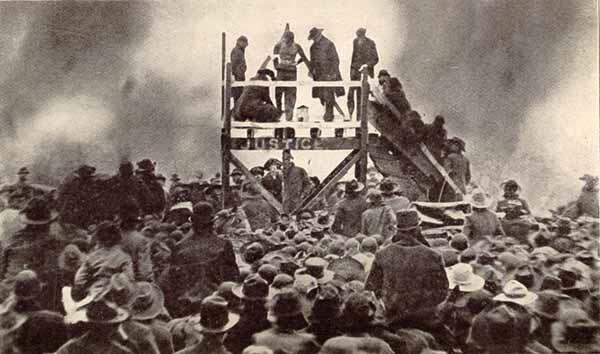
I used to say that one ought not to preach on the Passion Narrative. The Passion Narrative preaches itself. I still believe that to be the case, all things being equal. But all things are not equal in these days of warrantless detentions of legal residents, mass deportations of persons who have lived, worked and contributed to our economy for decades, summary discharge of transgender military personnel who have served this country with distinction and the efforts through ruthless censorship to erase from our nation’s memory the struggles and contributions of black, indigenous and all other nonwhite persons under the rubric of eliminating “DEI.” This extrajudicial oppression committed by our government against vulnerable communities in the name of “making America great again” leaves no doubt that the power of the state is now at the disposal of the MAGA lynch mob.

Contrary to what I was taught in school, the creed of white supremacy did not end with the Civil War. Though formal slavery ended in 1865, the creed of white supremacy that gave it moral justification lived on to be enacted into a matrix of laws robbing Black citizens of the right to vote, depriving black people of basic legal protections and blocking their access to everything from educational opportunities to access to public facilities. As Abraham Lincoln’s successor, President Andrew Johnson declared, “This is a country for white men, and by God, as long as I am president, it shall be a government for white men.”[1] Lynching was the ultimate instrument of terror employed to that end. The belief that Black men were inherently inclined toward rape, particularly of white women, was expressed by none other than President Theodore Roosevelt who said that “the greatest existing cause of lynching is the perpetration, especially by black men, of the hideous crime of rape-the most abominable in all the category of crimes, even worse than murder.”[2] The same sentiment was echoed by social reformers like Rebecca Latimer Fenton who endorsed lynching as a necessary deterrent for the protection of women.[3] The same pervasive belief in Black criminality continues to fuel disproportionately high rates of police stops, arrests and incarceration for Black folk.[4]  

Lynching, it must be emphasized, was not a rare and aberrant occurrence perpetrated only by extremists in the most backwards areas of the country. It was national policy. The United States Congress, driven largely by Southern Democrats, defeated both the Dyer Anti-Lynching Bill of 1918 and the similar Costigan-Wagner Act of 1933.[5] Such legislation was deemed an infringement on the right of states to frame their own solutions to “the race problem.” Killings of black folk based on infractions of racial etiquette, unsubstantiated allegations and simply for being at the wrong place at the wrong time were frequently inspired by the inflamed rhetoric of local leaders and carried out with no interference from and frequently with the assistance of law enforcement. The extrajudicial killings of George Floyd, Breonna Taylor, Tyre Nichols, Sonya Massey and Ahmaud Arbery make it painfully clear that lynching is not merely a grotesque artifact of the distant past. It is still deeply rooted in the American DNA.

On Passion Sunday we recall another lynching-the crucifixion of our Lord. The connection between the Cross and the lynching tree is made articulately by the late James H. Cone, professor of systematic theology at Union Theological Seminary in his book by that name.[6] In his introduction he writes:

“The cross and the lynching tree are separated by nearly 2000 years. One is the universal symbol of Christian faith; the other is the quintessential symbol of black oppression in America. Though both are symbols of death, one represents a message of hope and salvation, while the other signifies the negation of that message by white supremacy. Despite the obvious similarities between Jesus’ death on a cross and the death of thousands of black men and women strung up to die on a lamppost or tree, relatively few people, apart from black poets, novelists, and other reality-seeing artists, have explored the symbolic connections. Yet, I believe this is a challenge we must face. What is at stake is the credibility and promise of the Christian gospel and the hope that we may heal the wounds of racial violence that continue to divide our churches and our society.” Ibid, Cone, pp. viii-ix.

In the world where Jesus lived, the law, both civil and religious, served the interests of the wealthy and powerful. It was the tool of systemic oppression enforced by ruthless cruelty. The ultimate instrument and symbol of terror employed by Rome to keep the “pax Romana” in place was the cross. The sign put up on Jesus’ cross says it all: “This is what happens to people who preach a kingdom other than Caesar’s. This is what happens to people who follow a king other than Caesar.” The meaning of the derisive caption, “king of the Jews” would not have been lost on anyone passing by-just as the mutilated corpse of a lynching victim serves as a warning to every person of color: “Do not forget that we are white, you are not and what that means.”

We are witnessing the cross and the lynching tree today in the work of masked thugs in unmarked vehicles arresting and detaining American people for no apparent reason. We are seeing the cross in relentless efforts by the Trump administration to dismantle the architecture of civil rights protection under the rubrics of ridding our workplaces, schools and government of “DEI,” that is diversity, equity and inclusion. One can only conclude that the objective is homogeneity, inequality and exclusion. Make no mistake, the thinly vailed objective is to enshrine further and ensure the reign of white supremacy. We see the cross in efforts of national, state and local governments to limit access to or outright ban books found to be offensive or contrary to the moral and political agendas of right wing constituencies. These are all means by which we are warned not to “get into any good trouble,”[7] rock the boat or dare to suggest that “Caeser is not Lord. No, we do not yet see the return of state and federally approve lynchings, arrests and execution of dissenters or death camps. But if January 6, 2021 taught us anything, it is that the MAGA lynch mob is prepared to kill for what it cannot achieve through political means.

As Professor Cone points out, “[u]ntil we can see the cross and the lynching tree together, until we can identify Christ with a “recrucified” black body hanging from a lynching tree, there can be no genuine understanding of Christian identity in America and no deliverance from the brutal legacy of slavery and white supremacy.” And I would add that the cross must also be recognized in the bodies of the 36 transgender and gender-expansive people killed in an epidemic of violence in the last twelve months. The cross must be seen in the body of Matthew Shepherd, the young gay college student beaten, tortured and left hanging on a fence to die. It must be recognized among the three young women in Texas who died from lack of emergent care due to the effect of the state’s abortion ban. The cross can be seen everywhere in our culture of increasing oppression.

Of course, the cross is not the last word. Nevertheless, the Resurrection, which is God’s last word, loses its potency under a shallow, sentimental and spiritualized understanding of the cross consigned to the distant past. The miracle of the Resurrection is not simply that God raised a person from death. Nobody in the First Century doubted that God or the gods could perform such a feat. The miracle is that God raised Jesus from death, the one who not only preached but lived God’s gentle reign of justice and peace-and was put to death on the cross for his trouble. Jesus, not Caesar, not any general or political leader, not any successful entrepreneur, not any billionaire was raised from death and exalted to God’s right hand. God stands with the crucified of all times and places, and so must Jesus’ disciples.  

So I would urge preachers to break with the otherwise sound admonition not to preach the Passion. Preach the cross and the way it can still be seen in the suffering flesh of the those most vulnerable among us now being crucified under our government’s oppressive machinery. There are, I know, people in our churches who, to one degree or another, support Donald Trump and his MAGA allies. To these folks, you need to say: “We love you. You are a valued part of our community. But in supporting this man and his cruelty, you have sinned against God and the people made in God’s image. Whether by malice or mere indifference, you have closed your heart to the people nearest God’s heart and so to Jesus. You must turn away from these sins lest they devour your soul.” If you are unwilling to do that, then for the sake of the church, for the sake of the world and for your own sake, step down from the pulpit and make room for someone who will.   

Here is the complete poem of Abel Meeropol a.k.a. Lewis Allen.

Strange Fruit

Southern trees bear strange fruit,

Blood on the leaves and blood at the root,

Black bodies swinging in the Southern breeze,

Strange fruit hanging from the poplar trees.

Pastoral scene of the gallant South,

The bulging eyes and twisted mouth,

The scent of magnolias, sweet and fresh,

Then the sudden smell of burning flesh.

Here is a fruit for the crows to pluck,

For the rain to gather, for the wind to suck,

For the sun to rot, for the trees to drop,

Here is a strange and bitter crop.

Source: Music Sales Corporation (ASCAP) (c. 1939).Abel Meeropol (1903 –1986) was an American songwriter and poet. His works were published under his pseudonym Lewis Allan. His poem and musical setting of “Strange Fruit” was famously sung and recorded by the American jazz and swing singer, songwriter, and actress Billie Holiday. Meeropol was born in 1903 to Ukrainian-Jewish immigrants in the Bronx, New York. He graduated from DeWitt Clinton High School in 1921. He e earned a B.A. from City College of New York and an M.A. from Harvard University. Meeropol taught English at DeWitt Clinton for 17 years. During his tenure as a high school teacher, Meeropol taught author and racial justice advocate James Baldwin. He published his work under the pseudonym of “Lewis Allan” in memory of the names of his two stillborn children.

Billie Holiday (1915-1959) was born Eleanora Fagan. She was an American jazz and swing music singer. Nicknamed “Lady Day” by her friend and music partner, Lester Young, Holiday made significant contributions to jazz music and pop singing. Her vocal style, strongly influenced by jazz instrumentalists, inspired a new way of manipulating phrasing and tempo. She was known for her vocal delivery and improvisational skills.

After a turbulent childhood, Holiday began singing in nightclubs in Harlem. Throughout the 1930s and 1940s, Holiday had mainstream success on labels such as Columbia and Decca. Sadly, she was beset with legal troubles and drug abuse and served a short prison sentence in the 1940s. She came back following her release, however, to perform a sold-out concert at Carnegie Hall. Holiday’s success continued throughout the 1950s, with two further sold-out shows at Carnegie Hall. Her last album, Lady in Satin, was released in 1958. Holiday died of heart failure at age 44. To hear a moving recording of the Meeropol’s poem sung by Billie Holidy, click on this link.


[1] Constitutional Daily, July 31, 2019.

[2] Shapiro, Herbert, White Violence and Black Response: From Reconstruction to Montgomery (c. 1988 by Amherst: University of Massachusetts Press) p. 106

[3] “The Nature of Reform in the Early Twentieth-Century South” by Natalie J. Ring, published in A New History of the American South, (Edited by W. Fitzhugh Brundage, Laura F. Edwards & John F. Sensbach, c. 2023 by University of North Carolina Press) p. 378.

[4] Black people made up almost half of the state prison population but only about 13% of the U.S. population. “Racial Disparities Persist in Many U.S. Jails,” The Pew Charitable Trusts, May 16, 2023. According to the Philadelphia District Attorney’s Office “Racial Injustice Report, 2023,” Black individuals account for 69% of police stops and 62% of individuals arrested while white people accounted for only 18% of police stops and 21% of arrests.

[5] In 2023 Congress finally took the step of making lynching a crime by passing the The Emmett Till Antilynching Act. The law defines lynching as a federal hate crime, increasing the maximum penalty to 30 years imprisonment for several hate crime offences. Reps. Andrew Clyde, Thomas Massie, and Chip Roy voted against the Act.

[6] Cone, James H., The Cross and the Lynching Tree (c. 2011 by James H. Cone; pub. by Orbis Books).

[7] Taken from the now famous quote from the late congressman John Lewis: “Never, ever be afraid to make some noise and get in good trouble, necessary trouble.”

Christians Persecuted in America? Give me a Break!

President Donald J. Trump recently signed an Executive Order establishing a task force to end the “anti-Christian weaponization of government” and “unlawful conduct targeting Christians.” Evangelical Christians, it should be noted, have led the charge to dehumanize and deny medical treatment to transgender persons, gleefully advocated to deprive women access to life saving medical care and fought relentlessly to dismantle civil rights for minorities. Yet these bullies imagine that they are victims in need of government protection. I took this issue up with evangelical icon, Rev. Franklin Graham in an open letter seven years ago. The letter is obviously dated but the nonsensical claim of “persecution” is just as obviously as current as it is asinine. So I am re-blogging it once again.