PALM/PASSION SUNDAY
Prayer of the Day: Everlasting God, in your endless love for the human race you sent our Lord Jesus Christ to take on our nature and to suffer death on the cross. In your mercy enable us to share in his obedience to your will and in the glorious victory of his resurrection, who lives and reigns with you and the Holy Spirit, one God, now and forever.
“I gave my back to those who struck me,
and my cheeks to those who pulled out the beard;
I did not hide my face
from insult and spitting.” Isaiah 50:6.
“And being found in human form,
he humbled himself
and became obedient to the point of death—
even death on a cross.” Philippians 2:7-8.
“When they came to the place that is called The Skull, they crucified Jesus there with the criminals, one on his right and one on his left.” Luke 23:33
“Southern trees bear strange fruit,
Blood on the leaves and blood at the root,
Black bodies swinging in the Southern breeze,
Strange fruit hanging from the poplar trees.” Abel Meeropol a.k.a. Lewis Allen
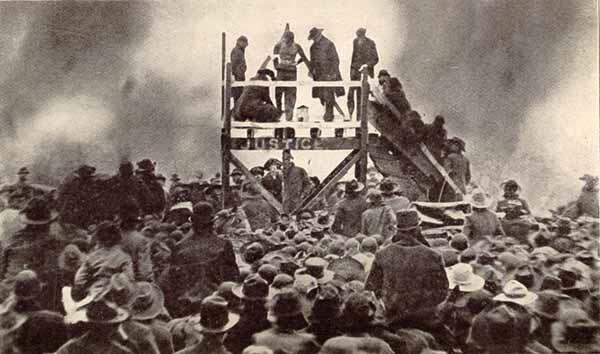
I used to say that one ought not to preach on the Passion Narrative. The Passion Narrative preaches itself. I still believe that to be the case, all things being equal. But all things are not equal in these days of warrantless detentions of legal residents, mass deportations of persons who have lived, worked and contributed to our economy for decades, summary discharge of transgender military personnel who have served this country with distinction and the efforts through ruthless censorship to erase from our nation’s memory the struggles and contributions of black, indigenous and all other nonwhite persons under the rubric of eliminating “DEI.” This extrajudicial oppression committed by our government against vulnerable communities in the name of “making America great again” leaves no doubt that the power of the state is now at the disposal of the MAGA lynch mob.
Contrary to what I was taught in school, the creed of white supremacy did not end with the Civil War. Though formal slavery ended in 1865, the creed of white supremacy that gave it moral justification lived on to be enacted into a matrix of laws robbing Black citizens of the right to vote, depriving black people of basic legal protections and blocking their access to everything from educational opportunities to access to public facilities. As Abraham Lincoln’s successor, President Andrew Johnson declared, “This is a country for white men, and by God, as long as I am president, it shall be a government for white men.”[1] Lynching was the ultimate instrument of terror employed to that end. The belief that Black men were inherently inclined toward rape, particularly of white women, was expressed by none other than President Theodore Roosevelt who said that “the greatest existing cause of lynching is the perpetration, especially by black men, of the hideous crime of rape-the most abominable in all the category of crimes, even worse than murder.”[2] The same sentiment was echoed by social reformers like Rebecca Latimer Fenton who endorsed lynching as a necessary deterrent for the protection of women.[3] The same pervasive belief in Black criminality continues to fuel disproportionately high rates of police stops, arrests and incarceration for Black folk.[4]
Lynching, it must be emphasized, was not a rare and aberrant occurrence perpetrated only by extremists in the most backwards areas of the country. It was national policy. The United States Congress, driven largely by Southern Democrats, defeated both the Dyer Anti-Lynching Bill of 1918 and the similar Costigan-Wagner Act of 1933.[5] Such legislation was deemed an infringement on the right of states to frame their own solutions to “the race problem.” Killings of black folk based on infractions of racial etiquette, unsubstantiated allegations and simply for being at the wrong place at the wrong time were frequently inspired by the inflamed rhetoric of local leaders and carried out with no interference from and frequently with the assistance of law enforcement. The extrajudicial killings of George Floyd, Breonna Taylor, Tyre Nichols, Sonya Massey and Ahmaud Arbery make it painfully clear that lynching is not merely a grotesque artifact of the distant past. It is still deeply rooted in the American DNA.
On Passion Sunday we recall another lynching-the crucifixion of our Lord. The connection between the Cross and the lynching tree is made articulately by the late James H. Cone, professor of systematic theology at Union Theological Seminary in his book by that name.[6] In his introduction he writes:
“The cross and the lynching tree are separated by nearly 2000 years. One is the universal symbol of Christian faith; the other is the quintessential symbol of black oppression in America. Though both are symbols of death, one represents a message of hope and salvation, while the other signifies the negation of that message by white supremacy. Despite the obvious similarities between Jesus’ death on a cross and the death of thousands of black men and women strung up to die on a lamppost or tree, relatively few people, apart from black poets, novelists, and other reality-seeing artists, have explored the symbolic connections. Yet, I believe this is a challenge we must face. What is at stake is the credibility and promise of the Christian gospel and the hope that we may heal the wounds of racial violence that continue to divide our churches and our society.” Ibid, Cone, pp. viii-ix.
In the world where Jesus lived, the law, both civil and religious, served the interests of the wealthy and powerful. It was the tool of systemic oppression enforced by ruthless cruelty. The ultimate instrument and symbol of terror employed by Rome to keep the “pax Romana” in place was the cross. The sign put up on Jesus’ cross says it all: “This is what happens to people who preach a kingdom other than Caesar’s. This is what happens to people who follow a king other than Caesar.” The meaning of the derisive caption, “king of the Jews” would not have been lost on anyone passing by-just as the mutilated corpse of a lynching victim serves as a warning to every person of color: “Do not forget that we are white, you are not and what that means.”
We are witnessing the cross and the lynching tree today in the work of masked thugs in unmarked vehicles arresting and detaining American people for no apparent reason. We are seeing the cross in relentless efforts by the Trump administration to dismantle the architecture of civil rights protection under the rubrics of ridding our workplaces, schools and government of “DEI,” that is diversity, equity and inclusion. One can only conclude that the objective is homogeneity, inequality and exclusion. Make no mistake, the thinly vailed objective is to enshrine further and ensure the reign of white supremacy. We see the cross in efforts of national, state and local governments to limit access to or outright ban books found to be offensive or contrary to the moral and political agendas of right wing constituencies. These are all means by which we are warned not to “get into any good trouble,”[7] rock the boat or dare to suggest that “Caeser is not Lord. No, we do not yet see the return of state and federally approve lynchings, arrests and execution of dissenters or death camps. But if January 6, 2021 taught us anything, it is that the MAGA lynch mob is prepared to kill for what it cannot achieve through political means.
As Professor Cone points out, “[u]ntil we can see the cross and the lynching tree together, until we can identify Christ with a “recrucified” black body hanging from a lynching tree, there can be no genuine understanding of Christian identity in America and no deliverance from the brutal legacy of slavery and white supremacy.” And I would add that the cross must also be recognized in the bodies of the 36 transgender and gender-expansive people killed in an epidemic of violence in the last twelve months. The cross must be seen in the body of Matthew Shepherd, the young gay college student beaten, tortured and left hanging on a fence to die. It must be recognized among the three young women in Texas who died from lack of emergent care due to the effect of the state’s abortion ban. The cross can be seen everywhere in our culture of increasing oppression.
Of course, the cross is not the last word. Nevertheless, the Resurrection, which is God’s last word, loses its potency under a shallow, sentimental and spiritualized understanding of the cross consigned to the distant past. The miracle of the Resurrection is not simply that God raised a person from death. Nobody in the First Century doubted that God or the gods could perform such a feat. The miracle is that God raised Jesus from death, the one who not only preached but lived God’s gentle reign of justice and peace-and was put to death on the cross for his trouble. Jesus, not Caesar, not any general or political leader, not any successful entrepreneur, not any billionaire was raised from death and exalted to God’s right hand. God stands with the crucified of all times and places, and so must Jesus’ disciples.
So I would urge preachers to break with the otherwise sound admonition not to preach the Passion. Preach the cross and the way it can still be seen in the suffering flesh of the those most vulnerable among us now being crucified under our government’s oppressive machinery. There are, I know, people in our churches who, to one degree or another, support Donald Trump and his MAGA allies. To these folks, you need to say: “We love you. You are a valued part of our community. But in supporting this man and his cruelty, you have sinned against God and the people made in God’s image. Whether by malice or mere indifference, you have closed your heart to the people nearest God’s heart and so to Jesus. You must turn away from these sins lest they devour your soul.” If you are unwilling to do that, then for the sake of the church, for the sake of the world and for your own sake, step down from the pulpit and make room for someone who will.
Here is the complete poem of Abel Meeropol a.k.a. Lewis Allen.
Strange Fruit
Southern trees bear strange fruit,
Blood on the leaves and blood at the root,
Black bodies swinging in the Southern breeze,
Strange fruit hanging from the poplar trees.
Pastoral scene of the gallant South,
The bulging eyes and twisted mouth,
The scent of magnolias, sweet and fresh,
Then the sudden smell of burning flesh.
Here is a fruit for the crows to pluck,
For the rain to gather, for the wind to suck,
For the sun to rot, for the trees to drop,
Here is a strange and bitter crop.
Source: Music Sales Corporation (ASCAP) (c. 1939).Abel Meeropol (1903 –1986) was an American songwriter and poet. His works were published under his pseudonym Lewis Allan. His poem and musical setting of “Strange Fruit” was famously sung and recorded by the American jazz and swing singer, songwriter, and actress Billie Holiday. Meeropol was born in 1903 to Ukrainian-Jewish immigrants in the Bronx, New York. He graduated from DeWitt Clinton High School in 1921. He e earned a B.A. from City College of New York and an M.A. from Harvard University. Meeropol taught English at DeWitt Clinton for 17 years. During his tenure as a high school teacher, Meeropol taught author and racial justice advocate James Baldwin. He published his work under the pseudonym of “Lewis Allan” in memory of the names of his two stillborn children.
Billie Holiday (1915-1959) was born Eleanora Fagan. She was an American jazz and swing music singer. Nicknamed “Lady Day” by her friend and music partner, Lester Young, Holiday made significant contributions to jazz music and pop singing. Her vocal style, strongly influenced by jazz instrumentalists, inspired a new way of manipulating phrasing and tempo. She was known for her vocal delivery and improvisational skills.
After a turbulent childhood, Holiday began singing in nightclubs in Harlem. Throughout the 1930s and 1940s, Holiday had mainstream success on labels such as Columbia and Decca. Sadly, she was beset with legal troubles and drug abuse and served a short prison sentence in the 1940s. She came back following her release, however, to perform a sold-out concert at Carnegie Hall. Holiday’s success continued throughout the 1950s, with two further sold-out shows at Carnegie Hall. Her last album, Lady in Satin, was released in 1958. Holiday died of heart failure at age 44. To hear a moving recording of the Meeropol’s poem sung by Billie Holidy, click on this link.
[1] Constitutional Daily, July 31, 2019.
[2] Shapiro, Herbert, White Violence and Black Response: From Reconstruction to Montgomery (c. 1988 by Amherst: University of Massachusetts Press) p. 106
[3] “The Nature of Reform in the Early Twentieth-Century South” by Natalie J. Ring, published in A New History of the American South, (Edited by W. Fitzhugh Brundage, Laura F. Edwards & John F. Sensbach, c. 2023 by University of North Carolina Press) p. 378.
[4] Black people made up almost half of the state prison population but only about 13% of the U.S. population. “Racial Disparities Persist in Many U.S. Jails,” The Pew Charitable Trusts, May 16, 2023. According to the Philadelphia District Attorney’s Office “Racial Injustice Report, 2023,” Black individuals account for 69% of police stops and 62% of individuals arrested while white people accounted for only 18% of police stops and 21% of arrests.
[5] In 2023 Congress finally took the step of making lynching a crime by passing the The Emmett Till Antilynching Act. The law defines lynching as a federal hate crime, increasing the maximum penalty to 30 years imprisonment for several hate crime offences. Reps. Andrew Clyde, Thomas Massie, and Chip Roy voted against the Act.
[6] Cone, James H., The Cross and the Lynching Tree (c. 2011 by James H. Cone; pub. by Orbis Books).
[7] Taken from the now famous quote from the late congressman John Lewis: “Never, ever be afraid to make some noise and get in good trouble, necessary trouble.”
 Peter's Outer Cape Portico