SUNDAY OF PENTECOST
Genesis 11:1-9 {alternate}
Acts 2:1-21 {alternate}
Prayer of the Day: God our creator, the resurrection of your Son offers life to all the peoples of earth. By your Holy Spirit, kindle in us the fire of your love, empowering our lives for service and our tongues for praise, through Jesus Christ, our Savior and Lord, who lives and reigns with you and the Holy Spirit, one God, now and forever.
“O Lord, how manifold are your works!
In wisdom you have made them all;
the earth is full of your creatures.” Psalm 104:24
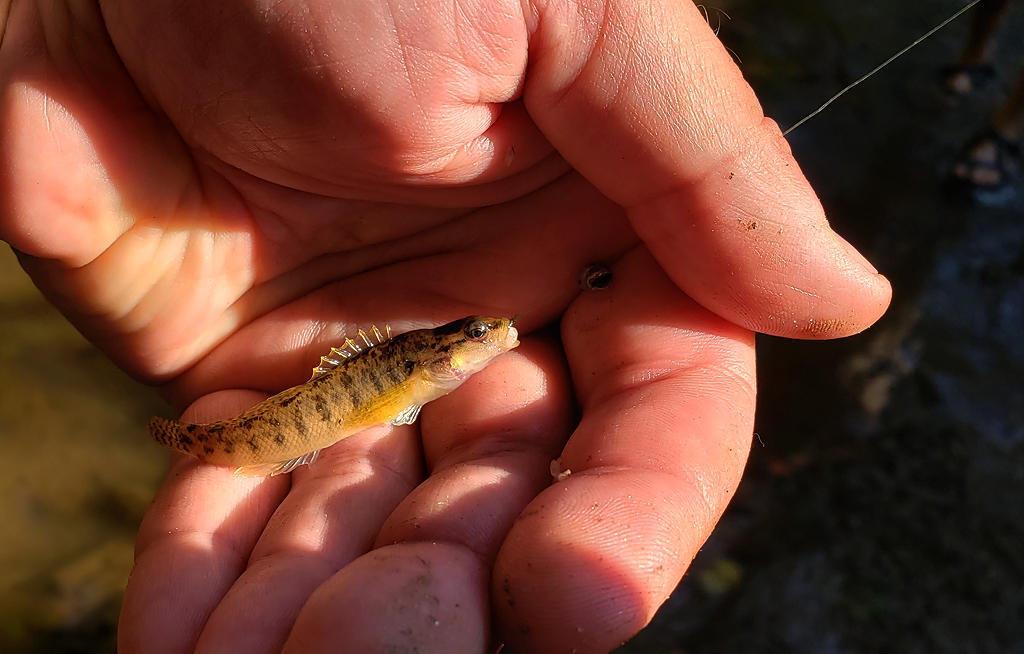
The snail darter, pictured above, is a small freshwater ray-finned fish, found in East Tennessee freshwater in the United States and in small portions of northern Alabama and Georgia. The snail darter was listed as endangered under the U.S. Endangered Species Act of 1973 in 1975. Construction of the Tellico Dam in Tennessee was held up for more than two years as biologists and activists fought to protect its only known habitat, the free-flowing Little Tennessee River. Those of us old enough to remember that controversy know that for many people the effort to save the snail darter was a silly and wasteful impediment to progress. The dam promised a much needed source of energy at a time when, due to the middle eastern oil embargo, the price of fossil fuel was going through the roof. The vast majority of Americans had never even heard of the snail darter. Between two and three inches long, it was not a particularly interesting or exquisite specimen. It had no commercial value and did not occupy a non-replaceable link in the food chain. Thus, for many of us, it seemed as though the world would be no worse off for the snail darter’s extinction.
The psalmist takes a different view. Though the author of our psalm for Pentecost was obviously unfamiliar with the snail darter, the psalmist would doubtlessly have recognized it as one of God’s “manifold” creatures made in God’s wisdom and in which God delights. As such, it has value, dignity and a place in the earth’s biosphere deserving protection and respect. As the caretakers of God’s good earth, it is our duty to ensure the wellbeing of all creatures, regardless their commercial value. We are not entitled to erase a unique species for no better reason than profit. Whether or not it affects the stock market, corporate profitability or industrial development, the extinction of a species impoverishes the earth by forever reducing its wonderful variety of divinely created life forms. To cause or allow extinction is therefore an afront to our Creator and shows profound disrespect for God’s creative genius.
Since the snail darter controversy, we have come to appreciate even more the importance of biodiversity, preservation of habitats and the complex threads of interrelatedness between living creatures, including humans. Biologists are now warning us that by driving our fellow creatures to the edge of extinction, we might well be engineering our own. A number of researchers today are convinced that it is actually humanity’s destruction of biodiversity that creates the conditions for new viruses and diseases such as Covid-19. See “‘Tip of the iceberg’: is our destruction of nature responsible for Covid-19?” The Guardian, March 18, 2020. “We invade tropical forests and other wild landscapes, which harbor so many species of animals and plants – and within those creatures, so many unknown viruses,” David Quammen, author of Spillover: Animal Infections and the Next Pandemic, recently wrote in the New York Times. “We cut the trees; we kill the animals or cage them and send them to markets. We disrupt ecosystems, and we shake viruses loose from their natural hosts. When that happens, they need a new host. Often, we are it.” Ibid.
As the psalmist points out, the biosphere is balanced in such a way as to ensure wholeness for all species.
You make springs gush forth in the valleys;
they flow between the hills,
giving drink to every wild animal;
the wild asses quench their thirst.
By the streams the birds of the air have their habitation;
they sing among the branches.
From your lofty abode you water the mountains;
the earth is satisfied with the fruit of your work.
You cause the grass to grow for the cattle
and plants for people to cultivate,
to bring forth food from the earth
and wine to gladden the human heart,
oil to make the face shine
and bread to strengthen the human heart.
The trees of the field are watered abundantly,
the cedars of Lebanon that he planted.
In them the birds build their nests;
the stork has its home in the fir trees.
The high mountains are for the wild goats;
the rocks are a refuge for the coneys.
You have made the moon to mark the seasons;
the sun knows its time for setting.
You make darkness, and it is night,
when all the animals of the forest come creeping out.
The young lions roar for their prey,
seeking their food from God.
When the sun rises, they withdraw
and lie down in their dens.
People go out to their work
and to their labor until the evening. Psalm 104:10-23.
The psalmist puts the lie to capitalism’s religion of ecological rape that views the earth as a lifeless ball of resources to be exploited for profit by whomever gets their hands on them first. The worth of a living thing is not measured by its marketability or usefulness to human society. God’s command to rule over the earth is not a license to “take her and rape her” as conservative commentator Ann Coulter famously asserted.[1] Human life is to be lived within the matrix of the biosphere, not above it. God charged Adam and Eve to tend the garden, not exploit it. The earth itself is a living creature, not a dead, soulless rock to be mined.
As I did last year at Pentecost, so this year I would encourage all preachers to consider focusing on this psalm and all that it has to say about the earth, its creatures, the wounds inflicted upon it by its human creatures and the lifegiving Spirit of God that continues to renew, refresh and revive it. I would encourage prayer for the healing of this wounded earth, the protection of its most vulnerable species and the work of biologists, climatologists, engineers and medical experts working to lead us to a more sustainable way of life on this planet.
Here is a poem by Dave Smith about the destructiveness humans inflict upon the earth with a flicker of resilience and hope in the form of a fish.
The Purpose of the Chesapeake & Ohio Canal
Thick now with sludge from the years of suburbs, with toys
fenders, wine bottles, tampons, skeletons of possums, and
edged by blankets of leaves, jellied wrappers unshakably
stuck to the scrub pines that somehow lift themselves
from the mossed wall of blockstone headlined a hundred
years back, this water is bruised as a shoe at Goodwill.
Its brown goes nowhere, neither does it remain, and elms
bend over its heavy back like the patient fans, dreamlessly.
This is the death of hope’s commerce, the death of cities
blank as winter light, the death of people who are gone
erratic and hopeless as summer’s glittering water-skimmers.
Yet the two climbing that path like a single draft horse
saw the heart of the water break open only minutes ago,
and the rainbow trout walked its tail as if the evening
arranged an offering in an unimaginable room where plans
inched ahead for the people, as if the trout always meant
to hang from that chain, to be borne through the last shades
like a lure sent carefully, deviously in the blue ache of
air thickening in still streets and between brown walls.
Source: Poetry, September 1983. Dave Smith (b. 1942) is an American poet. He holds BA, MA, and PhD degrees in English from the University of Virginia, Southern Illinois University, and Ohio University, respectively. He has authored more than a dozen volumes of poetry and has also published works of prose and edited literary collections. Smith has taught literature and creative writing at the University of Utah, the University of Florida, Virginia Commonwealth University, Louisiana State University and Johns Hopkins University. Formerly editor of The Southern Review, Smith now serves as editor of the Southern Messenger Poets series from Louisiana State University Press. He is an elected member of the Fellowship of Southern Writers and a frequent Sewanee Writers’ Conference faculty member. You can read more about Dave Smith and sample more of his poetry at the Poetry Foundation Website.
[1] “Ann Coulter has fallen from grace — and the reason why is terrifying,” Salon, June 29, 1915. A great deal of mischief has been unleashed by the misinterpretation of a single verse in the first chapter of Genesis in which human beings are commanded to “fill the earth and subdue it.” That one passage has been lifted out of context to justify wholesale rape of the environment by commercial entities for profit and a tragic indifference to the natural world by Christians convinced that God will rapture the righteous out of this world and leave it for the devil to wreak a ruinous “tribulation” upon it. We need to understand that the Hebrew word “CABASH” translated in Genesis 1:28 as “subdue” is the same word employed in God’s command for Israel to subdue the land of Canaan. Numbers 32:22; Numbers 32:29; Joshua 18:1. The subjugation of the land meant more than merely driving out Israel’s enemies. Very specific commands were given to Israel directing the people to care for the land and its non-human inhabitants. For example, trees were to be spared from the ravages of war. Deuteronomy 20:19-20. Egg producing birds were to be spared from slaughter. Deuteronomy 22:6-7. The sabbath rest mandated for all human beings, from king to servant, extended also to animals. Exodus 23:12. Moreover, the land itself was to be given a year’s sabbath rest from cultivation every seven years. Exodus 23:10-11. God was worshiped not only as the provider for human beings, but for all living creatures. Psalm 104:10-23. The Bible is big on ecology. In fact, insofar as the New Testament declares that God’s goal for the universe is the reconciliation of the world in Christ (II Corinthians 5:19), you could say that the Bible is all about ecology.
 Peter's Outer Cape Portico