Monthly Archives: January 2026

DHS Secretary Kristi Noem Recruits from Iranian Republican Guard for ICE

Kierkegaard’s Ghost

(News that’s fake, but credible)

The Ghost recently learned that Kristi Noem, Homeland Security Secretary is recruiting members of the Iranian Republican Guard for positions at ICE. The following draft promotional ad was obtained by us from an unnamed source who wishes to remain anonymous.

Attention members of the Iranian Republican Guard:

We have watched with admiration how thoroughly and efficiently you managed to put down the violent, left wing, radical enemies from within attacking your own country. As you probably know, we have a similar problem in many parts of our own country, particularly in Minnesota. We are calling upon you at this time because our Immigration Customs and Enforcement (ICE) needs men with your training, commitment and expertise. We are looking for men who are not afraid to use their guns. We are looking for unsentimental guardians of law and order, men who have the steely resolve to shoot the mother of six year old child in the face, to shoot an unarmed man in the back as he lies face down on the street, to look into the face of a trusting little puppy and blow its sweet little brains out. We need men who are free from the vices of empathy, ethics and pity. If you are one of those men, there is a future for you at ICE. In addition to a good salary, full benefits and a $50,000 sign on bonus, we can arrange payment for your travel to the United States and a fast track path to citizenship. So what are you waiting for? Call us today and begin your new life in the land of opportunity!

Kristi Noem, Homeland Security Secretary

**************************************************************

FAKE NEWS ALERT: The above article is satirical. The events it describes didn’t happen.  “There are people who will say that this whole account is a lie, but a thing isn’t necessarily a lie even if it didn’t necessarily happen.” John Steinbeck

The Making of a Trustworthy Conscience

FOURTH SUNDAY AFTER EPIPHANY

Micah 6:1-8

Psalm 15

1 Corinthians 1:18-31

Matthew 5:1-12

Prayer of the Day: Holy God, you confound the world’s wisdom in giving your kingdom to the lowly and the pure in heart. Give us such a hunger and thirst for justice, and perseverance in striving for peace, that in our words and deeds the world may see the life of your Son, Jesus Christ, our Savior and Lord.

“[God] has told you, O mortal, what is good,
    and what does the Lord require of you
but to do justice and to love kindness
    and to walk humbly with your God?” Micah 6:8.

It’s not rocket science. God does not need sacrificial slaughters, well choreographed liturgies, glamorous praise bands accompanied by hundred voice choirs. God does not need anything from us, thanks just the same. Our neighbors, however, do have many needs and that is where God would have us direct our attention. If you want to serve God, feed the hungry, clothe the naked, visit the prisoner, welcome the alien (legal or illegal, God makes no distinction and neither should we), care for the sick and defend the poor from oppression. Love God by loving your neighbor. That’s the law and the prophets, says Jesus. Matthew 22:34-40.

But that is not as simple as it might seem. While it is true that the biblical understanding of love is grounded in deeds rather than mere sentiment, it is also true that there is an affectional engine that drives love toward action, a “hunger and thirst for righteousness,” a love for God’s promised reign and a longing for the day when God’s “will is done on earth as in heaven.” Saint Augustine, Bishop of Hippo, teaches us however that love frequently goes off the rails. He maintains, rightly I think, that love drives both righteousness and sin. Our problem is that our love is disordered. Instead of being orientated toward the God who directs God’s own self-giving through us and to our neighbor, we love first what is not God, the creature rather than the creator or, in other words, an idol. According to Augustine, an idol is often not evil in and of itself. Familial love, love of one’s homeland, and love of one’s profession are all well and good, provided they are subject to one’s primary love toward God. When any one of these loves displaces love that must be directed to God alone, it becomes distorted. Love of spouse and family becomes possessive and controlling. Love of country degenerates into nationalism. Work becomes obsessive, burdensome and exploitive. Misdirected love distorts our sense of right and wrong and disorients our consciences.

Love, like faith and hope, is a habit of the heart. It is not something we are born with. Love is learned through practices of the communities in which we live. Our consciences are formed through teachings and examples absorbed through the institutions of government, education and religion. As these institutions are broken and misdirected, so are the consciences formed therein. In Mark Twain’s classic, The Adventures of Huckleberry Finn,[1] protagonist Huck Finn experiences a crisis of conscience illustrating the point. For those few who might not be familiar with the book, it narrates the story of Jim, an enslaved man living in the pre-bellum south, seeking to escape to the north and gain his freedom with the assistance of an orphaned boy, Huckleberry Finn. As the two draw nearer to Ohio and Jim’s hope for freedom seems within reach at last, Huck begins to experience profound guilt for his involvement with Jim. His conscience, shaped as it is by the culture of the southern slave states, cannot abide aiding and abetting a runaway slave. Huck regrets facilitating Jim’s escape from his enslaver, a widow of whom he says, “she tried to be good to [me] every which way she knowed how.” He says, “I got to feeling so mean and miserable I must have wished I was dead.” From his perspective, helping Jim escape from his enslaver constituted theft.

Caught between the promise of loyalty and friendship he made to Jim and the morality inculcated by the community in which he was raised, Huck nearly succumbs to the societal moral imperative demanding that he betray Jim. But the thought of breaking his word and violating his friendship to Jim seems equally appalling, even though Huck lacks the conceptual tools for justifying such fidelity. In the end, Huck abandons his intent to inform on Jim. He concludes, “what’s the use you learning to do right when it’s troublesome to do right and ain’t no trouble to do wrong, and the wages is just the same?” He decides that a conscience is unhelpful and bothersome and that henceforth he would “always do whichever came handiest at the time.” If there is a moral here, it is that a conscience is only as reliable as the morality of the community in which it is formed.[2] Though he does not put it in such terms, Huck’s conscience has been stretched in a new direction through his friendship with Jim and his participation in his quest for freedom.

In his book, Desiring the Kingdom,[3] professor of philosophy James K. Smith reminds us that we are and act in accordance with what we love. The question, then, is “what sort of community shapes and directs our love?” Or, to put it another way, what sort of community shapes our consciences?” There are plenty of communities of which we are part and which shape our desires, our moral values and our priorities. There are numerous liturgies in which we participate that shape our characters for better or worse. Take, for example, the community formed by the Superbowl. Thousands will gather on February 8th to watch the Seattle Seahawks square off against the New England Patriots.[4] Millions more will be watching remotely. This community assembled for Superbowl will witness a military show of force, rise to salute the flag and join in the singing of the national anthem, the teams will take the field to roars of applause and there will be a spectacular“half time” show. Oh, and did I mention that there will be a football game?

Another example of communal liturgy shows itself in national political conventions, the purpose of which is ostensibly to nominate a presidential candidate. Such conventions have all the hallmarks of a religious rite. The nomination is usually a done deal and the convention merely a celebration and proclamation of the party’s candidate and agenda. Still, the symbolic and persuasive power of the accompanying patriotic speeches, entertainment and formal nomination ceremony cannot be denied. Both these communities and their “liturgies” reflect and reinforce values, convictions and cultural assumptions. I am not suggesting that being a football fan or a member of a political party is necessarily idolatrous. I do believe, however, that our participation in their liturgies and practices is capable of influencing us in ways we might not even recognize. Thus, it is important that one be mindful of the communities of which one is a part and aware of the truth claims, explicit and implicit, that they are making.

The liturgies and practices of that community called church are grounded in Jesus’ obedient life, faithful death and glorious resurrection. Just as Huck Finn’s conscience was transformed through his relationship with Jim and his quest for freedom, so the consciences of Jesus’ disciples are formed by their relationship with him mediated by the worship and practices of the communion of saints. This is the context in which the Sermon on the Mount must be understood. It does not represent an aspirational morality for which humans must strive, but can never hope to realize in the world as it is. Rather, the sermon lays out the blueprint for the life Jesus actually lived in the world as we know it. It is also the life into which Jesus invites us to join him, a life that necessarily takes the shape of the cross in a world hostile to it. Consciences formed in the community of Jesus know better than to fall for quasi religious ideologies such as our nation’s gun fetish, American exceptionalism, capitalism, white supremacy and the numerous conspiracy theories that seek to give them credibility.

Our consciences and our beliefs about morality are not usually matters of choice. As I noted before, we are shaped by the communities in which we live. We can, however, be intentional about the communities by which we choose to be shaped. We can decide how much or our lives are spent on social media with various interest groups, how much time we give to watching news media, which media we watch and how much attention we give to “influencers” of various stripes. We can be intentional about the depth of our involvement with our church, its ministries and our fellow disciples. While we might be involved with communities other than church, we can be attentive to the ways in which their practices share an affinity to the church’s witness to Jesus and the reign of God he proclaims and critical of any claims, assumptions and practices contrary to that witness. A conscience painstakingly shaped by such discipleship is positioned to “do justice and to love kindness and to walk humbly with [] God.”

Here is a poem by Jan Richardson addressed to disciples formed by Jesus who “bear the light,” reminiscent of Jesus remark in the Sermon on the Mount that his followers are “the light of the world.” Matthew 5:14. They are the ones in whom “the brightness blazes.”

Blessed Are You Who Bear the Light

Blessed are you

who bear the light

in unbearable times,

who testify

to its endurance

amid the unendurable,

who bear witness

to its persistence

when everything seems

in shadow

and grief.

Blessed are you

in whom

the light lives,

in whom

the brightness blazes-

your heart

a chapel,

an altar where

in the deepest night

can be seen

the fire that

shines forth in you

in unaccountable faith,

in stubborn hope,

in love that illuminates

every broken thing

it finds.

Source: Circle of Grace, (c.  2015 by Jan Richardson; pub. by Wanton Gospeller Press) pp. 47-48. Jan Richardson is an artist, writer, and ordained minister in the United Methodist Church. She grew up in Evanston, a small community outside of Gainesville, Florida. She is currently director of The Wellspring Studio and serves as a retreat leader and conference speaker. In addition to the above cited work, her books include The Cure for SorrowCircle of Grace, A Book of Blessings for the Seasons, In the Sanctuary of Women, and Sparrow: A Book of Life and Death and Life. You can learn more about Jan Richardson and her work on her website.


[1] The Adventures of Huckleberry Finn, by Samuel Clemens, aka Mark Twain (New York Post Family Classics Library, c. Paperview).

[2] I note with some trepidation that the author’s notice prior to chapter one reads in pertinent part, “persons attempting to find a moral in [this narrative] will be banished.”

[3] Desiring the Kingdom, by James K. Smith, (c. 2009 by James K. Smith; pub by Baker Publishing Group)

[4] Full disclosure. I have an interest in this upcoming contest, two actually. As a kid raised in the shadow of Seattle, I have always backed the Seahawks. Nevertheless, as a citizen of the Commonwealth of Massachusetts, I feel a certain affinity for the Patriots as well. I actually do have a preference-which I am not inclined to disclose. Whatever the outcome, I will at least have the satisfaction of being able to say that my team won.

The Kingdom and the Church

THIRD SUNDAY AFTER EPIPHANY

Isaiah 9:1-4

Psalm 27:1, 4-9

1 Corinthians 1:10-18

Matthew 4:12-23

Prayer of the Day: Lord God, your lovingkindness always goes before us and follows after us. Summon us into your light, and direct our steps in the ways of goodness that come through the cross of your Son, Jesus Christ, our Savior and Lord.

From that time Jesus began to proclaim, “Repent, for the kingdom of heaven has come near.” Matthew 4:17.

“As he walked by the Sea of Galilee, he saw two brothers, Simon, who is called Peter, and Andrew his brother, casting a net into the sea—for they were fishers. And he said to them, “Follow me, and I will make you fishers of people.” Immediately they left their nets and followed him. As he went from there, he saw two other brothers, James son of Zebedee and his brother John, in the boat with their father Zebedee, mending their nets, and he called them. Immediately they left the boat and their father and followed him.” Matthew 4:18-22.

Alfred Loisy, French biblical scholar, linguist, philosopher and a founder of the modernist movement within the Roman Catholic Church is credited with saying that “Jesus proclaimed the Kingdom of God and what came was the church.” In his view, as in the view of many other modernist scholars since, the church was an unintended consequence of the historical Jesus’ prophetic ministry and preaching. In its creeds, theology and various institutional forms, the established church represents a betrayal of Jesus’ insistence upon the nearness of God’s impending reign that promises to transform human existence.

I have in previous articles expressed my views on the futility of chasing the so-called “historical Jesus” supposedly lurking behind the New Testament witness. I am far from the only one to have observed that the Jesus such people find turns out to be remarkably amenable to their own social, religious and political preferences. In my view, the only Jesus we have is the one to whom the New Testament witnesses in all of its textual messiness, theological diversity and cultural bias. Do these diverse voices witnessing to Jesus in this remarkable document nevertheless faithfully portray a coherent testimony to him as God’s Son and the world’s savior? That is a question neither historical criticism nor any other hermeneutical method can resolve. We are left with the Apostle Philip’s invitation to Nathaniel: “Come and see.”

While Jesus is no doubt dismayed with much of what the church is today, I do not believe it can be said from the perspective of the New Testament witness that the church was a mistake or unintended. In Sunday’s gospel, Jesus begins his ministry by announcing the nearness of God’s reign. In the very next breath the evangelist Matthew narrates the call of the first disciples. The church, albeit in embryonic form, and the kingdom are together from the beginning. They remain so throughout the gospel narrative. Sometimes the church is manifest in the work of the twelve, the faithful women who supported them and nameless others who followed Jesus throughout his ministry. Sometimes it is glanced fleetingly as in the people touched, instructed and healed by Jesus whose identity and destiny we never learn. Sometimes the church is found lurking on the sidelines in people like Nicodemus and Joseph of Arimathea who will not openly identify with Jesus, but show up unexpectedly for Jesus when his own closest disciples have abandoned him.

The New Testament reflects a church whose borders are porous. That comports with my experience of church. In every church to which I have belonged, there was a faithful core of disciples who were always present to assist a family coming to the sanctuary with needs for food, clothing or heating bills. If the discretionary fund was exhausted, they reached into their own wallets. They were the first to volunteer for every church ministry and event and the last to leave after the cleanup was done and the lights turned off. There were folks who worshipped regularly, contributed modestly but seldom, if ever, showed up at any other time. There were people who attended sporadically, never contributed significantly and disappeared for months at a time. But they returned often enough for us to know them by name and understand a little bit about their circumstances. There were folks who showed up only on Easter and Christmas. Finally, there were people who never showed up until someone needed to be baptized, married or buried. Yet even these folks had a sense that this church was “theirs” in some attenuated way. All of them belonged to our part of Christ’s Body in some sense.

I think the church has always been uncomfortable with its “open border” policies. Throughout the church’s history, there have been movements with leaders intent on closing the borders, drawing clear lines between the church and the world, the righteous and the sinners, the saved and the damned. The church, they argue, is to be counter-cultural, formed by thick practices and the teachings of apostles and prophets. Church is the furnace in which a new way to be human is forged. It is to be a community that operates as a “demonstration plot” for the reign of God, as Clarance Jordan once observed. I agree wholeheartedly with Jordan on this point. I would add, however, that the chief characteristic of God’s reign is inclusivity and hospitality. Those same attributes must also be present in the church. What distinguishes the church from a cult is its openness. Anyone can come in off the street and into our worship services. There is no secret initiation rite. Baptism, holy communion and confirmation are all public events. There are no secret esoteric teachings known only to the inner circle. What we believe is set forth in creeds that are confessed publicly at our public worship services. What you see is what you get.   

It is important to point out that there never was a “golden age” of the church. The New Testament does bear witness to great acts of faithfulness and courage by the church and its leaders. That, however, is far from the whole story. In the gospels, Jesus’ disciples consistently misunderstand him and the reign of God he proclaims. They argue and quarrel over which of them is the most important. They show a nasty intolerance for small children, Samaritans and foreigners they regard as unworthy or simply not important enough for Jesus’ attention. One of them betrays Jesus, all of them desert Jesus in his time of greatest need and the one he considered his “rock” denied knowing him when the pressure was on. The Book of Acts is rife with ethnic tensions, disputes over doctrine and practice as well as personality conflicts. Saint Paul’s letters to the various churches he founded and served demonstrate that these communities, too, fought over money, power and ecclesiastical order. In short, the first century church looks very much like the church of the twenty-first century. It was a mixed bag then as it is now.

The church is not the reign of God, but only its less than perfect witness. Confession of sin is a central part of Christian worship and a reminder that disciples are no less in need of God’s redemptive love than the rest of the world. The diversity and inclusiveness confessed for the “one, holy, catholic and apostolic church” is frequently more aspirational than real. But aspirations are important. If a student’s aspiration for achieving an A in physics results in receiving a B instead of a C, the student’s efforts were not in vain. The reign of God is revealed in the lives of those who believe in it, love it and live for it. Though painfully aware that their lives do not measure up to the new humanity revealed in their Lord, they nevertheless discover at times that they are capable of doing more and being more than they ever imagined they could do or be. Like John the Baptist, the church is not the savior of the world or the reign of God. Yet, again, like John, it is always pointing beyond itself to the one who is the savior of the world and who announces the nearness of God’s reign. In their flawed witness, the world sometimes gets a glimpse of what God has in store for it.

Here is a poem about the church’s imperfect but precious witness to God’s reign.

Prayer at the Closing of a Church

Good and gracious God,

this church-like our town-

is all used up.

There’s not enough of us

to keep the doors open.

So this little church

will join the row

of locked doors

and boarded up windows

that now line this street.

We didn’t do much

that is outstanding

over the last century.

There were no martyrs

among us, no heroes

of faith who gave all

for the sake of the gospel.

But we had Martha Bertrand

who taught Sunday school

for fifty years plus.

Her classes didn’t produce

Pastors or missionaries.

But she kissed away

a lot of bruises,

bandaged a lot of skinned knees

and once spent the whole

night with a former pupil,

by then a college freshman,

who arrived at her house

at some ungodly hour

looking desperately

for a reason not to end his life.

He didn’t.

We had several pastors,

None of them orators,

None of them church builders,

None of them well known

figures in the community.

But they were there

when a loved one died,

when a family was in crisis,

when anyone was at wit’s end

and had nowhere else to turn.

They baptized, married and

buried us with love

and the same old shopworn

but still comforting scriptures,

hymns and words of consolation.

We didn’t do much

to end the scourges

of hunger and homelessness

in our community.

But we took our turn

housing the homeless

each month in our basement,

giving them a home cooked meal

shared with us around a table,

because these people

deserved more than

a roof over their head.

They deserved a home

and we tried to give them

as much a home

as we could provide

in a church basement.

We cared for Arnie,

a schizophrenic kid

with a criminal record,

who never darkened the door

of the sanctuary

but showed up for every potluck.

When he stole Mrs. Higgins’ purse

we didn’t call the cops.

The pastor just paid a visit

to his group home

and asked him to return it-

which he did, asking with tears

that we forgive him.

We did.

We loved each other

As best we could-

Which often wasn’t very good.

We lived for Jesus, or tried.

But too often, his image was lost

in our concerns over finances,

the right way to worship,

fixing the boiler,

painting the restrooms

and in fights over who controls what.

But sometimes, we got Jesus right.

Sometimes, we met the challenge.

Sometimes we found ourselves

being better than we thought

we could be.

When that happened,

it was beautiful.

So as we retire

this old clay vessel,

we offer up these moments

as our final sacrifice of praise

in hopes that they have moved

the world just a little closer

to the day when your kingdom comes

and your will is done

on earth as it is in heaven.

Source: Anonymous      

The Power of the Beast and the Way of the Lamb

SECOND SUNDAY AFTER EPIPHANY

Isaiah 49:1-7

Psalm 40:1-11

1 Corinthians 1:1-9

John 1:29-42

Prayer of the Day: Holy God, our strength and our redeemer, by your Spirit hold us forever, that through your grace we may worship you and faithfully serve you, follow you and joyfully find you, through Jesus Christ, our Savior and Lord.

The next day he saw Jesus coming toward him and declared, “Here is the Lamb of God who takes away the sin of the world!” John 1:29.

“We live in a world in which you can talk all you want about international niceties and everything else, but we live in a world, in the real world, that is governed by strength, that is governed by force, that is governed by power. These are the iron laws of the world that have existed since the beginning of time.” -Stephen Miller, Whitehouse Deputy Chief of Staff.

“Political power grows out of the barrel of a gun.” -Mao Zedong, founder and former leader of the Chinese Communist Party.

“Those who beat their swords into plowshares usually end up plowing for those who kept their swords.” -Benjamin Franklin

“the only way to stop a bad guy with a gun is with a good guy with a gun.”-Wayne LaPierre, CEO and executive vice president of the National Rifle Association of America.

Stephan Miller, Mau Zedong, Benjamin Franklin and Wayne LaPierre make up a strange collection. Yet they all agree on one point: at the end of the day, power and the willingness to exercise it violently are the keys to survival. Raw power is the “iron law” that has “existed from the beginning of time.” Most near eastern religion contemporary with the Biblical witness would agree. According to the ancient Mesopotamian myth recorded in the Enūma Eliš, the creation of the world evolved out of a battle between gods in which the god, Marduk emerged triumphant. Marduk’s undisputed reign over the lesser gods served as a paradigm for the Babylonian empire’s undisputed dominance of its subjects.

That, however, is not the biblical witness. According to the Book of Genesis, the world comes into existence by the sovereign command of God. There is no struggle or strife involved. So far from being an “iron law” built into the nature of things, violence is a disruption of God’s ordered creation. God responds to the first murder not with retribution but forgiveness and protection from retribution for the murderer. Though God does at times respond forcefully to curb human violence, God’s nature is to be “merciful, slow to anger and abounding in steadfast love.” The depth of that love and the way in which God deals with hostility is nowhere better illustrated than in Jesus who John declares to be “the lamb of God.” The Lamb lays down his life for his friends. He does not resort to violence to defend himself from his enemies and he will not allow his disciples to employ it on his behalf. The just and gentle reign of God Jesus proclaims is worth dying for. Nothing is worth killing for.

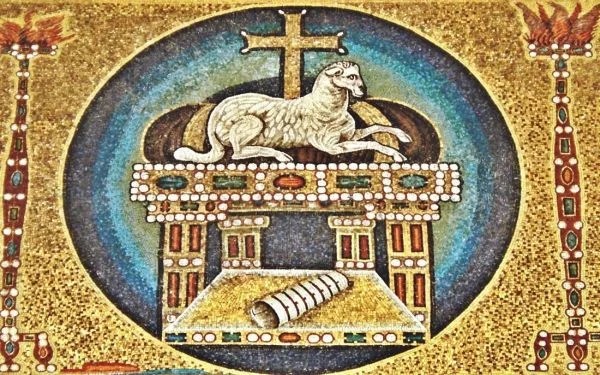
John of Patmos builds on the lamb image in the Book of Revelation where, after receiving a series of messages from an angelic emissary for the churches in Asia Minor, he is carried up to the throne room of the Almighty. There he is presented with a sealed book containing the revelation to be shared with the church. However, no one in heaven, earth or under the earth is mighty enough to break the seal. John is at first dismayed, but then encouraged by the promise that the “Lion of the tribe of Judah, the Root of David, has conquered, so that he can open the scroll and its seven seals.” Revelation 5:5. After this buildup, we might expect a shirtless Rambo to come strutting onto the stage or for John Wayne to come galloping up on a restless steed. But what John sees is “a Lamb standing as if it had been slaughtered….” Revelation 5:6.

As everyone who has read the Book of Revelation knows, the latter chapters are replete with lurid images of fantastic predatory creatures woven together from attributes of lions, bears and leopards. The devil is portrayed as a fearsome dragon. The Roman Empire is likened to a fearsome, multiheaded “beast.” Throughout Revelation, the image of the slaughtered lamb is juxtaposed to the images of “the beast” and the “dragon” whose lethal capabilities a lamb could never match. But that is the whole point. The Lamb’s powers are not lethal. They are lifegiving. The power of the beast, so admired by folks like Stephen Miller, is overrated. Any fool with a gun can kill a person. Only the Lamb of God can raise a person from death to life.

Violence and the ability to inflict it upon others is and always has been deeply ingrained in the American psyche. Through years of education, religious teaching and entertainment media Americans have been programed to believe that this continent was delivered to white settlers by the hand of Providence, that the “settlement” of the land by driving out the indigenous peoples was a brave and noble undertaking, that our nation’s wars were heroic struggles to defend our freedoms and that the stories and experiences of indigenous, African, Chinese, Japanese, Mexican and other nonwhite Americans have no relevance to American history. Indeed, the stories of nonwhite Americans must be expunged from the historical record, particularly when they call into question the myth of American exceptionalism. The power we Americans have been taught to worship, the power we attribute to God, the power we have been led to believe is necessary to keep us safe is the power of the beast, not the power of the Lamb.       

Last week saw numerous threats and acts of raw power. Lethal drone and missile attacks against Ukraine increased even as peace talks are supposedly continuing. Bombing continues in Gaza despite the alleged existence of a ceasefire. Violence has erupted in Iran and, as if this were not enough, our own nation in Hitleresque fashion is threatening to annex Greenland and take over Venezuela and for no better reason than because it can. To top all of this off, a masked gunman under the direction of our government shot to death an unarmed thirty seven year old mother of three just blocks away from where a Minneapolis officer murdered George Floyd in 2020. As her car careened out of control and crashed, the gunman called her an obscenity I will not dignify in print.  

How, then, do disciples of the Lamb live under the reign of the beast? Lately, I have seen any number of signs saying simply “resist.” The obvious meaning is that oppressive measures of our government against immigrants, LGBTQ+ folk and people of color generally should be resisted. It is hard to argue with that. But mere resistance is insufficient. In the first place, allowing oneself to be defined by what one is against is dangerous. It is all too easy to fall into the same violent strategies employed by agents of our government against them, thereby becoming the mirror image of what we hate. More significantly, however, mere resistance says nothing about what one is for. Without the vision of an alternative future based on concrete convictions supported by thick faith practices, resistance frequently fizzles. Discipleship is not about fighting the beast. It is about following the Lamb.

We get some good advice from the opening chapter of Revelation containing the letters dictated to the seven churches of Asia Minor. These churches were living under the dominion of the beast and knew only too well its savagery. The messages to these churches from John do not provide any strategy for defeating the beast. There is no need for that. The beast and its empire will collapse under the weight of their own violence and corruption. Instead, the churches are urged to cling to their faith, remember the good news of God’s reign delivered to them, avoid corruption of their faith through the influences of hateful ideologies, false religion and violent politics that characterize the empire of the beast. They are encouraged to accept suffering and the cross as the shape God’s kingdom must necessarily take in a world dominated by the beast. Most importantly, they are reminded repeatedly that God is faithful and will bring to fruition in God’s own good time the reign of peace and justice for which Jesus lived, died and continues to live. Following the Lamb and witnessing in word and deed to that reign by standing with the marginalized invariably brings one into conflict with the beast. But defeating the beast is not our calling.

Here is a poem by William Stafford expressing the conviction that one “fierce in love to the death,” the primary attribute I would contend of the Lamb, triumphs where “abject anger” can only surrender.

Thought, the Pacifist

While the bullet was coming

out of the gun we saw bird blood

on the gras begin to be

where the quail were going to fall;

and something that used our voice

repented even while something in

our ears caroled quickened breath

before any sound arrived.

Thus disbelieving us while living

in our ears, the fame of the world

contends against judgement;

and fierce in love and death

our thought easily overcomes what

–offering only bullets and blinking—

abject anger only surrenders to.

Source: Poetry, (July 1960). William Edgar Stafford (1914 –1993) was an American poet. Born in Hutchinson, Kansas he was the oldest of three children. During the Depression, the Stafford family moved from town to town in an effort to find work. Stafford helped contribute to the family income by delivering newspapers, working in sugar beet fields, raising vegetables and working as an electrician’s apprentice. He graduated from high school in the town of Liberal, Kansas and received a B.A. from the University of Kansas. He was drafted into the United States armed forces in 1941 while pursuing his master’s degree at the University of Kansas, but registered as a conscientious objector. As such, he performed alternative service in the Civilian Public Service camps consisting of forestry and soil conservation work. During this time, he met and married Dorothy Hope Frantz, with whom he later had four children. When the war ended, Stafford completed work for his MA and went on to earn a Ph.D. His teaching career included positions at Manchester College, Indiana, Lewis and Clark College, Oregon and San Jose State College, California. He was the father of poet and essayist Kim Stafford. In 1970, Stafford was appointed the twentieth Consultant in Poetry to the Library of Congress. You can read more about William Stafford and sample more of his poetry at the Poetry Foundation Website.

Baptismal Epiphany

EPIPHANY OF OUR LORD

Isaiah 60:1-6

Psalm 72:1-7, 10-14

Ephesians 3:1-12

Matthew 2:1-12

Prayer of the Day: Everlasting God, the radiance of all faithful people, you brought the nations to the brightness of your rising. Fill the world with your glory, and show yourself to all the world through him who is the true light and the bright morning star, your Son, Jesus Christ, our Savior and Lord, who lives and reigns with you and the Holy Spirit, one God, now and forever.

BAPTISM OF OUR LORD

Isaiah 42:1-9

Psalm 29

Acts 10:34-43

Matthew 3:13-17

Prayer of the Day: O God our Father, at the baptism of Jesus you proclaimed him your beloved Son and anointed him with the Holy Spirit. Make all who are baptized into Christ faithful to their calling to be our daughters and sons, and empower us all with your Spirit, through Jesus Christ, our Savior and Lord, who lives and reigns with you and the Holy Spirit, one God, now and forever.

“….this grace was given to me to bring to the gentiles the news of the boundless riches of Christ and to make everyone seewhat is the plan of the mystery hidden for ages in[g] God, who created all things, so that through the church the wisdom of God in its rich variety might now be made known to the rulers and authorities in the heavenly places.” Ephesians 3:8-10.

“I truly understand that God shows no partiality, but in every people anyone who fears him and practices righteousness is acceptable to him.” Acts 10:34-35.

“We believe in one holy catholic and apostolic church.

     We acknowledge one baptism for the forgiveness of sins.” Nicene Creed.

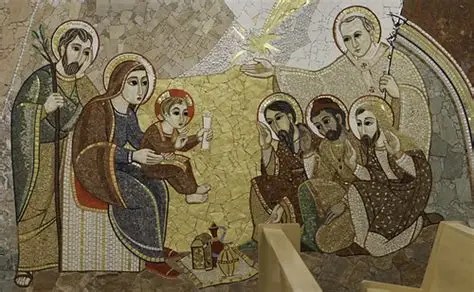
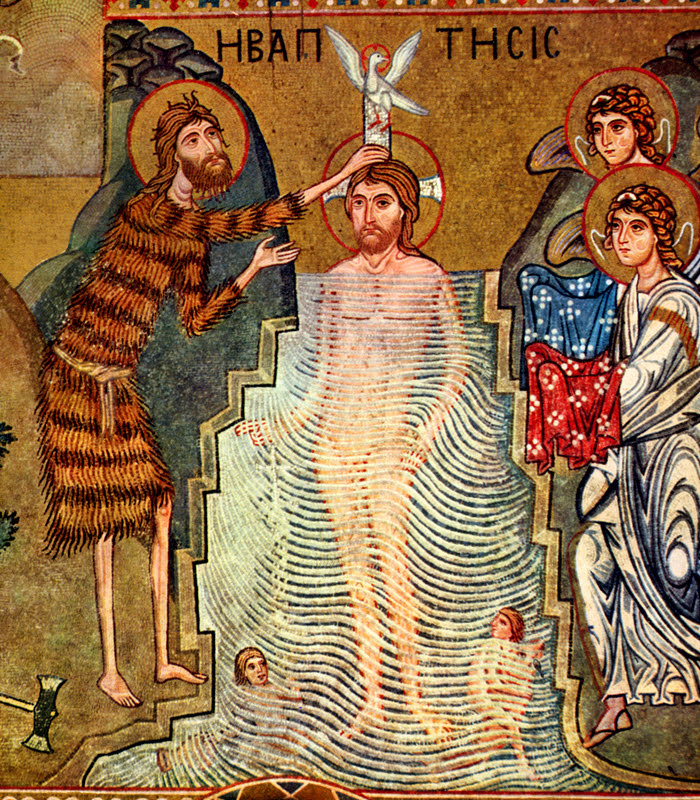
Preachers have three choices for the coming Sunday. We can celebrate the Baptism of our Lord that falls upon Sunday, January 11th, we can bump our observance of the Epiphany of our Lord from January 4th to Sunday or, as I would humbly suggest, we can celebrate both feasts this coming Sunday. Matthew’s gospel has Jesus accepting John’s baptism, thereby identifying with the marginalized outcasts that responded to John’s proclamation of the nearness of God’s reign. Matthew also testifies to the faithful response of the gentile magi to the sign of Jesus’ birth in the heavens. So, too, Saint Paul declares in his letter to the Ephesians how the unity of the church and the diversity of its members witnesses to the unity of all peoples, nations and tongues God desires for the world. This message is of great importance today as it addresses a fundamental misunderstanding of the gospel prominent throughout western Christianity.

As pointed out by New Testament scholar, Pauline theologian and Anglican bishop N.T. Wright, “The problem is that most Western Christians today think that the whole point of Christianity is for our souls to go to Heaven when we die, whereas the New Testament concentrates on God coming to dwell with us.” See interview with the Christian Post, December 1, 2025. In short, the gospel with which many of us, including me, have grown up offers only a life raft to rescue a few faithful souls from a sinking ship. According to the biblical witness, however, God’s intent is to save the ship. Thus, baptism is not to be understood as an individual fire insurance policy for the hereafter, but rebirth into the community that follows Jesus known as church. Furthermore, the church is not to be understood as the singular elevator to heaven outside of which there is no salvation. Rather, the church is the community that witnesses in word and deed to the salvation God offers to the whole world. Just as my baptism is far bigger than just me, so salvation is much bigger than the church.

Unlike the paltry salvation that preserves only a ghostly, immaterial and invisible soul, the salvation Jesus proclaims embraces all of creation, its air, water and mud; every creature that mucks about in it; every plant that springs from its soil; and, yes, every human being made in God’s image-however distorted that image may have become. Like the motto of the United States Marines, “nobody gets ‘left behind.’” In the biblical view of salvation, the world, its oceans, rivers, fields and forests are not merely temporary staging for God’s dealing with humanity. They are the objects of God’s redemptive love no less than the human beings charged with its care. The future holds not merely a haven for disembodied souls, but a new heaven and a new earth in which God’s good and gracious will is done.

The scriptures for Epiphany and the Baptism of Jesus testify to the physicality of God, which is another way to speak of the Incarnation. It was a star that led the pagan magi to Jesus, whereas the bible jocks in Jerusalem are caught completely off guard by his coming. The Spirit proclaims Jesus’ sonship in the muddy waters of the Jordan River. The scandal of the gospel, a stumbling block for so many (including Christians!), is that God has a body. When Saint Paul says to the doctrinally confused, morally compromised and deeply divided church at Corinth, “now you are the body of Christ,” he is not speaking metaphorically. The church, for all of its flaws, failures and sins, is nonetheless Christ’s body. It is through the church that God means to demonstrate God’s will for all creation. For that reason, it is critically important that the church both be and testify to the diversity, equity and inclusion that are the salvation of the world, so that “through the church the wisdom of God in its rich variety might now be made known….”

We need to be clear that it is not God’s intent to rapture a few disembodied souls to heaven and leave God’s beautiful world to the ravaging violence of some antichrist. Too many believers are caught up in just such misguided beliefs. We need to be clear that believers confess the resurrection of the body, not the immortality of the soul. To be honest, I am not even sure there is such a thing as a soul, if by that one means the survival of some part of the self following death. I am quite sure I will not survive my own death. That’s OK with me. I have no desire to continue on as a disembodied ghost. Thankfully, God promises much more. God has pledged to me in baptism that God’s love for me will survive my demise. What I do believe is that God is bringing all of creation to an end in God’s self where God will be “all in all.” Jesus’ resurrection is, among other things, God’s pledge that there is a place for me in that “life of the world to come,” along with birds of the air, fish of the sea, beasts of the forest, the mountains, valleys, oceans, lakes, rivers, a new humanity and, of course, the communion of saints.

Here is a poem by the nonbinary poet, K. Iver. Though highly critical of the church and its exclusion of gay, lesbian and non-binary folk, the poem takes seriously the humanity of God and addresses God directly through the “Body of Christ.” In a strange and perhaps unintentional way, Iver testifies to the physicality of God through the miracle of the Incarnation. The poem also illustrates the toxicity of the kind of Christian teaching against which N.T. Wright warns us. 

god

So we, being many, are one body in Christ,
and every one members one of another.
ROMANS 12:5

And if thy right hand offend thee, cut it off,
and cast it from thee.
MATTHEW 5:30

At my beloved’s burial,

I can’t see his body.

Only carnations. I hear

your name and my beloved’s

in the same sentence

I didn’t come to meet you

whose men are everywhere,

calling themselves your body

singing about their own

beautiful blood which I’ve never

seen but am willing to bet isn’t

as beautiful as my beloved’s

jacket, full of his skin cells

and waiting to reincarnate

from a Goodwill medium rack.

In the room of my beloved’s

body, no pictures. Only

carnations. They spill over

his box like misplaced grief.

Underneath them he dances

with strangers at a gay bar

two hours from town.

Unbuttons his uniform

in a desert barrack an ocean

from town. Leans on his red

Bronco smoking through relief

in the middle of town where

too many exes are watching

the club door. Lord,

in the room of my beloved’s

body, your men won’t admit

the fact of his body.

In the foyer, one room away,

a decade-old portrait of him

in pearls and a black dress,

his expression proof

your goodness doesn’t extend

where it counts, the stories

I hear about my beloved

as mistaken as your miracles.

Lord, when I loved you,

I didn’t know

so many of your men

would exile so many of us.

When I was ten, I wrote

volumes of letters addressed

Lord and warned classmates

about the rapture and called

televangelist hotlines for assurance

the devil’s lava wasn’t waiting

beneath sleep. Later,

my beloved took your side

in debates about your existence.

If he was right, you owe

him a confession. Tell him

how your body wouldn’t take

your advice, how its right hand

severed an entire demographic.

Look at him, in his new eyes. Say

what you can redeem, and won’t.

Source: Poetry (December 2025). K. Iver was born in Mississippi. They earned their PhD in poetry from Florida State University. Their debut collection Short Film Starring My Beloved’s Red Bronco (Milkweed Editions, 2023) won the 2022 Ballard Spahr Prize for Poetry, selected and was a finalist for the Los Angeles Times Book Award, the Kate Tufts Discovery Award, and the Lambda Literary Award for Transgender Poetry. The collection was also named a Best Book of 2023 by the New York Public Library. Iver’s poems have appeared in Boston ReviewKenyon ReviewLos Angeles Review of Books. They have received fellowships from the Wisconsin Institute for Creative Writing, the Sewanee Writers’ Conference, and the Helene Wurlitzer Foundation of New Mexico.

Iver is currently the Roger F. Murray Chair in Creative Writing at Phillips Academy in Andover, Massachusetts.