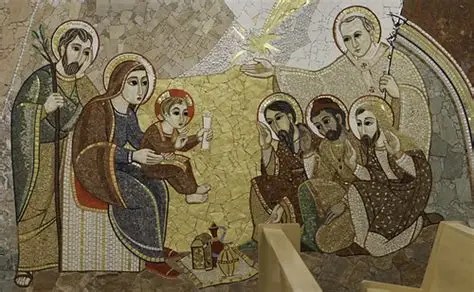
EPIPHANY OF OUR LORD
Prayer of the Day: Everlasting God, the radiance of all faithful people, you brought the nations to the brightness of your rising. Fill the world with your glory, and show yourself to all the world through him who is the true light and the bright morning star, your Son, Jesus Christ, our Savior and Lord, who lives and reigns with you and the Holy Spirit, one God, now and forever.
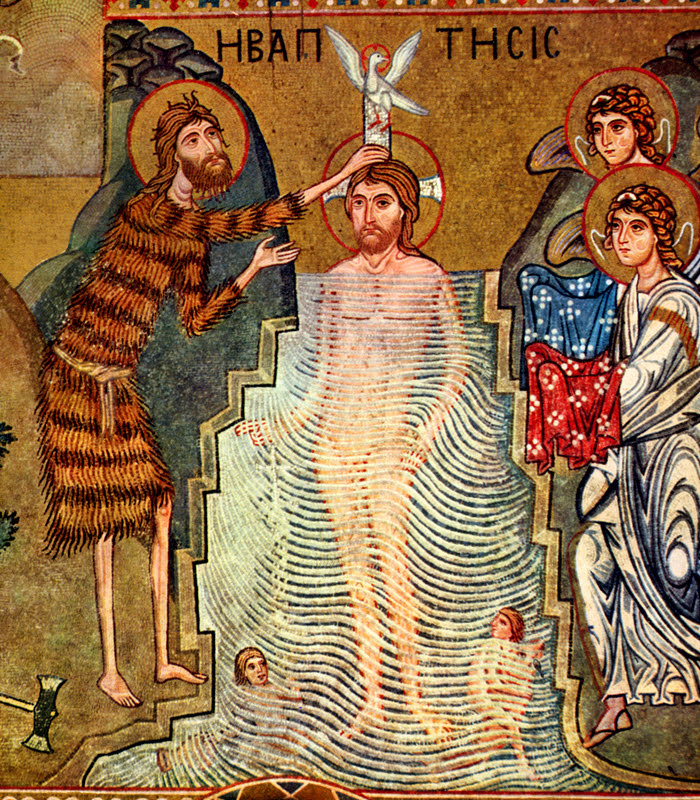
BAPTISM OF OUR LORD
Prayer of the Day: O God our Father, at the baptism of Jesus you proclaimed him your beloved Son and anointed him with the Holy Spirit. Make all who are baptized into Christ faithful to their calling to be our daughters and sons, and empower us all with your Spirit, through Jesus Christ, our Savior and Lord, who lives and reigns with you and the Holy Spirit, one God, now and forever.
“….this grace was given to me to bring to the gentiles the news of the boundless riches of Christ and to make everyone seewhat is the plan of the mystery hidden for ages in[g] God, who created all things, so that through the church the wisdom of God in its rich variety might now be made known to the rulers and authorities in the heavenly places.” Ephesians 3:8-10.
“I truly understand that God shows no partiality, but in every people anyone who fears him and practices righteousness is acceptable to him.” Acts 10:34-35.
“We believe in one holy catholic and apostolic church.
We acknowledge one baptism for the forgiveness of sins.” Nicene Creed.
Preachers have three choices for the coming Sunday. We can celebrate the Baptism of our Lord that falls upon Sunday, January 11th, we can bump our observance of the Epiphany of our Lord from January 4th to Sunday or, as I would humbly suggest, we can celebrate both feasts this coming Sunday. Matthew’s gospel has Jesus accepting John’s baptism, thereby identifying with the marginalized outcasts that responded to John’s proclamation of the nearness of God’s reign. Matthew also testifies to the faithful response of the gentile magi to the sign of Jesus’ birth in the heavens. So, too, Saint Paul declares in his letter to the Ephesians how the unity of the church and the diversity of its members witnesses to the unity of all peoples, nations and tongues God desires for the world. This message is of great importance today as it addresses a fundamental misunderstanding of the gospel prominent throughout western Christianity.
As pointed out by New Testament scholar, Pauline theologian and Anglican bishop N.T. Wright, “The problem is that most Western Christians today think that the whole point of Christianity is for our souls to go to Heaven when we die, whereas the New Testament concentrates on God coming to dwell with us.” See interview with the Christian Post, December 1, 2025. In short, the gospel with which many of us, including me, have grown up offers only a life raft to rescue a few faithful souls from a sinking ship. According to the biblical witness, however, God’s intent is to save the ship. Thus, baptism is not to be understood as an individual fire insurance policy for the hereafter, but rebirth into the community that follows Jesus known as church. Furthermore, the church is not to be understood as the singular elevator to heaven outside of which there is no salvation. Rather, the church is the community that witnesses in word and deed to the salvation God offers to the whole world. Just as my baptism is far bigger than just me, so salvation is much bigger than the church.
Unlike the paltry salvation that preserves only a ghostly, immaterial and invisible soul, the salvation Jesus proclaims embraces all of creation, its air, water and mud; every creature that mucks about in it; every plant that springs from its soil; and, yes, every human being made in God’s image-however distorted that image may have become. Like the motto of the United States Marines, “nobody gets ‘left behind.’” In the biblical view of salvation, the world, its oceans, rivers, fields and forests are not merely temporary staging for God’s dealing with humanity. They are the objects of God’s redemptive love no less than the human beings charged with its care. The future holds not merely a haven for disembodied souls, but a new heaven and a new earth in which God’s good and gracious will is done.
The scriptures for Epiphany and the Baptism of Jesus testify to the physicality of God, which is another way to speak of the Incarnation. It was a star that led the pagan magi to Jesus, whereas the bible jocks in Jerusalem are caught completely off guard by his coming. The Spirit proclaims Jesus’ sonship in the muddy waters of the Jordan River. The scandal of the gospel, a stumbling block for so many (including Christians!), is that God has a body. When Saint Paul says to the doctrinally confused, morally compromised and deeply divided church at Corinth, “now you are the body of Christ,” he is not speaking metaphorically. The church, for all of its flaws, failures and sins, is nonetheless Christ’s body. It is through the church that God means to demonstrate God’s will for all creation. For that reason, it is critically important that the church both be and testify to the diversity, equity and inclusion that are the salvation of the world, so that “through the church the wisdom of God in its rich variety might now be made known….”
We need to be clear that it is not God’s intent to rapture a few disembodied souls to heaven and leave God’s beautiful world to the ravaging violence of some antichrist. Too many believers are caught up in just such misguided beliefs. We need to be clear that believers confess the resurrection of the body, not the immortality of the soul. To be honest, I am not even sure there is such a thing as a soul, if by that one means the survival of some part of the self following death. I am quite sure I will not survive my own death. That’s OK with me. I have no desire to continue on as a disembodied ghost. Thankfully, God promises much more. God has pledged to me in baptism that God’s love for me will survive my demise. What I do believe is that God is bringing all of creation to an end in God’s self where God will be “all in all.” Jesus’ resurrection is, among other things, God’s pledge that there is a place for me in that “life of the world to come,” along with birds of the air, fish of the sea, beasts of the forest, the mountains, valleys, oceans, lakes, rivers, a new humanity and, of course, the communion of saints.
Here is a poem by the nonbinary poet, K. Iver. Though highly critical of the church and its exclusion of gay, lesbian and non-binary folk, the poem takes seriously the humanity of God and addresses God directly through the “Body of Christ.” In a strange and perhaps unintentional way, Iver testifies to the physicality of God through the miracle of the Incarnation. The poem also illustrates the toxicity of the kind of Christian teaching against which N.T. Wright warns us.
god
So we, being many, are one body in Christ,
and every one members one of another.
ROMANS 12:5
And if thy right hand offend thee, cut it off,
and cast it from thee.
MATTHEW 5:30
At my beloved’s burial,
I can’t see his body.
Only carnations. I hear
your name and my beloved’s
in the same sentence
I didn’t come to meet you
whose men are everywhere,
calling themselves your body
singing about their own
beautiful blood which I’ve never
seen but am willing to bet isn’t
as beautiful as my beloved’s
jacket, full of his skin cells
and waiting to reincarnate
from a Goodwill medium rack.
In the room of my beloved’s
body, no pictures. Only
carnations. They spill over
his box like misplaced grief.
Underneath them he dances
with strangers at a gay bar
two hours from town.
Unbuttons his uniform
in a desert barrack an ocean
from town. Leans on his red
Bronco smoking through relief
in the middle of town where
too many exes are watching
the club door. Lord,
in the room of my beloved’s
body, your men won’t admit
the fact of his body.
In the foyer, one room away,
a decade-old portrait of him
in pearls and a black dress,
his expression proof
your goodness doesn’t extend
where it counts, the stories
I hear about my beloved
as mistaken as your miracles.
Lord, when I loved you,
I didn’t know
so many of your men
would exile so many of us.
When I was ten, I wrote
volumes of letters addressed
Lord and warned classmates
about the rapture and called
televangelist hotlines for assurance
the devil’s lava wasn’t waiting
beneath sleep. Later,
my beloved took your side
in debates about your existence.
If he was right, you owe
him a confession. Tell him
how your body wouldn’t take
your advice, how its right hand
severed an entire demographic.
Look at him, in his new eyes. Say
what you can redeem, and won’t.
Source: Poetry (December 2025). K. Iver was born in Mississippi. They earned their PhD in poetry from Florida State University. Their debut collection Short Film Starring My Beloved’s Red Bronco (Milkweed Editions, 2023) won the 2022 Ballard Spahr Prize for Poetry, selected and was a finalist for the Los Angeles Times Book Award, the Kate Tufts Discovery Award, and the Lambda Literary Award for Transgender Poetry. The collection was also named a Best Book of 2023 by the New York Public Library. Iver’s poems have appeared in Boston Review, Kenyon Review, Los Angeles Review of Books. They have received fellowships from the Wisconsin Institute for Creative Writing, the Sewanee Writers’ Conference, and the Helene Wurlitzer Foundation of New Mexico.
Iver is currently the Roger F. Murray Chair in Creative Writing at Phillips Academy in Andover, Massachusetts.
 Peter's Outer Cape Portico