SECOND SUNDAY IN LENT
Genesis 12:1-4
Psalm 121
Romans 4:1-5, 13-17
John 3:1-17
Prayer of the Day: O God, our leader and guide, in the waters of baptism you bring us to new birth to live as your children. Strengthen our faith in your promises, that by your Spirit we may lift up your life to all the world through your Son, Jesus Christ, our Savior and Lord, who lives and reigns with you and the Holy Spirit, one God, now and forever.
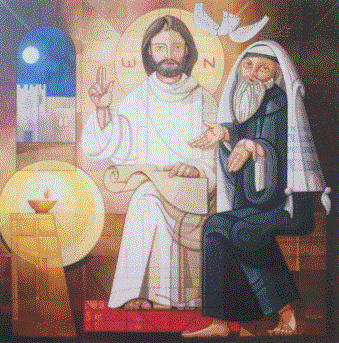
Sunday’s lessons from Genesis and Romans lift up Abraham as a person of strong faith. The psalm describes in a beautiful, lyrical way what such faith looks like. By contrast, the gospel lesson features Nicodemus-hardly someone that comes to mind when examples of faith are under discussion. We meet Nicodemus three times in John’s gospel. In our gospel lesson, we find him creeping silently through the night to question Jesus under the cover of darkness. John does not tell us specifically why Nicodemus came at night, but we can safely conjecture that he did not want to be publicly associated with Jesus. We know that there were some influential religious leaders who believed in Jesus but were fearful of expressing their faith in him. Evidently, Nicodemus was among them. John 12:42.
Nicodemus comes across as something of a dufus who cannot seem to follow Jesus’ line of thinking. But in all fairness, I have some difficulty with that myself. Jesus declares that no one can see the reign of God unless they are “born anew.” Nicodemus asks, quite reasonably, “How can anyone be born after having grown old?” Birth is a traumatic experience. One minute you are in a warm, dark, quiet and safe environment where all your needs are met without any effort on your part. The next you are thrust into realm of novel and unintelligible noise, harsh lights, cold air and new experiences of touch and smell. You have no conceptual tools or prior experience to make sense of everything that is happening to you. It is probably a good thing we cannot remember the experience of birth. If we did, we would probably be spending the rest of our lives in trauma therapy.
In order to be “born anew” or “born from above,” you need to unlearn everything you have ever learned. You must be stripped of all the assumptions, all of the biases, all of the family, religious and national loyalties into which you have been encultured and left psychically and spiritually naked. What, short of a traumatic brain injury, could put you into such a state? Yet according to Jesus, that is what must happen before we can comprehend God’s reign. Rebirth is hard to imagine. A new born infant or even a small child comes into the world without knowing what is possible, what is impossible, what is good or what is evil. For them, the world is all raw, unmediated sensation. Accordingly, they are radically open to learning and learn is what they do! Most of the critical learning we do occurs between infancy and early childhood. The older we get, the less open we are to learning. What we have already learned and believed becomes more deeply ingrained as we age. The older we get, the harder it is to let go of deeply held convictions and beliefs. The longer we have committed blood, sweat, time and effort supporting our religious institutions, our political parties and our familial communities, the harder it is question these loyalties, much less abandon them. Nicodemus was right to wonder how an adult can begin to view the world with the eyes of a child, unclouded by years of learning and experience.
Something like birth from above is what was required of Abraham when God called him to leave his home, his kindred and his tribe and follow God’s leading to some land somewhere he had never seen. His new life would consist of living as a homeless nomad and an alien in an unfamiliar land filled with hidden dangers. Yet this land, God tells the childness and aged Abraham, will one day belong to his descendants. Abraham would have been more than justified in asking, as did Nicodemus, “how can these things be?” John 3:9.
Sarah, Abraham and their descendants are models of faith. Notwithstanding what we moderns might view as their moral failures and shortcomings, they staked their lives on a promise. All the conditions that confronted them weighed against the fulfilment of the promise. As the author of the Letter to the Hebrews points out, their faith was based “on things hoped for, the conviction of things not seen.” Hebrews 11:1. Our nomadic spiritual ancestors’ conviction that the land of Cannan belonged to them was at odds with the hard geopolitical realities of the bronze age. Yet they lived in expectation of its fulfilment as though it were a sure thing.
As professor Stanley Hauerwas has observed, the life disciples of Jesus live makes no practical common sense apart from belief in Jesus’ resurrection. By raising from the dead the man whose life was lived in accord with the impractical, ineffective and hopelessly altruistic precepts of the Sermon on the Mount ending his crucifixion and the dispersion of his followers, God declares that the future belongs to the poor, the meek, the pure in heart, the merciful, the peacemakers and especially those who are most hated, despised and persecuted. The Resurrection places the proud, the wealthy, the war mongers, wall builders, the culture warriors and ethnic cleansers on the wrong side of history. So, because God raised Jesus from death, we continue to pick up the garbage on our streets even though our efforts are dwarfed by the tons of industrial waste dumped all over our planet by commercial interests whose only value is financial gain. We continue advocating for transgender children, racial justice and humane immigration policies even when our political allies plead with us to downplay such matters and focus instead on “kitchen table issues.” We make peace through seeking reconciliation, forgiveness and restorative justice in a world convinced that peace can only be made through the threat, and failing that, the use of military might. None of this makes sense unless you believe that God raised Jesus from death and that therefore the future belongs to the just, gentle and peaceful reign of God.
So how does our friend Nicodemus fit into all of this? As we have noted, he is one of the religious leaders who believed Jesus but was unwilling to associate with him publicly. John the Evangelist has harsh words for such under cover believers. He chides them for loving human praise more than the praise of God. John 12:43. Still, it is worth noting that when the religious authorities were hell bent on arresting Jesus, it was Nicodemus who spoke up and insisted that no such action should be taken without first hearing what Jesus had to say. John 7:45-52. Following Jesus’ crucifixion, his disciples all deserted him and left his body to be pecked at by crows and eaten by dogs at the foot of the cross. But Nicodemus, along with Joseph of Arimathea, another under cover disciple, sought permission to take down the body of Jesus and give him a proper burial. John 19:38-42. It seems that despite his initial skepticism, Nicodemus may have been born anew. It appears that perhaps he did catch a glimpse of God’s reign. Did it lead him finally to a life of discipleship? John the Evangelist leaves us to wonder about that.
Here is a poem by Ralph Waldo Emerson that speaks to “a love that in the spirit dwells that panteth after things unseen.” It is to that spirit Jesus appeals when he says to Nicodemus, “What is born of the flesh is flesh, and what is born of the Spirit is spirit. Do not be astonished that I said to you, ‘Youmust be born from above.’The windblows where it chooses, and you hear the sound of it, but you do not know where it comes from or where it goes. So it is with everyone who is born of the Spirit.” John 3:6-8.
Gnothi Seauton (Know Thyself)
There is in all the sons of men
A love that in the spirit dwells
That panteht after things unseen
And tidings of the future tells
And God hath built his alter here
To keep this fire of faith alive
And set his priests in holy fear
To speak the truth-for truth to survive.
And hither come the pensive train
Of rich & poor of young & old,
Of ardent youths untouched by pain
Of thoughtful maids & manhood bold
They seek a friend to speak the word
Already trembling on their tongue
To touch with prophet’s hand the Chord
Which God in human hearts hath strung
To speak the pain reproof of sin
That sounded in the soul before
And bid them let the angels in
That knock at humble Sorrows door.
They come to hear of faith & hope
That fill the exulting soul
They come to lift the curtain up
That hides the mortal goal
O thou sole source of hope assured
O give thy servant power
So shall he speak to us the word
Thyself dost give forever.
Source: Journals and Miscellaneous Notebooks of Ralph Waldo Emerson, vol. 3, edited by William H. Gilman & Alfred R. Ferguson (c. The Bellknap Press of Harvard University, Cambridge, MA, 1964) Ralph Waldo Emerson (1803-1882) was an American essayist, lecturer, philosopher, minister, abolitionist, and poet who led the Transcendentalist movement of the mid-19th century. He was born in Boston, Massachusetts, on May 25, 1803,[15] to Ruth Haskins and the Rev. William Emerson, a Unitarian minister. at age fourteen, Emerson went to Harvard College and was appointed freshman messenger for the president, requiring Emerson to fetch delinquent students and send messages to faculty. He took outside jobs to cover his school expenses, including as a waiter for the Junior Commons and as an occasional teacher. Emerson served as Class Poet and, as such, presented an original poem on Harvard’s Class Day, a month before his official graduation on August 29, 1821. In the early 1820s, Emerson was a teacher at the School for Young Ladies. He next spent two years living in a cabin in the Canterbury section of Roxbury, Massachusetts, where he wrote and studied nature.
In 1826, faced with poor health, Emerson went to seek a warmer climate. He first went to Charleston, South Carolina, but found the weather was still too cold. He then went farther south to St. Augustine, Florida. There Emerson had his first encounter with slavery. At one point, he attended a meeting of the Bible Society while a slave auction was taking place in the yard outside. He wrote, “One ear therefore heard the glad tidings of great joy, whilst the other was regaled with ‘Going, gentlemen, going!'” Emerson was staunchly opposed to slavery. In the years leading up to the Civil War he gave a number of lectures on the subject. He welcomed John Brown to his home during Brown’s visits to Concord and voted for Abraham Lincoln in 1860, whom he later met in person. Starting in 1867, Emerson’s health began to decline. He wrote much less and started experiencing memory problems. Still, he continued to travel widely and lecture in Europe and the United States. He died from complications of pneumonia in 1892. You can read more about Ralph Waldo Emerson and sample more of his poetry at the Poetry Foundation website



 Peter's Outer Cape Portico