RESURRECTION OF OUR LORD
or John 20:1-18
Prayer of the Day God of mercy, we no longer look for Jesus among the dead, for he is alive and has become the Lord of life. Increase in our minds and hearts the risen life we share with Christ, and help us to grow as your people toward the fullness of eternal life with you, through Jesus Christ, our Savior and Lord, who lives and reigns with you and the Holy Spirit, one God, now and forever.
“Then Peter began to speak to them: ‘I truly understand that God shows no partiality,but in every people anyone who fears him and practices righteousnessis acceptable to him.’” Acts 10:34-35.
“In a wide variety of global contexts, populist political movements pose serious challenges to churches and theology. Churches are called to reflect more deeply on their public role in view of populist exclusionary policies. In a situation where populist movements misappropriate Christian rhetoric to justify their aspirations, churches cannot remain silent, but need to resist exclusionary strategies.” Eva Harasta and Simone Sinn, INTRODUCTION, Resisting Exclusion Global Theological Responses to Populism,(LWF Studies, 2010/01) p. 11.
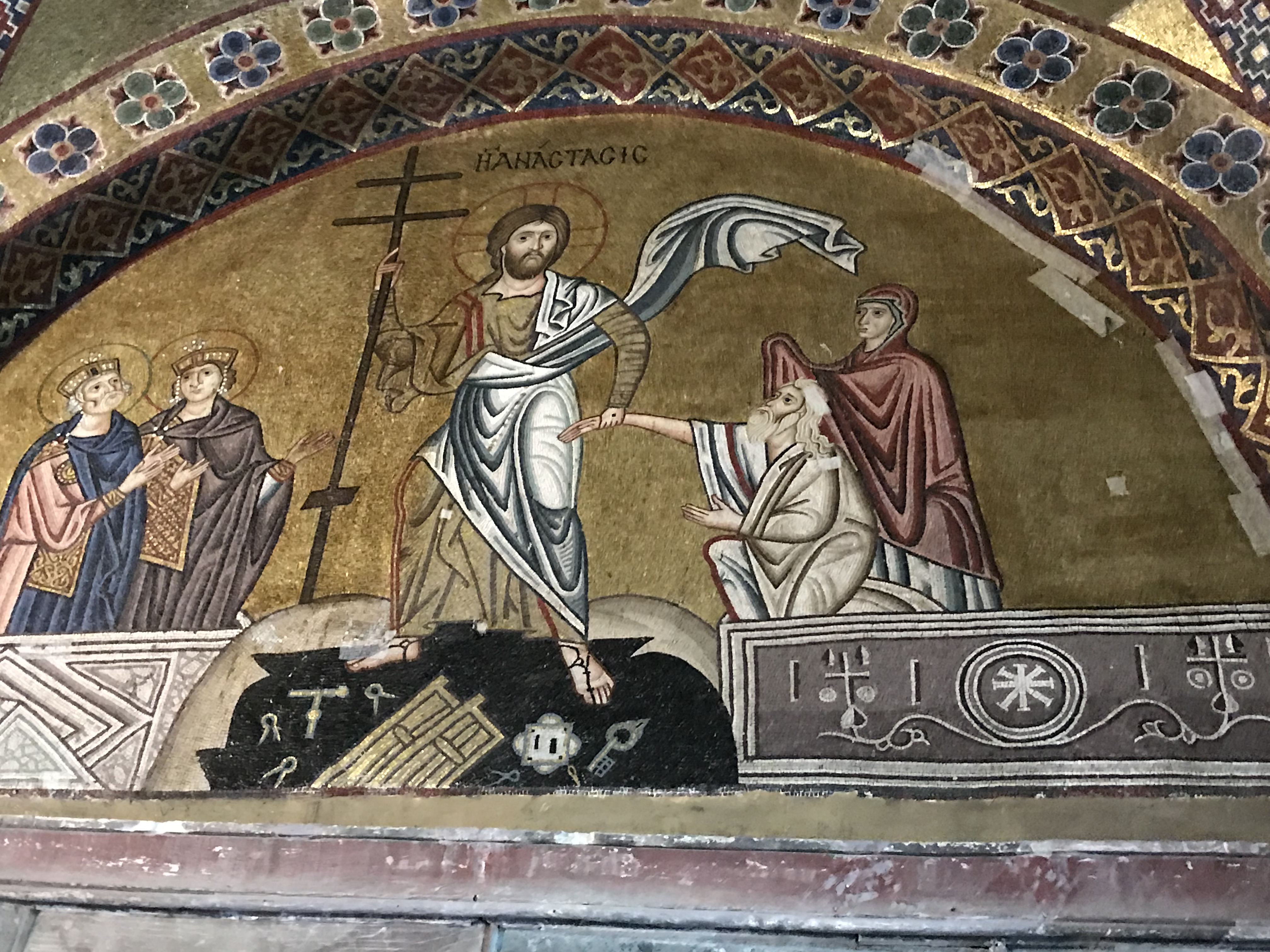
The above photograph was taken by yours truly at the Hosios Loukas-Byzantine Monastery Distomo in Greece. It depicts the Resurrection of Jesus which, in the thought of the Eastern Church (and St. Paul), is intimately linked to our own. For this reason, the risen Christ is seen taking the hand of Adam. Eve, who is just behind him, clings to the clothing of her husband. We are given to understand that, behind Eve, stands all of humanity. Jesus does not rise alone. He leads with him the whole human family from the grave to resurrection life. As Saint Peter points out, “God shows no partiality,but in every people anyone who fears him and practices righteousnessis acceptable to him.” This fresco, replicated in numerous sanctuaries and frequently engraved on Orthodox icons speaks eloquently to the God who loved the cosmos enough to send the Son, not to condemn the world but to save it.
This Sunday we celebrate the Feast of the Resurrection. The tone is one of joy and this is right. How else can we approach the titanic reversal of death itself? Yet to understand this miracle rightly, it is necessary to be clear about what is actually miraculous. Nobody in the first century doubted that God, or a god as the case may be, would be capable of raising someone from death. And if that were all there were to the Resurrection, it made little difference then and makes even less now. The miracle of the Resurrection does not lie in the assertion that God raised Jesus from death. The real miracle is that God raised Jesus from death. That is what makes the Resurrection truly radical. God raised the one who refused the temptation to employ coercive force in the service of God’s reign; the one who practiced radical hospitality, welcoming people living at the margins including the sick, the foreigner, the poor and the outcast; the one who recognized no humanly drawn barriers between peoples but died to draw all people to himself. John 12:32. The life Jesus lived that drew him into conflict with power, wealth, empire and oppressive religion ending in his execution God vindicates by raising Jesus from death. Any god who favors exclusively any nation, class, race, clan or religious group is not God.
This is why Harasta and Sinn remind us that “[i]n a situation where populist movements misappropriate Christian rhetoric to justify their aspirations, churches cannot remain silent…” This is why we must be clear and insistent that the God who raised Jesus from death is not the one engraved upon our coins, the one invoked to “bless America,” the one who “protects our war against Iran,” the one who sanctifies the graves of our fallen soldiers. The God who raised Jesus from death is not the vengeful deity imagined by much white evangelical religion who throws a wrathful fit over what people do or do not do in the bedroom, but is altogether indifferent to Iranian school girls killed by American tomahawk missiles or millions losing their health insurance and food stamps to finance tax breaks for the wealthy. The God who raised Jesus from death is not about to rapture a few million privileged souls off to heaven while leaving the world for which the Son died in the hands of the devil and to the fate of some great tribulation. The Resurrection and the reign of God is not for the privileged few. It is for all the descendants of Adam and Eve.
The good news of Easter is that the reign of God Jesus gave his life proclaiming is the future. That, however, does not sound like good news for those of us who have benefited from the status quo and want to keep it in place at all costs. Easter does not sound like good news for those of us accustomed to wealth and privilege. Easter does not seem like good news to those of us who feel threatened by people who look different, speak differently and worship differently than we do. The future does not belong to wall builders. If you have a problem with open borders, you have a problem with Jesus. If you have a problem with Jesus, you are on the wrong side of history.
As I have said before, sometimes the good news has to be heard as bad news before it can be received as the good news it truly is. Many of us need to be made aware that our privilege is actually a lethal addiction. Many of us need to recognize that the walls we build to protect ourselves are really imprisoning us. Many of us must learn that Jesus is appealing to us through our neighbors-even the ones we deem our enemies. Many of us must be liberated from the twisted, distorted and altogether too small and limited images of God arising from nationalistic ideologies before we can finally recognize the beauty and richness of the God whose love for us is stronger than death. Many of us need the blinding light of the Resurrection to chase the darkness out of our lives and open our eyes to the new reality of God’s reign that respects no humanly established border, favors no nation, race or class, turns away no person seeking mercy, forgiveness and welcome.
Here is a poem by Miller Williams that speaks of hope that struggles to see through the veil of failure, doubt and cynicism. It is a hope akin to that ignited by Jesus’ Resurrection.
Of History and Hope
We have memorized America,
how it was born and who we have been and where.
In ceremonies and silence we say the words,
telling the stories, singing the old songs.
We like the places they take us. Mostly we do.
The great and all the anonymous dead are there.
We know the sound of all the sounds we brought.
The rich taste of it is on our tongues.
But where are we going to be, and why, and who?
The disenfranchised dead want to know.
We mean to be the people we meant to be,
to keep on going where we meant to go.
But how do we fashion the future? Who can say how
except in the minds of those who will call it Now?
The children. The children. And how does our garden grow?
With waving hands—oh, rarely in a row—
and flowering faces. And brambles, that we can no longer allow.
Who were many people coming together
cannot become one people falling apart.
Who dreamed for every child an even chance
cannot let luck alone turn doorknobs or not.
Whose law was never so much of the hand as the head
cannot let chaos make its way to the heart.
Who have seen learning struggle from teacher to child
cannot let ignorance spread itself like rot.
We know what we have done and what we have said,
and how we have grown, degree by slow degree,
believing ourselves toward all we have tried to become—
just and compassionate, equal, able, and free.
All this in the hands of children, eyes already set
on a land we never can visit—it isn’t there yet—
but looking through their eyes, we can see
what our long gift to them may come to be.
If we can truly remember, they will not forget.
Source: Some Jazz A While: Collected Poems, (c. 1999 by Miller Williams; pub. by University of Illinois Press). Miller Williams (1930-2015) was an American Poet, editor, critic, and translator born in Hoxie, Arkansas to a Methodist pastor. He was honored as the country’s third inaugural poet, reading the above poem at the start of former President Bill Clinton’s second term. Williams earned a Bachelor of Science in biology from Arkansas State University and an Masters in zoology from the University of Arkansas. He taught college science for many years before securing a job in the English department at LSU with the support of his friend, the noted author, Flannery O’Connor. Williams has written, translated, or edited over thirty books, including a dozen poetry collections. You can read more about Miller Williams and sample more of his poetry at the Poetry Foundation website.

 Peter's Outer Cape Portico