FIFTH SUNDAY IN LENT
Prayer of the Day: Almighty God, your Son came into the world to free us all from sin and death. Breathe upon us the power of your Spirit, that we may be raised to new life in Christ and serve you in righteousness all our days, through Jesus Christ, our Savior and Lord, who lives and reigns with you and the Holy Spirit, one God, now and forever.
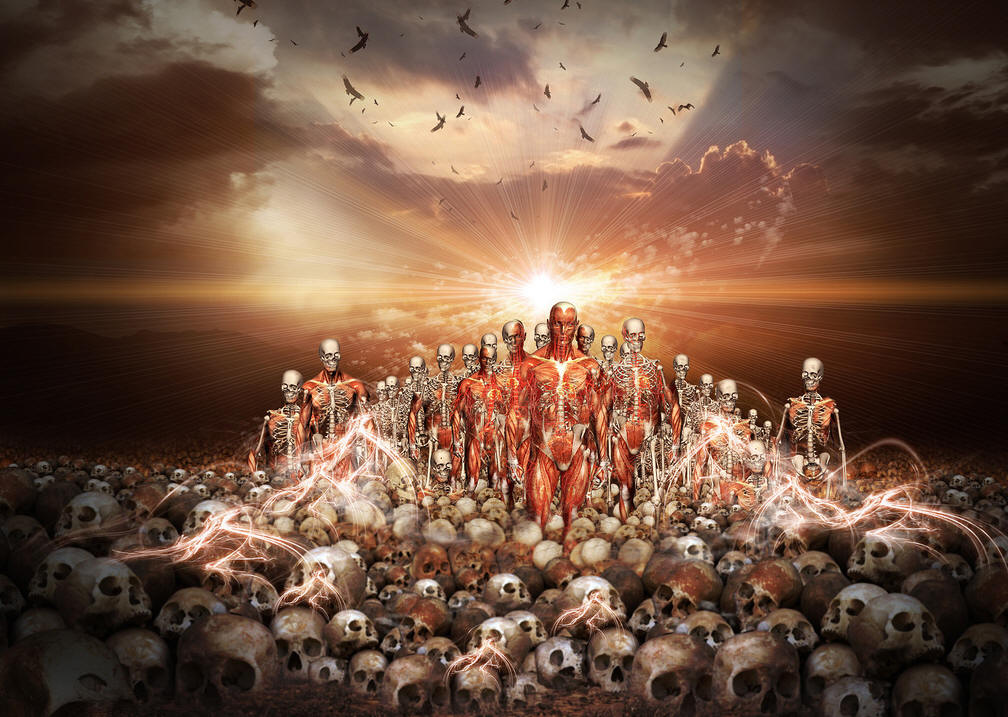
“Thus says the Lord God to these bones: I will cause breath to enter you, and you shall live.” Ezekiel 37:5.
Scholarly consensus is that Ezekiel’s vision in the valley of dry bones foretells not a general resurrection of the dead, but the restoration of the nation of Israel following the end of its exile in Babylon. That is probably so. But I am not convinced that exhausts the meaning and interpretation of this powerful text. Biblical narratives, oracles, parables, prayers and poems have always pointed beyond themselves and their immediate context. That is why they continue to engage us centuries later. Like a snowball rolling down hill, the Bible gathers meaning and its texts deepen and expand through interpretation and application to ever changing circumstances as it rolls through time convicting, inspiring and comforting faith communities as it goes. It is fair to say, I believe, that Ezekiel’s vision turned out to be bigger than he imagined. That would not have surprised or displeased Ezekiel. He knew, as all true prophets know, that the words he spoke were not his own. They were God’s Words animated by God’s Spirit. As such, they have a life of their own. They have power to stimulate the imaginations of their hearers in every age and to and open their eyes to new realities. That is, after all, the whole point of prophecy.
Ezekiel’s vision, therefore, is properly understood and preached as a Resurrection text. But wait! Aren’t we still deep in the season of Lent? Aren’t we jumping the gun, preaching the resurrection of the dead more than a week before Good Friday? For better or worse, the texts leave us little choice. Even as Jesus approaches Jerusalem where we know he will meet arrest, condemnation and crucifixion, he raises Lazarus from death. Ironically, the raising of Lazarus turns out to be both the reason for Jesus’ triumphal reception at Jerusalem and the event that finally convinces Caiaphas and the religious leaders of Judea that Jesus must be put to death. At least that is John the Evangelist’s take. Death and Resurrection are inseparably woven together. In our lesson from the Letter to the Church at Rome, Paul points out that death to sin is the flip side of sharing in Christ’s Resurrection. The line of demarcation between life and death is not as clear and absolute as we are prone to assume.
The lessons for this Sunday illustrate the difficulty of preaching the Resurrection-which we are called to do even-and perhaps especially-during the Sundays in Lent. As I have noted before, the temptation here is to say either too much or too little. We moderns are prone to preach Jesus’ resurrection as a metaphor for something else, such as liberation from economic oppression, a well ordered democratic government, world peace-you name it. One of the characters in John Updike’s first novel, The Poorhouse Fair, illustrates this approach. Updike’s story takes place in a state run home for the destitute elderly overseen by prefect Stephen Conner. Conner is a product of the New Deal. He believes in the inevitability of human progress through social evolution and the perfection of governmental institutions. Conner becomes engaged in a conversation among the residents about the afterlife. He shares his vision of “heaven on earth” formed in a future society where illness is overcome by advanced medicine; pollution eliminated through harnessing atomic power; and oppression defeated through the spread of democracy. Mrs. Mortis, one of the residents, asks him whether this heaven on earth will come soon enough for her to see it. Conner responds: “Not personally perhaps. But for your children, your grandchildren.”
“But not for ourselves?”
“No.” The word hung huge in the living room, the “o” a hole that let in the cold of the void.
“Well, then,” Mrs. Mortis spryly said, “to hell with it.” Updike, John, The Poorhouse Fair, (c. 1958 by John Updike, pub. by Random House).
I tend to share Mrs. Mortis’ sentiments. If the unsatisfied longings of billions for justice, peace, freedom and love never find fulfillment in God’s future, then for too many that future will have been a cruel hoax. Moreover, it is next to impossible for me to share Mr. Conner’s blithe optimism and his belief in the inevitable march of human progress under the shadow of a world slipping into fascism. His demythologized resurrection seems no less improbable than the real thing.
In the end, I do not believe our difficulty speaking about the Resurrection has anything to do with our inability to square it with modern science. Modern science has lost much of its enlightenment certainty in the face of ongoing discoveries and new theories undermining what we once believed were immutable laws. Increasingly, the questions posed by modern science are sounding ever more like those poets, novelists, philosophers and theologians have been asking for centuries. I believe our biggest problem with the mystery of Resurrection is that, well, it is a mystery. Even Jesus could speak of it only in parables. In a very real sense, when we say we believe in the resurrection of the body and the life of the world to come, we do not know what we are talking about. A mystery can never be explained. If it could, it would no longer be a mystery. Its inexplicability in rational terms does not make it any less real, however. Mysteries are a very real part of our existence. But they can be apprehended only through the medium of graphic art, poetry, fiction, mythology and storytelling-and then only in small part. Contemplating mysteries always leaves us with more questions than answers. I believe that we modern Christians, schooled as we have been to equate reality with what can be proven empirically in the sterility of the laboratory, must re-learn the ancient art of living comfortably alongside mystery.
There are many imponderables when it comes to contemplating the mysteries of Resurrection and eternal life. What does it mean to live in God’s eternal now? Will there still be equations to be worked out, new discoveries to be made and growth in maturity and understanding? It is hard to imagine life worth living in the absence of such challenges. It seems obvious, too, that we need to change substantially if we are to live harmoniously under God’s just and gentle reign. Eternity will be anything but heavenly if we bring into it the grudges, animosities, prejudices, resentments and blood feuds that are so much a part of this life and so much a part of ourselves. Yet I wonder how it is possible to extract the experiences of pain, grief, loss and anger from our lives without uprooting the wisdom, patience and triumphs that come with facing these challenges which makes us who we are. Must we be so radically changed as to be unrecognizable to our present selves? Will our relationships with loved ones be somehow preserved, complicated as they are with selfishness, jealousy, envy and resentment? Will questions like these matter or even make sense in the life of the world to come?
Preaching ought not to attempt resolving these issues-as if that were even possible. Instead, preachers need to emphasize that the reign of God is not wholly a future state, but that it is breaking into our world even now. The world to come is woven together out of the fabric made from our common life together, our faithful witness to God’s reign in our preaching, teaching and works of justice, mercy and compassion. Eternal life is not merely a matter of duration. To live eternally is to live in faith, hope and love-the three things Saint Paul reminds us are eternal. I Corinthians 13:13. Every second lived within the parameters of these virtues is a measure of eternal life. All time lived outside of them is tragically wasted. In sum, precisely because we believe in the Resurrection of the Body and the Life of the World to Come, the way we live in the here and now is critically important.
Philosopher and teacher Alfred North Whitehead has been a powerful influence in my thinking over the years, providing me with valuable conceptual tools for interpreting the Scriptures. The following passage, which I know I have quoted before, has been enormously comforting to me and helpful in thinking about the Life of the World to Come.
“The wisdom of [God’s] subjective aim prehends every actuality for what it can be in such a perfected system-its sufferings, its sorrows, its failures, its triumphs, its immediacies of joy-woven by rightness of feeling into the harmony of universal feeling, which is always immediate, always many, always one, always with novel advance, moving onward and never perishing. The revolts of destructive evil, purely self-regarding, are dismissed into their triviality of merely individual facts; and yet the good they did achieve in individual joy, in individual sorrow, in the introduction of needed contrast, is yet saved by its relation to the completed whole. The image-and it is but an image-the image under which this operative growth of God’s nature is best conceived, is that of a tender care that nothing be lost.
“The consequent nature of God is his judgment on the world. He saves the world as it passes into the immediacy of his own life. It is the judgment of a tenderness which loses nothing that can be saved. It is also the judgment of a wisdom which uses what in the temporal world is mere wreckage.” Whitehead, Alfred North, Process and Reality (c. 1979 by The Free Press) p. 346.
The message latent within Ezekiel’s vision is that, in the end, God will bring to completion in a future of breathtaking harmony what God began with the words, “Let there be.” Jesus assures us that we will be included in that future. That is not all that I would like to know about the Resurrection of the Dead and the Life of the World to Come. But it is enough.
Here is a poem by Sister Maris Stella that bears a striking resemblance to Ezekiel’s vision.
RESURRECTION
from the deep sea wrack
from the green light under the sea
from the coral caves men will come back
on mountain tops where
dropped from the air
or hurled
against the world
their bones grow cold
among the old
rock-frost above the tree-line
they will rise up with the divine
breath breathed into them again
as on the first of men
Adam, newly conceived of clay
on the sixth day
God breathed
even somewhere Adam will rise
opening again his eyes
on the world to find
nothing much changed but of a mind
that he was blind before
Abel, first-slain
having lain
longer in earth than any other man
and Eve with the look of the new Eve
upon her but still Eve
they will rise up having known
the terrible trumpets blown
would cry: this is the doom
this is the crack of doom
who will record the innumerable horde
in hope to see
what publican will mount into a tree
what wind
what weather what bird
will shout unheard
against the sound
of whole tribes and families growing up out of the ground
what earth does every spring
is only a hint of the thing.
Source: Poetry (April 1943). Sister Maris Stella (1899–1987) was born Alice Gustava Smith in Alton, Iowa, in 1899. During her junior year in high school she moved to St. Paul, Minnesota to attend Derham Hall High School. Smith graduated from Derham Hall in 1918. Two years later she entered the novitiate of the Sisters of St. Joseph and took the name Sister Maris Stella. In 1924 she received her undergraduate degree from the College of St. Catherine with majors in English and music. She traveled to England thereafter where she earned her master’s degree in English at the University of Oxford. In 1939, Sister Maris Stella published her first volume of poetry, Here Only a Dove. During the 1940s she continued to write poetry for magazines. You can read more about Sister Maris Stella in the Minnesota Historical Society website.
 Peter's Outer Cape Portico