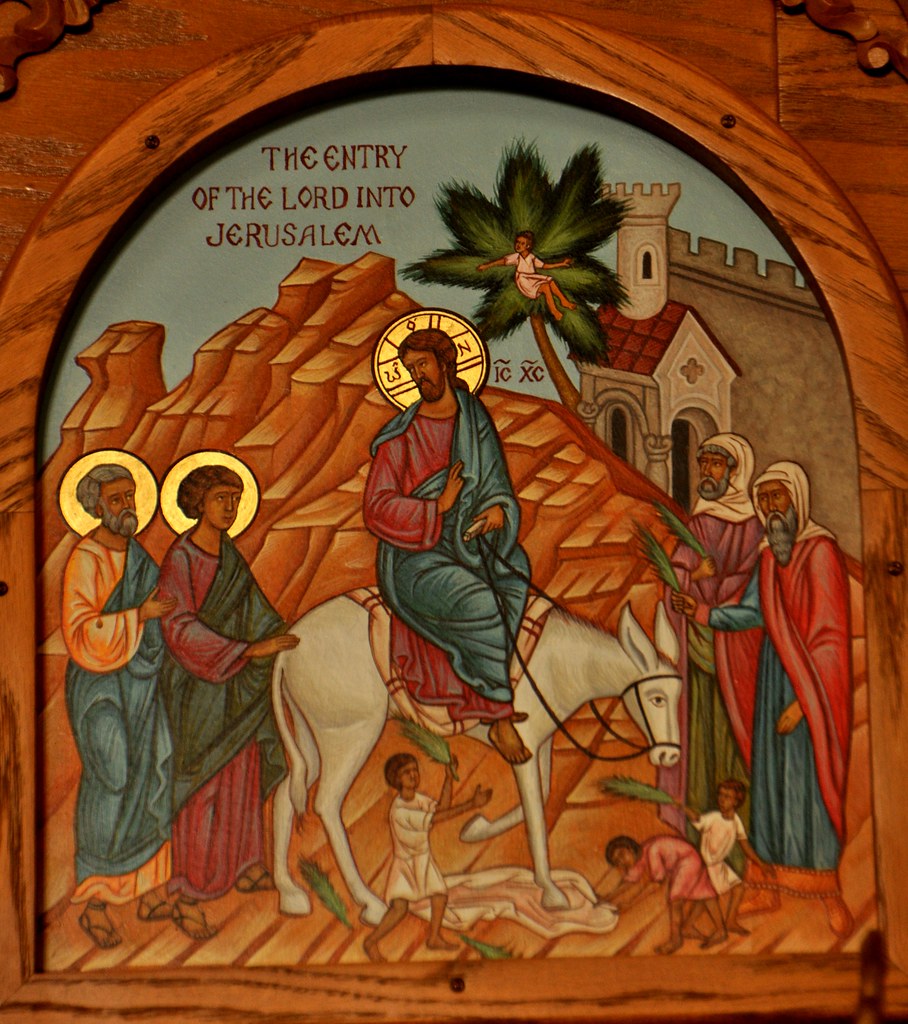
PALM/PASSION SUNDAY
“Hosanna to the Son of David!
Blessed is the one who comes in the name of the Lord!
Hosanna in the highest heaven!” Matthew 21:9.
“Pilate said to them, ‘Then what should I do with Jesus who is called the Messiah?’ All of them said, ‘Let him be crucified!’Then he asked, ‘Why, what evil has he done?’ But they shouted all the more, ‘Let him be crucified!’” Matthew 27:22-23.
In all the gospels, the “crowd” or “the people” constitute a unique character. The crowds flock from all over Palestine and beyond to hear Jesus’ teachings and to be healed of their ailments, though their understanding of his preaching and mission is limited. The religious leaders in Jerusalem fear the crowd. They know the crowd holds Jesus in high esteem and that the reign of God Jesus proclaims challenges the imperial power of Rome. They are also painfully aware that the position of privilege and power they hold depends on their placating Rome. Thus, the religious elite find themselves in an untenable situation. Arrest Jesus and risk a riot that would certainly bring down a military response from Rome; or ignore Jesus’ messianic mission which is clearly on a collision course with Rome. Either way, a conflict with Rome appears inevitable. The only solution: undermine the crowd’s attraction to Jesus.
Crowds are notoriously capricious. Their memories are short and their loyalties fleeting. Today’s hero is tomorrow’s villain. Crowds can be carried away by lofty rhetoric. They are easily seduced by charlatans who promise easy solutions to complex problems. Crowds are vulnerable to extremists who put the face of minorities, foreigners and other disfavored groups on all their fears and convince them they are being persecuted, victimized and dispossessed. A crowd has a mind and a spirit distinct from and bigger than any of its members. Its malignant will overwhelms one’s instincts of decency, compassion and civility. People will commit and applaud unspeakable acts of violence and brutality when part of a mob that they would never think of doing or condoning individually. Skilled rhetorical manipulators know how to awaken our deepest fears, prejudices and hatreds. They know how to exploit these dark angels of our nature to inspire paranoia, knowing that when we are afraid, uncertain and confused we can easily be driven to destructive and violent action. We can be made to forget who we are, the relationships that bind us together as a community and the values we hold dear. A mob has no memory, no vision and no thought process. It does not move deliberately. It is driven by the energy of its blind malice. Other than the crucifixion of Jesus, there is no better example of that phenomenon than the Republican insurrection of January 6, 2021.
The gospels do not tell us exactly how the religious leaders in Jerusalem “persuaded the crowds to ask for Barabbas and to have Jesus killed.” But we have contemporary examples of “influencers,” with large followings. The late Charlie Kirk comes to mind. Joe Rogan’s “manosphere” is another example as is Charlamagne the god. Taylor Swift exercises a powerful influence over her millions of fans as have other superstars over the decades. Influencers can affect the way we dress, the slang we use, the cars we drive (or wish we could drive), the music to which we listen, our politics, morality and spending habits. Of course, there is nothing wrong with having influence, nor is there anything sinister about being influenced. I do not know where I would be today without the teachers, pastors, authors, poets and artists who have influenced me over the years.
Still, I believe it is critical to recognize and acknowledge that we are, in fact, being influenced. It is also important that we ask ourselves frequently, “by what or by whom am I being influenced?” This inquiry is increasingly important in this age of social media which, in addition to making vast amounts of important news and information easily available, also constitutes a swamp of misinformation, unfounded conspiracy theories and hateful ideologies. The rise of AI makes it possible to distort and even fabricate pictures, videos and works of art such that it is becoming ever more difficult to determine what is real. We are open to mass manipulation and misdirection like never before. History has taught us that such manipulative power can drive a crowd of otherwise law abiding people to heinous acts of violence such as lynchings, rioting and genocide. The gospels teach us that mass manipulation led to the crucifixion of God’s Son.
During these last days of our Lenten pilgrimage I believe we would do well to consider the forces influencing us and to ask ourselves who or what is shaping our hearts and minds. What or who is demanding our attention? How are we being entertained? From where are we getting our news and information and what effect is all of this having on the way we think about our world, about our neighbors and about our God?
Here is a poem by Carl Sanburg speaking to the fickleness and capriciousness of the mob as well as its vulnerability to manipulation. The poem also expresses the hope that the mob might finally gain a soul and become a people governed by the lessons history has to teach.
I Am the People, the Mob
I am the people—the mob—the crowd—the mass.
Do you know that all the great work of the world is done through me?
I am the workingman, the inventor, the maker of the world’s food and clothes.
I am the audience that witnesses history. The Napoleons come from me and the Lincolns. They die. And then I send forth more Napoleons and Lincolns.
I am the seed ground. I am a prairie that will stand for much plowing. Terrible storms pass over me. I forget. The best of me is sucked out and wasted. I forget. Everything but Death comes to me and makes me work and give up what I have. And I forget.
Sometimes I growl, shake myself and spatter a few red drops for history to remember. Then—I forget.
When I, the People, learn to remember, when I, the People, use the lessons of yesterday and no longer forget who robbed me last year, who played me for a fool—then there will be no speaker in all the world say the name: “The People,” with any fleck of a sneer in his voice or any far-off smile of derision.
The mob—the crowd—the mass—will arrive then.
Source: Creative Commons. Carl Sandburg (1878 – July 22, 1967) was a Swedish-American poet, biographer, journalist and editor. He won three Pulitzer Prizes, two for his poetry and one for a biography of Abraham Lincoln. Sandburg is widely regarded as a major figure in contemporary literature. At the age of thirteen Sandburg left school and began driving a milk wagon. Throughout his early years, he worked as a porter at the Union Hotel barbershop in Galesburg, Illinois, a bricklayer, a farm laborer in Kansas, a hotel servant in Denver, Colorado and a coal-heaver in Omaha. Sandburg began his writing career as a journalist for the Chicago Daily News. Later he wrote poetry, history, biographies, novels, children’s literature and film reviews. He also collected and edited books of ballads and folklore. He spent most of his life in Illinois, Wisconsin, and Michigan before moving to North Carolina. You can find out more about Carl Sandburg and sample more of his poetry at the Poetry Foundation Website.
 Peter's Outer Cape Portico