Category Archives: Uncategorized

Honoring Sabbath-It’s More Than Going to Church

ELEVENTH SUNDAY AFTER PENTECOST

Isaiah 58:9b-14

Psalm 103:1-8

Hebrews 12:18-29

Luke 13:10-17

Prayer of the Day: O God, mighty and immortal, you know that as fragile creatures surrounded by great dangers, we cannot by ourselves stand upright. Give us strength of mind and body, so that even when we suffer because of human sin, we may rise victorious through your Son, Jesus Christ, our Savior and Lord.

“If you refrain from trampling the sabbath,
   from pursuing your own interests on my holy day;
if you call the sabbath a delight
   and the holy day of the Lord honorable;
if you honor it, not going your own ways,
   serving your own interests, or pursuing your own affairs;
then you shall take delight in the Lord,
   and I will make you ride upon the heights of the earth;
I will feed you with the heritage of your ancestor Jacob,
   for the mouth of the Lord has spoken.” Isaiah 58:13-14.

For most of us protestant Christians, honoring the Sabbath is nearly synonymous with going to church on Sunday. Some protestant churches continue to prohibit work on Sunday in honor of the Sabbath. Strictly speaking, however, the Sabbath is not about worship. It is about rest. Rest from labor for everyone, from princes at the pinnacle of society to the lowliest servant. According to the Hebrew Scriptures, animals were also to be given rest from work on the Sabbath. The land itself was to receive a year of sabbath from cultivation every seven years. In essence, the Sabbath is a labor law designed to protect humans, animals and the earth itself from ruthless exploitation.  

The command to rest was the first one God gave us when, at the completion of creation after six days, God rested. I saw recently a clever poster featuring a photograph of the earth from outerspace and this verse from Genesis: “Thus the heavens and the earth were finished, and all their multitude. And on the seventh day God finished the work that he had done, and he rested on the seventh day from all the work that he had done.” Genesis 2:1-2. Underneath were the words, “So, tell me again about how busy you are and how you just can’t afford to take a break from all your important work.” A rabbi under whom I studied Hebrew while in college told us that “God commanded us to rest because he knew that, left to ourselves, we never would.”

Work is a good gift of God and a blessing-or at least it is supposed to be. But work has a way of getting out of hand and taking over the rest of life. When I first began practicing law, the hours were long and difficult. When the work day ended, however, I got into my car and enjoyed a relatively easy commute back home, listening to music and decompressing. When I walked through the door into the house, the office was behind me and I was confronted with a fresh set of domestic challenges. If I didn’t have a complete day of rest, at least I got to enjoy little islands of rest protected from the reach of my job.

With the advent of the cell phone, I lost the comfort of knowing that, while driving from place to place, I could enjoy a period of peace where no one could reach me. E-mail extended into the sanctuary of my home the reach of anxious clients eager to know the status of their cases, senior partners needing a legal memo asap and associates with pressing questions about their assignments. More recently, the covid-19 pandemic accelerated this trend by blurring altogether the distinction between home and work through normalizing the practice of “working from home.”[1] It has become increasingly difficult to enjoy any sort of Sabbath, that is, time altogether free from the demands and obligations of work.

In Jesus day, the Sabbath itself had become a laborious burden. Instead of providing an oasis of peace for rest and rejuvenation, Sabbath had become an onerous network of rules to be observed. The ruler of the synagogue in our gospel lesson goes ballistic when Jesus heals a woman bent over from a chronic back condition. “There are six days on which work ought to be done;” he tells the people. “Come on those days and be cured, and not on the sabbath day.” Luke 13:14. It sounds reasonable enough at first blush. After all, this woman’s ailment is hardly a medical emergency. She has lived with the condition for eighteen years. All she has to do is wait another few hours until sundown.

Jesus, however, takes a different view. He reminds his audience why God gave us the Sabbath. It isn’t as though God created an elaborate set of rules and then, as an afterthought, decided to create people so that there would be someone to follow all of these wonderful rules. As Jesus has told us elsewhere, “The sabbath was made for humankind, and not humankind for the sabbath.” Mark 2:27. The Sabbath was designed to ensure that human beings are given rest from their labors. As all of us who suffer from back pain know, it is hard to get any rest when your back is killing you. Jesus is simply opening the door of Sabbath rest to this woman whose pain had been excluding her from it for eighteen years. What better way to honor the Sabbath than to expand its reach to those who need it most?

The Sabbath and its limitations on the scope of labor for the protection of the earth and all its human and nonhuman inhabitants stands in stark contrast to the values of late stage capitalism which exploits all for the sake of profit for a few. This false religion of profit permeates our educational institutions, which are designed to produce workers and professionals meeting the needs of corporate America. When speculating about a person’s wealth, we are typically heard making remarks like, “So what do you think she’s worth?” We compensate and value individuals based on how much value can be extracted from their labor. In the view of capitalism, the world is not God’s creation, but merely a ball of exploitable resources to be used in generating profit. Small wonder, then, that the earth is scarred with deforested wastelands, contaminated waters and dying cities filled with the ruins of factories and poverty stricken people capitalism has left behind after extracting everything it could use.

Sabbath points us to a different kind of economy. It is an economy driven by human need rather than human greed. It is an economy designed to create and nourish community rather than exploiting and then abandoning communities in the interest of cheaper labor and greater efficiency. A biblical economy treats the earth, its habitats and inhabitants with reverence and respect rather than as a treasure trove of resources to be mined ruthlessly for generating profit. A biblical economy seeks to build a society in which all people can live meaningful and productive lives rather than seeking to mold people into productive units to be used by corporate industry until obsolete and then summarily discarded. Honoring the Sabbath is a whole lot more than simply going to church. To honor the Sabbath is to pursue justice and ecological renewal passionately and relentlessly.

Here is a poem by Denise Levertov that speaks eloquently to what I believe can be characterized as Sabbath, both as presently experienced and as anticipated with passionate hope.        

To Live in the Mercy of God

To lie back under the tallest
oldest trees. How far the stems
rise, rise
before ribs of shelter
open!

To live in the mercy of God. The complete
sentence too adequate, has no give.
Awe, not comfort. Stone, elbows of
stony wood beneath lenient
moss bed.

And awe suddenly
passing beyond itself. Becomes
a form of comfort.
Becomes the steady
air you glide on, arms
stretched like the wings of flying foxes.
To hear the multiple silence
of trees, the rainy
forest depths of their listening.

To float, upheld,
as salt water
would hold you,
once you dared.

To live in the mercy of God.

To feel vibrate the enraptured

waterfall flinging itself
unabating down and down
to clenched fists of rock.
Swiftness of plunge,
hour after year after century,
O or Ah
uninterrupted, voice
many-stranded.
To breathe
spray. The smoke of it.
Arcs
of steelwhite foam, glissades
of fugitive jade barely perceptible. Such passion—
rage or joy?
Thus, not mild, not temperate,
God’s love for the world. Vast
flood of mercy
flung on resistance.

Source: Sands from the Well (c. 1996 by Denise Levertov; pub. by New Directions Publishing Corporation) Denise Levertov (1923–1997) never received a formal education. Nevertheless, she created a highly regarded body of poetry that earned her recognition as one of America’s most respected poets. Her father, Paul Philip Levertov, was a Russian Jew who converted to Christianity and subsequently moved to England where he became an Anglican minister.  Levertov grew up in a household surrounded by books and people talking about them in many languages. During World War II, Levertov pursued nurse’s training and spent three years as a civilian nurse at several hospitals in London. Levertov came to the United States in 1948, after marrying American writer Mitchell Goodman. During the 1960s Levertov became a staunch critic of the Vietnam war, a topic addressed in many of her poems of that era. Levertov died of lymphoma at the age of seventy-four. You can read more about Denise Levertov and sample more of her poetry at the Poetry Foundation Website.


[1] I know that many people find working from home to be liberating. I can understand that. It spares them the time, cost and aggravation of commuting to a distant office. Working from home allows one greater freedom in setting one’s own schedule, thereby enabling them to participate more fully in the life of their spouses and children. But my own experience has been that trying to get work done at home does not make me a better spouse, father or person all around.  

Interpreting the Times

TENTH SUNDAY AFTER PENTECOST

Jeremiah 23:23-29

Psalm 82

Hebrews 11:29—12:2

Luke 12:49-56

Prayer of the Day: O God, judge eternal, you love justice and hate oppression, and you call us to share your zeal for truth. Give us courage to take our stand with all victims of bloodshed and greed, and, following your servants and prophets, to look to the pioneer and perfecter of our faith, your Son, Jesus Christ, our Savior and Lord.

“You hypocrites! You know how to interpret the appearance of earth and sky, but why do you not know how to interpret the present time?” Luke 12:56.

I have to confess that my sympathies here are with Jesus’ audience. I have never had much success interpreting the present time. The “signs” of the time have always seemed contradictory to me. While I was growing up in the late 60s and 70s, hard won gains for women and people of color seemed to point to a brighter future even as tensions between the United States and the Soviet Union threatened thermonuclear doom. Ultimately, the Soviet threat evaporated while a more conservative Supreme Court began the work of dismantling affirmative action, the Voting Rights Act and protections for reproductive rights-a job the current Supreme Court is poised to complete. Fascism, once thought to have died with Francisco Franco, is on the rise globally and has commandeered one of our nation’s two major parties. Russia has re-emerged under Vladimir Putin as an empire hungry to expand. The future of democracy and human rights is at stake. Nevertheless, if the direst predictions of climate scientists are accurate and the paralysis of world leaders in addressing them persists or the superpower proxy wars turn nuclear, none of that will matter.

Yet as I write these lines, the United States Congress is poised to approve a bill addressing climate change in a significant way. Voters in the state of Kansas overwhelmingly defeated an attempt to role back women’s reproductive rights and the House Committee Investigating the insurrection of January 6, 2020 is slowly but surely chipping away at the pervasiveness of the “big lie” of the stolen election. In spite of efforts by reactionary forces to turn back the clock, time marches on. The sight of interracial couples walking down the street holding hands, a sight never seen in my childhood, is so common today as not to merit a second glance. Same sex couples, who throughout most of my life have had to live in the shadows, now live openly as families and are increasingly gaining acceptance. As dark as the future sometimes seems, today is in many respects a better day than the one on which I was born. That is not to say that tomorrow will be brighter still. Many once great civilizations have fallen into ruin, leaving in their wake ages of barbarism and violence. The jury is out on the future of our current global order. So, on balance, I cannot say where the signs of the times are pointing.

Or perhaps my way of reading the signs of the time is all wrong. Maybe Jesus is not directing our speculative gaze into the future at all. After all, Jesus has warned us more than once against trying to cobble together from scriptural passages and current events God’s timeline for bringing the world to its end and ushering in the reign of God-as though there were such a timeline. Jesus himself denied having such knowledge. That alone should cast more than doubt about anyone who claims to have “cracked the biblical end times code.”

These warnings should also caution us against becoming too shrill and bombastic in our declarations about what God wills or where God is taking us or what constitutes progress toward God’s coming reign. Can we be so sure that “saving American democracy” is God’s priority? What if God means to dissolve the whole world order, the United States included, to make way for something new? Can we be so certain that our frantic efforts to turn around the steady decline in church membership and support is consistent with God’s intent for God’s church? Could it be that God, not secularization or any of the other culprits we blame, is responsible for the modern church’s decreasing numbers, loss of prestige and influence? Could it be that God is looking for a small, poor and marginalized church that has only the Word to sustain it-which is, of course, all that it ever really had to begin with. Perhaps the signs of the times are meant make us aware of how little we understand our own time, how incomplete is our comprehension of what God is doing and how careful and humble we ought to be in speaking those fearful words, “Thus saith the Lord.”

Still, Jesus does assure us that God is at work in the messiness of human life bringing into existence something new. Jesus tells us that what often seem like death throes are in fact birth pangs. Before its birth as a people, Israel was incubated four hundred years in slavery. Before its return to and rebirth in the promised land, the people of Israel languished for seventy years in exile. Jesus lay for three days in the darkness of a sealed tomb-which might better be characterized a womb. As it turns out, God does God’s best work in the dark. That is good news for people like me who are in the dark about most things most of the time!

In the final analysis, the cross and the resurrection are key to interpreting the present time. Birth does not happen without pain, rending of flesh and bloodshed. The new creation implies the death of the old. The new heaven and earth is pushing its way into the old, but the old is not going down without a fight. To welcome the new creation, one must be willing to relinquish one’s hold on the old. Even the intimate ties of family must give way to the embrace of God’s reign. The temptation to do just the opposite is more powerful for those of us who have known mainly the comforts, privilege and influence this world affords. We who cling desperately to what we deem ours by right and imagine God’s future reign as nothing more than an eternal continuation of our past benefits are bound to be sorely disappointed. The signs of the times should serve as a warning to us that our attachment to wealth, power, blood, soil, nation or whatever else we deem eternal is bound for dissolution. Hell might be nothing more or less than one’s realization that one’s life has been wasted on a whole lot of what doesn’t matter.   

Perhaps that is what the “signs” are intended to remind us. The events of our day, random, threatening and chaotic as they might be, are nevertheless given meaning by the cross and resurrection of Jesus and the biblical narrative bearing witness to it. In Jesus’ faithful life, obedient death and glorious resurrection we are invited to see in our lives and experiences signs of God birthing a new thing in the midst of an old and tired world. We may not know all that God is up to, but we know that God is at work for our redemption in the midst of our messy existence. We have no idea exactly what that will look like, how it will emerge or when it will reach completion. Yet, whatever it turns out to be, it is sure to be more wonderful than anything we could have imagined. That isn’t all we might like to know. But it is enough.      

The following poem by Alli Warren invites us to interpret the present time. Though she suggests that events, great or small, are bearers of meaning and significance, she leaves much for us readers to supply. Her poem functions in many respects the way Jesus’ parables function, seeking not to answer our questions, but rather to solicit from us better questions.

Something is Coming Toward us

Flaunting in the atrium, ostentatious at the gates

I saw a shooting star thru a window on Alcatraz Ave

& cladding struck up against those who demand

We stomach the stick and tend the commode

They’re selling trees in the paint store! trees in the paint store

Datebook chips in the soft skin of our wrists

On NBC, CNN, and NPR broken windows are weeping

We’ll have 35 apples and shrieking in the thickets

Aloft in the air golden and golden the dial among the mounds

So much is stunted in understanding of what a light can be

They storm the scrimmage line and clear-cut bran and germ

We want the petal unto itself, the unalterable vessel

The arc end of the precipice grows 1.9% annually

What was popular music like before the crisis?

Source: I Love It Though, (c. 2017 by Alli Warren;  pub. by Nightboat Books). Alli Warren is an Ameican poet and author. She was born in Los Angeles and now lives in the Bay Area of San Francisco. Her writing has been published in many venues, including Harpers, Poetry, The Brooklyn Rail and Feminist Formations. You can find out more about Alli Warren and sample more of her poetry at the Poetry Foundation Website.

Refugee Discipleship

NINTH SUNDAY AFTER PENTECOST

Genesis 15:1-6

Psalm 33:12-22

Hebrews 11:1-3, 8-16

Luke 12:32-40

Prayer of the Day: Almighty God, you sent your Holy Spirit to be the life and light of your church. Open our hearts to the riches of your grace, that we may be ready to receive you wherever you appear, through Jesus Christ, our Savior and Lord.

“All of these died in faith without having received the promises, but from a distance they saw and greeted them. They confessed that they were strangers and foreigners on the earth, for people who speak in this way make it clear that they are seeking a homeland. If they had been thinking of the land that they had left behind, they would have had opportunity to return. But as it is, they desire a better country, that is, a heavenly one. Therefore God is not ashamed to be called their God; indeed, he has prepared a city for them.” Hebrews 11:13-16.

Our second lesson for this coming Sunday is an excerpt from a much longer roll call of faith heroes in the Hebrew Scriptures, beginning with Abel, the first born of Adam and Eve, and ending with the prophets. I encourage you to read Chapter 11 of the Letter to the Hebrews in its entirety. The faith of these individuals, we are told by the anonymous author of the letter, consists of the assurance of things they do not yet see, trust in promises not yet fulfilled, belief in a future beyond the horizons of their lifetimes. Like them, disciples of Jesus are “strangers and foreigners on the earth.” They are “are seeking a homeland.” They are refugees for whom there is no permanent place, no ultimate loyalty and no “blood and soil” tie to any place.

Unless you have been residing on another planet for the last ten years, you know that “refugees,” “foreigners” and “strangers” are among the most hated individuals on the globe. Refugee camps all over the world host millions of people that are unwanted by any nation anywhere. Refugees fleeing war zones, gang violence, religious persecution and starvation brave unimaginable dangers seeking to bring themselves and their families to safe havens in our country and others, only to be met with barbed wire, armed guards and a population unwilling to offer them sanctuary. Like the saints of old, they suffer “mocking and flogging, and even chains and imprisonment. They [are] killed by the sword; they [go] about….destitute, persecuted, tormented…”  Hebrews 11:36-37. It is as refugees, the writer tells us, that disciples of Jesus are to live. We are a people belonging to no country but seeking a homeland that, for now, is only a promise.

Refugee status defines much of biblical history. Adam and Eve are exiled from Eden. Abraham and Sarah are foreigners and squatters in the land of Canaan. They later become refugees driven by famine into Egypt and compelled to trade sexual favors for security in that realm. The people of Israel spend four hundred years as enslaved and exploited laborers in the land of Egypt and forty more years as landless nomads in the wilderness. Following the Assyrian and Babylonian conquests of Israel and Judah, the people of Israel are carried into exile and resettled throughout the middle east. Those who return to the land of Israel find themselves ruled by imperial decree and treated as foreigners in their own land. Jesus and his family came to Egypt fleeing political violence and genocide. As the Letter to the Hebrews makes clear, the story of Israel and the Church is a story of God’s love for refugees and God’s choice of those who are “no people” to be “God’s people.” I Peter 2:10.   

In view of all this, it should come as no surprise that the church has historically been involved in the ministry of welcoming refugees and assisting them in resettling. Lutheran Immigration and Refugee Services, an oranization of my own Evangelical Lutheran Church in America, has been in this good work for eight decades. That has never before been considered a political issue. Welcoming strangers is part and parcel of discipleship. As the GEICO commercial says, “its what you do” when you follow Jesus. See Matthew 25:35. There has, of course, always been some opposition to admitting refugees into the country, most of which has been grounded in racism, xenophobia and an unfounded fear that refugees will take jobs away from hard working Americans and bleed taxpayer dollars in public benefits. But these misguided and uninformed voices were a small, if noisy, minority. Overall, refugee resettlement has been historically popular and has enjoyed bipartisan support in Congress. Consequently, the church’s resettlement ministry has been no more controversial than running food pantries and thrift shops.

But then came the presidential campaign of Donald Trump and his virulent rhetoric characterizing refugees as murderers, rapists and violent criminals. For many reasons, discussion of which is beyond the scope of this article, Trump’s rude characterization of refugees caught on in a big way. Churches that had been involved with refugee resettlement for decades suddenly found themselves faced with angry local citizen’s groups and even death threats. See “Opposition to Refugee Arrivals Keeps Getting Louder,” by Joel Rose on NPR’s All Things Considered. Suddenly, this ancient church practice of welcoming strangers recognized in the Hebrew Scriptures, established as a fundamental Christian practice in the New Testament and practiced by monasteries, convents, hospitals and inns throughout the centuries has become subversive and anti-American.

The church has historically stood with the refugee because we are refugees ourselves. If we don’t look much like refugees seeking a better homeland, then perhaps it is because we have gotten a little too cozy with the one through which we are supposed to be “just passing through.” In the words of the hymn/poem below:

“O shame to us who rest content
While lust and greed for gain
In street and shop and tenement
Wring gold from human pain,
And bitter lips in blind despair
Cry, ‘Christ has died in vain.’”

We have perhaps forgotten that “the earth is the Lord’s” and that no claim of national sovereignty can rise higher than God’s bequest of this good earth for the benefit of all people. No demand for national loyalty can rise above Jesus’ call to love our neighbor, no matter what side of any humanly drawn border that neighbor might have resided. Baptism trumps citizenship. To turn away a refugee is to turn away Jesus. The nations built on foundations of blood, soil and culture that would demand our ultimate allegiance at the expense of our neighbor are simply too small to accommodate the reign of God. Nothing less than the “Holy City seen of John” is fit to be called our homeland. These are neither liberal propositions nor conservative ones. They are neither Democratic nor Republican. They are just plain Jesus. If they do not comport with your politics, then you will just have to get yourself a new politics or a new savior.

Here is the text of the hymn written by Walter Russell Bowie cited above. It speaks of the City long sought by the biblical saints and how pursuit of that homeland ought to shape our hearts and actions.

1 O Holy City, seen of John,
Where Christ, the Lamb, does reign,
Within those four-square walls shall come
No night, nor need, nor pain,
And where the tears are wiped from eyes
That shall not weep again.

2 O shame to us who rest content
While lust and greed for gain
In street and shop and tenement
Wring gold from human pain,
And bitter lips in blind despair
Cry, “Christ has died in vain.”

3 Give us, O God, the strength to build
The City that has stood
Too long a dream, whose laws are love,
Whose ways, the common good,
And where the shining sun becomes
God’s grace for human good.

4 Already in the mind of God
That City rises fair:
Lo, how its splendor challenges
The souls that greatly dare:
Yea, bids us seize the whole of life
And build its glory there.

Source: RitualSong (2nd ed.) #957. Walter Russell Bowie (1882–1969) was a priest, author, editor, educator, hymn writer, and lecturer in the Episcopal Church (United States). He was born in Richmond, Virginia where his family had deep roots. He received a B.A and M.A. from Harvard University. As an undergraduate, Bowie was co-editor of The Harvard Crimson along with Franklin D. Roosevelt. He was ordained a deacon in 1908 and returned to Virginia where he entered the Protestant Episcopal Theological Seminary, now known as Virginia Theological Seminary in Alexandria, Virginia.  Bowie became known as a preacher as well as author and hymnist. In the 1920s, he advocated for creation of the League of Nations and US immigration reform. He staunchly opposed the the Ku Klux Klan and the spread of religious fundamentalism. Bowie joined the American Committee for Protection of the Foreign Born, The Church League for Industrial Democracy, the Citizens’ Committee to Free Earl Browder and the Civil Rights Congress.  

On Truth Telling

EIGHTH SUNDAY AFTER PENTECOST

Ecclesiastes 1:2, 12-14; 2:18-23

Psalm 49:1-12

Colossians 3:1-11

Luke 12:13-21

Prayer of the Day: Benevolent God, you are the source, the guide, and the goal of our lives. Teach us to love what is worth loving, to reject what is offensive to you, and to treasure what is precious in your sight, through Jesus Christ, our Savior and Lord.

“Do not lie to one another, seeing that you have stripped off the old self with its practices and have clothed yourselves with the new self, which is being renewed in knowledge according to the image of its Creator.” Colossians 3:9-10.

This should go without saying. We have all been taught that lying is immoral. Still, most of us would confess that, at some point in our lives, we have been guilty of telling a lie. Those who profess otherwise are probably compulsive liars who have lost the capacity to distinguish between truth and falsehood. Such types appear to be on the increase in this age of “alternative facts.” Civil discourse has been rendered impossible by lies which have gained large public credence. There has been much lament in recent years about “polarization” in our society. But I do not believe polarization is the problem. Every community, including ecclesiastical ones, are polarized or divided to some extent. That is not necessarily a bad thing. It is possible for two intelligent people of good will to examine the same facts and come to very different conclusions about how significant those facts are, how they are related and what response they require from us. But as long as we are dealing with the same facts, it is possible to learn from each other’s perspective on them and find common ground and mutual concerns. Compromise can lead to agreed upon courses of action that are beneficial to all, even when they do not give all of us everything we might want.

In an environment where we cannot agree on the facts, however, no such constructive dialogue can take place. If one side dismisses all the science supporting the threat of climate change as “bunk and propaganda,” there is no likelihood that any meaningful joint response to the threat can be made. Lies that dismiss, deny and distort the facts make communal life impossible. Lies and misinformation abound these days and addressing every crackpot notion, conspiracy theory and piece of junk science bubbling up through talk radio, the internet and shadowy online communities feels a little like playing whack a mole. Still, I believe it is important that responsible citizens and, as Saint Paul reminds us, disciples of Jesus speak up to stop the lies and witness to the truth.

The opportunity for truth telling arises in the arena of social media, letters to the editor of local papers, in our congregations and within our families. The truth about our nation’s racism, misogyny, and homophobia needs to be told in our schools, in our churches, in our legislatures and in our courts. Most importantly, the truth needs to be told in barbershops, quilting groups and family gatherings because that is often where it makes the greatest impact. Crazy uncle Ned’s racist comments and wild conspiracy ravings should not be politely tolerated at the Thanksgiving dinner table. Uncle Ned needs to be told, in the clearest terms possible, that he is lying and and that he needs to stop it. That might make for some uncomfortable moments and perhaps some permanent family rupture. But Jesus warned us that such might well be the result of faithfulness to God’s reign. Luke 12:51-53.  

That being said, it is important to remember that truth is more than the sum of the facts. Back when I taught confirmation, I posed a hypothetical to my class. Imagine, I said, that you are on the school board. The board is planning to hire Mary Smith to be its treasurer. As such, she will be responsible for managing funds for the whole school district. You learn that Mary was formerly convicted of embezzlement and sentenced to ninety days in prison. Should you inform the board about Mary’s conviction?

Under these circumstances, the class unanimously agreed that the board should be made aware of this event in Mary’s past. After all, as treasurer, Mary will be responsible for managing a substantial amount of public money critical for the operation of the schools within the district. It would be a breach of duty for a member of the school board to turn a blind eye to the facts and allow the board to place a person with a history of financial dishonesty in this important position. 

But then I added to the hypothetical. Mary was a foster child who aged out of the system when she turned eighteen years old. At that time, she was informed that she could no longer live in the halfway house where was staying. Mary was working at a convenience store during this period of her life. One evening, when her employer left early and asked her to close up the store for the night, Mary took three hundred dollars from the cash register to cover her deposit for a room she planned to rent. She had intended to pay the money back again once she got established, but her theft was detected and Mary was arrested shortly thereafter. Upon release from prison, Mary found a job at a restaurant. She put aside as much money from her meager salary as she could each week. As soon as she had saved enough, she went back to her former employer at the convenience store and repaid the three hundred dollars she had taken with interest. Her former employer was impressed with Mary’s act and offered to re-hire her. Mary soon became her employer’s assistant and has been managing the store’s finances faithfully for over twenty years. In addition, Mary has been doing volunteer work with an agency helping first time offenders newly released from prison to find work and integrate back into society. She is currently serving as treasurer for her church.

The class agreed that having this additional information made the decision a great deal more difficult. Is something that happened so long ago in the life of a desperate and inexperienced young girl relevant to the woman she has become? There was some lively discussion over what obligation a school board member had under these circumstances. Some of the kids felt that there was no need to disclose Mary’s conviction and that doing so would be unfair. Others expressed the view that, although duty bound as a member of the board to disclose the conviction, they would also be obligated to provide the context and relate the exemplary nature of Mary’s subsequent life of integrity and service. All agreed that simply disclosing the conviction, without more, would be wrong.

Speaking truthfully involves more than accurately relating facts. Within the parameters of my hypothetical, Mary’s conviction at the age of eighteen was a true fact. Standing alone, however, it did not accurately reflect the true content of her character. Without more, simply relating the fact of Mary’s conviction to the school board would have been a lie. It would have led the board to conclude that Mary was not trustworthy when, in fact, she clearly was. It would have reduced the rich and varied narrative of Mary’s life to a single exercise of poor judgment in a state of desperation at a young age. How many of us would want our whole lives to be measured by the worst thing we have ever done? Truthful speech is not “just the facts.” Truthful speech places facts into a larger narrative where they can be understood properly.

Saint Paul teaches us that, in order to speak the truth, one must be “clothed […..]with the new self, which is being renewed in knowledge according to the image of its Creator.” That is to say, one must view the facts from God’s perspective-something that happens gradually and only as the “mind of Christ” is formed in us. Philippians 2:5. Facts need to be contextualized and the context in which disciples view individual facts is the end toward which God is moving all creation revealed in the obedient life, faithful death and glorious resurrection of Jesus Christ. The truth about any person or nation cannot be understood apart from what we believe God’s loving purpose is for all people. Each individual is created in and with the potential for reflecting God’s image. Jesus could see in Peter the coward, James and John the self seeking brothers, Judas the terrorist and Matthew the collaborator the apostles they each ultimately became. So, too, we are challenged not merely to see in one another what in fact is, but also what in Christ each of us can become. That context shapes the way we speak truthfully. Truthful speech is always healing, redemptive and restorative-even when it is difficult to utter and painful to hear. What is spoken with the intent to tear down, hurt and destroy is never true, however factually accurate it might be.

Here is a poem by Patricia Goedicke reflecting the difficulty as well as the urgency of speaking truthfully.

I have arrived here after taking many steps

Over the kitchen floors of friends and through their lives.

The dun-colored hills have been good to me

And the gold rivers.

I have loved chrysantheumums, and children:

I have been grandmother to some.

In one pocket I have hidden chocolates from you

And knives.

Speaking my real thoughts to no one

In bars and at lecterns I have told the truth

Fairly often, but hardly ever to myself.

I have not cried out against the crimes of my country

But I have protected myself, I have watched from a safe corner

The rape of mountains, the eagle’s reckless plunge.

Ever since high school I have waved goodbye to history:

I have assisted you to grow

In all ways that were convenient to me.

What is a block vote against steam shovels?

My current events teacher was a fine man

But his moral precepts were a put-up job and I followed them.

Well-dressed, in my new Adidas

At every gathering I investigated my psyche with friends

And they investigated theirs with me.

But whenever Trouble came in the front door I ran out the back

And fell into the pit of my bones.

Escaped from those burning buildings, the past,

What balance can any of us hope for?

I was comparing lipsticks

The day Nagasaki vanished.

The day Solzhenitsyn disappeared into the Gulag

I was attending a cocktail party.

Perhaps there are only ashes in my handbag.

A man at the corner of Broadway and Forty-Second Street

Tried to sweep me into a trash barrel and I almost agreed.

Already the dried blood was sifting along my wrists.

Already my own hands

Were tightening around my throat

But Sorrow saved me, Sorrow gave me an image

Of bombs like human tears watering the world’s gardens.

How could I not answer?

Since then I have been planting words

In every windowbox, poking them to grow up.

What’s God, That he should be mindful of me?

Sometimes I feel like wood

Waiting for someone to peel me.

Indeed I have been lukewarm

At heart, which is all that matters.

Of tiny bread-colored atoms,

Equal fragments equally dispersed

That love each other and are never hungry.

What have I ever ignited

That warmed anyone?

I have not followed the rivers.

Dangerous as a pine needle

Packed in among others, in the dense multitudes

And dry timbers of the West

I am afraid of greed,

The rich taste of it, the anger

Hidden in my pockets.

Columns of smoke on the horizon,

Pillars of green fire.

But I have arrived here somehow,

Neither have I stopped talking.

Numberless are the kitchens I have sat in,

Chewing my fingers, trying to say something,

Anything, so that the daughters of men should see

As many sides of themselves as possible.

Word after word my footprints

Have stumbled across deserts.

How should I escape them?

They keep following after me.

A little wind stirs itself,

Whisks across my eyelids,

And I know what it is before I say it:

What if the world really articulates itself

In the socket of a human knee?

God save me

From the swamps of hubris but it may be, it may be.

Before the idea, the impulse.

I feel it moving in me, it is there

Arthritic but still powerful, a seizure

Delicate as grasshoppers, a light

Gathering in the skull.

Between thumb and forefinger

And the ballbearing joints of the tongue

In soft, glottal convulsions

Out of no alien skies

But out of the mind’s muscle

The hieroglyph figures rise.

The little histories of words

Cannot be eaten.

I know it, you know it

And the children…

But the images we make are our own.

In the cool caves of the intellect

The twisted roots of them lead us

Backwards and then forwards.

If only we could understand

What’s in our pockets is for everyone!

I have a dictionary in one hand, a mirror.

Strangers look at themselves in it,

Tracing the expressions they use

From one family to the next

They comfort themselves, murmuring

The tongues we speak are a blizzard

Of words like warm wool flying:

In the shy conjugal rites

Of verb, consonant, vowel,

In the dark mucosal flesh lining

The prismed underside of the skin

Each one is a spark sheared

From the veined fleece of the spirit

Of the looking-glass body we live in.

It is the one I have been cherishing,

The one all of us speak from,

For the world as we know it moves

Necessarily by steps.

Breath, pulse beat, ten digital stops.

At the foot of the mountains I look up. Does God

Lift up His hand to cover them?

Blinded by tears like rain

My bones turn granite, the spine of the hills congeals them.

Where is the eye of the storm,

Or where is the center of my seeing?

The wind of my breath is a hurricane:

I am locked inside myself.

Painfully, up the bald stepladder I climb,

But sometimes the light in my head goes on

More like the sun than a match.

Just as they said in Arabia

There’s a huge pantalooned angel swelling

Inside the body’s glass jar.

The white-haired thread of steam

From the teakettle on the range whistles

And sharpens itself into a voice

Bodiless as history, invisible

But still whispering in ears

That keep trying to hear it.

It is as if midgets were bellowing their names

Down sets of cardboard cylinders.

But we have not disappeared

Yet.

My friends, we have said many things to each other

In new combinations, seed upon seed exploding

And blossoming in kitchen gardens.

I confess I am ashamed of myself:

I have not tried hard enough to understand

Or listen to you speak.

But the Word is mindful of itself

And always has been.

Littering every street

In the sly eyes of tin cans,

Drops of water in the gutter

The world looks back at us

From every known language:

Yoruba, Hebrew, Chinese,

Arrogant English, the subject

Subjecting all to its desires,

Even the softer tongues, romantic

Self-reflexive, done to

As we would be done by,

Whatever life we cultivate

Out of the animal moans of childhood

It is all wheat fields, all grass

Growing and being grown.

With poisoned bread in my pockets, or gumdrops,

Or armies like Myrmidons rising

What I say is true

For a time only, thank God,

If I have only arrived anywhere it is to look

Carefully, at all I thought I knew.

In living rivers of speech

The reflections I make are my own

And yet not:

Though the old growth rings are hidden from us

And the echoing tomorrows of the acorn,

The warm currents of the senses

Are a two-way street, my friends:

The palms of our hands are crisscrossed

With as many intersections as a leaf.

Source: The Tongues We Speak (c. Patricia Goedicke; pub. by Milkweed Editions, 1989). Patricia Goedicke (1931-2006) was born in Boston, Massachusetts, but she grew up in Hanover, New Hampshire where her father was a resident psychiatrist at Dartmouth College. During her high school years, Goedicke distinguished herself as a downhill skier. She earned her B.A. at Middlebury College where she studied with Robert Frost. Her awards and accomplishments include the Rockefeller Foundation Residency; a National Endowment for the Arts Creative Writing Fellowship; a Pushcart Prize; the William Carlos Williams Prize; the 1987 Carolyn Kizer Prize; the Hohenberg Award, and the 1992 Edward Stanley Award from Prairie Schooner. Her last book was recognized as one of the top 10 poetry books of 2000 by the American Library Association. The Tongues We Speak, featuring the above poem, was a New York Times Notable Book of the Year in 1990. Goedicke was awarded The Chad Walsh Poetry Prize by the Beloit Poetry Journal in 2002. You can read more about Patricia Goedicke and sample more of her poetry at the Poetry Foundation website.


Praying for Daily Bread

SEVENTH SUNDAY AFTER PENTECOST

Genesis 18:20-32

Psalm 138

Colossians 2:6-19

Luke 11:1-13

Prayer of the Day: Almighty and ever-living God, you are always more ready to hear than we are to pray, and you gladly give more than we either desire or deserve. Pour upon us your abundant mercy. Forgive us those things that weigh on our conscience, and give us those good things that come only through your Son, Jesus Christ, our Savior and Lord.

“Give us each day our daily bread.” Luke 11:3.

The context is important here. Jesus is asked specifically by his disciples to teach them how to pray. In Luke’s account, there are just four things: That God’s reign come; for each day’s bread; for forgiveness; and to be spared from “the time of trial.” Tomes could be written on each of these four petitions, but I want to say just one thing about the second petition for “daily bread.” It is a modest request, or at least it seems so. Though my family was hardly rich, there was never a day I doubted that there would be food on the table at the next meal. I never lacked for the bare necessities of life and, in fact, I grew up with plenty of things that were hardly necessary to survival. Praying for daily bread, then, seems a bit insincere. I already have daily bread and more. So what is the point of asking for what I already have?

But there is another way of reading this text. Think back to John the Baptist’s admonition for those who have food to share with those who do not. Luke 3:10-11. Or recall Mary’s song of praise:

“He has shown strength with his arm;
   he has scattered the proud in the thoughts of their hearts.
He has brought down the powerful from their thrones,
   and lifted up the lowly;
he has filled the hungry with good things,
   and sent the rich away empty.” Luke 1:51-53.

I don’t think the rich are being sent away to starve. But they are sent away “empty” of the blessings God would bestow upon them. That is because one can only receive “good things” from God when one’s hands are empty. How many of us really want to empty our hands? How many of us want to be content to live each day with only what we need? For those who are starving, for those desperately ill and without adequate medical care, for those who are homeless having these bare necessities, the promise of daily bread represents the opportunity to live and thrive. But for those of us who have become accustomed to more, to those of us who have grown up with a degree of privilege, for those of us who feel entitled to more than our daily bread, the coming reign of God appears threatening and fearful. Fixated on what we are trying so hard to hang onto, we are blind to the life of blessing God would give us.

So how do rich Christians pray this prayer Jesus taught us? We might begin by praying for the courage to trust God’s promise to provide for us just as God provides for the grass of the fields and the birds of the air. If the prospect of losing our savings, property and livelihood is frightening, it is because we have put our faith in the engines of the economy rather than in one another. We have exchanged the security found in God’s promises and the safety assured through a community governed by generosity for that nirvana of “financial security” promised by banks and insurance companies. Ironically, the wealthier we become, the more fearful and insecure we feel. We know that what the market gives, the market can as easily take away. But what if we put away our misplaced faith in an economy that does not care about us? What if we invested in friendships and community instead of individual financial plans?

We might pray for contentment. As Saint Paul reminds Timothy, “the love of money is the root of all evils…” and “if we have food and clothing, with these we shall be content.” I Timothy 6:6-10. In a culture of consumerism where more is always better and worth is measured in dollars, disciples of Jesus are called to a radically different economy. Unlike our capitalist system fueled by greed and an insatiable hunger for acquisition, the economy of God’s reign exists to serve the needs of people and especially those deemed “least” among us. We need to ask ourselves with each dollar we spend, who made what I am purchasing? Under what conditions did they labor to produce it? What materials go into what I buy and at what cost to human health, ecological wellbeing and environmental safety were they extracted from the planet? Is this an item I need? Why do I think I need it?

We might expand our understanding of “us” and “our” in the petition to include those who lack daily bread. This would serve as a salutary reminder that God’s reign has not yet come and that God’s will is not yet being done on earth as in heaven. The answer to this prayer for daily bread does not end with the satisfaction of our own hunger. In a sense, we ought to rise up from the dinner table hungrier than we came, determined to seek first God’s reign that our deepest needs and those of others will finally be met.

We might rediscover the practice of fasting, whether that be from food, entertainment, social media or any other aspect of our lives. Fasting brings into sharper focus our dependence on God’s promises and upon one another. It reminds us that our daily bread comes through the labor and services of others upon whom we depend. It can make us more sensitive to the pain of those whose fasting is not voluntary but imposed by poverty and injustice.

Jesus teaches us that daily bread is a free gift from our Creator. God has given us a world capable of feeding our need. It cannot, however, sustain our greed. So we pray that God would teach us to accept with thanksgiving our daily bread, to be content with this precious gift, to know that we have been blessed to be a blessing to our neighbors and to live gently and peacefully on our planet, being faithful caretakers of all God has made.

Here is a poem by Juan Felipe Herrera that might well serve as a faithful prayer for daily bread.

[Let us Gather in a Flurishing way]

Let us gather in a flourishing way

with sunluz grains abriendo los cantos

que cargamos cada día   

en el young pasto nuestro cuerpo

para regalar y dar feliz perlas pearls

of corn flowing árboles de vida en las cuatro esquinas

let us gather in a flourishing way

contentos llenos de fuerza to vida

giving nacimientos to fragrant ríos   

dulces frescos verdes turquoise strong

carne de nuestros hijos rainbows

let us gather in a flourishing way

en la luz y en la carne of our heart to toil

tranquilos in fields of blossoms

juntos to stretch los brazos

tranquilos with the rain en la mañana

temprana estrella on our forehead

cielo de calor and wisdom to meet us

where we toil siempre

in the garden of our struggle and joy

let us offer our hearts a saludar our águila rising

freedom

a celebrar woven brazos branches ramas

piedras nopales plumas piercing bursting

figs and aguacates

ripe mariposa fields and mares claros

of our face

to breathe todos en el camino blessing

seeds to give to grow maiztlán

en las manos de nuestro amor

Source: Half of the World in Light, Juan Felipe Herrera (The University of Arizona Press, 2008). Juan Felipe Herrera (b. 1948) is an American poet, performer, writer, cartoonist, teacher, and activist. was the 21st United States Poet Laureate from 2015 to 2017. Herrera’s experiences as the child of migrant farmers have strongly shaped his work. He lived from crop to crop and from tractor to trailer to tents on the roads of the San Joaquín Valley and the Salinas Valley. He graduated from San Diego High School in 1967 and received the Educational Opportunity Program scholarship to attend the University of California, Los Angeles where he received his B.A. in Social Anthropology. Later, he received his master’s degree in social anthropology from Stanford University, and his Master of Fine Arts in creative writing from the University of Iowa. Herrera currently resides in Redlands, California with his partner Margarita Robles, a performance artist and poet. They have five children. You can read more about Juan Felipe Herrera and sample more of his poetry at the Poetry Foundation website.

Don’t Barter Away Your Rights at the Kitchen Table!

This evening I listened to columnist David Brooks on NPR telling us that Democrats are wasting their time talking about reproductive rights, racial injustice and legal protection for sexual minorities. What Americans are concerned about these days are “kitchen table issues.” That is, they care chiefly about issues that have an immediate impact on their daily lives, the chief one being inflation, i.e., the rising price of gas, rent, groceries, heating fuel and consumer goods. That, says Brooks, is what will drive the outcome of the midterm elections and beyond.

If Mr. Brooks is right about the voting proclivities of the American public, the American public had best heed the admonition of Benjamin Franklin to the effect that “They who can give up essential liberty to obtain a little temporary safety, deserve neither liberty nor safety.” Just to be clear, I am not a Democrat, nor am I interested in wasting my breath telling Democrats what they should or should not be saying to do well in the next election. But if you are one of those people telling pollsters that you have got a family to feed, a mortgage to pay and places you need to drive and that you have no time to waste on esoteric legal issues that don’t affect you, then listen up.

Just a century ago, before I was born, there was a nation suffering a good deal more than the United States is now. It was a nation that suffered a severe and humiliating military defeat in a world war for which it was unfairly held responsible and punished with crushing demands for reparations. Inflation was so bad that a wheel barrow full of paper money could hardly buy a loaf of bread. Unemployment was rampant, crime and corruption systemic and poverty the norm. But a leader arose who was able to deliver jobs, an economic revival, a renewed sense of national pride and a measure of international influence. Yes, the press was being systematically repressed, but its criticism of the new regime that was doing so much for the nation seemed to justify these measures. Yes, it was a shame that so many Jewish people were losing their homes and businesses. But what is that in the grand scheme of things? And anyway, it doesn’t affect us. Bottom line, the leader has given us jobs, incomes, pride in our country and a strong economy. For that we can surely overlook his personal flaws and the unfortunate effects of his policies on people at the margins. I don’t have to finish the story for you. You know how it ended.

Unlike a tank of gas, a bottle of milk or a 401K, fundamental rights cannot be seen, measured, weighed or given a dollar value. They are like the air you breath. You never notice or think about them until the day you discover you don’t have them anymore. Then they become pretty damn urgent. And here is the thing about rights. If they do not belong to everyone, they don’t belong to anyone. The present Supreme Court has demonstrated a willingness to play fast and lose with the Constitution in the service of nullifying rights of common people and enhancing the power of its favored politcal leaders and their policies. Consider, the same Court that casually erased the guarantee of bodily integrity women have relied upon for fifty years on grounds that it isn’t specifically mentioned in the Constitution turned around and spun out of whole cloth a doctrine of presidential immunity that is not even inferable from the founding documents. If the Court can arbitrarily take reproductive freedom away from women today, it can just as easily wipe out any other right tomorrow.

The right of privacy recognized in Roe v. Wade is no longer theoretical when some court or state board of examiners demands that your ten year old daughter bear the child of her rapist-regardless the physical and psychic trauma that induces. And be advised that rights protected in Roe v. Wade are far more extensive than the right to an abortion. If the Supreme Court carries forward the reasoning it used to overrule Roe v. Wade, you stand to lose your ability to make decisions affecting birth control, end of life treatment and other deeply personal medical decisions that will sooner or later affect all of us. Loving v. Virginia mean anything to you? It will once the Supreme Court decides, as it very well could, that the right to marry affirmed by this case is not recognized by the constitution such that the state can determine who you can and cannot marry and insurance companies are free to deny health coverage when you marry or have children with a spouse carrying a genetic abnormality.

I may not be old enough to remember Hitler’s Germany or imperial Japan, but I remember very well my parents’ stories of the sacrifices their generation made to defend our country against the threat of totalitarian fascism. My father and his brother, both veterans of that conflict, understood well what was at stake. They put their lives on the line to defend the rights we enjoy today. Many of their fellow service people put their lives over the line. As much as I miss my Dad, I am glad he is not here to witness the disinterest and contempt half of his country has for the precious freedoms he and his peers sacrificed so much to preserve for us.

Here is what I can remember: I remember a time in these United States when women were dying routinely of sepsis form self induced abortions, when interracial marriage was illegal in most states, when prayer was imposed on public school children, when kids merely suspected of being gay were routinely bullied and the school authorities turned a blind eye. I am old enough to remember how my mother, who rose to the level of supervisor of her department in a government agency, was paid half of what her male counterparts were paid-and the law said that was just fine. I can still remember how four KKK members bombed a Birmingham church killing four little black girls and got off scott free. This is the country we had before, Brown v. Board of Education, before Roe v. Wade, before Loving v. Virginia, before Obergefell v. Hodges. It is the sort of country you get when rights are taken away.

So, I have to ask you, is that the kind of country in which you want your children to grow up? Are you really willing to trade the precious freedoms won with the blood of our soldiers, the sacrifices of civil rights leaders and the courage of ordinary citizens over the centuries for cheap gas and chicken McNuggets?  I hope not. I hope you are all better than Mr. Brooks thinks you are. I hope that you stand up and tell political leaders who trample on your civil liberties while wooing you with the promise of a better economy that your rights and the future of your children are not for sale. I hope you have the courage to tell your congressional leaders, be they Democrat, Republican or something else, that if they won’t defend your rights, they can’t expect your vote.

Then again, maybe Mr. Brooks is right. Maybe Donald Trump was right when he called our veterans “suckers” and “losers.” Maybe this country turned out to be unworthy of the blood, sweat and tears they put into defending its freedoms. Maybe we deserve Hitler, Tito, Mussolini or Donald Trump. If the price of defending our rights doesn’t fit into the family budget, then perhaps we no longer deserve them.  

When the Arc of the Universe Bends Toward Chaos

SIXTH SUNDAY AFTER PENTECOST

Genesis 18:1-10a

Psalm 15

Colossians 1:15-28

Luke 10:38-42

Prayer of the Day: Eternal God, you draw near to us in Christ, and you make yourself our guest. Amid the cares of our lives, make us attentive to your presence, that we may treasure your word above all else, through Jesus Christ, our Savior and Lord.

“[Christ] himself is before all things, and in him all things hold together.” Colossians 1:17.

The divine word, “Let there be” pulled together out of nothingness an ordered universe and continues holding it together against the destructive pull of chaos. The breath of God animates the cosmos as it is guided by God’s parental providence toward the end were “God is all in all.” I Corinthians 15:28. That, of course, is a statement of faith. It cannot be verified empirically. But I hasten to add that its being a statement of faith does not mean that it is irrational. Trinitarian faith is the lens through which disciples of Jesus look out upon the universe and make sense of its terrifying beauty, mystery and potential. It is not the only lens through which one might view this thing we call “reality.” Those who stand upon other platforms looking through other lenses may well see things differently and make observations of which we are incapable. Genuine Trinitarian faith welcomes knowledge and understanding from whatever source it may come, whether that be scientific research, literary or artistic expression or the teachings and reflections of other religious traditions. Greater knowledge and understanding do not threaten, but deepen such faith.

That being said, faith does not always comport with life as one experiences it. Dr. Martin Luther King, Jr. is known to have said on more than one occasion that “the arc of the moral universe is long, but it bends toward justice.” He was paraphrasing a longer and perhaps more modest quote by abolitionist Unitarian minister Theodore Parker who said: “I do not pretend to understand the moral universe. The arc is a long one. My eye reaches but little ways. I cannot calculate the curve and complete the figure by experience of sight. I can divine it by conscience. And from what I see I am sure it bends toward justice.” See “The Truth About the ‘Arc of the Moral Universe,’” Huffpost, January 18, 2018. Many of the of the biblical witnesses express the same confidence. “I have been young,” says the psalmist, “and now am old; yet I have not seen the righteous forsaken or his children begging bread…The righteous shall be preserved forever…The righteous shall possess the land and dwell upon it forever.” Psalm 37:25-29.

Other biblical witnesses testify, however, that they have indeed seen the righteous forsaken. The prophet Habakkuk cries out,

“O Lord, how long shall I cry for help,
   and you will not listen?
Or cry to you ‘Violence!’
   and you will not save?
Why do you make me see wrongdoing
   and look at trouble?
Destruction and violence are before me;
   strife and contention arise.
So the law becomes slack
   and justice never prevails.
The wicked surround the righteous—
   therefore judgement comes forth perverted.” Habakkuk 1:2-4.

Like the psalmist, the prophet also expresses faith in God’s ultimate justice, though in spite of rather than because of what experience has taught him. Habakkuk 2:1-5. Habakkuk “walks by faith and not by sight” as Saint Paul would say. II Corinthians 5:7. That is how I find myself walking these days. I have always disavowed the “progressive” label because I don’t believe in progress-at least not in the sense of its inevitability. The hard fought gains of women, people of color and LGBTQ+ folk in securing basic human rights can be wiped out in a single day-as our Supreme Court has taught us. The rule of law and the constitution are proving powerless against a party now driven by a narcissistic megalomaniac and a court stacked by reactionary justices who, not to put too fine a point on it, lied their way through confirmation into their high office. We might well be witnessing the twilight of American democracy, to say nothing of the peace that has held in Europe for the last seventy years. In the midst of all this dissolution, the call to believe that all things hold together in Christ Jesus seems like a mighty big ask.

Yet it is this sort of faith that carried Israel through four hundred years of slavery, centuries of foreign military occupation and seventy years of exile. It is the kind of faith that has seen the church through the rise and fall of empires, revolutions, pandemics, persecution and social change. In spite of history’s erratic course, people of faith maintain that our world is, in fact, going somewhere. We are on a pilgrimage toward “a city which is to come.” Hebrews 13:14. Faith in this hope has sustained Israel and the church in the darkest of times. Our current position in history appears to be yet another such dark time. We are being challenged to believe that God has “the whole world in his hands,” even as it appears to be falling into the abyss.

If there is an arc bending toward anything hopeful, it has often been difficult to discern. So perhaps the arc is not the best of metaphors one might use in speaking about the hope for God’s just and peaceful reign “on earth as in heaven.” Rather than a relentless progressive march toward a better world in which “every round goes higher, higher,”[1] our journey is rather one of false starts, wrong turns, dead ends and missed opportunities held on course nevertheless by a God who will not give up, will not let go, will not stop working redemptively with whatever messes we make to nudge us closer to a new creation.

None of this is to say that what we do or refrain from doing makes no difference because, as our Lutheran Catechism teaches, “God’s kingdom comes without our prayers-” or anything else from us. It matters that our failure to restrain capitalistic exploitation of our environment is leaving for our children a poorer, less biologically diverse and more toxic planet. It matters that God no longer has nineteen beautiful children and two wonderful teachers from Uvalde, Texas to work with. It matters that, regardless how things turn out on the battlefield in Ukraine, the seeds of hatred, resentment and distrust planted in the course of that conflict will continue between two closely related peoples for generations. No, we cannot stop God’s kingdom from coming. But we can certainly make things a lot more difficult for God and deprive God and God’s kingdom of much that is true, beautiful and good by our self destructive resistance. Perhaps that is as close as we can come to imagining what it means to be in hell: living for eternity with full knowledge and understanding of all that could have been but was not. That is why, after telling us that God’s reign comes without our prayers, the Catechism goes on to say, “but we pray that it might come among us.”

Here is a poem by Langston Hughes describing what it might be like to cling fast to a word urging us forward when everything seems to be sliding backwards.

Mother to Son

Well, son, I’ll tell you:

Life for me ain’t been no crystal stair.

It’s had tacks in it,

And splinters,

And boards torn up,

And places with no carpet on the floor—

Bare.

But all the time

I’se been a-climbin’ on,

And reachin’ landin’s,

And turnin’ corners,

And sometimes goin’ in the dark

Where there ain’t been no light.

So boy, don’t you turn back.

Don’t you set down on the steps

’Cause you finds it’s kinder hard.

Don’t you fall now—

For I’se still goin’, honey,

I’se still climbin’,

And life for me ain’t been no crystal stair.

Source: The Collected Works of Langston Hughes  (c. 2002 by Langston Hughes; pub. by University of Missouri Press (BkMk Press)). Langston Hughes (1902–1967) was an important African American voice in the “Harlem Renaissance” of the 1920s. Though well-educated and widely traveled, Hughes’ poetry never strayed far from his roots in the African American community. Early in his career, Hughes’ work was criticized by some African American intellectuals for portraying what they viewed as an unflattering representation of back life. In response to these critics, Hughes replied, “I didn’t know the upper class Negroes well enough to write much about them. I knew only the people I had grown up with, and they weren’t people whose shoes were always shined, who had been to Harvard, or who had heard of Bach. But they seemed to me good people, too.”  Today Langston Hughes is recognized globally as a towering literary figure of the 20th Century. You can read more about Hughes and discover more of his poetry at the Poetry Foundation website (from which the above quote is taken).


[1] From the spiritual, “We are Climbing Jacob’s Ladder.”

Mercy From Where You Least Expect It

FIFTH SUNDAY AFTER PENTECOST

Deuteronomy 30:9-14

Psalm 25:1-10

Colossians 1:1-14

Luke 10:25-37

Prayer of the Day: O Lord God, your mercy delights us, and the world longs for your loving care. Hear the cries of everyone in need, and turn our hearts to love our neighbors with the love of your Son, Jesus Christ, our Savior and Lord.

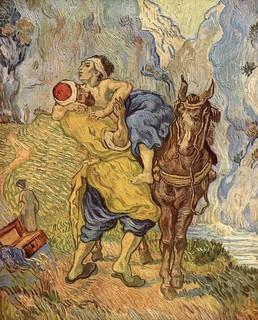
There is more than one way to read a parable. There are three characters in this story of the Good Samaritan. There is the lawyer standing at the sidelines posing the question, “who is my neighbor?” We might well put ourselves in his shoes and, in so doing, hear Jesus’ admonition to do as was done by the Samaritan to the robbery victim. Or we might look at this parable from the standpoint of the Samaritan who, finding a wounded Jew on the road side, sees not an enemy but simply a man in need of care and feels compassion. From that standpoint, we might evaluate our own capacity to see in our enemies the call of Jesus for the exercise of compassion. But it is also possible to view this parable from the standpoint of the guy who got the crap beaten out of him and was left on the roadside to die-and then received mercy from a source he never imagined mercy would ever come.

Twenty-three years ago, my wife lay in a coma and I was sitting at her bedside in the ICU waiting for some word on her prospects of recovery from any one of the many physicians caring for her. Had I been at home on the east coast, I would have been surrounded by family, caring friends and my church. As it was, we were on vacation in Seattle, Washington when my wife became ill and sank into unconsciousness. I desperately needed someone with whom to pray, to share my fear and pain. I made this need known to the hospital social worker. Though the hospital had no chaplaincy program, the social worker said she would reach out to the local Lutheran churches. A day later I had received neither a visit nor any pastoral communication. The social worker told me apologetically that she could find no Lutheran pastors willing or able to come out to the hospital. So I told her that I was not denominationally particular and that any flavor of Christian would do.

Not twenty minutes later a young man walked into the ICU room where I was sitting with my wife and introduced himself as an elder of the Church of Jesus Christ of Latter Day Saints, commonly known as Mormons. Having grown up in a town where Mormons were heavily represented, I had had a number of experiences with their aggressive evangelistic methods. I learned very early on that when they showed up at the door, the best policy was to say that you were in the middle of an important  phone call that would probably last for at least an hour and so were unable to speak. Then you shut the door before they can suggest scheduling another visit at a more convenient time. Under no circumstances do you open the screen door even a crack, unless you really are interested in having your soul saved. That was about the last thing I needed that day. I was beginning to think that my request for “any flavor of Christian” was maybe just a bit over broad.

Perhaps the young elder sensed my dismay. “Brother Peter,” he said. “You’ve probably heard that my church is very committed to evangelizing and winning people to our faith. But I know this isn’t the time or place for that. So perhaps we can sit together and pray in Jesus’ name for your wife and say the Lord’s Prayer together. Would that be OK?” That was exactly what I needed at that time and in that place. I was looking for ministry from my Lutheran and/or orthodox Christian siblings. But help came from the last place I could have expected. I think I know how that beaten and bloodied Jew lying on the side of the road must have felt when he looked up into the face of that Samaritan tenderly washing and binding up his wounds. Since that day, I have never been able to think of Mormons with the same uncharitable and judgmental attitude I developed growing up. To be sure, I still have my doctrinal and theological differences with Mormons. But I know now that they are my neighbors because, of all the churches from which help was sought on my behalf, the Mormons came and showed me compassion.

When you are in dire need of compassion and another human being offers it, you tend to forget about all the distinctions that seem so very important in this polarized culture of ours. When your house is on fire, you don’t ask the firefighter that got you safely outside and is risking life and limb to save your home whether she is a Muslim or whether he is gay or whether their politics is liberal or conservative or whether they are properly documented or what church, if any, they belong to. You are just grateful that your neighbors care enough about each other to arrange for fire protection; that there are women and men who care enough to take on the risky work of fighting fires and saving lives; that there are people willing to open their doors for you if necessary until you get back on your feet. Compassion does not recognize distinctions. God has created us with a marvelous capacity to look beyond our surface distinctions and recognize in one another the holy image we all share with our Creator. Sometimes, though, we need to get the crap beaten out of us to remind us that it’s there.

Here is a poem by Mark Turbyfill speaking to our common humanity pulling against all that divides us.

Strangers

God,

I shall tell you:

I am seeing and seeing strangers

Who are not strangers,

For there is something in their eyes,

And about their faces

That whispers to me

(But so low

That I can never quite hear)

Of the lost half of myself

Which I have been seeking since the beginning of earth.

And I could follow them to the end of the world,

Would they but lean nearer, nearer,

And tell me….”

Source: Poetry, (May 1917). Mark Turbyfill (1896-1990) was an American poet, dancer, and painter. He was born in Oklahoma City and came to Chicago with his parents in 1911. He began publishing poems while still a teenager. His professional dance career began in 1919 when he joined the Pavley-Oukrainsky corps de ballet with the Chicago Grand Opera Company. He continued to dance through the 1920s and 1930s, later becoming principal dancer under Adolph Bolm with the Chicago Allied Arts and partnering Chicago dancer and choreographer Ruth Page.