Tag Archives: Bible

Learning to See with the Heart

FOURTH SUNDAY IN LENT

1 Samuel 16:1-13

Psalm 23

Ephesians 5:8-14

John 9:1-41

Prayer of the Day: Bend your ear to our prayers, Lord Christ, and come among us. By your gracious life and death for us, bring light into the darkness of our hearts, and anoint us with your Spirit, for you live and reign with the Father and the Holy Spirit, one God, now and forever.

 “If you were blind, you would not have sin. But now that you say, ‘We see,’ your sin remains.” John 9:41.

According to Jesus, there is more to blindness than simply lack of sight. In fact, even a person born blind is capable of sight, while those with perfectly sound eyes can be utterly blind. The disciples were blind to the humanity of the man Jesus encounters in our gospel lesson, a man who managed against the odds to survive without sight in a world without a safety net for the disabled. To the disciples, this man was an abstraction, a theological riddle to be solved with sophistic arguments. Surely a good and gracious God cannot be responsible for such a dreadful circumstance as congenital blindness. “So what do you think, Jesus,” the disciples ask. “Who sinned, this man or his parents?” The disciples saw the man born blind with their perfectly sound eyes, but not with their hearts.

This kind of thinking is not unusual. Although we enlightened moderns are not inclined to attribute the misfortunes of others to divine wrath, we are often quick to attribute their suffering to some mistake, misstep or bad judgment on their part. In fact, there is a tendency to take perverse satisfaction in pointing out how easily the tragedies of others could have been avoided. “What was he thinking of, going into a neighborhood like that in the dark of night?” “What did she expect was going to happen, going to a frat party in that skimpy outfit?” “If he had thought for a single minute before answering that text, he would have recognized it as a scam.” I expect there is more than just meanness at work here. It is, after all, comforting to believe that we live in a universe where wise, good and prudent conduct is always rewarded and foolish, wicked and careless behavior punished. Such belief allows us to indulge in the delusion that we are safe from injury, tragedy and untimely death-if only we practice good sense and a modicum of decency. It blinds us to the reality that our world actually is one in which bombs incinerate teenage girls whose only crime was coming to school; tornados rip through towns leveling indiscriminately both churches and brothels; terminal cancer, starvation and violence afflict innocent children while vicious war criminals live into their nineties and die in peace.

Living in the light, as Jesus calls us to do, forces us to see things to which we might rather remain blind. Witness president Trump’s recent failed attempt to remove from President’s House in Philadelphia an exhibit that honored the lives of the nine people held there who were enslaved by President George Washington. Desperate to maintain the false mythology of a pure and virtuous America and its white founders, many among us would simply erase from our history the terrible legacy of slavery, Jim Crow and ideological racism. We prefer living in the darkness of comforting lies rather than in the harsh light of truth.    

There is a price to be paid, however, for such willful blindness. The real world, with all its unpredictable catastrophes, random tragedies and undeserved suffering affords those with eyes to see it opportunities to “work the works of [God] who sent [Jesus].” John 9:4. But for those who choose to remain in the false security afforded by what Jesus calls “darkness,” such opportunities remain forever out of reach. Blindness of willful complacency blunts the capacity for empathy and compassion, thereby deforming our humanity and preventing us from seeing with our hearts. This, not a mere infraction of some moral or religious code, is the biblical understanding of sin. Sin, according to Jesus, is the dangerous habit of willful blindness. It is a refusal to see what makes one uncomfortable, what challenges what one thinks one knows, what invites one into a larger understanding of what it means to be fully human. Jesus does not bother entertaining the disciples’ theoretical questions about the cause of the man’s blindness. Instead, he acts with compassion. He opens the blind man’s eyes and, in so doing, opens the spiritual eyes of his disciples. Unlike the disciples, Jesus sees the man born blind with his heart.

I have had to have my eyes opened numerous times throughout my life. I have had to learn over and over again to see not merely with my eyes, but with my heart. Through my wife’s debilitating injuries, I have come to a new realization of how thoroughly our society excludes persons with mobility challenges from full participation in our common life. Though it has been twenty-six years since the passage of the Americans with Disabilities Act, numerous barriers to restaurants, doctors offices, municipal buildings, places of worship, museums, beaches and public parks remain, preventing or making it difficult and dangerous for persons with mobility challenges to access essential services as well as recreational resources-which they support with their taxes as much as the rest of us. In traveling with Sesle on the slow, difficult road of recovery and adaptation, I have learned to see public buildings of all kinds in a new way. I see now the barriers, obstacles and obstructions that make a mockery of signs reading “welcome.” I am also increasingly mindful of others experiencing difficulty with these barriers and opportunities for offering assistance. That to which I was once blind, I can now see.

What will it take to open our eyes? What difference would it make if we could see the Iranian school girls killed by our bombs, not as inevitable “collateral damage,” but as the daughters of dads who beamed with pride as they watched them recite their prayers, moms who dressed them, brushed their hair and sent them off to school with no clue they would never see them again. What difference would it make if enough of us saw the 350,000 Haitian refugees the Trump administration is desperately seeking to deport, not as a mere number, but as parents seeking the same safe environment we seek for our children, young people longing for the opportunity to get a basic education, families who wish only to live free from the scourge of gang violence? What difference would it make if we could see all people with our hearts through the eyes of Jesus?

Here is a poem by Howard Nemerov speaking to the willful blindness against which Jesus warns us and from which he would liberate us.

The Murder of William Remington[1]

It is true, that even in the best-run state

Such things will happen; it is true,

What’s done is done. The law, whereby we hate

Our hatred, sees no fire in the flue

But by the smoke, and not for thought alone

It punishes, but for the thing that’s done.

And yet there is the horror of the fact,

Though we knew not the man. To die in jail,

To be beaten to death, to know the act

Of personal fury before the eyes can fail

And the man die against the cold last wall

Of the lonely world—and neither is that all:

There is the terror too of each man’s thought,

That knows not, but must quietly suspect

His neighbor, friend, or self of being taught

To take an attitude merely correct;

Being frightened of his own cold image in

The glass of government, and his own sin,

Frightened lest senate house and prison wall

Be quarried of one stone, lest righteous and high

Look faintly smiling down and seem to call

A crime the welcome chance of liberty,

And any man an outlaw who aggrieves

The patriotism of a pair of thieves.

Source:  The Collected Poems of Howard Nemerov (c. 1977 by Howard Nemerov, pub. by The University of Chicago Press). Howard Nemerov (1920-1991) was an American poet. He was twice Poet Laureate Consultant in Poetry to the Library of Congress, from 1963 to 1964 and again from 1988 to 1990. He also won the National Book Award for Poetry, Pulitzer Prize for Poetry, and Bollingen Prize. Nemerov was raised in New York City where he attended the Society for Ethical Culture’s Fieldston School. He later commenced studies at Harvard University where he earned his BA. During World War II he served as a pilot in the Royal Canadian Air Force as well as the United State Air Force. He was honorably discharged with the rank of Lieutenant and thereafter returned to New York to resume his writing career. Nemerov began teaching, first at Hamilton College and subsequently at Bennington College and Brandeis University. He ended his teaching career at Washington University in St. Louis, where he was elevated to Edward Mallinckrodt Distinguished University Professor of English and Distinguished Poet in Residence from 1969 until his death in 1991. Nemerov’s poems demonstrated a consistent emphasis on thought, the process of thinking and on ideas themselves. Nonetheless, his work always displayed the full range of human emotion and experience. You can find out more about Howard Nemerov and sample more of his poetry at the Poetry Foundation website.  

[1] William Walter Remington (1917–1954) was an American economist who was employed in various United States government positions. His career was interrupted by accusations of communist espionage made by Elizabeth Bentley, a Soviet spy and defector. Remington was tried twice and convicted twice. The first conviction was set aside on legal grounds, but the second conviction on two counts of perjury was upheld. He was sentenced to three years in federal prison. In November 1954, he was murdered in his cell by fellow inmates at Lewisburg Prison.

The Power of Weakness

THIRD SUNDAY IN LENT

Exodus 17:1-7

Psalm 95

Romans 5:1-11

John 4:5-42

Prayer of the Day: Merciful God, the fountain of living water, you quench our thirst and wash away our sin. Give us this water always. Bring us to drink from the well that flows with the beauty of your truth through Jesus Christ, our Savior and Lord, who lives and reigns with you and the Holy Spirit, one God, now and forever.

In this Sunday’s gospel reading we find Jesus slumped against the façade of Jacob’s well, famished, exhausted and thirsty. The journey through hostile Samaritan territory from Galilee to Judea did not afford much in the way of comforts. The Samaritan villages along the way could hardly be expected to offer hospitality or even staples such as food and water to a band of Jewish travelers. It seems the disciples had to go some distance out of their way to get food-perhaps a detour into a more friendly Jewish enclave? In any event, Jesus was evidently too worn out to accompany them.

We are not accustomed to thinking of Jesus as weak, vulnerable and at the mercy of strangers. But that is the way the woman from Samaria found him. I can imagine the smirk on her face as she answered Jesus call for a drink, “How is it that you, a Jew, ask a drink of me, a woman of Samaria?” I can hear her thinking to herself or perhaps even saying, “guess you must be pretty thirsty mister high and mighty rabbi to beg a filthy Samaritan woman for a drink.” She must have been amused to hear Jesus offer her living water. “Well isn’t that just like one of you holier than thou Jews. Think you’re the one in control? Think you hold all the cards? Well guess what? I’m the one with the bucket. If anyone here is going to get water, it’s going to come from my bucket.”

Jesus then tells her to call her husband only to be told that she has none. Then, Jesus reveals that he knows her better than she thinks anyone could. It is here that I think the preaching of this story goes off the rails. Too often, the fact that the woman has been married five times and is now living with a man who is not her husband draws moral disapproval from us moderns. We assume that she is a floozie, a loose woman, an adulteress with a torrid sexual history. But that is hardly likely. In the first century, divorce was the sole prerogative of men and, as evidenced by Jesus’ dealings with religious authorities elsewhere in the gospels, there were some who believed that it was “lawful for a man to divorce his wife for any cause.” Matthew 19:3. The Samaritan woman might have been divorced due to a health condition that made her sexually undesirable. She might have been unable to conceive and bear children and thus incapable of continuing the family line. Or perhaps she was, like the luckless woman described by Jesus’ opponents in the dispute over the resurrection, passed through a succession of brothers, all of whom predeceased her. Mark 12:18-23. Whatever the case may have been it is obvious that this woman has known repeated rejection and her failure to remarry marks her as “damaged goods.” In spite of all this, which is somehow known to Jesus, Jesus is genuinely interested in her. The woman, for her part, is beginning to take an interest in this strange Jewish rabbi.

Now the woman poses a question to Jesus: “Our ancestors worshiped on this mountain, but you say that the place where people must worship is in Jerusalem.” So, which is it? It was hardly an idle question. The subject had been a matter of fierce dispute ever since the northern Israelite tribes broke away from the tribes of Judah and Benjamin to become the Northern Kingdom of Israel a millennium ago.  Perhaps she was expecting a lengthy dissertation on why the temple in Jerusalem is the only legitimate place of worship and that the Samaritan temple on Mount Gerizim was an idolatrous sham. What she got was a startling admission on Jesus’ part that neither the Temple in Jerusalem nor the Jewish nation hold a monopoly on genuine worship. “The hour is coming and is now here,” says Jesus, “when the true worshipers will worship the Father in spirit and truth, for the Father seeks such as these to worship him.” Did this Jew just say that Samaritans, too, can be genuine worshipers of God? The thought is almost too big to get one’s head around. “I know that Messiah is coming,” says the woman. It seems she wants to be done with this conversation. “When he comes, he will proclaim all things to us.” To this, Jesus replies, “I am he, the one who is speaking to you.” 

At this point, the disciples return and wonder why Jesus is speaking with a woman of Samaria and what he could possibly want with her. The woman takes her leave at this point. Significantly, I think, she leaves her bucket behind, thereby enabling Jesus to access the water from Jacob’s well, a small act of compassion toward the one she so recently deemed a de facto enemy.  Moreover, she invites the people of her village to come and see this remarkable teacher who saw her, knew her and expressed a passionate interest in her. The Samaritans come out in force to meet Jesus, inviting him and his disciples to stay with them. Jesus “remains” with them for a full two days.

The Greek word “meno” meaning “to remain” is a significant one in John’s gospel. John the Baptizer announces that Jesus was known to him by the witness of the Holy Spirit that both descended and “remained” upon Jesus. John 1:32. In his final words to his disciples, Jesus urged his disciples to “abide in me as I abide in you.” John 15:4. Here the English word “abide” is but another translation of the Greek word, “meno.” Thus, you could translate the verse as “remain in me as I remain in you.” As God loves God’s beloved Son, so the Son loves us and invites us to “abide” or “remain” in God’s love. John 15:9. In Sunday’s gospel, the love of God that stubbornly abides in Jesus penetrates the heart of a women that ought to have been an enemy. The inroads made into her heart opened up a crack in the wall of historic enmity between Jew and Samaritan, allowing the living waters of reconciliation and healing to flow freely and bring new life.  

There is an old saying, the source of which I have not been able to ascertain, that “an enemy is a person whose story you have not heard.” Saint Paul reminds us that our “struggle is not against blood and flesh but against the rulers, against the authorities, against the cosmic powers of this present darkness, against the spiritual forces of evil in the heavenly places.” Ephesians 6:12. The weapons we are given to resist them are truthful speech, righteous integrity, the way of peace, prayer and the good news of God’s redemptive intent for our world. Ephesians 6:14-18. We wage peace rather than war, forgiveness rather than retribution, prayer rather than threats. We know that those who display aggressiveness, utter threats and commit violence do so from profound hurt, desperate fear and deep seated insecurity. Loving one’s neighbor (which includes the enemy) as oneself requires that one get inside the other’s skin, try to see the world through their eyes and understand the journey that led them to where they are. Such love requires one to look past whatever harm the other has done, whatever hateful views the other might express and whatever threat they may appear to present in order to touch with a healing hand the places where they are hurting. As Jesus demonstrates, such love requires one to become vulnerable, helpless and open to the other.

As again Saint Paul reminds us, this way of Jesus appears as folly to those who believe that strength consists in raw coercive power. I Corinthians 1:18-25. But we are witnessing today the tragic consequences of employing raw coercive power to achieve justice and peace throughout the middle east. Violence does not end violence. It only begets more violence spiraling out of control and drawing ever more victims into its vortex of death and destruction. Today, as has always been the case, Jesus’ way is the way, the truth and the life. Jesus and his way of the cross are the only way out of our self destructive path. It is not for nothing the Samaritan villagers recognized in Jesus “the savior of the world.”

Here is a brief poetic fragment by Edwin Markham that illustrates in one broad stroke the way of Jesus as it appears in our gospel lesson for this coming Sunday.

He drew a circle that shut me out –

Heretic, rebel, a thing to flout.

But Love and I had the wit to win:

We drew a circle that took him in.

Source: This poem is in the public domain. Edwin Markham (1852—1940) was born in Oregon City, Oregon and was the youngest of 10 children. At the age of four and following his parent’s divorce, he moved with his mother to Lagoon Valley in Solano County, California. Markham attended San Jose Normal School (now San Jose State University) graduating in 1872. Markham’s most famous poem, “The Man with the Hoe,” which accented laborers’ hardships, was first presented at a public poetry reading in 1898. His main inspiration was a French painting of the same name (in French, L’homme à la houe) by Jean-François Millet. Markham’s poem was published and achieved instant popularity. Throughout Markham’s life, many readers viewed him as an important voice in American poetry, a position signified by honors such as his election in 1908 to the National Institute of Arts and Letters. You can read more about Edwin Markham and sample more of his poetry at the Poetry Foundation website.

Born Anew the Better to See

SECOND SUNDAY IN LENT

Genesis 12:1-4

Psalm 121

Romans 4:1-5, 13-17

John 3:1-17

Prayer of the Day: O God, our leader and guide, in the waters of baptism you bring us to new birth to live as your children. Strengthen our faith in your promises, that by your Spirit we may lift up your life to all the world through your Son, Jesus Christ, our Savior and Lord, who lives and reigns with you and the Holy Spirit, one God, now and forever.

Sunday’s lessons from Genesis and Romans lift up Abraham as a person of strong faith. The psalm describes in a beautiful, lyrical way what such faith looks like. By contrast, the gospel lesson features Nicodemus-hardly someone that comes to mind when examples of faith are under discussion. We meet Nicodemus three times in John’s gospel. In our gospel lesson, we find him creeping silently through the night to question Jesus under the cover of darkness. John does not tell us specifically why Nicodemus came at night, but we can safely conjecture that he did not want to be publicly associated with Jesus. We know that there were some influential religious leaders who believed in Jesus but were fearful of expressing their faith in him. Evidently, Nicodemus was among them. John 12:42.

Nicodemus comes across as something of a dufus who cannot seem to follow Jesus’ line of thinking. But in all fairness, I have some difficulty with that myself. Jesus declares that no one can see the reign of God unless they are “born anew.” Nicodemus asks, quite reasonably, “How can anyone be born after having grown old?” Birth is a traumatic experience. One minute you are in a warm, dark, quiet and safe environment where all your needs are met without any effort on your part. The next you are thrust into realm of novel and unintelligible noise, harsh lights, cold air and new experiences of touch and smell. You have no conceptual tools or prior experience to make sense of everything that is happening to you. It is probably a good thing we cannot remember the experience of birth. If we did, we would probably be spending the rest of our lives in trauma therapy.

In order to be “born anew” or “born from above,” you need to unlearn everything you have ever learned. You must be stripped of all the assumptions, all of the biases, all of the family, religious and national loyalties into which you have been encultured and left psychically and spiritually naked. What, short of a traumatic brain injury, could put you into such a state? Yet according to Jesus, that is what must happen before we can comprehend God’s reign. Rebirth is hard to imagine. A new born infant or even a small child comes into the world without knowing what is possible, what is impossible, what is good or what is evil. For them, the world is all raw, unmediated sensation. Accordingly, they are radically open to learning and learn is what they do! Most of the critical learning we do occurs between infancy and early childhood. The older we get, the less open we are to learning. What we have already learned and believed becomes more deeply ingrained as we age. The older we get, the harder it is to let go of deeply held convictions and beliefs. The longer we have committed blood, sweat, time and effort supporting our religious institutions, our political parties and our familial communities, the harder it is question these loyalties, much less abandon them. Nicodemus was right to wonder how an adult can begin to view the world with the eyes of a child, unclouded by years of learning and experience.

Something like birth from above is what was required of Abraham when God called him to leave his home, his kindred and his tribe and follow God’s leading to some land somewhere he had never seen. His new life would consist of living as a homeless nomad and an alien in an unfamiliar land filled with hidden dangers. Yet this land, God tells the childness and aged Abraham, will one day belong to his descendants. Abraham would have been more than justified in asking, as did Nicodemus, “how can these things be?” John 3:9.

Sarah, Abraham and their descendants are models of faith. Notwithstanding what we moderns might view as their moral failures and shortcomings, they staked their lives on a promise. All the conditions that confronted them weighed against the fulfilment of the promise. As the author of the Letter to the Hebrews points out, their faith was based “on things hoped for, the conviction of things not seen.” Hebrews 11:1. Our nomadic spiritual ancestors’ conviction that the land of Cannan belonged to them was at odds with the hard geopolitical realities of the bronze age. Yet they lived in expectation of its fulfilment as though it were a sure thing.

As professor Stanley Hauerwas has observed, the life disciples of Jesus live makes no practical common sense apart from belief in Jesus’ resurrection. By raising from the dead the man whose life was lived in accord with the impractical, ineffective and hopelessly altruistic precepts of the Sermon on the Mount ending his crucifixion and the dispersion of his followers, God declares that the future belongs to the poor, the meek, the pure in heart, the merciful, the peacemakers and especially those who are most hated, despised and persecuted. The Resurrection places the proud, the wealthy, the war mongers, wall builders, the culture warriors and ethnic cleansers on the wrong side of history. So, because God raised Jesus from death, we continue to pick up the garbage on our streets even though our efforts are dwarfed by the tons of industrial waste dumped all over our planet by commercial interests whose only value is financial gain. We continue advocating for transgender children, racial justice and humane immigration policies even when our political allies plead with us to downplay such matters and focus instead on “kitchen table issues.” We make peace through seeking reconciliation, forgiveness and restorative justice in a world convinced that peace can only be made through the threat, and failing that, the use of military might. None of this makes sense unless you believe that God raised Jesus from death and that therefore the future belongs to the just, gentle and peaceful reign of God.

So how does our friend Nicodemus fit into all of this? As we have noted, he is one of the religious leaders who believed Jesus but was unwilling to associate with him publicly. John the Evangelist has harsh words for such under cover believers. He chides them for loving human praise more than the praise of God. John 12:43. Still, it is worth noting that when the religious authorities were hell bent on arresting Jesus, it was Nicodemus who spoke up and insisted that no such action should be taken without first hearing what Jesus had to say. John 7:45-52. Following Jesus’ crucifixion, his disciples all deserted him and left his body to be pecked at by crows and eaten by dogs at the foot of the cross. But Nicodemus, along with Joseph of Arimathea, another under cover disciple, sought permission to take down the body of Jesus and give him a proper burial. John 19:38-42. It seems that despite his initial skepticism, Nicodemus may have been born anew. It appears that perhaps he did catch a glimpse of God’s reign. Did it lead him finally to a life of discipleship? John the Evangelist leaves us to wonder about that.

Here is a poem by Ralph Waldo Emerson that speaks to “a love that in the spirit dwells that panteth after things unseen.” It is to that spirit Jesus appeals when he says to Nicodemus, “What is born of the flesh is flesh, and what is born of the Spirit is spirit. Do not be astonished that I said to you, ‘Youmust be born from above.’The windblows where it chooses, and you hear the sound of it, but you do not know where it comes from or where it goes. So it is with everyone who is born of the Spirit.” John 3:6-8.

Gnothi Seauton (Know Thyself)

There is in all the sons of men

A love that in the spirit dwells

That panteht after things unseen

And tidings of the future tells

And God hath  built his alter here

To keep this fire of faith alive

And set his priests in holy fear

To speak the truth-for truth to survive.

And hither come the pensive train

Of rich & poor of young & old,

Of ardent youths untouched by pain

Of thoughtful maids & manhood bold

They seek a friend to speak the word

Already trembling on their tongue

To touch with prophet’s hand the Chord

Which God in human hearts hath strung

To speak the pain reproof of sin

That sounded in the soul before

And bid them let the angels in

That knock at humble Sorrows door.

They come to hear of faith & hope

That fill the exulting soul

They come to lift the curtain up

That hides the mortal goal

O thou sole  source of hope assured

O give thy servant power

So shall he speak to us the word

Thyself dost give forever.

Source: Journals and Miscellaneous Notebooks of Ralph Waldo Emerson, vol. 3, edited by William H. Gilman & Alfred R. Ferguson (c. The Bellknap Press of Harvard University, Cambridge, MA, 1964) Ralph Waldo Emerson (1803-1882) was an American essayist, lecturer, philosopher, minister, abolitionist, and poet who led the Transcendentalist movement of the mid-19th century. He was born in Boston, Massachusetts, on May 25, 1803,[15] to Ruth Haskins and the Rev. William Emerson, a Unitarian minister. at age fourteen, Emerson went to Harvard College and was appointed freshman messenger for the president, requiring Emerson to fetch delinquent students and send messages to faculty. He took outside jobs to cover his school expenses, including as a waiter for the Junior Commons and as an occasional teacher. Emerson served as Class Poet and, as such, presented an original poem on Harvard’s Class Day, a month before his official graduation on August 29, 1821. In the early 1820s, Emerson was a teacher at the School for Young Ladies. He next spent two years living in a cabin in the Canterbury section of Roxbury, Massachusetts, where he wrote and studied nature.

In 1826, faced with poor health, Emerson went to seek a warmer climate. He first went to Charleston, South Carolina, but found the weather was still too cold. He then went farther south to St. Augustine, Florida. There Emerson had his first encounter with slavery. At one point, he attended a meeting of the Bible Society while a slave auction was taking place in the yard outside. He wrote, “One ear therefore heard the glad tidings of great joy, whilst the other was regaled with ‘Going, gentlemen, going!'” Emerson was staunchly opposed to slavery. In the years leading up to the Civil War he gave a number of lectures on the subject. He  welcomed John Brown to his home during Brown’s visits to Concord and voted for Abraham Lincoln in 1860, whom he later met in person. Starting in 1867, Emerson’s health began to decline. He wrote much less and started experiencing memory problems. Still, he continued to travel widely and lecture in Europe and the United States. He died from complications of pneumonia in 1892. You can read more about Ralph Waldo Emerson and sample more of his poetry at the Poetry Foundation website

Joyful Repentance?

FIRST SUNDAY IN LENT

Genesis 2:15-17; 3:1-7

Psalm 32

Romans 5:12-19

Matthew 4:1-11

Prayer of the Day: Lord God, our strength, the struggle between good and evil rages within and around us, and the devil and all the forces that defy you tempt us with empty promises. Keep us steadfast in your word, and when we fall, raise us again and restore us through your Son, Jesus Christ, our Savior and Lord, who lives and reigns with you and the Holy Spirit, one God, now and forever.

“Happy are those whose transgression is forgiven,
    whose sin is covered.

Happy are those to whom the Lord imputes no iniquity
    and in whose spirit there is no deceit.”  Psalm 32:1-2.

Our prayer for this first Sunday in Lent rings true with a particular clarity these days. The “struggle between good and evil rages within and around us” and we are tempted with a slew of “empty promises” at every turn. The Lenten challenge is to turn away from the allure of such promises, reject the claims the evil one would assert over our lives and lament our complicity in society’s systemic injustice. But is that really all there is to it? Is repentance only a matter of lamenting sin, turning away from evil and receiving forgiveness for past wrongs? I don’t think so. Over many years of leading my congregations through the season of Lent, the Three Days and celebration of the Resurrection, I have become convinced that we have not gotten repentance completely right.

A member of the worshiping community of which I am a part during the vacation season here on the Outer Cape recently summarized a sermon he heard in which the preacher declared, concerning the oppressive measures of our government against so many vulnerable groups, “I am not part of the so-called resistance. I am not resisting anything. I am struggling to follow Jesus and live into the reign of God he proclaims. They are the resistance.” I heard similar sentiments expressed by a member of one of our churches in Minneapolis involved with providing food assistance to persons afraid to leave home for fear of ICE violence. Disciples of Jesus practice the life of God’s coming reign in the face of resistance from a world unprepared to accept it. To be sure, such an existence takes the form of the cross, but its end is resurrection and a new creation. Thus, repentance is not merely or even chiefly a matter of sorrow for sin and turning away from evil. It is turning toward the imminent reign of God. Rejection of the devil and all his empty promises is not a precondition, but the consequence of this joyful turning.

What happens when we view the temptations Jesus faced in this light? The good news here is that God can be trusted to provide for our most basic human needs-and has so provided. Contrary to what the false apostles of scarcity keep telling us, this earth is capable of feeding, sheltering and caring for all people, notwithstanding the violence we have inflicted upon it. I recall a lecture I once attended led by a leader of my church’s global hunger ministry during which a woman posed the following question: “If God loves us so much, how come there are so many of these hungry people you keep talking about?” Without missing a beat, the speaker replied, “Many theologians and philosophers have struggled with that question and written thousands of books on the subject. But I think part of the solution to the problem is resting right there in your purse.” As the disciples learned when faced with a hungry crowd of five thousand, a little bit goes a long way when placed into the hands of Jesus, who calls us to trust God’s generosity as we practice our own.

The good news is that suffering, loss and even pain need not be feared. The devil would have Jesus believe that the reign of God will come without sacrifice. If you trust God, God will “rapture you away from the great tribulation.” Your faith plants the seeds and God sends the harvest of prosperity,” “all things work out for good for those who trust God.” Quoting Psalm 91, the devil assures Jesus that he can safely throw himself down from the roof of the temple because,

 “God will command his angels concerning you,’
    and ‘On their hands they will bear you up,
so that you will not dash your foot against a stone.’”  

But there is more to this Psalm than the devil is letting on. The author of the psalm is quite possibly a soldier who has known the dangers of combat. Or perhaps he or she is the survivor of a plague. Whoever they may be, they have seen death up close and personal. They know that God “will be with them in trouble.” Psalm 91:15. That is quite different from promising that there will be no trouble for those who trust in God. To the contrary, Jesus knows that his trust in his Heavenly Father will subject him to opposition, suffering and death. But suffering and death, real though they surely are, do not have the last word. For that reason, they have, as Saint Paul says, “lost their sting.” I Corinthians 15:54-55.

The good news is that God’s reign comes without violence, force or coercion of any kind. Jesus has no need for “all the kingdoms of the world and their glory.” Matthew 4:8. He knows that such glory and power are illusionary. As the prophet Isaiah points out, the nations “are like a drop from a bucket.” Isaiah 40:15. As went Assyria, Babylon, Persia and Greece, so goes Rome, the Third Reich, the Soviet Union and, perhaps soon, the United States of America. Contrary to what much of American Christianity believes, God does not need the United States, democracy or the constitution to implement or prop up God’s reign. Jesus knows that empires have only time to “strut and fret” their “hour upon the stage” and then be “heard no more.” MacBeth, Act 5, Scene 5. God has all eternity with which to work. God’s reign will come with or without our efforts. The only question is, will we accept Jesus’ invitation to participate in that joyous occurrence or throw our lives away in futile resistance?

In sum, I believe repentance to be a joyful opportunity. It is grounded not in angry reaction to the evil around us, but in a thankful response to Jesus’ invitation to live under God’s just and gentle reign. Joyful repentance is on full display in the words of Wendell Berry:

“So, my friends, every day do something

that won’t compute. Love the Lord.

Love the world. Work for nothing.

Take all that you have and be poor.

Love somebody who does not deserve it.

Denounce the government and embrace

The flag. Hope to live in that free

republic for which it stands.”

Repentance is not mere resistance, but an affirmative response to the better live Jesus invites us to share with him. We don’t have to repent. We get to repent.

To be clear, repentance does involve sorrow for the time we have wasted in bitterness, envy, selfishness and greed. There is genuine and proper regret for the harm we have done to others and the wounds we have inflicted on our planet. But the good news of the gospel is that our past need not determine our future. What we have done cannot be undone, but it can be worked into a narrative of redemption. Again, as Wendell Berry urges,

“As soon as the generals and politicos

can predict the motions of your mind,

lose it. Leave it as a sign

to mark the false trail, the way

you didn’t go…”

Let this Lenten season be one in which our sober acknowledgement of brokenness nevertheless glows with a measure of Easter joy.

Here is the full poem of Wendell Berry cited above.

    Love the quick profit, the annual raise,
    vacation with pay. Want more
    of everything ready-made. Be afraid
    to know your neighbors and to die.
    And you will have a window in your head.
    Not even your future will be a mystery
    any more. Your mind will be punched in a card
    and shut away in a little drawer.
    When they want you to buy something
    they will call you. When they want you
    to die for profit they will let you know.

    So, friends, every day do something
    that won’t compute. Love the Lord.
    Love the world. Work for nothing.
    Take all that you have and be poor.
    Love someone who does not deserve it.
    Denounce the government and embrace
    the flag. Hope to live in that free
    republic for which it stands.
    Give your approval to all you cannot
    understand. Praise ignorance, for what man
    has not encountered he has not destroyed.

    Ask the questions that have no answers.
    Invest in the millennium. Plant sequoias.
    Say that your main crop is the forest
    that you did not plant,
    that you will not live to harvest.
    Say that the leaves are harvested
    when they have rotted into the mold.
    Call that profit. Prophesy such returns.

    Put your faith in the two inches of humus
    that will build under the trees
    every thousand years.
    Listen to carrion – put your ear
    close, and hear the faint chattering
    of the songs that are to come.
    Expect the end of the world. Laugh.
    Laughter is immeasurable. Be joyful
    though you have considered all the facts.
    So long as women do not go cheap
    for power, please women more than men.
    Ask yourself: Will this satisfy
    a woman satisfied to bear a child?
    Will this disturb the sleep
    of a woman near to giving birth?

    Go with your love to the fields.
    Lie down in the shade. Rest your head
    in her lap. Swear allegiance
    to what is nighest your thoughts.
    As soon as the generals and the politicos
    can predict the motions of your mind,
    lose it. Leave it as a sign
    to mark the false trail, the way
    you didn’t go. Be like the fox
    who makes more tracks than necessary,
    some in the wrong direction.
    Practice resurrection.  

Source: The Peace of Wild Things, Wendell Berry, (c. Wendell Berry, 2016; pub. by Penguin Random House, UK). Wendell Berry (b. 1934) is a poet, novelist, farmer and environmental activist. He is an elected member of the Fellowship of Southern Writers, a recipient of The National Humanities Medal and the Jefferson Lecturer for 2012. He is also a 2013 Fellow of The American Academy of Arts and Sciences. Berry was named the recipient of the 2013 Richard C. Holbrooke Distinguished Achievement Award. On January 28, 2015, he became the first living writer to be inducted into the Kentucky Writers Hall of Fame. You can read more about Wendell Berry and sample more of his works at the Poetry Foundation website.

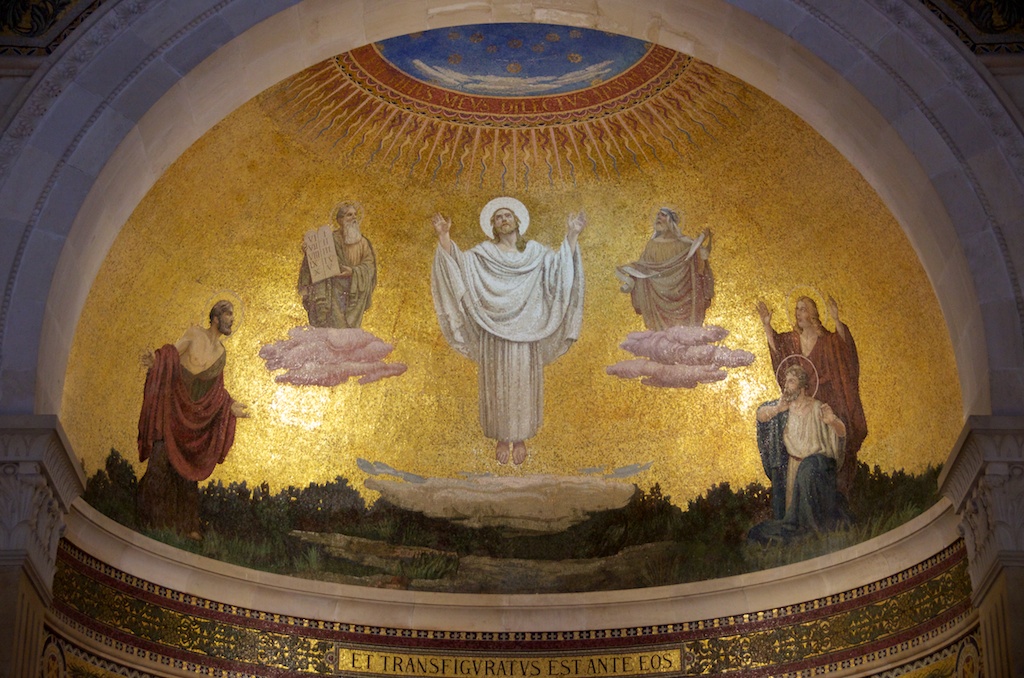
From Transfiguration to Transformation

TRANSFIGURATION OF OUR LORD

Exodus 24:12-18

Psalm 2 or

Psalm 99

2 Peter 1:16-21

Matthew 17:1-9

Prayer of the Day: O God, in the transfiguration of your Son you confirmed the mysteries of the faith by the witness of Moses and Elijah, and in the voice from the bright cloud declaring Jesus your beloved Son, you foreshadowed our adoption as your children. Make us heirs with Christ of your glory, and bring us to enjoy its fullness, through Jesus Christ, our Savior and Lord, who lives and reigns with you and the Holy Spirit, one God, now and forever.

 “This is my Son, the Beloved; with him I am well pleased; listen to him!” Matthew 17:5.

Just when the disciples think they finally have Jesus figured out, they find out they don’t. Just when they think they understand what the reign of God is all about, they discover they have a lot more to learn. They struggle to comprehend Jesus’ parables, they question his judgment when he tells them they are bound for Jerusalem and they do not know what to make of the Transfiguration but are clearly intent on making it last. The succeeding generations of disciples have fared no better. We are still trying to figure out who Jesus is, what he demands of us and how to follow him. Over the centuries, the church has made some disastrous wrong turns, not the least of which was turning Jesus into the mascot of empire, the tool of colonialism and, most recently, the patron saint of American racism, genocide, misogyny and homophobia. The way of discipleship is, as Jesus characterizes it, “narrow” and “hard.” By contrast, the way leading us away from it is “wide and the road is easy.” Matthew 7:13-14. Thus, the divine imperative: “This is my Son, the Beloved…listen to him.”

How do people like us who are two millennia removed from Jesus’ earthly ministry listen to him? Of course, the most direct witnesses we have to Jesus are the Hebrew Scriptures and the New Testament. The Bible, consisting of both documents, is understood in my Lutheran tradition to be the Word of God-but only in a derivative sense. Primarily, the Word of God is the Word made flesh, the incarnate Word, Jesus the Christ. In the not too distant past, we would have said that the Bible is “inerrant and infallible.” The abandonment of these terms in our more recent statements of faith caused quite a stir among folks who felt we were watering down the Bible’s authority. But I think jettisoning these terms was a wise decision. They say both too much and too little. They claim too much because they ascribe everything to the text, suggesting that we disciples of Jesus are a “people of the book.” [1] On the other hand, these two terms say too little because they fail to specify the focus of the Bible’s testimony to the Incarnate Word. In arguing with his opponents, Jesus remarked, “you search the scriptures because you think that in them you have eternal life, and it is they that testify on my behalf.” John 5:39. I prefer to say that the Bible is a faithful and reliable witness to God’s saving acts toward Israel and God’s redemptive acts for all creation through the obedient life, faithful death and glorious resurrection of Jesus. Disciples of Jesus read and interpret the scriptures through this lens. That is how the Bible enables us to listen to Jesus.  

Still, the fact remains that the Bible has not always functioned as a redemptive text or a faithful witness to Jesus and the reign of God he proclaims. Throughout history the Bible has been cited in support of unspeakable hatred, violence and cruelty. In both the United States and South Africa, the accounts of Israel’s conquest of Canaan were cited as a rationale for invading, conquering and dispossessing indigenous peoples. Saint Paul’s admonition to respect governing authorities as instruments of God’s justice has been cited to justify tyranny and condemn resistance to it. The Bible was regularly invoked to support the institution of slavery in the antebellum United States and afterward to support the systemic racism of Jim Crow. Biblical passages have been employed to demonize, ostracize and incite violence against gay, lesbian and transgender persons. The Bible is a complex, layered and diverse collection of literature filled with rabbit holes leading to dark and frightening places. It is a dangerous book in the hands of the wrong people.

That brings us to our reading from II Peter where the apostle says, “First of all you must understand this, that no prophecy of scripture is a matter of one’s own interpretation.” II Peter 1:20. That is not to say the Bible needs no interpretation. As noted above, it clearly does. The operative words in Peter’s remark are “one’s own.” Interpretation of scripture is far too important a task to be left to everyone’s individual conscience. It is too important to be placed solely in the hands of ecclesiastical authorities or left to the outcome of any democratic process. Interpretation of scripture is the task of the whole church. We need the wisdom and experience of bishops, pastors and teachers to school us in the lessons learned by the church over the centuries and the hard won teachings that have guided us. We need prophetic voices of preachers speaking from the margines to warn us when our orthopraxy does not match our orthodoxy and call us back to faithfulness. We need writers, poets, artists and musicians to stretch our imaginations and help us to see and understand in new ways our Lord Jesus and the reign of God he proclaims. I daresay we need even the heretics. While we may reject their claims and teachings, we can thank them for helping us clarify, revise and strengthen our own. (And I hope we are learning to treat them more grace and gentleness than we have in the past!) Through all these witnesses, we discover anew the Jesus we thought we knew as he is constantly transfigured and we are by him transformed.

Here is a poem about perception that transfigures and its transformative potential by Jennifer Jean.

Doors of Perception

My father leapt on stage at the Hollywood Bowl

to grab drum and cymbal sticks

from a star—he wanted to be

a star, a door, a Door. White. Security

thugs dragged him off

John Densmore. He saw doors everywhere, he saw Doors

everywhere—at the Whisky,

the Beanery, the Magic Mountain fest—and

in primary colors

in Windward, Oakwood, or North of  Rose. He wanted

to forget war in Venice, to be a door in Venice

and face the faux canals.

Later, he flew to Paris to pay homage to the Door who died

with a head of Alexandrian hair.

He carried huge pale poppies

to the “Poets’ Corner” in the Père Lachaise,

to this stranger under a cream coffin

door nailed shut. He said, Break on through.

He put a poppy in his pocket

like a receipt,

and chased daylight till he landed

in LA, saw a wave of  white

stars rippling

on the Pacific on new moon nights,

when the ever-present rust cloud was blown out to sea.

He found a motel room door, particle door, and shut it

on all that he owned

for fifty years. He lived there, adding up primary colors,

hour to hour in Bliss Consciousness—

crossing his legs on the bed, letting electric snow

hush the TV. Hush

gunfire and

blood. He forgot his father’s father’s Cabo Verde

and let himself   be Italian there—

a different kind of   Venetian—because who he really was was

too close to Black.

Source: Poetry (October 2020). Jennifer Jean is a poet, translator, editor and educator. She was born in Venice, California and lived in foster-care until she was seven. Her ancestors are from the Cape Verde Islands. She grew up in California’s San Fernando Valley. She earned her BA in creative writing from San Francisco State University and her MFA in poetry from Saint Mary’s College. Jean has been awarded fellowships from the Kenyon Review Writers Workshop, Disquiet/Dzanc Books, the Massachusetts Cultural Council, and the Kolkata International Poetry Festival. She received the Jean Pedrick Award from the NEPC, and an Ambassador for Peace Award from the Women’s Federation for World Peace. Jean is the founder of Free2Write: Poetry Workshops for Trauma Survivors, and has been the poetry editor for Talking Writing Magazine and MER. You can read more about Jennifer Jean and sample more of her poetry at the Poetry Foundation website.


[1] My friends who insist on an inerrant Bible find themselves drawn down a thousand rabbit holes, having to defend a literal six day creation, a literal worldwide flood and a literal halt to the earth’s rotation against all scientific evidence. This is necessary because if the Bible is found to be unreliable in any single detail, its credibility is destroyed and faith is undermined. But this is to do exactly what Jesus’ opponents were doing, namely, placing faith in the scriptures rather than the God to whom the scriptures testify.  

Salt for our Wounds

FIFTH SUNDAY AFTER EPIPHANY

Isaiah 58:1-12

Psalm 112:1-10

1 Corinthians 2:1-16

Matthew 5:13-20

Prayer of the Day: Lord God, with endless mercy you receive the prayers of all who call upon you. By your Spirit show us the things we ought to do, and give us the grace and power to do them, through Jesus Christ, our Savior and Lord. Amen.

“Is not this the fast that I choose:
    to loose the bonds of injustice,
    to undo the straps of the yoke,
to let the oppressed go free,
    and to break every yoke?
Is it not to share your bread with the hungry
    and bring the homeless poor into your house;
when you see the naked, to cover them
    and not to hide yourself from your own kin?” Isaiah 58:6-7.

“You are the salt of the earth, but if salt has lost its taste, how can its saltiness be restored? It is no longer good for anything but is thrown out and trampled under foot.” Matthew 5:13.

Salt had numerous uses in the first century. It was used for enhancing the flavor of food as it is today. Salt was also employed as a preservative, critical for warm climates. It was used to brighten the light of oil lamps, increase the efficiency of baking ovens and as a cleansing agent. Salt was a component in ritual sacrifices, sometimes spoken of as a symbol of Israel’s covenant with God. For more on this, see Nolland, John, The Gospel of Matthew, (New International Greek Testament Commentary, c. 2005 by Wm. B. Eerdmans Publishing Co.). We need not settle on which particular use Jesus had in mind to appreciate the metaphor. Whether acting as seasoning, preservative, cleanser, brightener, cooking aid or ritual symbol, salt is always used to benefit something else. The one thing salt cannot do is salt itself. Salt that has become degraded, diluted or altered in some way such that its effectiveness is impaired cannot be restored by adding more salt to it.

As we move further into this section of Matthew known as the Sermon on the Mount, we hear Jesus becoming increasingly critical of the religion practiced by many of the scribes and Pharisees. He makes clear, however, that his criticism is not of Judaism and its practices. To the contrary, he makes clear that he did not come to abolish, but to fulfill the Torah. Jesus is fully supportive of his opponents’ practices of fasting, prayer and almsgiving. His criticism goes rather to the failure of their fasting, prayers and giving to inspire them toward observance of the “weightier matters of the law: justice and mercy and faith.” Matthew 23:23. In this Jesus was consistent with the prophet Isaiah who chides his own contemporaries for their scrupulous observance of ritual fasting on the one hand while ignoring the needs of their needy neighbors on the other. Faith that does not embody empathy toward the world of neighbors is not Christian, however much it might be plastered with crosses and smothered with mouthed praises of Jesus.

If the Sermon is to be preached faithfully, the preacher must recognize that it is an indictment of our own worship as much or more than that of Jesus’ contemporaries. Ours, too, is often worship that is more form than substance. It is one thing to issue preachy-screechy social statements condemning poverty. It is quite another to “bring the homeless poor into your house.” It is easy enough to condemn colonialism from comfort of our homes and offices built on land our recent ancestors stole from indigenous tribes. It is quite another to consider what it might mean to reverse the colonial systems from which we obviously continue to benefit. It is easy to lament and issue declarations of apology for our church’s participation with and complicity in our nation’s shameful history of slavery. As those of us who have been urging the church to take concrete steps toward restorative justice and reparations for Black Americans, acting on such bold declarations is not something our leaders are keen on pursuing.

The Sermon on the Mount is good news. To the poor it throws open the door to God’s reign of plenty; to those who groan under the yoke of oppression, it promises liberation; to those who are persecuted, it promises vindication and blessing; to the rich, it promises liberation from addiction to wealth; to the privileged, it promises demolition of the walls that separate us from the neighbors who have for too long paid the price for our consumptive way of life. In the Sermon, Jesus invites us to join him in a new way of being human in an increasingly inhumane world. No matter how beaten down one might be under the crushing oppression of empire, no matter how deeply one might be implicated in driving that oppression, the inbreaking of God’s reign opens up opportunities for repentance, justice and reconciliation (in that order). Jesus invites us to become “like a watered garden, like a spring of water whose waters never fail.” Isaiah 58:11. He calls us to become a sign of what our world can be.

That brings us back to salt, the substance that seasons, cleanses, preserves, enlightens and sanctifies-among other things. Disciples understand that they cannot establish the reign of God through their own efforts. They can, however, and must witness to it in deed as well as word. That is what food pantries in the church basement are all about. They do not make much of a dent in world hunger, but they season a nation, half of which is starving from lack of nutrition while the other is starving from lack of compassion. Protests against Donald Trump’s private army of ICE thugs killing their neighbors may not break the resolve of our government to inflict terror upon our neighborhoods. But it will shine a light on oppression and highlight the humanity of its victims. Sanctuary churches are not the solution to anti-immigrant violence and oppressive policies. But they do, along with numerous other communities of faith and humanitarian organizations, hold together vulnerable communities and provide essential support for families in the greatest danger of arrest and deportation. The preachers who find courage to speak truthfully to their congregations about what discipleship means in an age of bigotry dressed up as patriotism will not move the needle of public opinion. But they can perhaps light a flame that God’s Spirit will one day fan into a fierce and cleansing fire. Like salt, Jesus’ disciples are called to be agents of seasoning, preservation, cleansing, illumination and sanctification.

It may seem counterintuitive to think of salt as a healing agent. Nobody likes the idea of “rubbing salt into a wound.” But pain is an inevitable part of healing and recovery. A pinch of salt in the right places can be the catalyst for needed change. Here is a poem by Larry Neal celebrating the many people whose lives and struggles have seasoned the long (and as yet incomplete) sojourn of Black Americans toward liberation from the oppression of white supremacy. 

Holy Days

Holy the days of the prune face junkie men

Holy the scag pumped arms

Holy the Harlem faces

looking for space in the dead rock valleys of the City

Holy the flowers

sing holy for the raped holidays

and Bessie’s guts spilling on the Mississippi

road

Sing holy for all of the faces that inched

toward freedom, followed the North Star

like Harriet and Douglass

Sing holy for all our singers and sinners

for all the shapes and forms

of our liberation

Holy, holy, holy for the midnight hassles

for the gods of our Ancestors bellowing

sunsets and blues that gave us vision

O God make us strong and ready

Holy, holy, holy for the day we dig ourselves

and rise in the sun of our own peace and place

and space, yes Lord.

                                                                                                1969/70

Source: Hoodoo Hollerin’ Bebop Ghosts, (c. 1968, 1974 by Larry Neal; pub. by Published by Howard Univ Press). Larry Neal (1937–1981) was an American writer, poet, critic and academic. He was a well known scholar of African-American theater who contributed to the Black Arts Movement of the 1960s and 1970s. Neal was a major force pushing for black culture to focus less on integration with white culture. He sought rather to lift up its unique features within an equally important and meaningful artistic and political field celebrating Black heritage.

Neal was born in Atlanta, Georgia, to Woodie and Maggie Neal, who had five sons. He graduated from a Roman Catholic High School in Philadelphia in 1956. He later graduated from Lincoln University, Pennsylvania in 1961 with a degree in history and English. He then went on to receive a master’s degree in Folklore which became a major subject of many of his later works. Neal was a professor at Drexel Institute of Technology in Philadelphia and a copywriter in Wiley and Sons. He held professorships at City College of New York, Wesleyan University and Yale University. He won a Guggenheim Fellowship for African-American critical studies. You can read more about Larry Neal and sample more of his poetry at the Poetry Foundation website.
The Making of a Trustworthy Conscience

FOURTH SUNDAY AFTER EPIPHANY

Micah 6:1-8

Psalm 15

1 Corinthians 1:18-31

Matthew 5:1-12

Prayer of the Day: Holy God, you confound the world’s wisdom in giving your kingdom to the lowly and the pure in heart. Give us such a hunger and thirst for justice, and perseverance in striving for peace, that in our words and deeds the world may see the life of your Son, Jesus Christ, our Savior and Lord.

“[God] has told you, O mortal, what is good,
    and what does the Lord require of you
but to do justice and to love kindness
    and to walk humbly with your God?” Micah 6:8.

It’s not rocket science. God does not need sacrificial slaughters, well choreographed liturgies, glamorous praise bands accompanied by hundred voice choirs. God does not need anything from us, thanks just the same. Our neighbors, however, do have many needs and that is where God would have us direct our attention. If you want to serve God, feed the hungry, clothe the naked, visit the prisoner, welcome the alien (legal or illegal, God makes no distinction and neither should we), care for the sick and defend the poor from oppression. Love God by loving your neighbor. That’s the law and the prophets, says Jesus. Matthew 22:34-40.

But that is not as simple as it might seem. While it is true that the biblical understanding of love is grounded in deeds rather than mere sentiment, it is also true that there is an affectional engine that drives love toward action, a “hunger and thirst for righteousness,” a love for God’s promised reign and a longing for the day when God’s “will is done on earth as in heaven.” Saint Augustine, Bishop of Hippo, teaches us however that love frequently goes off the rails. He maintains, rightly I think, that love drives both righteousness and sin. Our problem is that our love is disordered. Instead of being orientated toward the God who directs God’s own self-giving through us and to our neighbor, we love first what is not God, the creature rather than the creator or, in other words, an idol. According to Augustine, an idol is often not evil in and of itself. Familial love, love of one’s homeland, and love of one’s profession are all well and good, provided they are subject to one’s primary love toward God. When any one of these loves displaces love that must be directed to God alone, it becomes distorted. Love of spouse and family becomes possessive and controlling. Love of country degenerates into nationalism. Work becomes obsessive, burdensome and exploitive. Misdirected love distorts our sense of right and wrong and disorients our consciences.

Love, like faith and hope, is a habit of the heart. It is not something we are born with. Love is learned through practices of the communities in which we live. Our consciences are formed through teachings and examples absorbed through the institutions of government, education and religion. As these institutions are broken and misdirected, so are the consciences formed therein. In Mark Twain’s classic, The Adventures of Huckleberry Finn,[1] protagonist Huck Finn experiences a crisis of conscience illustrating the point. For those few who might not be familiar with the book, it narrates the story of Jim, an enslaved man living in the pre-bellum south, seeking to escape to the north and gain his freedom with the assistance of an orphaned boy, Huckleberry Finn. As the two draw nearer to Ohio and Jim’s hope for freedom seems within reach at last, Huck begins to experience profound guilt for his involvement with Jim. His conscience, shaped as it is by the culture of the southern slave states, cannot abide aiding and abetting a runaway slave. Huck regrets facilitating Jim’s escape from his enslaver, a widow of whom he says, “she tried to be good to [me] every which way she knowed how.” He says, “I got to feeling so mean and miserable I must have wished I was dead.” From his perspective, helping Jim escape from his enslaver constituted theft.

Caught between the promise of loyalty and friendship he made to Jim and the morality inculcated by the community in which he was raised, Huck nearly succumbs to the societal moral imperative demanding that he betray Jim. But the thought of breaking his word and violating his friendship to Jim seems equally appalling, even though Huck lacks the conceptual tools for justifying such fidelity. In the end, Huck abandons his intent to inform on Jim. He concludes, “what’s the use you learning to do right when it’s troublesome to do right and ain’t no trouble to do wrong, and the wages is just the same?” He decides that a conscience is unhelpful and bothersome and that henceforth he would “always do whichever came handiest at the time.” If there is a moral here, it is that a conscience is only as reliable as the morality of the community in which it is formed.[2] Though he does not put it in such terms, Huck’s conscience has been stretched in a new direction through his friendship with Jim and his participation in his quest for freedom.

In his book, Desiring the Kingdom,[3] professor of philosophy James K. Smith reminds us that we are and act in accordance with what we love. The question, then, is “what sort of community shapes and directs our love?” Or, to put it another way, what sort of community shapes our consciences?” There are plenty of communities of which we are part and which shape our desires, our moral values and our priorities. There are numerous liturgies in which we participate that shape our characters for better or worse. Take, for example, the community formed by the Superbowl. Thousands will gather on February 8th to watch the Seattle Seahawks square off against the New England Patriots.[4] Millions more will be watching remotely. This community assembled for Superbowl will witness a military show of force, rise to salute the flag and join in the singing of the national anthem, the teams will take the field to roars of applause and there will be a spectacular“half time” show. Oh, and did I mention that there will be a football game?

Another example of communal liturgy shows itself in national political conventions, the purpose of which is ostensibly to nominate a presidential candidate. Such conventions have all the hallmarks of a religious rite. The nomination is usually a done deal and the convention merely a celebration and proclamation of the party’s candidate and agenda. Still, the symbolic and persuasive power of the accompanying patriotic speeches, entertainment and formal nomination ceremony cannot be denied. Both these communities and their “liturgies” reflect and reinforce values, convictions and cultural assumptions. I am not suggesting that being a football fan or a member of a political party is necessarily idolatrous. I do believe, however, that our participation in their liturgies and practices is capable of influencing us in ways we might not even recognize. Thus, it is important that one be mindful of the communities of which one is a part and aware of the truth claims, explicit and implicit, that they are making.

The liturgies and practices of that community called church are grounded in Jesus’ obedient life, faithful death and glorious resurrection. Just as Huck Finn’s conscience was transformed through his relationship with Jim and his quest for freedom, so the consciences of Jesus’ disciples are formed by their relationship with him mediated by the worship and practices of the communion of saints. This is the context in which the Sermon on the Mount must be understood. It does not represent an aspirational morality for which humans must strive, but can never hope to realize in the world as it is. Rather, the sermon lays out the blueprint for the life Jesus actually lived in the world as we know it. It is also the life into which Jesus invites us to join him, a life that necessarily takes the shape of the cross in a world hostile to it. Consciences formed in the community of Jesus know better than to fall for quasi religious ideologies such as our nation’s gun fetish, American exceptionalism, capitalism, white supremacy and the numerous conspiracy theories that seek to give them credibility.

Our consciences and our beliefs about morality are not usually matters of choice. As I noted before, we are shaped by the communities in which we live. We can, however, be intentional about the communities by which we choose to be shaped. We can decide how much or our lives are spent on social media with various interest groups, how much time we give to watching news media, which media we watch and how much attention we give to “influencers” of various stripes. We can be intentional about the depth of our involvement with our church, its ministries and our fellow disciples. While we might be involved with communities other than church, we can be attentive to the ways in which their practices share an affinity to the church’s witness to Jesus and the reign of God he proclaims and critical of any claims, assumptions and practices contrary to that witness. A conscience painstakingly shaped by such discipleship is positioned to “do justice and to love kindness and to walk humbly with [] God.”

Here is a poem by Jan Richardson addressed to disciples formed by Jesus who “bear the light,” reminiscent of Jesus remark in the Sermon on the Mount that his followers are “the light of the world.” Matthew 5:14. They are the ones in whom “the brightness blazes.”

Blessed Are You Who Bear the Light

Blessed are you

who bear the light

in unbearable times,

who testify

to its endurance

amid the unendurable,

who bear witness

to its persistence

when everything seems

in shadow

and grief.

Blessed are you

in whom

the light lives,

in whom

the brightness blazes-

your heart

a chapel,

an altar where

in the deepest night

can be seen

the fire that

shines forth in you

in unaccountable faith,

in stubborn hope,

in love that illuminates

every broken thing

it finds.

Source: Circle of Grace, (c.  2015 by Jan Richardson; pub. by Wanton Gospeller Press) pp. 47-48. Jan Richardson is an artist, writer, and ordained minister in the United Methodist Church. She grew up in Evanston, a small community outside of Gainesville, Florida. She is currently director of The Wellspring Studio and serves as a retreat leader and conference speaker. In addition to the above cited work, her books include The Cure for SorrowCircle of Grace, A Book of Blessings for the Seasons, In the Sanctuary of Women, and Sparrow: A Book of Life and Death and Life. You can learn more about Jan Richardson and her work on her website.


[1] The Adventures of Huckleberry Finn, by Samuel Clemens, aka Mark Twain (New York Post Family Classics Library, c. Paperview).

[2] I note with some trepidation that the author’s notice prior to chapter one reads in pertinent part, “persons attempting to find a moral in [this narrative] will be banished.”

[3] Desiring the Kingdom, by James K. Smith, (c. 2009 by James K. Smith; pub by Baker Publishing Group)

[4] Full disclosure. I have an interest in this upcoming contest, two actually. As a kid raised in the shadow of Seattle, I have always backed the Seahawks. Nevertheless, as a citizen of the Commonwealth of Massachusetts, I feel a certain affinity for the Patriots as well. I actually do have a preference-which I am not inclined to disclose. Whatever the outcome, I will at least have the satisfaction of being able to say that my team won.

The Kingdom and the Church

THIRD SUNDAY AFTER EPIPHANY

Isaiah 9:1-4

Psalm 27:1, 4-9

1 Corinthians 1:10-18

Matthew 4:12-23

Prayer of the Day: Lord God, your lovingkindness always goes before us and follows after us. Summon us into your light, and direct our steps in the ways of goodness that come through the cross of your Son, Jesus Christ, our Savior and Lord.

From that time Jesus began to proclaim, “Repent, for the kingdom of heaven has come near.” Matthew 4:17.

“As he walked by the Sea of Galilee, he saw two brothers, Simon, who is called Peter, and Andrew his brother, casting a net into the sea—for they were fishers. And he said to them, “Follow me, and I will make you fishers of people.” Immediately they left their nets and followed him. As he went from there, he saw two other brothers, James son of Zebedee and his brother John, in the boat with their father Zebedee, mending their nets, and he called them. Immediately they left the boat and their father and followed him.” Matthew 4:18-22.

Alfred Loisy, French biblical scholar, linguist, philosopher and a founder of the modernist movement within the Roman Catholic Church is credited with saying that “Jesus proclaimed the Kingdom of God and what came was the church.” In his view, as in the view of many other modernist scholars since, the church was an unintended consequence of the historical Jesus’ prophetic ministry and preaching. In its creeds, theology and various institutional forms, the established church represents a betrayal of Jesus’ insistence upon the nearness of God’s impending reign that promises to transform human existence.

I have in previous articles expressed my views on the futility of chasing the so-called “historical Jesus” supposedly lurking behind the New Testament witness. I am far from the only one to have observed that the Jesus such people find turns out to be remarkably amenable to their own social, religious and political preferences. In my view, the only Jesus we have is the one to whom the New Testament witnesses in all of its textual messiness, theological diversity and cultural bias. Do these diverse voices witnessing to Jesus in this remarkable document nevertheless faithfully portray a coherent testimony to him as God’s Son and the world’s savior? That is a question neither historical criticism nor any other hermeneutical method can resolve. We are left with the Apostle Philip’s invitation to Nathaniel: “Come and see.”

While Jesus is no doubt dismayed with much of what the church is today, I do not believe it can be said from the perspective of the New Testament witness that the church was a mistake or unintended. In Sunday’s gospel, Jesus begins his ministry by announcing the nearness of God’s reign. In the very next breath the evangelist Matthew narrates the call of the first disciples. The church, albeit in embryonic form, and the kingdom are together from the beginning. They remain so throughout the gospel narrative. Sometimes the church is manifest in the work of the twelve, the faithful women who supported them and nameless others who followed Jesus throughout his ministry. Sometimes it is glanced fleetingly as in the people touched, instructed and healed by Jesus whose identity and destiny we never learn. Sometimes the church is found lurking on the sidelines in people like Nicodemus and Joseph of Arimathea who will not openly identify with Jesus, but show up unexpectedly for Jesus when his own closest disciples have abandoned him.

The New Testament reflects a church whose borders are porous. That comports with my experience of church. In every church to which I have belonged, there was a faithful core of disciples who were always present to assist a family coming to the sanctuary with needs for food, clothing or heating bills. If the discretionary fund was exhausted, they reached into their own wallets. They were the first to volunteer for every church ministry and event and the last to leave after the cleanup was done and the lights turned off. There were folks who worshipped regularly, contributed modestly but seldom, if ever, showed up at any other time. There were people who attended sporadically, never contributed significantly and disappeared for months at a time. But they returned often enough for us to know them by name and understand a little bit about their circumstances. There were folks who showed up only on Easter and Christmas. Finally, there were people who never showed up until someone needed to be baptized, married or buried. Yet even these folks had a sense that this church was “theirs” in some attenuated way. All of them belonged to our part of Christ’s Body in some sense.

I think the church has always been uncomfortable with its “open border” policies. Throughout the church’s history, there have been movements with leaders intent on closing the borders, drawing clear lines between the church and the world, the righteous and the sinners, the saved and the damned. The church, they argue, is to be counter-cultural, formed by thick practices and the teachings of apostles and prophets. Church is the furnace in which a new way to be human is forged. It is to be a community that operates as a “demonstration plot” for the reign of God, as Clarance Jordan once observed. I agree wholeheartedly with Jordan on this point. I would add, however, that the chief characteristic of God’s reign is inclusivity and hospitality. Those same attributes must also be present in the church. What distinguishes the church from a cult is its openness. Anyone can come in off the street and into our worship services. There is no secret initiation rite. Baptism, holy communion and confirmation are all public events. There are no secret esoteric teachings known only to the inner circle. What we believe is set forth in creeds that are confessed publicly at our public worship services. What you see is what you get.   

It is important to point out that there never was a “golden age” of the church. The New Testament does bear witness to great acts of faithfulness and courage by the church and its leaders. That, however, is far from the whole story. In the gospels, Jesus’ disciples consistently misunderstand him and the reign of God he proclaims. They argue and quarrel over which of them is the most important. They show a nasty intolerance for small children, Samaritans and foreigners they regard as unworthy or simply not important enough for Jesus’ attention. One of them betrays Jesus, all of them desert Jesus in his time of greatest need and the one he considered his “rock” denied knowing him when the pressure was on. The Book of Acts is rife with ethnic tensions, disputes over doctrine and practice as well as personality conflicts. Saint Paul’s letters to the various churches he founded and served demonstrate that these communities, too, fought over money, power and ecclesiastical order. In short, the first century church looks very much like the church of the twenty-first century. It was a mixed bag then as it is now.

The church is not the reign of God, but only its less than perfect witness. Confession of sin is a central part of Christian worship and a reminder that disciples are no less in need of God’s redemptive love than the rest of the world. The diversity and inclusiveness confessed for the “one, holy, catholic and apostolic church” is frequently more aspirational than real. But aspirations are important. If a student’s aspiration for achieving an A in physics results in receiving a B instead of a C, the student’s efforts were not in vain. The reign of God is revealed in the lives of those who believe in it, love it and live for it. Though painfully aware that their lives do not measure up to the new humanity revealed in their Lord, they nevertheless discover at times that they are capable of doing more and being more than they ever imagined they could do or be. Like John the Baptist, the church is not the savior of the world or the reign of God. Yet, again, like John, it is always pointing beyond itself to the one who is the savior of the world and who announces the nearness of God’s reign. In their flawed witness, the world sometimes gets a glimpse of what God has in store for it.

Here is a poem about the church’s imperfect but precious witness to God’s reign.

Prayer at the Closing of a Church

Good and gracious God,

this church-like our town-

is all used up.

There’s not enough of us

to keep the doors open.

So this little church

will join the row

of locked doors

and boarded up windows

that now line this street.

We didn’t do much

that is outstanding

over the last century.

There were no martyrs

among us, no heroes

of faith who gave all

for the sake of the gospel.

But we had Martha Bertrand

who taught Sunday school

for fifty years plus.

Her classes didn’t produce

Pastors or missionaries.

But she kissed away

a lot of bruises,

bandaged a lot of skinned knees

and once spent the whole

night with a former pupil,

by then a college freshman,

who arrived at her house

at some ungodly hour

looking desperately

for a reason not to end his life.

He didn’t.

We had several pastors,

None of them orators,

None of them church builders,

None of them well known

figures in the community.

But they were there

when a loved one died,

when a family was in crisis,

when anyone was at wit’s end

and had nowhere else to turn.

They baptized, married and

buried us with love

and the same old shopworn

but still comforting scriptures,

hymns and words of consolation.

We didn’t do much

to end the scourges

of hunger and homelessness

in our community.

But we took our turn

housing the homeless

each month in our basement,

giving them a home cooked meal

shared with us around a table,

because these people

deserved more than

a roof over their head.

They deserved a home

and we tried to give them

as much a home

as we could provide

in a church basement.

We cared for Arnie,

a schizophrenic kid

with a criminal record,

who never darkened the door

of the sanctuary

but showed up for every potluck.

When he stole Mrs. Higgins’ purse

we didn’t call the cops.

The pastor just paid a visit

to his group home

and asked him to return it-

which he did, asking with tears

that we forgive him.

We did.

We loved each other

As best we could-

Which often wasn’t very good.

We lived for Jesus, or tried.

But too often, his image was lost

in our concerns over finances,

the right way to worship,

fixing the boiler,

painting the restrooms

and in fights over who controls what.

But sometimes, we got Jesus right.

Sometimes, we met the challenge.

Sometimes we found ourselves

being better than we thought

we could be.

When that happened,

it was beautiful.

So as we retire

this old clay vessel,

we offer up these moments

as our final sacrifice of praise

in hopes that they have moved

the world just a little closer

to the day when your kingdom comes

and your will is done

on earth as it is in heaven.

Source: Anonymous      

The Power of the Beast and the Way of the Lamb

SECOND SUNDAY AFTER EPIPHANY

Isaiah 49:1-7

Psalm 40:1-11

1 Corinthians 1:1-9

John 1:29-42

Prayer of the Day: Holy God, our strength and our redeemer, by your Spirit hold us forever, that through your grace we may worship you and faithfully serve you, follow you and joyfully find you, through Jesus Christ, our Savior and Lord.

The next day he saw Jesus coming toward him and declared, “Here is the Lamb of God who takes away the sin of the world!” John 1:29.

“We live in a world in which you can talk all you want about international niceties and everything else, but we live in a world, in the real world, that is governed by strength, that is governed by force, that is governed by power. These are the iron laws of the world that have existed since the beginning of time.” -Stephen Miller, Whitehouse Deputy Chief of Staff.

“Political power grows out of the barrel of a gun.” -Mao Zedong, founder and former leader of the Chinese Communist Party.

“Those who beat their swords into plowshares usually end up plowing for those who kept their swords.” -Benjamin Franklin

“the only way to stop a bad guy with a gun is with a good guy with a gun.”-Wayne LaPierre, CEO and executive vice president of the National Rifle Association of America.

Stephan Miller, Mau Zedong, Benjamin Franklin and Wayne LaPierre make up a strange collection. Yet they all agree on one point: at the end of the day, power and the willingness to exercise it violently are the keys to survival. Raw power is the “iron law” that has “existed from the beginning of time.” Most near eastern religion contemporary with the Biblical witness would agree. According to the ancient Mesopotamian myth recorded in the Enūma Eliš, the creation of the world evolved out of a battle between gods in which the god, Marduk emerged triumphant. Marduk’s undisputed reign over the lesser gods served as a paradigm for the Babylonian empire’s undisputed dominance of its subjects.

That, however, is not the biblical witness. According to the Book of Genesis, the world comes into existence by the sovereign command of God. There is no struggle or strife involved. So far from being an “iron law” built into the nature of things, violence is a disruption of God’s ordered creation. God responds to the first murder not with retribution but forgiveness and protection from retribution for the murderer. Though God does at times respond forcefully to curb human violence, God’s nature is to be “merciful, slow to anger and abounding in steadfast love.” The depth of that love and the way in which God deals with hostility is nowhere better illustrated than in Jesus who John declares to be “the lamb of God.” The Lamb lays down his life for his friends. He does not resort to violence to defend himself from his enemies and he will not allow his disciples to employ it on his behalf. The just and gentle reign of God Jesus proclaims is worth dying for. Nothing is worth killing for.

John of Patmos builds on the lamb image in the Book of Revelation where, after receiving a series of messages from an angelic emissary for the churches in Asia Minor, he is carried up to the throne room of the Almighty. There he is presented with a sealed book containing the revelation to be shared with the church. However, no one in heaven, earth or under the earth is mighty enough to break the seal. John is at first dismayed, but then encouraged by the promise that the “Lion of the tribe of Judah, the Root of David, has conquered, so that he can open the scroll and its seven seals.” Revelation 5:5. After this buildup, we might expect a shirtless Rambo to come strutting onto the stage or for John Wayne to come galloping up on a restless steed. But what John sees is “a Lamb standing as if it had been slaughtered….” Revelation 5:6.

As everyone who has read the Book of Revelation knows, the latter chapters are replete with lurid images of fantastic predatory creatures woven together from attributes of lions, bears and leopards. The devil is portrayed as a fearsome dragon. The Roman Empire is likened to a fearsome, multiheaded “beast.” Throughout Revelation, the image of the slaughtered lamb is juxtaposed to the images of “the beast” and the “dragon” whose lethal capabilities a lamb could never match. But that is the whole point. The Lamb’s powers are not lethal. They are lifegiving. The power of the beast, so admired by folks like Stephen Miller, is overrated. Any fool with a gun can kill a person. Only the Lamb of God can raise a person from death to life.

Violence and the ability to inflict it upon others is and always has been deeply ingrained in the American psyche. Through years of education, religious teaching and entertainment media Americans have been programed to believe that this continent was delivered to white settlers by the hand of Providence, that the “settlement” of the land by driving out the indigenous peoples was a brave and noble undertaking, that our nation’s wars were heroic struggles to defend our freedoms and that the stories and experiences of indigenous, African, Chinese, Japanese, Mexican and other nonwhite Americans have no relevance to American history. Indeed, the stories of nonwhite Americans must be expunged from the historical record, particularly when they call into question the myth of American exceptionalism. The power we Americans have been taught to worship, the power we attribute to God, the power we have been led to believe is necessary to keep us safe is the power of the beast, not the power of the Lamb.       

Last week saw numerous threats and acts of raw power. Lethal drone and missile attacks against Ukraine increased even as peace talks are supposedly continuing. Bombing continues in Gaza despite the alleged existence of a ceasefire. Violence has erupted in Iran and, as if this were not enough, our own nation in Hitleresque fashion is threatening to annex Greenland and take over Venezuela and for no better reason than because it can. To top all of this off, a masked gunman under the direction of our government shot to death an unarmed thirty seven year old mother of three just blocks away from where a Minneapolis officer murdered George Floyd in 2020. As her car careened out of control and crashed, the gunman called her an obscenity I will not dignify in print.  

How, then, do disciples of the Lamb live under the reign of the beast? Lately, I have seen any number of signs saying simply “resist.” The obvious meaning is that oppressive measures of our government against immigrants, LGBTQ+ folk and people of color generally should be resisted. It is hard to argue with that. But mere resistance is insufficient. In the first place, allowing oneself to be defined by what one is against is dangerous. It is all too easy to fall into the same violent strategies employed by agents of our government against them, thereby becoming the mirror image of what we hate. More significantly, however, mere resistance says nothing about what one is for. Without the vision of an alternative future based on concrete convictions supported by thick faith practices, resistance frequently fizzles. Discipleship is not about fighting the beast. It is about following the Lamb.

We get some good advice from the opening chapter of Revelation containing the letters dictated to the seven churches of Asia Minor. These churches were living under the dominion of the beast and knew only too well its savagery. The messages to these churches from John do not provide any strategy for defeating the beast. There is no need for that. The beast and its empire will collapse under the weight of their own violence and corruption. Instead, the churches are urged to cling to their faith, remember the good news of God’s reign delivered to them, avoid corruption of their faith through the influences of hateful ideologies, false religion and violent politics that characterize the empire of the beast. They are encouraged to accept suffering and the cross as the shape God’s kingdom must necessarily take in a world dominated by the beast. Most importantly, they are reminded repeatedly that God is faithful and will bring to fruition in God’s own good time the reign of peace and justice for which Jesus lived, died and continues to live. Following the Lamb and witnessing in word and deed to that reign by standing with the marginalized invariably brings one into conflict with the beast. But defeating the beast is not our calling.

Here is a poem by William Stafford expressing the conviction that one “fierce in love to the death,” the primary attribute I would contend of the Lamb, triumphs where “abject anger” can only surrender.

Thought, the Pacifist

While the bullet was coming

out of the gun we saw bird blood

on the gras begin to be

where the quail were going to fall;

and something that used our voice

repented even while something in

our ears caroled quickened breath

before any sound arrived.

Thus disbelieving us while living

in our ears, the fame of the world

contends against judgement;

and fierce in love and death

our thought easily overcomes what

–offering only bullets and blinking—

abject anger only surrenders to.

Source: Poetry, (July 1960). William Edgar Stafford (1914 –1993) was an American poet. Born in Hutchinson, Kansas he was the oldest of three children. During the Depression, the Stafford family moved from town to town in an effort to find work. Stafford helped contribute to the family income by delivering newspapers, working in sugar beet fields, raising vegetables and working as an electrician’s apprentice. He graduated from high school in the town of Liberal, Kansas and received a B.A. from the University of Kansas. He was drafted into the United States armed forces in 1941 while pursuing his master’s degree at the University of Kansas, but registered as a conscientious objector. As such, he performed alternative service in the Civilian Public Service camps consisting of forestry and soil conservation work. During this time, he met and married Dorothy Hope Frantz, with whom he later had four children. When the war ended, Stafford completed work for his MA and went on to earn a Ph.D. His teaching career included positions at Manchester College, Indiana, Lewis and Clark College, Oregon and San Jose State College, California. He was the father of poet and essayist Kim Stafford. In 1970, Stafford was appointed the twentieth Consultant in Poetry to the Library of Congress. You can read more about William Stafford and sample more of his poetry at the Poetry Foundation Website.

Baptismal Epiphany

EPIPHANY OF OUR LORD

Isaiah 60:1-6

Psalm 72:1-7, 10-14

Ephesians 3:1-12

Matthew 2:1-12

Prayer of the Day: Everlasting God, the radiance of all faithful people, you brought the nations to the brightness of your rising. Fill the world with your glory, and show yourself to all the world through him who is the true light and the bright morning star, your Son, Jesus Christ, our Savior and Lord, who lives and reigns with you and the Holy Spirit, one God, now and forever.

BAPTISM OF OUR LORD

Isaiah 42:1-9

Psalm 29

Acts 10:34-43

Matthew 3:13-17

Prayer of the Day: O God our Father, at the baptism of Jesus you proclaimed him your beloved Son and anointed him with the Holy Spirit. Make all who are baptized into Christ faithful to their calling to be our daughters and sons, and empower us all with your Spirit, through Jesus Christ, our Savior and Lord, who lives and reigns with you and the Holy Spirit, one God, now and forever.

“….this grace was given to me to bring to the gentiles the news of the boundless riches of Christ and to make everyone seewhat is the plan of the mystery hidden for ages in[g] God, who created all things, so that through the church the wisdom of God in its rich variety might now be made known to the rulers and authorities in the heavenly places.” Ephesians 3:8-10.

“I truly understand that God shows no partiality, but in every people anyone who fears him and practices righteousness is acceptable to him.” Acts 10:34-35.

“We believe in one holy catholic and apostolic church.

     We acknowledge one baptism for the forgiveness of sins.” Nicene Creed.

Preachers have three choices for the coming Sunday. We can celebrate the Baptism of our Lord that falls upon Sunday, January 11th, we can bump our observance of the Epiphany of our Lord from January 4th to Sunday or, as I would humbly suggest, we can celebrate both feasts this coming Sunday. Matthew’s gospel has Jesus accepting John’s baptism, thereby identifying with the marginalized outcasts that responded to John’s proclamation of the nearness of God’s reign. Matthew also testifies to the faithful response of the gentile magi to the sign of Jesus’ birth in the heavens. So, too, Saint Paul declares in his letter to the Ephesians how the unity of the church and the diversity of its members witnesses to the unity of all peoples, nations and tongues God desires for the world. This message is of great importance today as it addresses a fundamental misunderstanding of the gospel prominent throughout western Christianity.

As pointed out by New Testament scholar, Pauline theologian and Anglican bishop N.T. Wright, “The problem is that most Western Christians today think that the whole point of Christianity is for our souls to go to Heaven when we die, whereas the New Testament concentrates on God coming to dwell with us.” See interview with the Christian Post, December 1, 2025. In short, the gospel with which many of us, including me, have grown up offers only a life raft to rescue a few faithful souls from a sinking ship. According to the biblical witness, however, God’s intent is to save the ship. Thus, baptism is not to be understood as an individual fire insurance policy for the hereafter, but rebirth into the community that follows Jesus known as church. Furthermore, the church is not to be understood as the singular elevator to heaven outside of which there is no salvation. Rather, the church is the community that witnesses in word and deed to the salvation God offers to the whole world. Just as my baptism is far bigger than just me, so salvation is much bigger than the church.

Unlike the paltry salvation that preserves only a ghostly, immaterial and invisible soul, the salvation Jesus proclaims embraces all of creation, its air, water and mud; every creature that mucks about in it; every plant that springs from its soil; and, yes, every human being made in God’s image-however distorted that image may have become. Like the motto of the United States Marines, “nobody gets ‘left behind.’” In the biblical view of salvation, the world, its oceans, rivers, fields and forests are not merely temporary staging for God’s dealing with humanity. They are the objects of God’s redemptive love no less than the human beings charged with its care. The future holds not merely a haven for disembodied souls, but a new heaven and a new earth in which God’s good and gracious will is done.

The scriptures for Epiphany and the Baptism of Jesus testify to the physicality of God, which is another way to speak of the Incarnation. It was a star that led the pagan magi to Jesus, whereas the bible jocks in Jerusalem are caught completely off guard by his coming. The Spirit proclaims Jesus’ sonship in the muddy waters of the Jordan River. The scandal of the gospel, a stumbling block for so many (including Christians!), is that God has a body. When Saint Paul says to the doctrinally confused, morally compromised and deeply divided church at Corinth, “now you are the body of Christ,” he is not speaking metaphorically. The church, for all of its flaws, failures and sins, is nonetheless Christ’s body. It is through the church that God means to demonstrate God’s will for all creation. For that reason, it is critically important that the church both be and testify to the diversity, equity and inclusion that are the salvation of the world, so that “through the church the wisdom of God in its rich variety might now be made known….”

We need to be clear that it is not God’s intent to rapture a few disembodied souls to heaven and leave God’s beautiful world to the ravaging violence of some antichrist. Too many believers are caught up in just such misguided beliefs. We need to be clear that believers confess the resurrection of the body, not the immortality of the soul. To be honest, I am not even sure there is such a thing as a soul, if by that one means the survival of some part of the self following death. I am quite sure I will not survive my own death. That’s OK with me. I have no desire to continue on as a disembodied ghost. Thankfully, God promises much more. God has pledged to me in baptism that God’s love for me will survive my demise. What I do believe is that God is bringing all of creation to an end in God’s self where God will be “all in all.” Jesus’ resurrection is, among other things, God’s pledge that there is a place for me in that “life of the world to come,” along with birds of the air, fish of the sea, beasts of the forest, the mountains, valleys, oceans, lakes, rivers, a new humanity and, of course, the communion of saints.

Here is a poem by the nonbinary poet, K. Iver. Though highly critical of the church and its exclusion of gay, lesbian and non-binary folk, the poem takes seriously the humanity of God and addresses God directly through the “Body of Christ.” In a strange and perhaps unintentional way, Iver testifies to the physicality of God through the miracle of the Incarnation. The poem also illustrates the toxicity of the kind of Christian teaching against which N.T. Wright warns us. 

god

So we, being many, are one body in Christ,
and every one members one of another.
ROMANS 12:5

And if thy right hand offend thee, cut it off,
and cast it from thee.
MATTHEW 5:30

At my beloved’s burial,

I can’t see his body.

Only carnations. I hear

your name and my beloved’s

in the same sentence

I didn’t come to meet you

whose men are everywhere,

calling themselves your body

singing about their own

beautiful blood which I’ve never

seen but am willing to bet isn’t

as beautiful as my beloved’s

jacket, full of his skin cells

and waiting to reincarnate

from a Goodwill medium rack.

In the room of my beloved’s

body, no pictures. Only

carnations. They spill over

his box like misplaced grief.

Underneath them he dances

with strangers at a gay bar

two hours from town.

Unbuttons his uniform

in a desert barrack an ocean

from town. Leans on his red

Bronco smoking through relief

in the middle of town where

too many exes are watching

the club door. Lord,

in the room of my beloved’s

body, your men won’t admit

the fact of his body.

In the foyer, one room away,

a decade-old portrait of him

in pearls and a black dress,

his expression proof

your goodness doesn’t extend

where it counts, the stories

I hear about my beloved

as mistaken as your miracles.

Lord, when I loved you,

I didn’t know

so many of your men

would exile so many of us.

When I was ten, I wrote

volumes of letters addressed

Lord and warned classmates

about the rapture and called

televangelist hotlines for assurance

the devil’s lava wasn’t waiting

beneath sleep. Later,

my beloved took your side

in debates about your existence.

If he was right, you owe

him a confession. Tell him

how your body wouldn’t take

your advice, how its right hand

severed an entire demographic.

Look at him, in his new eyes. Say

what you can redeem, and won’t.

Source: Poetry (December 2025). K. Iver was born in Mississippi. They earned their PhD in poetry from Florida State University. Their debut collection Short Film Starring My Beloved’s Red Bronco (Milkweed Editions, 2023) won the 2022 Ballard Spahr Prize for Poetry, selected and was a finalist for the Los Angeles Times Book Award, the Kate Tufts Discovery Award, and the Lambda Literary Award for Transgender Poetry. The collection was also named a Best Book of 2023 by the New York Public Library. Iver’s poems have appeared in Boston ReviewKenyon ReviewLos Angeles Review of Books. They have received fellowships from the Wisconsin Institute for Creative Writing, the Sewanee Writers’ Conference, and the Helene Wurlitzer Foundation of New Mexico.

Iver is currently the Roger F. Murray Chair in Creative Writing at Phillips Academy in Andover, Massachusetts.