Monthly Archives: July 2024

Exclusive Interview with J.D. Vance

Kierkegaard’s Ghost

(News that’s fake, but credible)

Kierkegaard’s Ghost is privileged to have secured this exclusive interview with Republican Vice Presidential nominee, J.D. Vance by our chief journalistic investigator, Phucker Sharlitan. We thank Mr. Vance and the Donald J. Trump presidential campaign organization for giving him the day off and making this interview possible.

Sharlitan: Let me start, Mr. Vance, by congratulating you on your nomination for vice president at the recent Republican National Convention.

Vance: Thank you, Phucker. It is truly an honor to have been selected by president Trump. We look forward to campaigning together in order to make America great again again.

Sharlitan: Mr. Vance, the lame stream media has made a lot of hay out of a remark you made to the effect that “We’re effectively run in this country—via the Democrats, via our corporate oligarchs—by a bunch of childless cat ladies who are miserable at their own lives and the choices that they’ve made, and so they want to make the rest of the country miserable, too.” Did you mean that?

Vance: Look Phucker. That was sarcasm and maybe a little unfair to cat owners. Truth is, I know many married, female cat owners who have plenty of kids and keep their place in the kitchen for traditional families. I know plenty of cats too and I’ve got nothing against them. It’s only the childless ones, the ones that think they don’t need a man to make them happy, the ones that have a notion they can wear pants to a man. They are the ones who are wrecking the American home, effeminating our men and castrating our boys by filling our schools with wok propaganda. It’s only the women who insist on running their own lives and controlling their own bodies that I criticized. I love the rest.   

Sharlitan: Well, thank you for clearing that up for us. So, what do you say to those who claim you are trying to turn back the clock for woman and the gains they have made over the last few decades?

Vance: Gains? Let’s face facts. Women were made to be helpmeets for men. They may not realize it, but they will never be happy until they take their place within the traditional family as homemakers. The next Trump administration will work hard to help them achieve the happiness for which they were made. That is what I call a gain.

Sharlitan: So, as I understand it, you and Mr. Trump are championing a bill called the Women’s Voting Protection Act. Can you tell us about that?

Vance: Surely. Currently, state laws provide that people are entitled to a secret ballot. They go into the voting booth, vote and nobody is entitled to influence their vote beforehand or compel them to disclose how they voted afterward. The WVPA would make an exception to that rule in the case of married women. The new law would allow men to accompany their wives into the voting booth to ensure that they vote properly.

Sharlitan: Wow! Don’t you think that is going a bit too far?

Vance: It doesn’t go far enough if you ask me. Truth is, women have no business voting at all. It is too confusing and stressful for them. They would be happier if they didn’t have to vote and, believe me, I would relieve them of that burden if I could. But the damned Nineteenth Amendment prevents us from banning women from voting. So if we cannot stop them from voting, we can ensure that they vote sensibly-at least the married ones.

Sharlitan: Of course, that would leave the childless cat women you are worried about.

Vance: Like I said, the law isn’t perfect. But we think we can reduce significantly the deficit we face in support by women if we make it possible for their men to straighten them out. This isn’t discriminatory. It doesn’t prevent women from voting. It only protects them from foolishly throwing their vote away on the wrong candidates and the wrong positions on important issues, all of which are beyond their understanding.  

Sharlitan: Some of your critics have equated your views with those of the Gilead government in Margaret Atwood’s book, The Handmaids Tale.

Vance: That is a bunch of hyperbolic radical leftist hysteria. But look, for the sake of argument, let’s suppose the next Trump administration were to establish a patriarchal, totalitarian theocratic state in which women are forcibly assigned to produce children for a ruling class of men. Would that really be so bad?

Sharlitan: I see your point. At least guys like us could finally get dates.

Vance: And we wouldn’t have to worry ourselves with all the politically correct crap about respecting their careers, accomplishments or their precious bodies. Under the new regime, every man will be a celebrity just like my boss. It’ll just be a matter of kissing them whenever we feel like it and grabbing ‘em by the p#$#y. And no worries about law suits or assault charges.

Sharlitan: Well Mr. Vance, you have given us some inspiring words today. Thanks so much for this interview.

Vance: Pleasure is all mine.    

**************************************************************

FAKE NEWS ALERT: The above article is satirical. The events it describes didn’t happen.  “There are people who will say that this whole account is a lie, but a thing isn’t necessarily a lie even if it didn’t necessarily happen.” John Steinbeck

Handling Heresy

Augustine Refuting Heretic

ELEVENTH SUNDAY AFTER PENTECOST

Exodus 16:2-4, 9-15

Psalm 78:23-29

Ephesians 4:1-16

John 6:24-35

Prayer of the Day: O God, eternal goodness, immeasurable love, you place your gifts before us; we eat and are satisfied. Fill us and this world in all its need with the life that comes only from you, through Jesus Christ, our Savior and Lord.

“There is one body and one Spirit, just as you were called to the one hope of your calling, one Lord, one faith, one baptism, one God and Father of all, who is above all and through all and in all.” Ephesians 4:4-6.

“We must no longer be children, tossed to and fro and blown about by every wind of doctrine, by people’s trickery, by their craftiness in deceitful scheming.” Ephesians 4:14.

More than a decade ago now an acquaintance of mine, a colleague ordained as a pastor in the United Methodist Church, informed me that she was converting to Roman Catholicism. I was flabbergasted. “Why are you doing this,” I asked incredulously. “Your ordination will not be recognized. You will not be able to preach or preside at worship. Your views on women’s rights and the gifts they have to offer will not be welcome.” “I know that,” she replied. “But as I see it, the greatest threat to human wellbeing and the health of our planet is nationalism that places the gods of country, blood and soil dividing humanity into armed camps. That is what drives the nations of the world into ever more bloody conflicts and prevents us collectively from addressing the ecological threat to our planet. If we do not disarm these demons, the rest of the issues won’t matter. As I see it, the Roman Catholic Church, for all its corruption, faults and shortcomings, bears the clearest witness to the oneness of God, the oneness of the human family and the catholicity of the church which transcends humanly concocted national boundaries and loyalties. For that, I am willing put some of my issues, important as they are, on the back burner.”

You may agree or disagree with my friend’s assessment of the Roman Catholic Church and her decision to join it, but I think the point she makes is valid. As Paul explains, unity of the human family is a direct and necessary corollary of the oneness of God who is “through all and in all-” even those who call upon God by different names or do not call upon God at all. Paul is merely repeating the truth expressed in the Hebrew creation narratives when in his sermon on the Areopagus in Athens he tells his audience that God made “from one ancestor all nations.” Acts 17:26. It is no overstatement, then, to say that the ideologies supporting American exceptionalism and white supremacy, whether political or religious, are heretical. They are, to use Paul’s terminology, doctrines concocted “by people’s trickery, by their craftiness in deceitful scheming.” Bishops, pastors, teachers of the church ought to be saying so in no uncertain terms.

Heresy is a word we so-called progressive protestants tend to avoid. It conjures up violent images of the crusades, the inquisition and the burning of witches. Accusations of heresy have been employed throughout the church’s history to silence voices of dissent, marginalize women and exclude sexual minorities. The result of all this has been to cement the church’s decision making power in the hands of a relatively few who think alike. Here the old adage holds true: where everyone thinks alike nobody thinks at all. That goes a long way toward explaining why the church, which was called to follow Jesus into God’s future, has often had to be dragged there kicking and screaming out of the past.

That said, I believe it matters what we say and what we believe about who God is and what God requires of us. After all, we have seen unspeakable acts of violence committed against LGBTQ+ folk, attacks on women’s health clinics and suicide bombers killing scores of people along with themselves, all in what they believe to have been in the service of God. Heresy kills. The church was right to reject the various Arian teachings that created a hierarchy within the Godhead mirroring the hierarchical machinery of empire. The church was right to reject Marcion’s effort to sever the gospel of Jesus Christ from its Jewish roots in the Hebrew scriptures. The church was right to reject gnostic teachings that denigrated the physical world and rejected the Incarnation. We could wish that the church had done so with more civility, more inclusiveness and without resort to violence. Yet however flawed the process, the outcome was, I believe, correct.

I also believe the churches that have opened the way for ordination, ministry and full participation to women in the life of the church are correct. That brings me to another important point. Heresy does not always manifest as a novel teaching. Sometimes it comes in the form of traditional orthodox teachings time, experience and deeper reflection on the scriptures has shown to be incorrect, but to which the church or some within it continue to hang on. Orthodoxy, which means “right teaching,” is not a static set of dogmas written in stone and immune from growth, change and modification. It has less to do with consistency than with seeking to move ever closer to what is true, beautiful and good by building on, enhancing and reinterpreting what has been established and passed down throughout the church’s history. One does not avoid heresy by standing firmly on what has been established in the past, nor does one necessarily fall into heresy by introducing new perspectives and novel ideas.

Since the conversation I had with my colleague over a decade ago, the drum beat of nationalistic populism and the hateful ideologies it promotes has grown louder, angrier and increasingly menacing. Rev. Dr. Martin Junge’s[1] preface to the recent statement, Resisting Exclusion, produced byThe Lutheran World Federation (LWF) notes that:

“Public discourse has become significantly more aggressive and divisive, as ethno-nationalist populist movements have gained traction. Political agitation and hate speech have led to hate crimes, especially against vulnerable groups like refugees and migrants. There is a tangible negative impact on the cohesion of societies and the infringement on the rights and freedoms of diverse groups of people.”

In discussing this phenomenon in the United States, contributor to that work, Rev. Dr. Linda E. Thomas,[2] explains that “one of the reasons that the polarizing populism in the United States has developed is that for many years there has been a disregard for those in underserved communities, those left out because of elitism and alienation across socioeconomic classes. This alienation of the white poor and working class has often led to blaming and attacking black and brown people as the cause of their poverty.”  This inbred bigotry is currently being exploited by powerful political and commercial interests for their own purposes. Thomas goes on to point out that “[w]hat we call the right-wing populist narrative in the United States is led by the white elite, making it a populist movement. There is an underclass of white people in the United States who have been trained to believe that their ‘whiteness’ elevates them over black and brown people.” The late former president Lyndon B. Johnson understood this dynamic well. When asked how poor white people can be induced to vote against their own economic interests, he replied “If you can convince the lowest white man he’s better than the best colored man, he won’t notice you’re picking his pocket. Hell, give him somebody to look down on, and he’ll empty his pockets for you.” That is why working class white people, blinded by racist hate, consistently vote for candidates who promise to gut the safety net on which they will likely need to depend at some point if they are not already dependent upon it.

Paul calls or, rather, pleads with the church in Ephesus to “lead a life worthy of the calling to which you have been called.” The church is to embody within itself and so witness to the oneness of humanity that Christ Jesus lived, died and was raised again to restore. To that end, the church is endowed with gifts enabling “some [to] be apostles, some prophets, some evangelists, some pastors and teachers, to equip the saints for the work of ministry, for building up the body of Christ, until all of us come to the unity of the faith and of the knowledge of the Son of God, to maturity, to the measure of the full stature of Christ.” The church is a work in progress. Its members are called out from under the dominion of empire where the weak and vulnerable serve the mighty into the communion of saints were all alike employ their unique gifts to serve one another. The primary job of the church is be a community in which disciples of Jesus can be formed, where people learn the art of living under God’s reign within the midst of an empire that claims sole jurisdiction. “Speaking the truth in love, we must grow up in every way into him who is the head, into Christ, from whom the whole body, joined and knitted together by every ligament with which it is equipped, as each part is working properly, promotes the body’s growth in building itself up in love.”

The stark contrast between the religion, values and power structures of the Roman Empire under which the New Testament church existed and the life to which Jesus calls his disciples was all too evident for Paul and his congregations. By contrast, I believe American Christians are, on the whole, nearly blind to any distinction between the civil piety of United States citizenship and the obedience called for in their baptismal vows. We lionize military veterans while praying to the Prince of Peace who chose death over taking up the sword in defense of his life. We recite creeds in which we affirm our belief in the one holy catholic church made up of people of every nation, tribe and tongue while pledging our allegiance to the American flag and uttering slogans like “America First.” We get into heated arguments over what America should look like rather than focusing on what the reign of God does look like and growing up into Jesus Christ so that we can better live under it. As much as we so-called progressive Christians abhor the Christian nationalism of the religious right, we are in many respects captives to the same false national mythologies and blind to the idolatries into which they have led us.    

The good news Paul proclaims in his letter to the Ephesians is that the walls dividing the human family cannot stand. Gated communities, segregated neighborhoods, heavily guarded national boundaries and the humanly designed class distinctions we make on the basis of race, wealth, citizenship, gender and religion are destined to fall. Those who are frantically trying to prop them up are on the losing side of history. The need for witnessing to that liberating good news has never been more urgent.

Here is a poem by Simon J. Ortiz reflecting the struggle of becoming genuinely human in overlapping cultures. I believe it also reflects the struggle to which disciples of Jesus are called.

Becoming Human

We are given permission
by the responsibility we accept
and carry out. Nothing more,
nothing less.
                        People are not born.
They are made when they become
human beings within ritual,
tradition, purpose, responsibility.


Therefore, as humans, this we do:
Sun Father begins red
in the east.
Stand and be humble.
Red through trees,
moments changing each instant
into the next change,
each change tied to the next.
To be human is to have
a sense of being within self.


Sun. Red. Trees.
Our hearts’ eyes seeing
inward and outward, accepting:
Stand and be humble.
  The more names you have the more of a person you become. That’s what I’ve heard. I was telling Tom yesterday afternoon. Values, education, social change, cultural corruption, what is and what isn’t. I have to dispute him at moments. I tell him, The knowledge we derive from the education we get is our own. Knowledge is determined by our cultural, spiritual, linguistic, political environment. The knowledge from the community and context here cannot be anything but the people’s own. This is not Chicago, St. Louis, Dallas, or Rapid City. This is Rosebud, the Lakota homeland.

Our names are both Indian and American. We have so many names now we don’t know them all. In a sense, we have become more of a people than ever before.

Source: After and Before the Lightning  (c. Simon Ortiz; pub. by University of Arizona Press). Simon J. Ortiz (born 1941) is a Native American writer, poet, and member of the Pueblo of Acoma. He is one of the key figures in the second wave of what has been called the Native American Renaissance, a period marking the significant increase in production of literary works by Native Americans in the United States in the late 1960s. Ortiz is commited to preserving and expanding the literary and oral histories of the Acoma Pueblo. That commitment is reflected in many of the themes and techniques that compose his work. You can read more about Simon Ortiz and sample more of his poetry at the Poetry Foundation website.


[1] Rev. Dr. Martin Junge served as General Secretary of the Lutheran World Federation from 2010-2021.

[2] Rev. Dr. Linda E. Thomas is a professor of theology and anthropology at the Lutheran School of Theology, Chicago, IL

Reading Genesis with Emily and Marilynne

TENTH SUNDAY AFTER PENTECOST

Prayer of the Day: Gracious God, you have placed within the hearts of all your children a longing for your word and a hunger for your truth. Grant that we may know your Son to be the true bread of heaven and share this bread with all the world, through Jesus Christ, our Savior and Lord.

“I pray that you may have the power to comprehend, with all the saints, what is the breadth and length and height and depth, and to know the love of Christ that surpasses knowledge, so that you may be filled with all the fullness of God.” Ephesians 3:18-19.

“The Lord is just in all his ways,
   and kind in all his doings.
The Lord is near to all who call on him,
   to all who call on him in truth.” Psalm 145:17-18.

I have spent the last week reading Reading Genesis” by author, Marilynne Robinson with my daughter, Rev. Emily Olsen-Brandt visiting us while on sabbatical. It is a refreshing read. Unlike so many commentaries that dissect isolated pericopes with the tools of historical critical research, treating them as independent units, Ms. Robinson treats the whole book of Genesis as the complete, coherent and compelling work of literature it is. Though mindful of the complex and diverse history of the many different sources, traditions and their transmission over time, she never loses sight of the overarching theme that is God’s faithfulness.

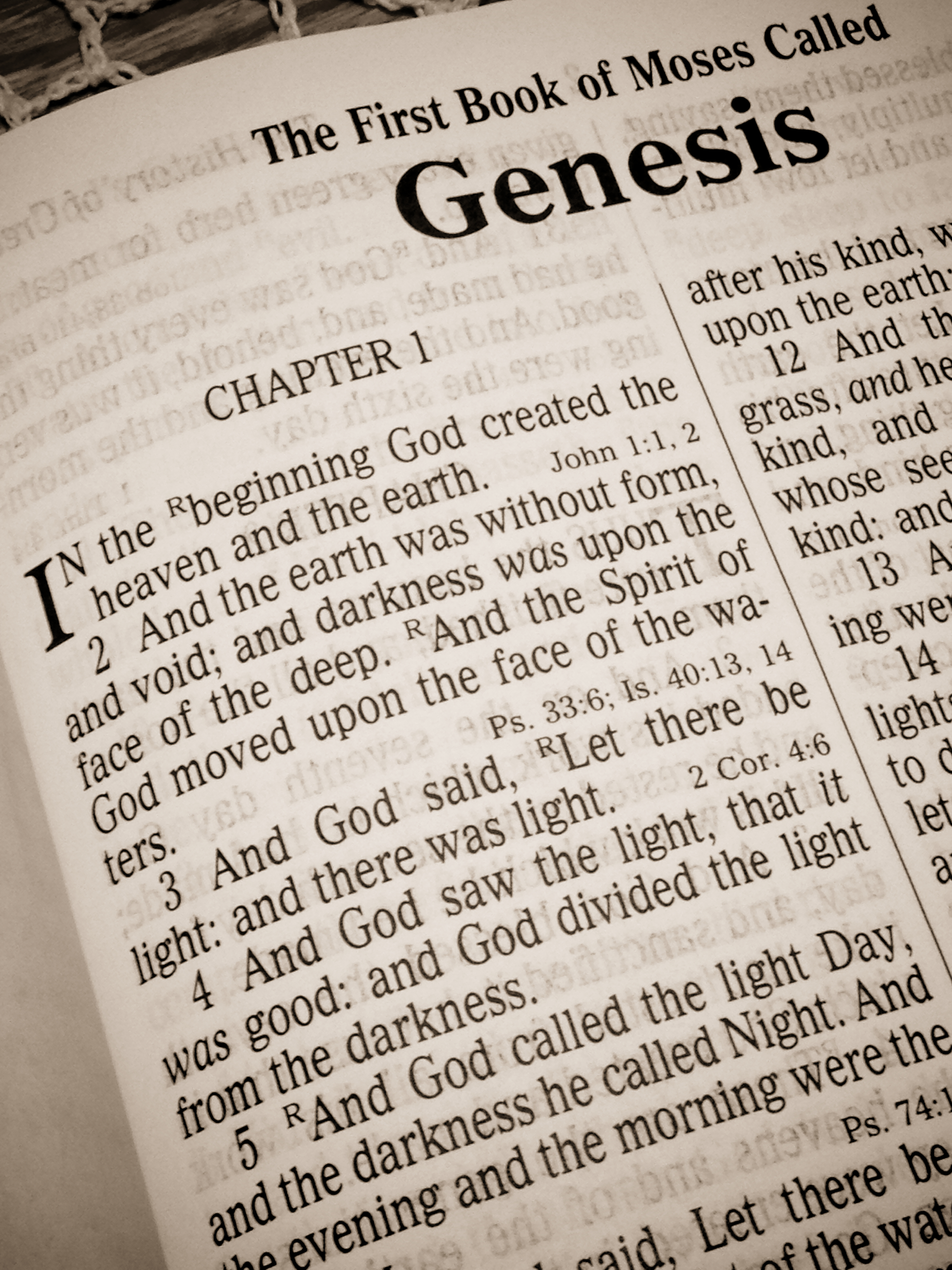
Genesis begins with God creating the cosmos, not from the body of a defeated foe as much near eastern mythology would have it, but by God’s own creative word. There is no back story to creation. As a Rabbi and teacher of mine once explained it, there is a reason the Holy Scriptures begin with the Hebrew letter “B” instead of the letter “A” as one might expect. The letter b appears in Hebrew as “ב.” As the Hebrew language is written from right to left, “everything proceeds out of the mouth of b,” or “beth” as it is pronounced in Hebrew. [———ב] Everything knowable originates from God’s speaking the creative word. There is nothing above the word, before the word or beneath the word. There is no asking about what came before creation. To make such inquiries of the text is rather like asking a physicist what was going on before the big bang or into what is the universe expanding. Such questions betray a fundamental misunderstanding of astrophysics just as surely as inquires into what preceded creation indicate a failure of comprehension in reading Genesis.

God created human beings “very good.” As the second creation account in Genesis 2 illustrates, they were not made to serve God’s own needs, as though God had any! Rather than commanding humans to build God a temple, or offer sacrifices to God or worship God, God commands the first human to till and keep the garden God made. Though God’s human creatures prove faithless in their charge, God does not do as they expect, namely, condemn them to death. God continues to care for them and to be present for them in their altered existence brought about by their unfaithfulness. Remarkably, this God who created the universe displays a keen interest in and concern for some particular individuals who are not kings or emperors, but mere nomads living a precarious existence in the shadow of powerful nations and city states.

Again and again, God deals graciously and generously with the world. Just as God did not kill or abandon Adam and Eve for eating from the forbidden tree, so God does not condemn the first murderer, Cain, to death or even life without parole. In fact, God puts a mark on Cain to ensure that no one will seek revenge against him. The matriarchs and patriarchs sometimes behave in ways that are unjust, cruel and immoral by whatever historical or cultural standard one may wish to apply. But God seems uninterested in punishing or correcting them. God is, however, merciful and just where human actors prove unjust. God seeks out the outcast concubine Hagar, not merely saving her and her child from starvation, but making with her a covenant similar to that made with Abraham and Sarah. God does not punish Jacob for deceiving his blind old father Isaac and stealing his brother Esau’s birth right and blessing. But God makes of Esau a nation and gives him a heritage. God is generous in terms of mercy and acts with extreme restraint when it comes to retributive justice.

To be sure, there are instances when God inflicts judgment that takes the form of violence. God behaves in ways that cause us progressive, white and ever polite American protestant types to cringe. Robinson does not, as too many preachers are prone to do, apologize for the text or dismiss its discomforting portrayals of God and God’s acts as primitive and barbaric notions that we enlightened modernists are free to ignore. God is God and requires no defense, explanation or justification.

The great flood comes to mind as an example of God’s judgment, as does the fate of Sodom and Gomorrah. Yet even in these instances, God is more inclined toward mercy. The violence of the flood is intended to check human violence spiraling out of control. The flood saga ends with God taking the nuclear option forever off the table, promising never again to undo the good work of creation however wicked its human inhabitants may become. God is prepared to forbear destroying the two wicked cities of Sodom and Gomorrah if but ten righteous people can be found there. God’s default posture is always that of mercy and compassion.

God is all but absent from the story of Joseph. Unlike the matriarchs and patriarchs of prior generations, Joseph never experiences a theophany. His is a story of sibling rivalry born of his father Jacob’s favoritism. Aside from his dreams, which prove to have been prescient only in retrospect, Joseph’s adventures are all too human. Sold into slavery by his jealous brothers, Joseph must negotiate life first as a slave and then as a prisoner. His rise to prominence comes about through his having made a valuable connection with the royal household of Pharoh while in prison. Once elevated to a place of power and prestige in Egypt, Joseph does what every good immigrant does. He took an Egyptian name and forgot the affliction of his father’s house. He married a prominent Egyptian and gave his children Egyptian names.

As Pharoh’s number two, Joseph prepares Egypt for a devastating famine by storing up grain in the fruitful years before it occurs. He then leverages these stores to obtain for Pharoh first the lands and property of his Egyptian subjects and finally the Egyptians themselves. Ironically, Joseph transforms Egypt into a slave state, a circumstance that will have a devastating impact on his descendants. For all intents and purposes, Joseph has integrated himself into Egyptian society and culture.

But when Joseph’s brothers appear seeking relief from the famine, Joseph’s past and his family identity comes crashing back. Joseph finds himself in a position to save his family from starvation-or wreak vengeance upon his brothers for their treachery. Joseph’s toying with his brothers for what most have been several months suggests that he must have been conflicted. On the one hand, ten of his brothers were clearly deserving of whatever misery he might inflict upon them. On the other hand, there was his aged father and his full brother Benjamin for whom his heart yearned. In the end, neither his love for the two nor his just anger at the ten guide his decision. Joseph’s decision to show mercy and forgiveness hinge on his recognition that there was a greater meaning and purpose for his life than even his dreams could have revealed. Though Joseph’s brothers acted against him with evil intent, God put the consequences of their evil actions to a redemptive purpose, namely, “that many people should be kept alive, as they are today.” Genesis 50:20.

Joseph’s theophany, such that it is, occurs entirely in the rear view mirror. Only at the end of his story does he recognize the guiding hand of the God who appeared so graphically to his father, grandparents and great grandparents. Yet it is through Joseph’s insight that we are to view all the past chapters of Genesis. We are to understand that however evil, misguided, dense and unfaithful human beings might be, God remains faithful working God’s gracious intent and purpose in, with and under, through and sometimes in spite of the actions of God’s people. The message of Genesis is that it is finally God’s providential purpose that prevails. This is not to say that everything is preordained. Human agency is real. People act of their own volition and human actions have consequences. Abraham might not have left Ur. Easau might have killed Jacob for his treachery instead of welcoming him home and embracing him. Joseph might have imprisoned or killed his brothers, leaving his father Jacob to starve in Canaan. Still, God’s intent and purpose would continue to work itself out because God is faithful to the world God made. The truly remarkable thing is that God graciously invites ordinary humans leading ordinary bread and butter lives to participate in God’s struggle to bring humanity and all creation into blessing.

Just as the Jospeh story is the lens through which the rest of Genesis is to be viewed, so the book of Genesis sets the trajectory for the scriptural narrative to follow culminating, as Christians confess, in the obedient life, faithful death and glorious resurrection of Jesus. There, too, human agency at its worst crucified the best gift God had to give. But God raised and continues to raise that gift up and offer it to us again and again for as many times as it takes until God’s providential purpose for creation is fulfilled. This, to use Paul’s words, “is the breadth and length and height and depth, and to know the love of Christ that surpasses knowledge…”

To recap, I owe many of the insights expressed herein to Marilynne Robinson and her remarkable book, Reading Genesis (c. 2024 by Marilynne Robinson; pub. by Farrar, Straus and Giroux) and daughter Rev. Emily Olsen-Brandt

Here is a poem by William Cowper reflecting confidence in God’s mercy and providential purposes so well illustrated in the book of Genesis.

1

God moves in a mysterious way,

His wonders to perform;

He plants his footsteps in the sea,

And rides upon the storm.

2

Deep in unfathomable mines

Of never-failing skill,

He treasures up his bright designs,

And works his sov’reign will.

3

Ye fearful saints, fresh courage take,

The clouds ye so much dread

Are big with mercy, and shall break

In blessings on your head.

4

Judge not the Lord by feeble sense,

But trust him for his grace;

Behind a frowning providence

He hides a smiling face.

5

His purposes will ripen fast,

Unfolding ev’ry hour;

The bud may have a bitter taste,

But sweet will be the flow’r.

6

Blind unbelief is sure to err,

And scan his work in vain;

God is his own interpreter,

And he will make it plain.

Source: This poem is in the public domain. William Cowper (1731 –1800) was an English poet and Anglican hymnist. He was one of the most popular poets of his time, writing poetry about everyday life and scenes of the English countryside. A fervent evangelical, he struggled with doubt about his salvation and at one point became convinced that he was eternally damned. Cowper was tormented with mental illness and placed for a time in what was then called an insane asylum. He gradually recovered from his illness and gained some stability in his faith life. Cowper gave expression to his newfound confidence in God’s grace and forgiveness in the many hymns and poems he wrote thereafter. He also wrote a number of anti-slavery poems. His friendship with John Newton, an avid anti-slavery campaigner, resulted in Cowper’s being asked to write in support of the Abolitionist campaign. He wrote a poem called “The Negro’s Complaint” in1788 which rapidly became very famous. It was often quoted by Martin Luther King Jr. You can read more about William Cowper and sample more of his poetry at the Poetry Foundation website.  

Of Shepherds, Kings and the Failures of Democracy

NINTH SUNDAY AFTER PENTECOST

Jeremiah 23:1-6

Psalm 23

Ephesians 2:11-22

Mark 6:30-34, 53-56

Prayer of the Day: O God, powerful and compassionate, you shepherd your people, faithfully feeding and protecting us. Heal each of us, and make us a whole people, that we may embody the justice and peace of your Son, Jesus Christ, our Savior and Lord.

“The days are surely coming, says the Lord, when I will raise up for David a righteous Branch, and he shall reign as king and deal wisely, and shall execute justice and righteousness in the land.” Jeremiah 23:5.

Kings are a dying breed. The few that are left do little in the way of actual governing. Their duties are primarily ceremonial. The real work of government is now done by presidents, prime ministers, congressional bodies and judicial officers. Kings and queens christen ships, cut ribbons for new highways and host dinners for visiting dignitaries. They do not declare wars, legislate or enforce the law. Nations like our own have rejected even the ceremonial brand of monarchy. Our struggle with King George III left a bad taste for monarchy in our mouths. The very idea is repugnant to us. Berger King is about the only king you will find in these parts.

Yet the idea of kingship is a powerful one that pervades scripture and classical literature.[1] Kings are frequently the central characters in the works of William Shakespear. I believe it is important to pay attention to this literary context when reading texts like the one from or reading in Jeremiah this coming Sunday. Understand first and foremost that a king is not a dictator. Kings are subject to the same laws and the same moral standards governing the rest of humanity. Given their exalted position, however, they are expected to excel in them. The biblical adage applies: “From everyone to whom much has been given, much will be required; and from one to whom much has been entrusted, even more will be demanded.” Luke 12:48.

Kings are not elected. They do not serve at the pleasure of the people. They are, according to the literary tradition, divinely instituted through the sacred line of succession. As the recipient of a sacred divine trust, a king is charged with administering justice without regard to what the polls say or what wealthy doners request or what lobbyists are demanding. A king may have counselors, confessors and advisors, but the ultimate authority to decide matters of state rests solely upon the king. For this reason, the highest degree of honesty, integrity and fairness must govern the conscience of a king if he is to fulfill his office faithfully.

The responsibilities of kingship demand much from frail human nature, vulnerable as it is to the temptations of power. Perhaps that is why so many of the kings from the Hebrew Scriptures, the literature of antiquity and the plays William Shakespear come to grief. Few mortals can bear well the weight of the crown. Even the “good” kings, such as David, abused their power and used it for self serving ends. Perhaps that is why the psalmist warns us, “Do not put your trust in princes, in mortals, in whom there is no help.” Psalm 146:3. After two disastrous conflicts with Rome that resulted in the Jews being exiled from their own land, Judaism moved away from its focus on hope for a human messianic deliverer. The church also tempered its expectations for the return of Jesus, cautioning its members to ignore representations of any who might claim to be the returning Christ, heeding his admonition, “if they say to you, ‘Look! He is in the wilderness,’ do not go out. If they say, ‘Look! He is in the inner rooms’, do not believe it. For as the lightning comes from the east and flashes as far as the west, so will be the coming of the Son of Man.” Matthew 24:26-27. The only king to be trusted is the King of Kings, the God who is sovereign over all nations.

Human leadership, according to the scriptural witness, cannot rise above the flaws of human nature. Thus, good leadership requires, above all else, humility. By that I mean a sober recognition that the best of us is subject to pride, arrogance, the need for recognition and affirmation, greed and selfishness. All these traits can taint our judgment and cloud our vision of the good. A good leader recognizes the danger of these very human tendencies in him/herself and so surrounds her/himself with trusted advisors who can be relied upon to tell the truth-however inconvenient, unpopular or embarrassing it may be. More important still, a good leader finds the courage to act upon that truth. It takes profound strength of character to admit that a decision affecting the lives of hundreds of million might have been wrong and to turn away from it. It requires a boatload of courage to admit that you are uncertain about the way forward, that there is no quick fix to the problems your people are facing and that it will take enormous sacrifices to arrive at the common good. Any political strategist will tell you that there is no path to electoral victory for such a candidate. We elect strong, confident leaders who assure us that they have a plan to fix what is wrong and that it will not cost us a penny.

In the end, we get the kind of leaders we deserve, namely, leaders that lie to us, make promises on which they cannot deliver and offer solutions that make great soundbites, but poor policy. The way to electoral victory does not lie in laying out effective solutions to complex problems. The way to electoral victory is studying the polls, figuring out what people desire and what they fear, and crafting a message that appeals. Then, when our elected leaders disappoint our unrealistic expectations, we angrily kick them off the pedestal where we placed them and elect someone new peddling the same old lies. As long as we want to go on believing that the right person can solve our problems, assuage our fears and give us the good life to which we feel entitled, we will get leaders who lie to us, exploit our gullibility and disappoint us.

The prophet Jeremiah understood all of this. That is why he declares that God alone is the shepherd worthy of the crown. God alone reunites the scattered and abandoned sheep. God will raise up a leader from the line of David to rule justly because human leaders invariably fall short. Followers of Jesus identify that leader as their Lord, a man who exercised a starkly different sort of leadership. The reign of God Jesus proclaims is not imposed by force or implemented by will of the people. Democratic rule is no more immune from the corrupting influence of power than any other type of human leadership. Professor Stanly Hauerwas once pointed out that there is only one instance of democracy in the Bible, namely, the race between Jesus and Barabas. Jesus lost. And Jesus is prepared to lose again to the power of empire, the power of popular opinion, the power of ideologically driven movements and the power of religious institutions, as many times as it takes to open our eyes to the better way of being human God would give us.

When will we enjoy honest, faithful and courageous leadership? When we finally let politics be politics and stop making a religion of it. When we finally understand that the challenges we face, local and global, are complex and admit of no simple, cost free solutions. When we stop seeking the false security afforded by comforting lies, simplistic rhetoric and the political campaigns that package them for us in easy to open cartons. When we finally learn that the danger of fearing one another is greater than the risk of trusting one another. When we finally figure out that the wellbeing of each one of us individually is bound up with the well being of all of us, regardless of which side of the border we reside. When we understand that the line between good and evil does not run along party lines, international boundaries, religious communities or the contours of legality, but right through the middle of every human heart where the battle for righteousness is finally won or lost. When all of this becomes evident to us at last, we may finally be in a position to elect honest, humble and wise leaders able to guide us in healing our wounded planet, reconciling our divided people and erasing the inequality of wealth, health and opportunity that has plagued us from the dawn of time.

Here is a poem by Dorothy E. Reid about kings for whom the weight of the crown proved too heavy, the love of their subjects too fickle and their downfall too hard for their inflated egos to comprehend.    

Kings

Kings sit down on rocks to remember,

And stare at the shore;

They wonder why the people who loved them

Don’t love them any more.

They think: surely we are dreaming,

We shall wake soon

To a purple High Lord of the Bedchamber

Handing us the moon-

A round moon, heavier than ermine,

For us to hold,

And the threadbare kings on the seashore

Shiver in the cold.  

Source: Poetry (March 1927). Dorothy E. Reid (1896-1977)earned a degree from Ohio State University in 1925. She wrote as both a poet and journalist. Coach into Pumpkin, her book of poetry, won the Yale Younger Poets Prize and was published by Yale University Press in 1925. She subsequently published in Poetry.


[1] Regrettably, female monarchs are sorely underrepresented in the classical literary tradition.

On the Futility of Banning Books

EIGHTH SUNDAY AFTER PENTECOST

Amos 7:7-15

Psalm 85:8-13

Ephesians 1:3-14

Mark 6:14-29

Prayer of the Day: O God, from you come all holy desires, all good counsels, and all just works. Give to us, your servants, that peace which the world cannot give, that our hearts may be set to obey your commandments; and also that we, being defended from the fear of our enemies, may live in peace and quietness, through Jesus Christ, our Savior and Lord.

“Then Amaziah, the priest of Bethel, sent to King Jeroboam of Israel, saying, ‘Amos has conspired against you in the very center of the house of Israel; the land is not able to bear all his words.” Amos 7:10.

The most valuable gift bestowed upon me by my public education was a love for and appreciation of books. In the eighth grade I read Tolstoy’s War and Peace, Melville’s Moby Dick and Dickens’ Great Expectations. In high school I was introduced to John Steinbeck in The Red Pony, Of Mice and Men, Grapes of Wrath and East of Eden. His books have continued to entertain, nurture and challenge me throughout my lifetime. For reasons I still do not fully understand, I got placed in high school honors humanities where I read 1984 and Animal Farm, by George Orwell, Brave New World by Aldous Huxley and Stranger in a Strange Land by Robert A. Heinlein. The Hobbit was on the reading list and it got me hooked on Tolkien’s Lord of the Rings Trilogy. At every stage of my educational sojourn, I had teachers who encouraged me read beyond the established curriculum and I did. One particularly formative book for me was Jan de Hartog’s Peaceable Kingdom, a lengthy historical novel I found in the high school library that followed the lives of actual and fictional leaders and followers of the Society of Friends, otherwise known as the Quakers, in both England and in the United States. I found this saga so compelling that I considered converting for a time.

These books literally made me. They introduced me to the mysteries of human nature. They taught me the virtues of courage, integrity and faithfulness. Through the exercise of imagination, these authors and their stories helped me explore the potential for both good and evil that come of human ambition. They taught me about the corrupting influence of wealth and power, the opportunities for good and the temptation to abuse that comes with leadership. Books introduced me to the mysteries of science and the promise/threat of technology. I do not know where or even who I would be without these and so many other books that shaped my understanding and character.

It is not lost on me that many of these books are being removed from school curricula and libraries these days for various reasons. The Tolkien books have been attacked by some religious groups for promoting witchcraft. Many of the other books mentioned above have been removed because they contain “explicit sexual material.” Also under fire are more recent books in the young adult genre dealing with the struggles and triumphs of LGBTQ+ youth. Perhaps most distressing is the removal of books that delve into historical and contemporary systemic racism in America and its continuing effects. Recently, the American Library Association‘s (ALA) Office for Intellectual Freedom released preliminary data that reports 695 attempts to censor library materials and services and challenges to 1,915 unique books. That represents a 20% increase over 2022, which reached the highest number of book challenges since ALA began compiling the data more than 20 years ago. PEN America also tracked school book bans specifically and found 3,362 book bans affecting 1,557 unique titles during the 2022-23 school year, an increase of 33% from the 2021-22 school year. The removal of these books from schools and libraries is supposedly being done “to protect our children.”[1]    

There is no getting around the fact that books are dangerous to the status quo. They always have been. Books awaken our imagination and challenge us to think differently about ourselves and our world. They force us to question what we have been taught and whether the way things are is the way they must be. Nothing is quite so terrifying to a tyrant as a child with a book. That is why every tyrannical regime has attempted to control books and their publication. Books were routinely burned in Hitler’s Germany and in Stalin’s Russia. They are scrutinized and banned when deemed contrary to the reigning dogma of theocratic regimes like Iran. That we are seeing the same thing beginning to take place here in the United States should be a cause of concern, if not outright alarm.

Before books were put into writing, Amaziah, the priest of Bethel in Israel, understood their power. He reported to the king of Israel that the “land was not able to bear” all the words of the prophet Amos. The prophet’s witness to a God who demanded justice for the poor and despised religion glorifying the king and “his” sanctuary was a threat too dangerous to ignore. And so Amaziah did what book banners are doing today. He banished Amos, exiled him, took away his green card and sent him packing. Out of sight, out of mind. But words of truth and justice are not so easily dispatched. The mere presence of the Book of Amos the prophet in the Hebrew Scriptures illustrates the futility of seeking to ban literature. Amaziah’s attempt to silence Amos did not work. Censorship never does. Amos’ words live on. But have you ever heard of the Book of Amaziah the priest of Bethel?

Behind all the energy expended on removing books from our schools and libraries lies a deep seated fear of change on the part of those who see a very comfortable status quo and the privileges it affords them slipping away. I guess the theory is that if we can keep children from finding out about racial inequities, the complexities of gender identity, the toxic effects of sexism on our girls and boys, the hard realities of social class distinctions and the growing disparity in wealth between the rich and the working class, then all these uncomfortable realities will simply go away and everything will stay the same. In fact, however, censorship does not erase uncomfortable truths. It only robs our children of the information, ideas and conceptual tools they need to think deeply and creatively about addressing them.    

Disciples of Jesus must be on the side of authors, teachers and librarians. We believe, as St. Augustine taught us, that truth has an independent existence grounded in God our Creator. It cannot be erased. Consequently, we have nothing to fear from books-even those we deem wrong, misguided and inaccurate. As one colleague of mine puts it, “I read all the books that are being banned today and all I ever got from it was smarter.” The best defense against books we deem wrong or dangerous is not censorship, but good books or, rather, minds formed and grounded in truth through the reading of good books. The truth needs our witness, not our defense.

Here is a poem by Margurite Engle about books, censorship and its ultimate futility.

Tula [“Books are door-shaped”]

Books are door-shaped

portals

carrying me

across oceans

and centuries,

helping me feel

less alone.

But my mother believes

that girls who read too much

are unladylike

and ugly,

so my father’s books are locked

in a clear glass cabinet. I gaze

at enticing covers

and mysterious titles,

but I am rarely permitted

to touch

the enchantment

of words.

Poems.

Stories.

Plays.

All are forbidden.

Girls are not supposed to think,

but as soon as my eager mind

begins to race, free thoughts

rush in

to replace

the trapped ones.

I imagine distant times

and faraway places.

Ghosts.

Vampires.

Ancient warriors.

Fantasy moves into

the tangled maze

of lonely confusion.

Secretly, I open

an invisible book in my mind,

and I step

through its magical door-shape

into a universe

of dangerous villains

and breathtaking heroes.

Many of the heroes are men

and boys, but some are girls

so tall

strong

and clever

that they rescue other children

from monsters.

Source: The Lightning Dreamer, Margarita Engle (C. 2013 by Margarita Engle: pub. by Houghton Mifflin Harcourt). Margarita Engle (b.1951) is a Cuban American poet. She is also the author of many books for children and young adults. Engle was born and raised in California, but she spent many summers with her extended family in Cuba. She earned a B.S. from California State Polytechnic University in 1974 and an M.S. from Iowa State University in 1977. Engle became the first Latino awarded a Newbery Honor in 2009. She was selected by the Poetry Foundation to serve as the sixth Young People’s Poet Laureate from 2017-2019. On October 9, 2018, Margarita Engle was announced the winner of the 2019 NSK Neustadt Prize for Children’s Literature. Most of Engle’s stories are written in verse and are a reflect her Cuban heritage and her love of nature. You can read more about Margarita Engle and sample more of her poetry at the Poetry Foundation Website.


[1] I am not suggesting that care should not be taken to ensure books recommended to children are age appropriate. There are some books containing language, images and topics inappropriate for very young children. In this regard, I find it amusing that many of the same folks who want to remove books they view as offensive from our schools are also advocating teaching the Bible in the class room. That leads me to wonder whether these folks have ever read the Bible. Do they know that the Bible contains stories of gang rape, mutilation, incest and sexual imagery bordering on the pornographic? (See Judges 19:1-30; Genesis 19:30-38; Ezekiel 23:1-21). For this reason, I have often questioned the protestant custom of handing out Bibles to children as though they were benign peppermints. For more on that, see The Bible: Handle With Care & Keep Out of the Reach of Children.

This is Us

SEVENTH SUNDAY AFTER PENTECOST

Ezekiel 2:1-5

Psalm 123

2 Corinthians 12:2-10

Mark 6:1-13

Prayer of the Day: God of the covenant, in our baptism you call us to proclaim the coming of your kingdom. Give us the courage you gave the apostles, that we may faithfully witness to your love and peace in every circumstance of life, in the name of Jesus Christ, our Savior and Lord.

“Prophets are not without honour, except in their home town, and among their own kin, and in their own house.” Mark 6:4.

For the last decade, people like me have been in a state of collective denial. When Donald Trump first descended the escalator announcing his candidacy, we laughed. Nobody in their right mind, we thought, will take this buffoon seriously. Then November 8, 2016 dawned and we learned that Donald J. Trump, the mulitbankruptcy business failure, flamboyant reality TV showman, unrepentant racist and sexual predator, would indeed occupy the oval office. “This is not us,” we gasped. We tried to rationalize the result. Hillary Clinton was a weak candidate. Her campaign failed to work hard enough in the crucial swing states. Voter turnout was low that year which always favors Republicans. Surely, this election was a fluke, an artifact, a blip on the radar. Surely the next four years, however bleak they might be, will shock the Republican party and the country back into sanity.

When Joe Biden won both the popular and electoral majority over Trump in 2020, we assured ourselves that sanity had, in fact returned. But that assurance was misplaced. While 80 million people turned out to vote for Biden, a whopping 70 million voted for Trump. Then came the January 6, 2021 Republican insurrection.[1] In the wake of that shocking day, the old refrain was played again. “This is not us. This is not who we are.” Again, we comforted ourselves with the belief that, finally, the Republican party will recognize the monster they have created. Surely, this will wake up the American people to the true nature of Trumpism and the malignancy of the MAGA mob. For a few brief days that seemed to be so. Both Republican Senate leader Mitch McConnell and House leader Kevin McCarthy blamed Donald Trump for instigating the insurrection that could well have gotten them both killed. But when it became clear that the MAGA mob was as loyal as ever to its head, both men crawled back to their master.

Still, we hoped that the era of Trump would pass. We expected him to continue making noise, holding racous rallies with a steadily diminishing base of supporters and disrupting the political process wherever possible. But he would, we were convinced, fade into the mist like Joe McCarthy, George Wallace, Strom Thurman and all the other American demagogues. After four years of his chaotic presidency ending in an attack on your democracy which, up to that point, would have been unthinkable, we could not imagine the country giving Donald Trump a second term. This is America after all.  

We should have known better. We ought to have realized that the demons of misogyny, homophobia, xenophobia, anti-intellectualism and, above all, racism have never been cast out of our nation’s soul. They are and always have been essential elements of our cultural DNA. Like a recessive gene, they can skip a generation, lie dormant for a spell fulminating in the darkness of skeevy locker rooms, smoke filled bars and backyard barbeques. But eventually, they erupt like a cancerous sore into the public square and metastasize into systemic malignancy.

People like me, who can still recall the struggle for racial equality and civil rights, the battles hard fought by courageous women for equality, reproductive freedom and access to the professions, the days when merely being suspected of being gay could turn you into a social pariah, get you fired from your job and perhaps get you killed, we all assumed that the progress made in these areas was permanent. To be sure, there remained much to be done, but we were convinced that a solid foundation had been established upon which to build. In fact, however, there have always been forces at work undermining that foundation. It was never as secure as we though it was. We should not have been shocked or surprised to see it crumble.

The bottom line is that up to half of our country’s population is OK with voting for a man who has been found by a jury to have sexually assaulted a woman, convicted by a jury of a felony, found guilty of financial fraud in a court of law, and indicted for inciting an insurrection against the United States government, stealing sensitive classified government documents and fraudulently attempting to overturn an election. Further, these same Americans are OK with Donald Trump’s pardoning of rioters guilty of violently attacking our capital, obstructing our democratic processes and killing a police officer in the process. How can they possibly support the candidacy of such an individual?

Reams of paper, bandwidth busting blogs and countless hours of air time have been dedicated to explaining the attraction of Donald Trump. But the explanation is simpler than any of us want to believe. Donald Trump’s anger, narcissism and sense of victimhood appeal to a large sector of America that sees in his rage their own anger and frustration with a country that is changing too fast for them. Donald Trump is the middle finger of the fragile white man[2] who finds himself in a world where women are stepping into the jobs that were once his, where people of color are moving into neighborhoods, workplaces and schools he feels are his own, where stores are popping up in his town with foreign sounding names and people on the streets are speaking languages he cannot understand, where the faces on TV, in advertising and the movies are increasingly non-white. He sees his religion, his values and way of life mocked on late night comedy. It seems to him that the country is being taken away from him and he is mad as hell about it. These people are not” fringe” folk. They are America every bit as much as any of us.

I want to be clear that this not is about the upcoming election. No matter who occupies the Whitehouse in January of 2025, the demonic spirits inspiring hatred and violence will still be among us. They always have been.  The mob that attacked the capital in 2021 is essentially the same mob that burned down thirty-five acres of the Black commercial district of Tulsa known as Greenwood in 1921 killing as many as three-hundred. Current and proposed legislation limiting the reproductive rights of women is based on the same rationale employed by the National Association Opposed to Woman Suffrage in 1911, namely, that women lack the capacity to make decisions for themselves. The Hitleresque rhetoric of “foreign vermin” and the “poisoning” American blood has its antecedent in rhetoric spewed by the German American Bund Nazi rally at Madison Square Garden in 1939. Racism, sexism, homophobia and xenophobia are as American as apple pie. We cannot with integrity insist with moral indignation that “this is not who we are.” The foul spirit of MAGA has not only hijacked one of our two major parties. It infects our schools, our neighborhoods and it sits with us each Sunday in the pews of our churches.   

Preaching this stuff on a celebratory holiday like Independence Day might not seem like a good idea. Amidst the noise of fireworks, “God Bless America” and patriotic speeches, truthful speech about our nation and its culture strike a distinctly dissonant chord. Nobody wants to hear that America is sick on the Fourth of July. Still less popular is the sad truth that this sickness has infected the church as well and that within the church is precisely where we need to start treating it. Healing ourselves will be painful. Genuine repentance always is. But ecclesiastical healing is urgently needed. The one, holy, catholic and apostolic church that knows no racial, tribal or national borders exists to give us a better vision of what it means to be human. The church exists to expose the empty promises made by the false gods of nation, race, blood and soil that would distort our image of God and turn us against one another. It is to be a living witness that the human family is one. God knows we need that witness in these days!

Jesus knew, as did the Hebrew prophets, that “prophets are not without honor, except in their home town, and among their own kin, and in their own house.”  In our lesson from the Hebrew scriptures Ezekiel is warned that his words might not be heeded. Nevertheless, “whether they hear or refuse to hear (for they are a rebellious house), they shall know that there has been a prophet among them.” Ezekiel 2:5. Ezekiel did not live to see the effects of his preaching. For all we know, he may have died wondering whether he had wasted his life speaking words nobody was hearing. But his words, preserved in some way, shape or form, brought understanding and hope to an exiled community and inspired that community to rise up from the ashes of defeat to welcome a new day. It is God’s responsibility to fulfill God’s word. Our only job is to proclaim it.

One of my readers told me recently, “I hear what you are saying about prophetic preaching. But some of those people wearing MAGA hats call me ‘pastor.’” I get that. I cannot emphasize enough that we need to distinguish between the hateful ideologies that deserve no tolerance and the persons enslaved to them who need our love, our patience and our forgiveness. Nonetheless, they also need our truthful witness, admonition and correction. To attempt either without the other is pastoral malpractice. Preaching, teaching and leading are daunting tasks in these days. Of course, they always have been. Current events only serve to make us aware of just how crucial they are and how we may well have failed to give them the attention they deserve. Hopefully we will also be spurred on to give them all the thought, time, effort and imagination we can muster-and the courage we need to accept the consequences.

In closing, I have sometimes been accused of being an “America hater.” I do not hate America-anymore than Jesus and the Hebrew prophets hated Judah and Israel. To the contrary, there is much that I love about this country. I love its cultural richness and diversity. I love the many different communities in which I have lived and the way in which people of diverse views, conflicting interests and unique backgrounds so often come together to solve problems and work together for the common good. I love each of our great cities and their unique characters and histories. I love our wilderness areas. I also love the commitment so many Americans have displayed in seeking to make the values of freedom and equality real for all of us. But love brings with it some difficult responsibilities. When you see that one of your relatives or friends has a serious drinking problem that is destroying his life and harming those dear to her, you don’t turn a blind eye. You don’t ignore the obvious or make excuses that enable them to continue on with their self destructive behavior. You confront them with the truth. You make them face their dependence. You make them see the consequences of their behavior. Then you offer to walk with them on their journey to recovery. True patriots do the same for their country.

Here is a poem by Claude McCay reflecting love for a flawed, unjust and tyrannical nation that America has been for African Americans and too many others as well.

America

Although she feeds me bread of bitterness,

And sinks into my throat her tiger’s tooth,

Stealing my breath of life, I will confess

I love this cultured hell that tests my youth.

Her vigor flows like tides into my blood,

Giving me strength erect against her hate,

Her bigness sweeps my being like a flood.

Yet, as a rebel fronts a king in state,

I stand within her walls with not a shred

Of terror, malice, not a word of jeer.

Darkly I gaze into the days ahead,

And see her might and granite wonders there,

Beneath the touch of Time’s unerring hand,

Like priceless treasures sinking in the sand.

Source: Liberator (The Library of America, 1921).  Claude McKay (1889-1948) was born Festus Claudius McKay in Nairne Castle, Jamaica. He came to the United States in 1912 to attend the Tuskegee Institute. McKay was shocked by the racism he encountered in this country and that experience of culture shock shaped his career as a writer and poet. McKay became a key figure in the Harlem Renaissance, a Black American intellectual, social, and artistic movement centered in Harlem, New York spanning the 1920s. His poetry celebrates peasant life in Jamaica, challenges white supremacy in America and lifts up the struggles of black men and women striving to live their lives with dignity in a racist culture. You can learn more about Claude McKay and read more of his poetry on the Poetry Foundation Website.


[1] Some might object to my so characterizing the January 6th attempted coup. They might complain that I am being inflammatory and unfair. Too bad. In the aftermath of the riot, we heard Republican Senators insist that the whole event was nothing more than a sight seeing tour. Now the presumptive Republican presidential nominee, who called his mob to Washington and sent them to Capital Hill, is calling these insurrectionists, who smashed down the doors of our capital, carried the flag of treason through its halls and smeared dung in its offices “patriots” and those who have been identified and prosecuted as “hostages.”  The January 6th insurrection has Republican fingerprints all over it. It was a Republican circus and Republicans must own the mess their monkeys made.   

[2] Yes, I know there are a lot of women who support Donald Trump. I know there are people of color who support him as well. Trump’s appeal goes beyond racism, however. His misogyny, homophobia and xenophobic hatred of migrants plays well among Americans and crosses over into other demographics which might find some of his racist rhetoric objectionable.  Witness how hatred of liberals and LGBTQ+ folk can induce evangelicals to excuse rape, adultery, racism and fraud in a president who is willing to advance their political agenda. Common hatred makes strange bedfellows.