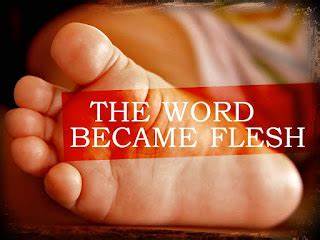
SECOND SUNDAY OF CHRISTMAS
Prayer of the Day: Almighty God, you have filled all the earth with the light of your incarnate Word. By your grace empower us to reflect your light in all that we do, through Jesus Christ, our Savior and Lord, who lives and reigns with you and the Holy Spirit, one God, now and forever.
“And the Word became flesh…” John 1:14.
Over the years my prayers, preaching and teaching have shifted, slowly and almost imperceptibly, away from a singular focus on the cross and redemption to the miracle of the Incarnation and what the Eastern Church calls “deification” or “theosis.” This, I believe, has nothing much to do with humans attaining divine attributes like “omniscience,” “omnipotence” and “omnipresence.” It is more like Saint Paul’s admonition last week in our lesson from Colossians, urging us “to clothe yourselves with compassion, kindness, humility, meekness, and patience.” Colossians 3:12. It involves having “the same mind…in you that was in Christ Jesus.” Philippians 2:5. This is a possibility now precisely because the Word became flesh, God became human-and remains so.
I do not mean to say that the cross and redemption have lost any degree of significance in my understanding of the faith. Rather, they have taken on a deeper and more profound meaning as my appreciation of the Incarnation has grown. The Incarnation, as John the Evangelist tells us, was God’s intent for humanity and the world from the beginning. The cross illuminates the terrible price God was willing to pay in order to carry through with this intent in spite of human sinfulness and the worst depravity of which we are capable. However much selfishness, cruelty and indifference is manifest in human existence, God remains indwelt there. Every human being is therefore the image and temple of God. The desecration of sanctuaries, temples and cathedrals can never desecrate or diminish God. But each act of violence, unkindness and indifference inflicts wounds on the body of the resurrected Christ.
It is for this reason that racism, defamation of migrants, vilification of LGBTQ folk, criminalization of begging and homelessness, pouring arms into the conflicts in Gaza and Ukraine, prosecuting church organizations providing humanitarian aid to immigrants at the border are not merely immoral. They are frontal attacks on the Word that became flesh. That is why, when asked which commandment is first of all, Jesus responded that the first commandment requires us to “love the Lord []our God with all []our heart, and with all []our soul, and with all []our mind.” Note well, however, that Jesus adds that the second is like it, namely, “You shall love your neighbor as yourself.” Matthew 22:34-40. The two commandments are, in fact, one. To love God is to love one’s neighbor and all who love their neighbors are loving God, whether they know it or not. On these two commandments, Jesus insists, rest the entire law and the prophets. Matthew 22:40. Jesus was frequently compelled to point out that the Sabbath and, indeed, the entire law was created to serve the needs of people, people were not created in order to follow rules.
Much of Christian ethical reflection has been grounded in readings of the scriptures that are not grounded in the miracle of the Incarnation, but based rather on casuistic reasoning from specific biblical texts, often torn from their context. Such reasoning has given us hat mandates for women, exclusion of women from positions of church leadership, prohibitions against long hair for men and particularly cruel treatment of gay, lesbian and transgender persons. Then, too, there are the many prohibitions that find no basis in Scripture but reflect belief in a god obsessed with rule keeping and eternally incensed with the slightest infraction. I refer to the prohibitions against dancing, drinking alcohol, playing pool, playing card games, two piece bathing suits for women and other forbidden practices. Such religion makes of the law a ruthless slave master rather than a servant of humanity for facilitating justice, reconciliation and peace. [1]
Making the Incarnation the starting point for ethical reflection is transformative. No longer is God’s assuming human flesh a distasteful necessity for dealing with human sin. Instead, it represents the culmination of God’s eternal purpose for humanity and for all creation. The cross, then, is a twofold revelation. In the first place, it reveals the depths of human depravity in our rejection of the very best God has to give us. Second, and more importantly, it reveals God’s determination not to be deterred by the world’s rejection of the Son. God will not be drawn into the vortex of retributive violence by which we are enslaved. Rather than responding to our violence with divine retribution, God responds by raising up the rejected Son and offering him to us again. The cross and resurrection is a triumph of mercy over judgment in the heart of the Triune God, God’s refusal to be driven from the flesh God assumes. At our very worst, God remains Immanuel, God with us. It is this belief that enables disciples of Jesus to meet hostility with hospitality, abuse with forgiveness, violence with a witness for peace, hatred with understanding, the darkness of fear with the light of hope.
Here is an incarnational poem/prayer by Michel Quoist dwelling on the Word that sanctifies human flesh.
The Pornographic Magazine
Lord, I am ashamed of this magazine.
You must be profoundly hurt in your infinite purity.
The office employees all contributed to buy it.
The boy ran to fetch it,
And pored over it on the way back.
Here it is.
On its shining pages, naked bodies are exposed;
Going from office to office, from hand to hand-
Such foolish giggles, such lustful glances….
Empty bodies, soulless bodies,
Adult toys for the hardened and the soild.
And yet, Lord, man’s body is beautiful.
From the beginning you, the supreme artist, held the model
before you, knowing that one day you would dwell in a
human body when taking on the nature of man.
Slowly you shaped it with your powerful hands; and into its
inert matter you breathed a living soul.
From then on, Lord, you asked us to respect the body, for the
whole body is a conveyer of the spirit,
And we need this sensitive instrument that our spirits may
commune with those of our brothers.
Words, in long processions, lead us toward other souls.
A smile on our lips, the expression in our eyes, reveal the soul.
The clasp of a hand carries our soul to a friend,
A kiss yields it to the loved one.
The embrace of the couple unites two souls in quest of a new
child of God.
But it was not enough for you, Lord, to make of our flesh the
visible sign of the spirit.
Through your grace the Christian’s body became sacred, the
temple of the Trinity.
A member of the Lord, and a bearer of this God,
Supreme dignity of this splendid body!
Here, Lord, before you tonight, are the bodies of sleeping men:
The pure body of the tiny child,
The soiled body of the prostitute,
The vigorous body of the athlete,
The exhausted body of the factory worker,
The soft body of the playboy,
The surfeited body of the rich man,
The battered body of the poor man,
The beaten body of the slum child,
The feverish body of the sick man,
The painful body of the injured man,
The paralyzed body of the cripple,
All bodies, Lord, of all ages.
Here is the body of the fragile new-born baby, plucked like a ripe
fruit from its mother.
Here is the body of the light-hearted child who falls and gets up,
unmindful of his cuts.
Here is the body of the worried adolescent who doesn’t know that
it’s a fine thing to grow up.
Here is the body of the grown man, powerful and proud of his
strength.
Here is the body of the old man, gradually failing.
I offer them all to you, Lord, and ask you to bless them, while
they lie in silence, wrapped in your night.
Left by their sleeping souls, they are therefore before your eyes,
your own.
Tomorrow, shaken from their sleep, they will have to resume
work.
May they be servants and not masters,
Welcoming homes and not prisons,
Temples of the living God, and not tombs.
May these bodies be developed, purified, transfigured by those
who dwell in them,
And may we find in them, at the end of their days, faithful
companions, illumined by the beauty of their souls,
In your sight, Lord, and in your mother’s,
Since you both belong to our earth,
And all the bodies of men will be the guests in glory of your
eternal heaven.
Source: Quoist, Michel, Prayers (c. 1963 Sheed & Ward, Inc.) Translated by Agnes M. Forsyth and Anne Marie de Cammaille. Michel Quoist (1921-1997) was ordained a priest in1947. A French Catholic of the working-class, Quoist reveled in presenting Christianity as part of gritty daily reality, rather than in forms of traditional piety. He was for many years pastor to a busy city parish in Le Havre, France serving a working class neighborhood and developing ministries to young people through Catholic Action groups. Prayers, the book from which the above poem was taken, has been translated from the original French into several languages including Hungarian, Polish, Chinese, Portuguese, Swedish and English.
[1] Coupled with this misconception is the over simplistic rendering of the doctrine of “substitutionary atonement,” a rendering of which is spelled out in the tract popular among Evangelicals entitled “The Four Spiritual Laws.” According to this theory, God is in an impossible position. Being completely righteous, God cannot abide the slightest infraction of God’s rules, the punishment for which is eternal damnation. Yet God also desires to show mercy and forgiveness to God’s creatures, but without compromising God’s perfect righteousness by simply overlooking human sin. By taking on flesh in the person of Jesus who, in turn, takes the wrap for our sins, God is now able to forgive human sin while retaining God’s perfect righteousness. Problem solved. While the math works, the theory seems to indicate that God is helplessly trapped in the mechanics of God’s own metaphysic. Like the sympathetic meter maid who would love to give you a pass on parking illegally for just a second, but cannot do it because, alas, the ticket has been written out and is now in the system, so God cannot forgive sin without a payment of some kind. Yet the proposition that God cannot forgive sin without a suitable punishment strains credibility. If my Mom could forgive my breaking an antique lamp she inherited from Grandma that could never be replaced, I find it hard to believe God is incapable of being similarly magnanimous. For more on this, see “The Cross-Because Love Hurts.”
 Peter's Outer Cape Portico
Insightful and tender, and an illuminating step towards a deeper understanding of that which will always be beyond our understanding – so we mustn’t think that we have come to the end of the search.
But, dear God, that patristic poem. the whole thing is man – it is grating and painful – and patriarchal and man-splaining and if we haven’t moved beyond this, we haven’t have moved beyond the iron bands of male supremacy. In other words, this is not Jesus.
LikeLike
Thanks again for your good words and comments.
I agree that the language (use of “men” and “man” for humanity as a whole) is grating. Some of that is, I think, attributable to the process of translation. It is worth remembering that Quoist was a person of his time (40s, 50s, and 60s) speaking out of the context of the faith, culture and society in which he was raised. We can acknowledge his prejudices and conceptual limitations while still appreciating his insights on and expressions of the beauty of human body and its dignity in view of the Incarnation. I have lived long enough to find some of the language and theology used in past sermons cringeworthy. I like to think I have grown and matured over the years and will continue to do so. Still, I expect that language I am using today might well be found by future generations to reflect insensitivity, narrowmindedness and prejudices I cannot now recognize. As I hope that my shortcomings in understanding and expression will be treated generously, so I try to be generous toward my predecessors.
LikeLike
A thoughtful and thought-provoking piece. Like you, I have become more and more centered in incarnational theology. Reading Richard Rohr, Duns Scotus and Bonaventure have led me deeper in that direction. I like your interpretation of the cross but I think I need to wrestle with that some more. I find Gerard helpful here, but also, in the end, inadequate. I’ve been reading Chardin and Ilia Delio hoping to find something that will help me cobble my own understanding. You’re right though— it does reveal both the depths of human awfulness and the height of God’s forbearance and love. But where does that human awfulness come from? What makes us so afraid?
LikeLike
Thanks again for your comments, Steve. I have thought a lot about the origins of evil and injury. I’m not sure I have a definitive answer. I ruminated over that following my wife’s crippling accident four years ago now. For what it’s worth, A Dangerous World and the Good God who Made It
LikeLike