Monthly Archives: October 2025

Sainthood in a Violent World

ALL SAINTS SUNDAY

Daniel 7:1-3, 15-18

Psalm 149

Ephesians 1:11-23

Luke 6:20-31

Prayer of the Day: Almighty God, you have knit your people together in one communion in the mystical body of your Son, Jesus Christ our Lord. Grant us grace to follow your blessed saints in lives of faith and commitment, and to know the inexpressible joys you have prepared for those who love you, through Jesus Christ, our Savior and Lord, who lives and reigns with you and the Holy Spirit, one God, now and forever.

God put this power to work in Christ when he raised him from the dead and seated him at his right hand in the heavenly places, far above all rule and authority and power and dominion and above every name that is named, not only in this age but also in the age to come. And he has put all things under his feet and has made him the head over all things for the church, which is his body, the fullness of him who fills all in all.” Ephesians 1:20-23.

The “power” of which Saint Paul speaks, the power that raised Jesus from death is love. God’s power is God’s refusal to be drawn into the vortex of retribution that has drawn humanity into orgies of bloodshed since the dawn of time. God loves the world, even when it goes off the rails. God loves the world, all of it. God loves the arctic regions newly opened to the fossil fuel industry crying, “Drill, baby, drill” with the rapist’s grin on their faces. God loves rivers choked with industrial sludge, lakes dead from acid rains and oceans plagued with floating islands of plastic. God loves animals and plants on the brink of extinction whose preservation is deemed economically unfeasible. And God loves God’s human creatures responsible for so much of this planet’s misery, creatures who, when offered the most precious gift God had to give, nailed him to a cross. In response to the crucifixion of Jesus, God did not retaliate. Instead, God raised up the crucified and rejected Son and offered him back to the same creatures that rejected him. Vengeance, wrath and retaliation are not God’s way. Neither are they the way of Jesus’ disciples.

Our gospel lesson for All Saints Sunday spells out with unmistakable clarity what sainthood looks like. Jesus calls upon his disciples to exercise the same love for their enemies God exercises toward the world that rejected the Son. “But I say to you who are listening: Love your enemies; do good to those who hate you; bless those who curse you; pray for those who mistreat you. If anyone strikes you on the cheek, offer the other also, and from anyone who takes away your coat do not withhold even your shirt.” Luke 6:27-29. The way of Jesus reflecting the power of God does not look anything like power as we understand it. Mao Tse Tung once said that “All political power comes from the barrel of a gun.” That is not far from the American Marvel Comic book mythology animating so much of our thinking about conflict and the way it must be resolved. It underlies the uniquely American gun fetish and a growing conviction on the part of so many that our fellow citizens are all potentially hostile, our neighbors cannot be trusted and our government and laws are incapable of protecting us.  

In their recent book, The Myth of the American Superhero,[1] John Shelton Lawrence and Robert Jewett argue that, in a culture that doubts the integrity and ability of its government and institutions to achieve justice, people are naturally drawn to the uniquely American “monomyth.” This “monomyth” supplies the underlying plot for stories about heroes who must take the law into their own hands in order to rid a community of evil. The world of entertainment is laced with such monomythic tales. We find them in the oldest black and white westerns that feature a virtuous gunslinger riding into town to rid the populace of a criminal gang neither the law nor the courts can handle. The same basic plot can be found in such productions as the Star Wars movies in which “jedi knights” with superhuman powers and a code of law all their own rise up to destroy an evil empire that has usurped the powers of the old republic. The most insidious element of this myth is the unspoken and unquestioned assumption that, when all is said and done, evil can only be eliminated by violence.

That assumption shapes the prevailing understanding of God in much of American religion. The god we meet in much of white evangelical religion is an angry, controlling and violent tyrant with an anal preoccupation with sex. This is a god who damns to hell a loving same sex couple while blessing a politician who works to deprive millions of needed healthcare. This is a god who cares more about his picayune rules than about the people he supposedly created. Because this god is toxically male, it comes as no surprise that he wants men to be in charge and women to submit. For the god of American evangelicalism, the cross is not sufficient. This god must come back at the end of time with military like fire power to beat the world into submission in a final cosmic battle. This is a violent god that appeals to violent people. As the poet remarks, “Give us burly gods to pummel the world and us.” I do not know whether people become mean, bigoted and hard hearted because they worship such a god or whether the god they worship is merely a reflection of their own hateful souls. Either way, this god is not the God and Father of Jesus Christ we meet in our lessons for this Sunday.  

In a culture with such a distorted understanding of who God is and that is spiraling ever deeper into violence, in a culture where mass shootings are weekly occurrences, civil war rhetoric is becoming mainstream and law enforcement increasingly unrestrained by legal limits, I believe sainthood must take the shape of radical pacifism. Our bishops need to be saying with clarity that no disciple of Jesus has any business owning or carrying a weapon, the one exception being those serving in the military or law enforcement.[2] We need to ensure that our sanctuaries, offices and events are weapon free zones. Our churches need to be challenging police violence, use of the military against our citizens and using the “war on drugs” as a pretext for military attacks on unarmed foreign ships in international waters. More than this, we need to be prepared to practice hospitality and offer sanctuary to victims of our government’s violent and ruthless immigration policies. That might place us in legal jeopardy-or worse. But love that is grounded in the love of our God who put the life of the Son on the line requires nothing less.  

Here is a poem by Father Daniel Berrigan with an expression of such faith and the difficulty of hanging onto it.

Astonishment

Wonder

          why illness

an odious plague dispersed

settles again after deep knives made

of the loved face a tragic mask.

Wonder

          why after one

tentative promise

raised like a green denial of death,

life resumes

its old mortician method after all.

Wonder

        why men break

in the kiln, on the wheel; men made of the sun,

men sprung from the world’s cry; the only men,

literal bread and wine, the crucial ones

poured out, wasted among dogs. Wonder,

And the lees of men, the stale men, there

in the fair vessels, a mock feast;

take it or leave-nothing else in the house.

Wonder

          at omnipresence of grey minds,

the shade of that made

O years ago, ash of the rowdy world.

Wonder

          at incapacity of love;

a stern pagan ethic, set against Christ at the door

(the discomfiting beggar, the undemanding poor).

Wonder

          woman and man, son and father

priest and sacrifice-to all right reason

one web of the world, one delicate

membrane of life. Ruptured.

Wonder

Transcendent God does nothing.

The Child plays

among the stocs and stones

A country almanac

moon phase, sun phase

hours

records and elements, grey dawn and red;

He sleeps and stands again,

moony, at loss, a beginner in the world.

History makes much of little, bet He

of clay and Caesars, nothing.

There is no god in Him. Give us burly gods

to pummel the world and us, to shake its tree

quail and manna at morning!

Wonder, wonder,

                           across his eyes

the cancerous pass unhealed, evil

takes heat monstrously. What use

the tarrying savior, the gentle breath of time

that in beggars is continuous and unruly,

that in dumb minds comes and chimes and goes

that in veins and caves of earth

sleeps like a tranced corpse, the abandoned body

of violated hope?

Wonder

given such a God, how resolve the poem?

Source: Selected & New Poems, (c. 1973 by Daniel Berrigan, pub. by Doubleday & Company, Inc.) pp. 133-134. Daniel Berrigan was born May 9, 1921, in Virginia, Minnesota. He entered the Jesuit novitiate at St. Andrew-on-the-Hudson, New York in August 1939 and graduated in 1946. Thereafter, he entered the Jesuit’s Woodstock College in Baltimore graduating in 1952. He was ordained the same year and appointed professor of New Testament studies at Le Moyne College in Syracuse in 1957. Berrigan is remembered by most people for his anti-war activities during the Vietnam era. He spent two years in prison for destroying draft records, damaging nuclear warheads and leading other acts of civil disobedience. He also joined with other prominent religious figures like Rabbi Abraham Joshua Heschel, the Rev. Richard John Neuhaus and the Rev. Martin Luther King Jr. to found Clergy and Laity Against the War in Vietnam. In February of 1968 he traveled to North Vietnam and returned with three American prisoners of war he convinced the North Vietnamese to release. Berrigan died on April 30, 2016 of natural causes at a Jesuit health care facility in the Bronx. He was 94 years old.


[1] Lawrence, John Shelton and Jewett, Robert, The Myth of the American Superhero (c. 2002 Wm. B. Eerdmans Publishing Co.)

[2] This is in accordance with the “Just War” doctrine held by most orthodox churches. I have long expressed my doubts about this particular teaching which I believe to be contrary to the gospel. I would welcome serious dialogue within the church concerning its legitimacy. That being said, the church would do well in standing by the doctrine’s insistence that pacifism is the default position of Christians in face of the American assumption that gun ownership and the use of guns for self defense is a sacred right.   

Hope from a History of Failure?

TWENTIETH SUNDAY AFTER PENTECOST

Jeremiah 14:7-10, 19-22

Psalm 84:1-7

2 Timothy 4:6-8, 16-18

Luke 18:9-14

Prayer of the Day: Holy God, our righteous judge, daily your mercy surprises us with everlasting forgiveness. Strengthen our hope in you, and grant that all the peoples of the earth may find their glory in you, through Jesus Christ, our Savior and Lord.

“Have you completely rejected Judah?
    Does your heart loathe Zion?” Jeremiah 14:19.

Jeremiah has good reason to wonder whether God might finally have given up on Judah and Israel. He witnessed the demise of the brief revival of his nation under King Josiah following the monarch’s untimely death. He witnessed the destruction of Jerusalem, the burning of its temple and the exile of so many of his fellow Judeans. Jeremiah was also acutely aware of his nation’s unfaithfulness to God’s covenants with it. He saw its kings routinely disregard protections for the poor written into the Torah. He saw Judah and its leaders repeatedly put their hope for survival on alliances with imperial powers and their gods at the price of crushing tribute falling chiefly on the backs of those least able to bear its weight. Jeremiah had every reason to suspect that, by now, God had had enough. He had every reason to believe that the people of Israel would henceforth be on their own.

But Jeremiah could not give in to this terrible fear, however plausible it might have been. Note well that his words are not those of a despondent cynic sitting alone on a park bench muttering to the wind. Neither is he speaking to some nameless, faceless deity on grounds of divine justice-as though it were self evident that God, if such a being really exists, owes him an ordered, just and predictable universe. Jeremiah’s words are addressed to the God of his people Israel, the God of the covenant. Under the terms of that covenant, God made specific promises to Israel. Though Israel may have been less than faithful in its own covenant responsibilities, God is not thereby excused from God’s obligations. Jeremiah knows that his God cannot renege on the covenant promises. That is not because of any limitation on God’s divine power. God cannot abandon Israel because God’s essential nature is faithfulness. If God were to break God’s promises to Israel, God would not be the God that God has always revealed God’s self to be. God must honor the covenant promises in order to be true to God’s self. Therefore, Jeremiah can pray with confidence,

“Do not spurn us, for your name’s sake;
    do not dishonor your glorious throne;
    remember and do not break your covenant with us.” Jeremiah 14:21.

I find that immensely comforting. As much as I love the church, I have been deeply wounded by it, disappointed in it, frustrated with its shortsightedness, enraged at its timidity in the face of evil, its blindness to the suffering on its doorstep and its indifference to the cries for justice, mercy and peace from the world around it. There are times that I, too, wonder whether God is ready to give up on a church that often looks little like Jesus, whose Body it is supposed to be. As I have witnessed the decline of the church in this country over the decades of my life, I have wondered at times whether we are experiencing God’s judgment on our many failures. Perhaps God is washing God’s hands of the whole ecclesiastical project.

Still, however tempted I might be to give up on the church, I find it impossible to give up on my baptismal covenant which, whether I like it or not, binds me to the church. During those times in my life when the covenant seemed most frayed and likely to break, there has always been some saint whose witness convinced me to remain. At times when church life seemed most petty, mean and shallow, there was always some event, some small expression of kindness, courage and faith that caused me to doubt my doubts about the presence of Jesus in his church. So, like Jeremiah, I cling to the covenant for dear life, because I know deep down that there is no life for me outside of it.

This month, the Spirit gave me one of those rare faith saving assurances. It came in the form of a letter from the bishops of my Evangelical Lutheran Church in America to the church:

Beloved in Christ,

Grace and peace to you in the name of our Lord and Savior, Jesus Christ.

As bishops of the Evangelical Lutheran Church in America (ELCA), we write to you in this moment of national and global tension with clarity and conviction. Our faith compels us to stand where Jesus stands—with and for those whom society often seeks to exclude, erase, or diminish.

Our shared confession that every person is created in the image of God (Genesis 1:27) grounds us in the conviction that all people possess inherent dignity. The incarnation of Jesus Christ reveals God’s profound solidarity with humanity—especially with those who are marginalized or oppressed. The gospel we proclaim insists that our neighbor’s need is the occasion for our love and that our public life is shaped by justice, mercy, and a commitment to the common good.

Further, we have a shared tradition in our social teachings which grounds us. The ELCA’s Social Message on Immigration reminds us:

“We are to respond to newcomers as we would to Christ—welcoming them, meeting their immediate needs, and advocating for justice in our laws and policies.”

Likewise, our recently adopted Social Statement, Faith and Civic Life, affirms that Christians are called to be “a public witness, holding leaders accountable when they fail to protect the vulnerable.”

We are living through a time when vulnerable communities are being scapegoated and attacked. Immigrants and refugees are vilified, though Scripture commands us to welcome the stranger. People of color continue to bear the devastating weight of racism woven into the fabric of our society. Transgender people, beloved by God, are being targeted with laws and rhetoric that deny their dignity and even their right to exist. These assaults on our siblings are not political abstractions—they are deep wounds in the body of Christ.

In this time of division and fear, we, as people grounded in our faith, insist on love. This commitment flows from our faith in Christ crucified and risen—the One whose love breaks down barriers, confronts hatred, and transforms hearts.

Love insists on the dignity of every human being.

Love insists on justice for the marginalized and oppressed.

Love insists that the church must reflect God’s diverse, life-giving community. Love insists that we listen, speak, and act with respect, even in disagreement. Love insists on hope, trusting that God’s kingdom of justice and peace will prevail.

This love also compels us to speak clearly against Christian Nationalism, which our Churchwide Assembly named as a distortion of the Christian faith and an unhealthy form of patriotism. Christian Nationalism confuses the Gospel with political power, turns God into a mascot for the state, and privileges some people over others based on race, religion, or birthplace. This is not the way of Jesus. The kingdom of God is not a nation, not a culture, not a political ideology—it is God’s reign of love, justice, and mercy for all people.

Therefore, as bishops of this church, we declare that the ELCA cannot be silent. Our call is clear:

  • To proclaim the God-given dignity of every human being.
  • To resist systems and ideologies, including Christian Nationalism, that oppress, dehumanize, or erase.
  • To stand shoulder to shoulder with those who are targeted or harmed.
  • To bear public witness that the love of Christ is stronger than fear, stronger than hatred, and stronger than death.

We call on all members of the ELCA to join us in prayer, advocacy, and action:

  • Pray for those who are vulnerable and for all who work for justice.
  • Advocate in your communities, legislatures, and Congress for laws that protect migrants, advance racial justice, and safeguard LGBTQIA+ people.
  • Engage in the holy work of hospitality, creating spaces of safety, affirmation, and belonging for all God’s children.
  • Model respectful dialogue in a polarized world, seeking understanding rooted in love.
  • Hold fast to hope, trusting that the Spirit is still at work renewing creation and reconciling the world to God.

In baptism, we are marked with the cross of Christ forever. That cross is not only a sign of our hope—it is also a summons to follow Jesus into solidarity with those who suffer.

In the power of the Spirit, let us be bold. Let us be faithful. Let us insist on Love—in our words, our actions, our public witness, and our life together.

I have long hoped for just such a bold statement of faith for these dark times. See, e.g., A Barmen Declaration for our time? This letter gives me reason for hope. I hope that this letter will be more than just another social statement. I hope that what we read in the text of this letter will make its way into the preaching within our congregations. I hope that our members will carry it into their family gatherings, into the barbershops, bowling alleys, hair salons, book clubs, back yard barbeques, classroom discussions, chat groups and everywhere else people gather. I hope that my church will not have to issue yet another statement of apology a generation from now for its failure to stand up for immigrants ruthlessly deported for lack of “documentation,” for people of color brutalized by our government’s ruthless efforts to rebuild the structures of Jim Crow, for the persecution, slander and violence committed against transgender persons and whatever other victims the present American regime consigns to the netherworld of “the least” among us. I hope that enough of us have learned the lessons of our failed past to avoid repeating it in this present moment God has given us for witness and service.

No, God has not rejected the church and never will. The question always is whether the church will, for the sake of peace in the ecclesiastical household, reject the peace God desires for the world that comes only through the doing of justice. History does not paint a hopeful picture. But the good news of the gospel is that history is not the final word. The past need not bind the future.   

Here is a poem by  CAConrad on the forward direction of hope.

Slaves of Hope Live Only For Tomorrow

photo of United States from

                                                                             outer space in trash

                                                                             green fire held to

                                                                             everything as

                                                                             everyone

                                                               whirls into abs-

                                                               tr-

                                                               action

                                                               a moment with the

                                           crystal and the weight of the house is released

                                                we hold fast

                                                we hold one another

                                                we hold to the vigor of the street

                                                     pain of picked flower our frame

reckless but never monochrome

                                                     everything the speed and

                                                     tension of eloping

                                                               saunter past

                                                                 barricades

                                                                 waking not

                                                                 sleeping to

                                                                        dream

Source: PoetryNow, 2015, (c. 2015 by CAConrad) CAConrad (b. 1966) is an American poet, professor and author. Conrad identifies as Queer and uses the pronouns they/their. They were born in Topeka, Kansas and grew up in Boyertown, Pennsylvania. Their mother was a fourteen-year-old runaway and their father was a Vietnam War veteran. They were bullied as a child and stated in the feature film documentary, The Book of Conrad (2015), “People called me ‘faggot’ more than they called me my name.”

Conrad was a 2014 Lannan Fellow, a 2013 MacDowell Fellow, and a 2011 Pew Fellow, they also conduct workshops on (Soma)tic poetry and Ecopoetics. Their book While Standing in Line for Death won a 2018 Lambda Book Award; their Amanda Paradise: Resurrect Extinct Vibration received a 2022 PEN Oakland – Josephine Miles Literary Award. In 2022, they were awarded a Ruth Lilly Poetry Prize for lifetime achievement in poetry. Conrad currently teaches poetry at Columbia University and the Sandberg Art Institute in Amsterdam. You can read more about CAConrad and sample more of their poetry at the Poetry Foundation website.

The Hazards of Prayer

NINETEENTH SUNDAY AFTER PENTECOST

Genesis 32:22-31

Psalm 121

2 Timothy 3:14-4:5

Luke 18:1-8

Prayer of the Day: O Lord God, tireless guardian of your people, you are always ready to hear our cries. Teach us to rely day and night on your care. Inspire us to seek your enduring justice for all this suffering world, through Jesus Christ, our Savior and Lord.

“Jacob was left alone, and a man wrestled with him until daybreak.” Genesis 32:24.

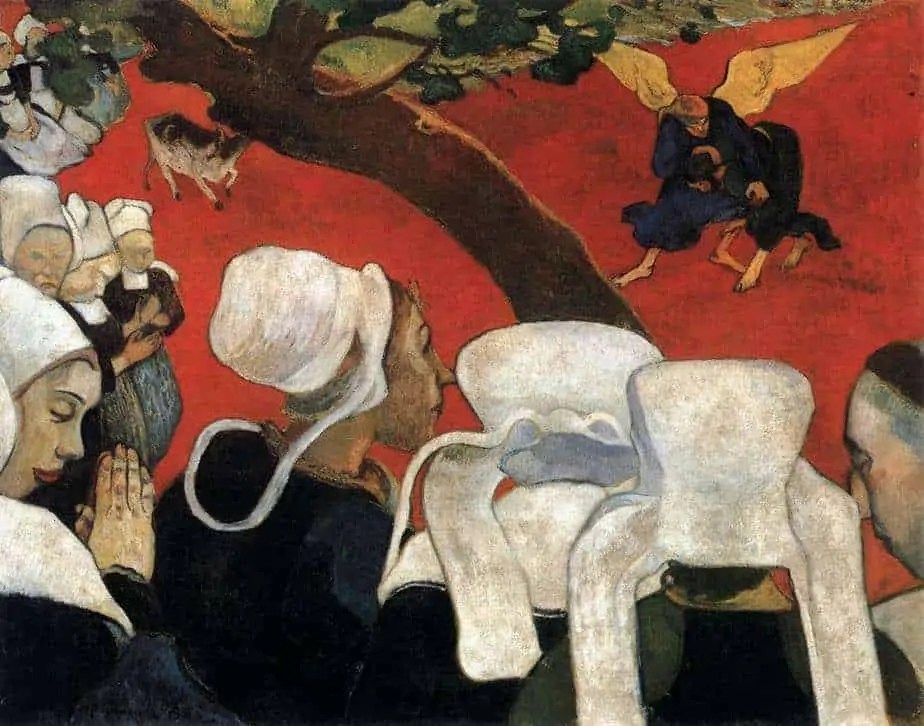
Few biblical stories are as mystifying as that of Jacob’s wrestling match at the Jabbok. There is a back story here. Jacob is on the run, as he has been for all of his life. After cheating brother Esau out of his rightful birthright and blessing as the eldest son, Jacob had to flee his brother’s lethal wrath. He found sanctuary, welcome and wives, four to be precise, with the family of his uncle Laban. But Jacob’s relationship with is uncle turned sour, forcing Jacob to flee once again. Now he is headed back home. This time he is not a lone fugitive, but a man with a family, flocks of animals and a degree of wealth. What he lacks is the shelter of community which make such blessings secure. Jacob is vulnerable, a sitting duck in the wilderness with an angry uncle behind him and a brother before him who has every reason to feel deep hostility toward him. That brother, Jacob learns, is coming to meet him in the company of four hundred men. Jacob the con man, the trickster, the guy who always has an angle knows as he settles down for the night that he has finally painted himself into a corner. It is at this point that Jacob encounters….what exactly? The bible refers to Jacob’s wrestling opponent as a man. Only when the sun is rising and the match is over does Jacob recognize that he has been wrestling with the God of his ancestors.     

A nocturnal being unable to overcome Jacob’s superior strength is hard to reconcile with the God of Israel whose almighty power is set over all other forces of nature by the prophets and throughout the psalms. Resorting to “source criticism,” commentators point out that this passage comes to us from the “Yahwist,” the oldest of the four literary sources constituting the first five books of the Bible known as the “Pentateuch.” They further suggest that elements of this story are drawn from even more ancient Canaanite myths about human encounters with spirits inhabiting rivers and lakes. These spirits, though powerful and dangerous at night, are driven back into their watery abode by the light of day. That would explain Jacob’s victory over his supernatural opponent as well as the opponent’s request that Jacob release him as dawn drew near.

I am not sure what to do with all of these helpful little noetic perjinkerties. I suppose we could use them to dismiss this text as an unhelpful throwback to Israel’s more primitive and unenlightened past and turn our attention instead to the clear expressions of monotheism found in other parts of the Pentateuch. That would surely comport with our 19th Century progressivist prejudices. But our prejudices are just that. Unless one accepts uncritically the doubtful proposition that “later” equates with “more advanced” and that each successive generation is necessarily wiser than the last, there is no basis for supposing that an older and more “primitive” expression of faith is any less true, profound or insightful than later expressions. Indeed, judged from the standpoint of John’s gospel in which the “Word became flesh and dwelt among us,” this gripping tale of an intense, sweaty, bone crunching wrestling match between Jacob and his God comes closer than anything else in the Hebrew Scriptures to the miracle of Incarnation lying at the heart of our faith.

The physicality of God has always been the scandal of Judeo-Christian faith. Greek and Mesopotamian religion generally viewed spirit and matter as binary opposites. The notion that a god could have a body was an alien concept. For this reason, some early Christian preachers seeking to make the good news of Jesus intelligible to the greco-roman world were tempted either to deny Jesus’ humanity or argue that the human Jesus was merely a disguise for the God who is pure spirit. The miracle of the Incarnation is equally problematic for post enlightenment folk like us who are skeptical of miracles in general. A great deal of liberal theology of the 19th and early 20th centuries was geared toward “demythologizing” the scriptures and accommodating Christian faith to a largely secular worldview. The result has been a kind of neo gnostic view of Jesus as a man with an unusually well developed “God consciousness.” This theological construct allowed for faith in Jesus while keeping God safely ensconced in the realm of spirit and thus beyond the reach of modern skepticism.

The liberal approach has been justified as a means for enabling rational moderns unable to believe in the virgin birth, the miracles of Jesus and his Resurrection to connect with and believe in Jesus. But I have a feeling this demythologized approach to interpreting Jesus has far more to do with avoiding the radical implications of the Incarnation than with the need for intellectual honesty. The Incarnation itself demythologizes our notions of a Supreme Being ensconced “way beyond the blue,” beyond the reach of human sight, hearing, touch, scent and taste. When asked by his disciple, Philip, to “show us the Father,” Jesus replies that in seeing and knowing him, they have already encountered the Father. John 14:8-11. The God who reigns over the universe from afar, pulling the levers and pushing the buttons that make things happen does not exist. The only God that exists is the one who is made of human flesh, the one who suffers. The only God that is real resides in refugee camps, sleeps on city streets, languishes in detention centers and starves to death in war zones. This God who hangs on the cross is the only One there is. To worship and serve this God is to care for these most vulnerable among us. To despise those regarded as “least” among us is to blaspheme the only God who truly is. All others are, as pastor and teacher Karl Barth once observed, “man talking in a loud voice.”

Praying to such a God is not a matter of submitting requests for favors. Prayer is entering into the redemptive struggle of the God whose “skin is in the game” of human existence. It is to align one’s heart, mind and life with the promised reign of God over a diverse, equitable and inclusive new creation. There is no better example of what such prayer looks like than the Psalms. These raw expressions of ecstasy, horror, thankfulness, praise, angry cries for vengeance are the stuff of Israel’s struggle to live faithfully under its covenants with the God of its matriarchs, patriarchs, prophets, judges and kings. The Psalms are prayers that formed the faith of Jesus and shaped his understanding of his messianic vocation. As Dietrich Bonhoeffer observed, from the Psalms “we learn…the word which God wants to hear from us.”[1]

“I cannot relate to the Psalms,” said a participant in a Bible Study I once led. “All this anger and hatred of enemies just doesn’t square with Jesus’ command to love and forgive our enemies.” Though I can understand this person’s sentiments, I think the comment reflects a high degree of privilege. If you have never seen your wife and daughters raped in front of you, if you have never seen your homeland bombed into rubble, if you have never suffered sexual assault and been dismissed, if you have never been beaten by the police that are supposed to protect you or imprisoned for no good reason, then you have no business piously dismissing the anguished prayers of those who have. Prayer is not a private, individual matter. To pray is to join with the whole people of God praying first and foremost that God’s kingdom will come and that God’s will be done on earth as in heaven. To that end, our prayers must be united with those of our siblings for whom the reign of God seems altogether absent. We must learn to cry out with their sorrow, longing and rage against the engines of their oppression and the violence they experience, all of which oppose God’s just and gentle reign.

None of this negates Jesus’ command to love our enemies and pray for our persecutors. But the love of which Jesus speaks is not personal sentiment. It is a desire for the wellbeing of those who harm us, regardless how we may feel about them and without tolerating or enabling their abusive behavior. The kindest thing we can do for the enemies who oppresses us is to work tirelessly for the liberation of the oppressed, thereby freeing our enemies from their pathological addiction to wealth, their deep seated insecurity leading to ever greater abuse of their power and their misguided and unsustainable belief in their entitlements. The rich must be “sent away empty” because only empty hands are capable of receiving the gifts of God. Luke 1:53. There is no thought of taking vengeance on our enemies. Although the psalmists call out for vengeance and sometimes tell God precisely what shape they believe vengeance should take, they always leave the business of executing retribution in God’s hands. As the prophet Jonah had to learn, God’s view of who deserves punishment for which sins, when it is administered and the shape it should take frequently differs from our own myopic views of what constitutes justice.

Praying the psalms gives us language to express ourselves. Often, they teach us prayers we do not seem to need just now, but will become a refuge and source of heartfelt expression as life unfolds. The psalms put us in touch with our siblings who experience oppression and opens our eyes to the price they must pay for the privileges so many of us claim as entitlements. Most importantly, praying the psalms engages us in the redemptive work of God for all of creation. This is prayer fused with action, a call to wrestle with God for a blessed future. But be warned, there is risk involved with praying so deeply. Jacob came away lame and broken after his night of wrestling with God. Serious prayer draws us into a confrontation with the truth about ourselves and our world. It breaks down our rationalizations, justifications and excuses for our self destructive and hurtful behavior. Jacob’s night of intense prayer broke more than his hip, even as it won him a blessing. Yet the new day into which Jacob limps holds for him reconciliation, peace and the promise of a new beginning.

Here is a poem by Emily Dickinson inspired by our Hebrew Scripture lesson from Genesis.

A Little East of Jordan

A little East of Jordan,

Evangelists record,

A Gymnast and an Angel

Did wrestle long and hard

Till morning touching mountain

And Jacob, waxing strong,

The Angel begged permission

To Breakfast to return

Not so, said cunning Jacob!

I will not let thee go

Except thou bless me Stranger!

The which acceded to

Light swung the silver fleeces

 Peniel Hills beyond,

And the bewildered Gymnast

Found he had worsted God!

Source: The Poems of Emily Dickinson: Reading Edition, (c. 1999 by the President and Fellows of Harvard College; edited by Ralph W. Franklin, ed., Cambridge, Mass.) Emily Dickinson (1830-1866) is indisputably one of America’s greatest and most original poets. Born in Amherst, Massachusetts, she attended a one-room primary school in that town and went on to Amherst Academy, the school out of which Amherst College grew. In the fall of 1847 Dickinson entered Mount Holyoke Female Seminary where students were divided into three categories: those who were “established Christians,” those who “expressed hope,” and those who were “without hope.” Emily, along with thirty other classmates, found herself in the latter category. Though often characterized a “recluse,” Dickinson kept up with numerous correspondents, family members and teachers throughout her lifetime. You can find out more about Emily Dickinson and sample more of her poetry at the Poetry Foundation website.


[1] Bonhoeffer, Dietrich, Life Together and Prayerbook of the Bible, ed. Gerhard Ludwig Müller, Albrecht Schönherr, and Geffrey B. Kelly, trans. Daniel W. Bloesch and James H. Burtness, vol. 5, Dietrich Bonhoeffer Works (Minneapolis, MN: Fortress Press, 1996), pp. 155–177.

Have I been Censored by FB?

Here is what I know. About a week ago, I noticed a decrease in volume on my website. Wondering whether I had neglected or failed in my efforts to post my weekly articles to the Facebook pages on which I have participated for many years, I discovered that my posts for the last five weeks have been marked “pending.” I clicked on the link marked Learn more and found the following message:

“To help keep this group safe, admins review some posts before they’re visible to others. You’ll be notified when your post is published in the group.”

I found this highly suspect for two Facebook pages to which I belong captioned “ELCA Rostered Ministers” and “ELCA Uncensored.” ELCA Rostered Ministers states under its “About” heading, “Posts are not moderated in any way, shape or form after complaints over removal of sexist and racist posts. So just work it out amongst yourselves or just scroll past that which you don’t like.” ELCA uncensored gives notice to its members, “This is a group open to all current or former ELCA Clergy and seminarians. Canadians are welcome, too. Other countries as well. The idea is that you will not be censored here. Talk about what you want. You’re CLERGY, for Pete’s sake. Not small children who have to be supervised in a ‘sandbox.’” Thus, I find it highly unlikely that the administrators of these pages have been holding my posts hostage over a month reviewing them for dangerous content. Stranger still was the block placed on a photography page of which I am a member. All we ever do on this page is share photographs. I have shared pictures of birds, bugs and other such nature shots infrequently on this page, but I noticed that the one I shared about two weeks ago was “pending.” Again, the notice stated: “This review is for group safety and so admins can get to know participants. You can create up to 5 posts and comments while admin review is pending. We’ll let you know when admins complete their review and your content is published in the group.” To date, I have received neither notice nor freedom to post.

I paid a visit to Facebook’s info page from which I learned the following:

“Temporary blocks from sharing posts on Facebook can happen if you’ve:

  • Posted a lot in a short amount of time
  • Shared posts that were marked as unwelcome
  • Shared something that goes against our Community Standards

Though we can’t lift the block early, you can still view posts in your Feed at any time. We realize that most people who get temporary blocks just didn’t know about our sharing policies. To avoid blocks like this in the future, the best thing you can do is review our Community Standards.”

Accordingly, I checked out the community standards in an effort to discover which of these I might have violated. I will not try to summarize the exhaustive list of behaviors that might earn blockage or removal of content from Facebook. Suffice to say that I was unable to identify any of Facebook’s community standards remotely applicable to anything I have ever posted. So I am left wondering why I have been blocked from sharing my posts on other pages.

As those of you who follow me regularly know, I have been openly critical of our government’s inhumane treatment of refugees under both Democratic and Republican administrations. I have been critical of our government’s support of the Israeli killing machine at work in Gaza and on the West Bank under both Democratic and Republican administrations. I have been particularly critical of the racist, misogynist, homophobic and xenophobic policies and actions of the current Trump administration. I have gone so far as to say that the GOP ought to be classified as a hate group under the standards of the Southern Poverty Law Center criteria. What I have never done and never will do is incite, advocate or defend violence against any person or group. Again, those who follow me regularly know that, as a Christological pacifist, I refuse to condone or justify even violence that my church would justify under the “just war” doctrine. So, once again, I wonder why Facebook has chosen to block sharing of my posts.  

In ordinary times, I might have ascribed all of this to some hiccup in Facebook’s algorithm. But these are no ordinary times. These are times in which masked thugs are “disappearing” our neighbors from off the street, raiding schools, hospitals and courthouses. These are times in which the FCC is bullying media networks into silencing people it deems offensive to the regime. These are times when the armed forces of the United States created to defend us against foreign enemies are being deployed against our cities and their people. These are times in which those of us who have the temerity to hold political convictions contrary to the Republican administration are characterized as “vermin,” “enemies from within” and “radicals.” So I am led to wonder if I am being censored.

To be clear, I am not so paranoid or so possessed by delusions of grandeur to imagine that I am being monitored by Homeland Security. I am sure Kristi Noem has bigger fish to fry (or puppies to shoot) than a minor league blogger with a following of three hundred fifty and a thousand or so folks who drop by his webpage every so often. I doubt this runs any deeper than Facebook. Nonetheless, Facebook is owned by Meta Platforms, Inc., a publicly traded company. Like all publicly traded companies, its objective is to make money for its shareholders. Meta’s chairman and CEO, Mark Zuckerberg, like the business leaders that ultimately supported and enabled the rise of Adolph Hitler, knows on which side his bread is buttered. To avoid being regulated or litigated out of existence, a good CEO will do whatever it takes to placate, ingratiate himself to and avoid conflict with the government whose actions could easily endanger the company’s profits and thereby enrage its shareholders. Is it so far fetched to imagine that Facebook might have an algorithm detecting persons who consistently post articles critical of Trump? Or articles that address in less than favorable terms the life and legacy of Charly Kirk as I recently did? Or any other content that might provoke the MAGA faithful? I do not believe that Zuckerberg or, for that matter, the business leaders that enabled Hitler in the 1930s necessarily supported their government’s oppressive aims. Nothing personal against the Jews-or women, people of color, or LGBTQ+ folk or immigrants. It’s just business.

My suspicions may very well be unfounded. In fact, I hope they are. I hope that I was merely caught up in some well meaning, but defective filter designed by Facebook to screen out genuinely dangerous content. Yet, since there seems to be no way to appeal Facebook’s action or even question it, my suspicions remain. Perhaps it is time to question whether our newspapers, news networks and media platforms belong in the hands of corporate ownership. Perhaps it is time for all of us to wonder who besides Alexa and Siri might be listening to us on those very convenient smart speakers in our homes. Maybe we should be a little more suspicious of all the apps that come with the smart phones and laptops we buy. Regardless whether my being blocked is intentional or inadvertent, it uncovers a frightening reality, namely, that the guarantees protecting our right to privacy, the integrity of our sources of information and our freedom of expression are extremely fragile right now. It would not take much to obliterate them altogether.