NINETEENTH SUNDAY AFTER PENTECOST
Prayer of the Day: O Lord God, tireless guardian of your people, you are always ready to hear our cries. Teach us to rely day and night on your care. Inspire us to seek your enduring justice for all this suffering world, through Jesus Christ, our Savior and Lord.
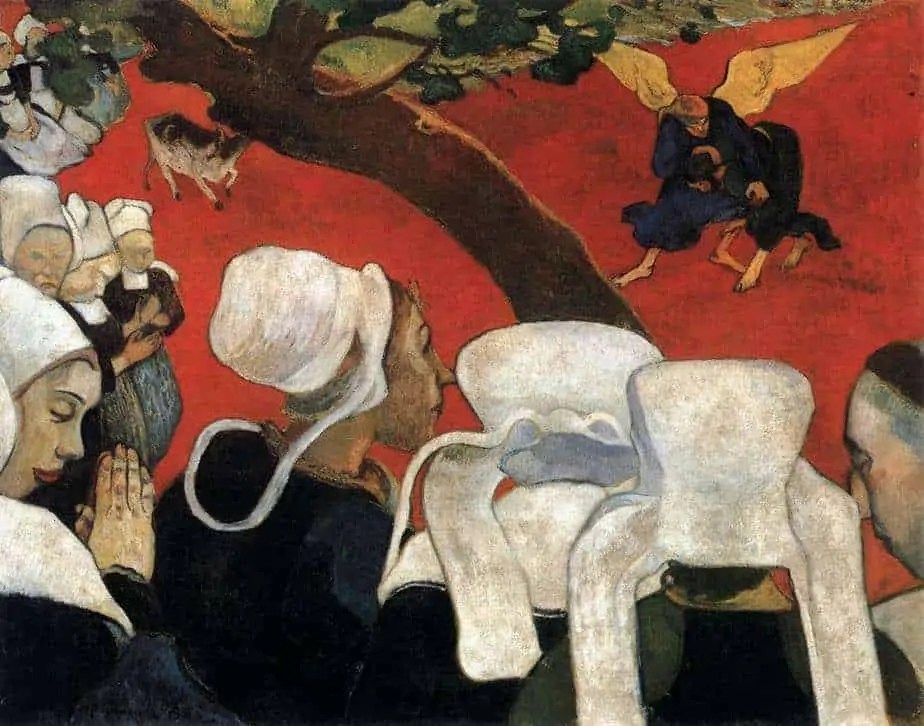
“Jacob was left alone, and a man wrestled with him until daybreak.” Genesis 32:24.
Few biblical stories are as mystifying as that of Jacob’s wrestling match at the Jabbok. There is a back story here. Jacob is on the run, as he has been for all of his life. After cheating brother Esau out of his rightful birthright and blessing as the eldest son, Jacob had to flee his brother’s lethal wrath. He found sanctuary, welcome and wives, four to be precise, with the family of his uncle Laban. But Jacob’s relationship with is uncle turned sour, forcing Jacob to flee once again. Now he is headed back home. This time he is not a lone fugitive, but a man with a family, flocks of animals and a degree of wealth. What he lacks is the shelter of community which make such blessings secure. Jacob is vulnerable, a sitting duck in the wilderness with an angry uncle behind him and a brother before him who has every reason to feel deep hostility toward him. That brother, Jacob learns, is coming to meet him in the company of four hundred men. Jacob the con man, the trickster, the guy who always has an angle knows as he settles down for the night that he has finally painted himself into a corner. It is at this point that Jacob encounters….what exactly? The bible refers to Jacob’s wrestling opponent as a man. Only when the sun is rising and the match is over does Jacob recognize that he has been wrestling with the God of his ancestors.
A nocturnal being unable to overcome Jacob’s superior strength is hard to reconcile with the God of Israel whose almighty power is set over all other forces of nature by the prophets and throughout the psalms. Resorting to “source criticism,” commentators point out that this passage comes to us from the “Yahwist,” the oldest of the four literary sources constituting the first five books of the Bible known as the “Pentateuch.” They further suggest that elements of this story are drawn from even more ancient Canaanite myths about human encounters with spirits inhabiting rivers and lakes. These spirits, though powerful and dangerous at night, are driven back into their watery abode by the light of day. That would explain Jacob’s victory over his supernatural opponent as well as the opponent’s request that Jacob release him as dawn drew near.
I am not sure what to do with all of these helpful little noetic perjinkerties. I suppose we could use them to dismiss this text as an unhelpful throwback to Israel’s more primitive and unenlightened past and turn our attention instead to the clear expressions of monotheism found in other parts of the Pentateuch. That would surely comport with our 19th Century progressivist prejudices. But our prejudices are just that. Unless one accepts uncritically the doubtful proposition that “later” equates with “more advanced” and that each successive generation is necessarily wiser than the last, there is no basis for supposing that an older and more “primitive” expression of faith is any less true, profound or insightful than later expressions. Indeed, judged from the standpoint of John’s gospel in which the “Word became flesh and dwelt among us,” this gripping tale of an intense, sweaty, bone crunching wrestling match between Jacob and his God comes closer than anything else in the Hebrew Scriptures to the miracle of Incarnation lying at the heart of our faith.
The physicality of God has always been the scandal of Judeo-Christian faith. Greek and Mesopotamian religion generally viewed spirit and matter as binary opposites. The notion that a god could have a body was an alien concept. For this reason, some early Christian preachers seeking to make the good news of Jesus intelligible to the greco-roman world were tempted either to deny Jesus’ humanity or argue that the human Jesus was merely a disguise for the God who is pure spirit. The miracle of the Incarnation is equally problematic for post enlightenment folk like us who are skeptical of miracles in general. A great deal of liberal theology of the 19th and early 20th centuries was geared toward “demythologizing” the scriptures and accommodating Christian faith to a largely secular worldview. The result has been a kind of neo gnostic view of Jesus as a man with an unusually well developed “God consciousness.” This theological construct allowed for faith in Jesus while keeping God safely ensconced in the realm of spirit and thus beyond the reach of modern skepticism.
The liberal approach has been justified as a means for enabling rational moderns unable to believe in the virgin birth, the miracles of Jesus and his Resurrection to connect with and believe in Jesus. But I have a feeling this demythologized approach to interpreting Jesus has far more to do with avoiding the radical implications of the Incarnation than with the need for intellectual honesty. The Incarnation itself demythologizes our notions of a Supreme Being ensconced “way beyond the blue,” beyond the reach of human sight, hearing, touch, scent and taste. When asked by his disciple, Philip, to “show us the Father,” Jesus replies that in seeing and knowing him, they have already encountered the Father. John 14:8-11. The God who reigns over the universe from afar, pulling the levers and pushing the buttons that make things happen does not exist. The only God that exists is the one who is made of human flesh, the one who suffers. The only God that is real resides in refugee camps, sleeps on city streets, languishes in detention centers and starves to death in war zones. This God who hangs on the cross is the only One there is. To worship and serve this God is to care for these most vulnerable among us. To despise those regarded as “least” among us is to blaspheme the only God who truly is. All others are, as pastor and teacher Karl Barth once observed, “man talking in a loud voice.”
Praying to such a God is not a matter of submitting requests for favors. Prayer is entering into the redemptive struggle of the God whose “skin is in the game” of human existence. It is to align one’s heart, mind and life with the promised reign of God over a diverse, equitable and inclusive new creation. There is no better example of what such prayer looks like than the Psalms. These raw expressions of ecstasy, horror, thankfulness, praise, angry cries for vengeance are the stuff of Israel’s struggle to live faithfully under its covenants with the God of its matriarchs, patriarchs, prophets, judges and kings. The Psalms are prayers that formed the faith of Jesus and shaped his understanding of his messianic vocation. As Dietrich Bonhoeffer observed, from the Psalms “we learn…the word which God wants to hear from us.”[1]
“I cannot relate to the Psalms,” said a participant in a Bible Study I once led. “All this anger and hatred of enemies just doesn’t square with Jesus’ command to love and forgive our enemies.” Though I can understand this person’s sentiments, I think the comment reflects a high degree of privilege. If you have never seen your wife and daughters raped in front of you, if you have never seen your homeland bombed into rubble, if you have never suffered sexual assault and been dismissed, if you have never been beaten by the police that are supposed to protect you or imprisoned for no good reason, then you have no business piously dismissing the anguished prayers of those who have. Prayer is not a private, individual matter. To pray is to join with the whole people of God praying first and foremost that God’s kingdom will come and that God’s will be done on earth as in heaven. To that end, our prayers must be united with those of our siblings for whom the reign of God seems altogether absent. We must learn to cry out with their sorrow, longing and rage against the engines of their oppression and the violence they experience, all of which oppose God’s just and gentle reign.
None of this negates Jesus’ command to love our enemies and pray for our persecutors. But the love of which Jesus speaks is not personal sentiment. It is a desire for the wellbeing of those who harm us, regardless how we may feel about them and without tolerating or enabling their abusive behavior. The kindest thing we can do for the enemies who oppresses us is to work tirelessly for the liberation of the oppressed, thereby freeing our enemies from their pathological addiction to wealth, their deep seated insecurity leading to ever greater abuse of their power and their misguided and unsustainable belief in their entitlements. The rich must be “sent away empty” because only empty hands are capable of receiving the gifts of God. Luke 1:53. There is no thought of taking vengeance on our enemies. Although the psalmists call out for vengeance and sometimes tell God precisely what shape they believe vengeance should take, they always leave the business of executing retribution in God’s hands. As the prophet Jonah had to learn, God’s view of who deserves punishment for which sins, when it is administered and the shape it should take frequently differs from our own myopic views of what constitutes justice.
Praying the psalms gives us language to express ourselves. Often, they teach us prayers we do not seem to need just now, but will become a refuge and source of heartfelt expression as life unfolds. The psalms put us in touch with our siblings who experience oppression and opens our eyes to the price they must pay for the privileges so many of us claim as entitlements. Most importantly, praying the psalms engages us in the redemptive work of God for all of creation. This is prayer fused with action, a call to wrestle with God for a blessed future. But be warned, there is risk involved with praying so deeply. Jacob came away lame and broken after his night of wrestling with God. Serious prayer draws us into a confrontation with the truth about ourselves and our world. It breaks down our rationalizations, justifications and excuses for our self destructive and hurtful behavior. Jacob’s night of intense prayer broke more than his hip, even as it won him a blessing. Yet the new day into which Jacob limps holds for him reconciliation, peace and the promise of a new beginning.
Here is a poem by Emily Dickinson inspired by our Hebrew Scripture lesson from Genesis.
A Little East of Jordan
A little East of Jordan,
Evangelists record,
A Gymnast and an Angel
Did wrestle long and hard
Till morning touching mountain
And Jacob, waxing strong,
The Angel begged permission
To Breakfast to return
Not so, said cunning Jacob!
I will not let thee go
Except thou bless me Stranger!
The which acceded to
Light swung the silver fleeces
Peniel Hills beyond,
And the bewildered Gymnast
Found he had worsted God!
Source: The Poems of Emily Dickinson: Reading Edition, (c. 1999 by the President and Fellows of Harvard College; edited by Ralph W. Franklin, ed., Cambridge, Mass.) Emily Dickinson (1830-1866) is indisputably one of America’s greatest and most original poets. Born in Amherst, Massachusetts, she attended a one-room primary school in that town and went on to Amherst Academy, the school out of which Amherst College grew. In the fall of 1847 Dickinson entered Mount Holyoke Female Seminary where students were divided into three categories: those who were “established Christians,” those who “expressed hope,” and those who were “without hope.” Emily, along with thirty other classmates, found herself in the latter category. Though often characterized a “recluse,” Dickinson kept up with numerous correspondents, family members and teachers throughout her lifetime. You can find out more about Emily Dickinson and sample more of her poetry at the Poetry Foundation website.
[1] Bonhoeffer, Dietrich, Life Together and Prayerbook of the Bible, ed. Gerhard Ludwig Müller, Albrecht Schönherr, and Geffrey B. Kelly, trans. Daniel W. Bloesch and James H. Burtness, vol. 5, Dietrich Bonhoeffer Works (Minneapolis, MN: Fortress Press, 1996), pp. 155–177.


I think it’s easier if you believe in the literal truth of the Gospels, and, as a Catholic, the real presence of Jesus in the Sacrament of the Eucharist. The duality has been expressly given as dogma. It happens every day, all over the Earth. It isn’t a memory or a memorial. The Protestant churches have taught us a lot, but they have also given up a lot.
LikeLiked by 1 person
Not sure what you mean by “literal truth of the gospels.” But when it comes to the real presence of Christ in the sacramental bread and wine, Lutherans are pretty much on the same page as Roman Catholics.
LikeLike
I just meant that Jesus is a historical person, not a story, and that He went out and preached in person and people could go and listen.
I often wonder if, had I been alive then, I would have had the sense to.
LikeLike
I grew up in a largely Catholic country, Mexico, and had very little contact with Protestantism until I moved to the States to finish college. There are so many varieties!
We studied the Protestant Reformation (and the Catholic counterreformation) as part of history at our all-girls Catholic school, but I don’t know how balanced that presentation was. I’ve always thought it was necessary to break the stranglehold the Catholic Church should never have had on the temporal world (that never works well), and which led to some very unholy people ending up as top clergy.
LikeLike
I’m always thankful for the things we share – sorry I don’t know more about the specific differences.
LikeLike
I love the idea of God as a “tireless guardian” – makes me think about how often I take his care for granted 🙏
LikeLike