TWENTY-SECOND SUNDAY AFTER PENTECOST
Prayer of the Day: O God, our eternal redeemer, by the presence of your Spirit you renew and direct our hearts. Keep always in our mind the end of all things and the day of judgment. Inspire us for a holy life here, and bring us to the joy of the resurrection, through Jesus Christ, our Savior and Lord.
“Those who belong to this age marry and are given in marriage,but those who are considered worthy of a place in that age and in the resurrection from the dead neither marry nor are given in marriage.” Luke 20:34-35.
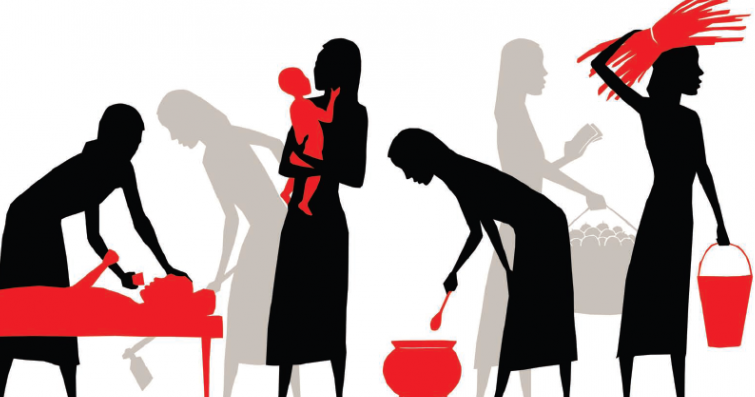
The Sadducees’ question is a man’s question posed by men, to men in a man’s world. A woman has been passed on like a piece of furniture from brother to brother as each died. Now at the resurrection, we have a legal problem. To whom does this woman belong? Who has “rights” to her body and soul? Nowhere is there any consideration about what the woman might prefer or who, if any, of these brothers she might want to be with. This dispute is over the conflicting claims between men. The Sadducees cannot imagine a future in which a man’s legal claim on a woman cannot be fairly adjudicated; hence, their skepticism over the resurrection. Jesus responds that their unbelief in the resurrection of the dead is a result of their failure to grasp the power of God. The radical equity among all people under God’s reign supersedes every human claim of ownership or dominion. There is no room in God’s kingdom for hierarchy or patriarchy, even when clothed in the sanctified dress of institutional marriage.
Marriage is, after all, a human institution that is very much of this world. Its shape and meaning have varied over time and between cultures. The Bible does not say otherwise. The often miscited passage from the second chapter of Genesis does not say that God instituted marriage. Rather, it tells us God, having determined that “it is not good” for the human creature to be alone, created a partner for this first human being. Thus, God is the author of human intimacy. The phenomenon of marriage, in all of its manifestations, is a human response to God’s creative act. Like all human institutions, marriage is as flawed as is human nature. Like government, church and family more generally, it can be a protective structure in which human intimacy, growth and development are nurtured. But it is also true that marriage, like these other institutions, can become a theater of oppression, exploitation and abuse. The practice of treating a woman as a mere piece of property represents the latter.
Neither marriage nor any other human institution is ever an end in itself. Even the Sabbath, a practice which truly is biblically grounded in a command of God, exists to further human wellbeing. When used in ways that diminish human thriving, the sabbath too, becomes an instrument of human oppression, defeating its own purpose. Jesus’ response to the Sadducees therefore goes beyond the scope of their hypothetical. He calls into question the premise of their inquiry. Claims of ownership, dominion or dominance by any individual or group over other individuals or groups have no standing under the reign of God. There, people “neither marry nor are given in marriage.” This is not to disparage marriage per se. It is only to say that marriage is not to be an instrument of hierarchy, patriarchy or any other species of domination. Under the reign of God, marriage must serve the objective of mutuality if it is to exist at all. To that point, Saint Paul likens marriage to the relationship between Christ and his church. Jesus reigns over his disciples by washing their feet and laying down his life for them. His disciples are led by the one most ready to serve.[1] It is because the Sadducees cannot conceive of such a radically equitable existence that they are unable to believe in the resurrection.
All that being said, there are numerous questions about resurrection and eternal life that are troubling for many of us. What about the broken relationships, unhealed wounds and regrets one inevitably carries to the grave? How can eternal life be blessed if we bring all that baggage with us? What happens to painful memories? Are they simply erased? Is it not the case that our greatest hardships, griefs and failures turn out to be the events that shape us into who we are? Who and what are we if all of that is washed away? And what about the character flaws, irritating habits and biases that are, however regrettably, part of our identity? If all of that were simply sheared away, would we be the same persons? Would we be recognizable to others we have known or even ourselves? Will questions like this even matter in the new creation?
Jesus does not give us a definitive answer. He only tells us that the resurrected are “like angels in heaven.” Given what little the Bible tells us about angels, that is not particularly helpful. Saint Paul tells the church in Corinth that such questions about post-resurrection life are stupid-and then goes on to answer them after a fashion:
“But someone will ask, “How are the dead raised? With what kind of body do they come?” Fool! What you sow does not come to life unless it dies. And as for what you sow, you do not sow the body that is to be but a bare seed, perhaps of wheat or of some other grain. But God gives it a body as he has chosen and to each kind of seed its own body.” I Corinthians 15:35-38.
The analogy makes clear that the “spiritual body”[2] to be raised up from the “physical body” is as qualitatively different as is the full grown plant from the “bare seed.” While there is surely continuity of identity, there is exponential growth and development that cannot yet be seen in the seed upon planting. As the Apostle John puts it, “Beloved, we are God’s children now; what we will be has not yet been revealed. What we do know is this: when he is revealed, we will be like him, for we will see him as he is.” I John 3:2. The final word belongs to Jesus: “[God] is God not of the dead but of the living, for to him all of them are alive.” Luke 20:38. In some way too marvelous to be contained within our wildest imaginings, God weaves the lives of the saints into the fabric of God’s new creation, preserving the wealth of our relationships, works of kindness and acts of faithfulness and courage, assuring us that what we know of God’s reign only in part will become clear at the Resurrection of the dead and in the life of the world to come. That might not be all we would like to know. But it is enough.
Here is a poem by May Swenson reflecting the often suffocating environment of patriarchy experienced by women today and which Jesus roundly rejected as inconsistent with God’s reign in his own time.
Women
Women Or they
should be should be
pedestals little horses
moving those wooden
pedestals sweet
moving oldfashioned
to the painted
motions rocking
of men horses
the gladdest things in the toyroom
The feelingly
pegs and then
of their unfeelingly
ears To be
so familiar joyfully
and dear ridden
to the trusting rockingly
fists ridden until
To be chafed the restored
egos dismount and the legs stride away
Immobile willing
sweetlipped to be set
sturdy into motion
and smiling Women
women should be
should always pedestals
be waiting to men
Source: New and Selected Things Taking Place (Pub. by Boston: Atlantic/Little Brown, 1978; c. 1978 by May Swenson.) Anna Thilda May Swenson (1913 –1989) was an American poet and playwright. Born to Margaret and Dan Arthur Swenson, she was the eldest of ten children in a Mormon household where Swedish was spoken regularly and English was a second language. Although her family struggled to accept that she was a lesbian, they remained close throughout her life. Much of her later poetry was devoted to children. She also translated the work of contemporary Swedish poets, including the selected poems of Nobel laureate Tomas Tranströmer.
Swenson attended Utah State University in Logan, Utah, graduating in 1934 with a bachelor’s degree. She taught poetry as poet-in-residence at Bryn Mawr College, the University of North Carolina at Greensboro, the University of California, Riverside, Purdue University, and Utah State University. From 1959 to 1966 she worked as a manuscript reviewer at New Directions Publishing. Swenson left New Directions Press in 1966 to focus more on her writing. She served as a chancellor of the Academy of American Poets from 1980 until her death. You can read more about May Swenson and sample more of her poems at the Poetry Foundation website.
[1] The most explicit portrayal of this image is in Paul’s letter to the church to the Ephesians. Some have been critical of Paul’s reference to the man as the “head” of the wife and his admonition for her to “submit” to him. While understandable, I think we need to look beyond these stereotypical gender roles that influenced Paul’s writing to the larger point. Jesus leads by persuasion and example, never domination. One could therefore switch the roles such that the text reads, “husbands, submit to your wives” and “wives, love your husbands” without doing any violence to its meaning. Paul is simply stating a variation of Jesus’ admonition that, as he has washed his disciples’ feet, so they should wash one another’s feet. John 13:12-14.
[2] The term “spiritual body” seems contradictory only if one subscribes to the dualistic assumption that “spirit” and “matter” are separable and distinct. No such binary thinking is native to Hebrew thought. To be “spiritual” is not to transcend the material world, but to be oriented toward God and the work of God’s Spirit in the world. The new creation is therefore not a realm of “pure spirit,” as though such a thing could even exist. It is rather a material world wholly oriented toward its Creator. It is God’s will done “on earth as it is in heaven.”


Good blog, Rev. Olsen. I am currently enrolled in a class with about 40 others on the Afterlife with Dr Adolf Hansen, retired professor at Garrett Theological Seminary in Evanston, IL and Theologian in Residence at St Luke’s UMC Indpls. The first issue to be addressed is what form will be in in the afterlife, to which he has answered that we will likely not have physical bodies, but will exist as a soul, which will recognize those we have known in earthly life. A large percentage of the class was been widowed, (I myself was widowed twice between May 2024 and May 2025) which makes for some interesting questions to ponder based on the strength of the marriage, whether trust was broken in the marriage, if there has been remarriage or partnership will I be meeting both in heaven, etc. And of course there are no definitive answers. Just lots of thinking to do.
LikeLike