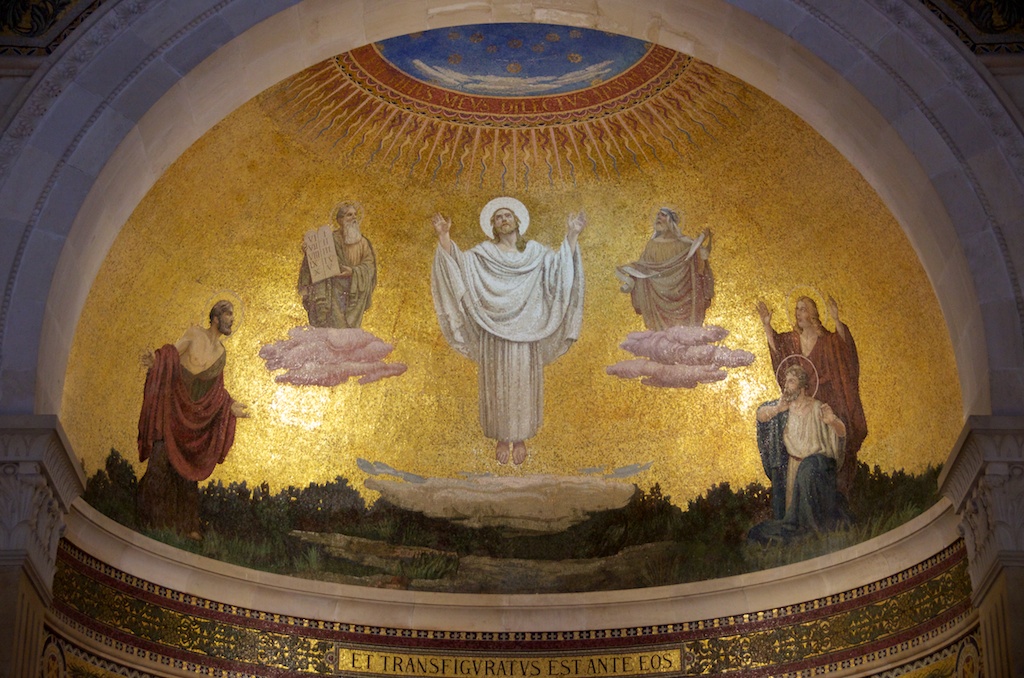
TRANSFIGURATION OF OUR LORD
Psalm 2 or
Prayer of the Day: O God, in the transfiguration of your Son you confirmed the mysteries of the faith by the witness of Moses and Elijah, and in the voice from the bright cloud declaring Jesus your beloved Son, you foreshadowed our adoption as your children. Make us heirs with Christ of your glory, and bring us to enjoy its fullness, through Jesus Christ, our Savior and Lord, who lives and reigns with you and the Holy Spirit, one God, now and forever.
“This is my Son, the Beloved; with him I am well pleased; listen to him!” Matthew 17:5.
Just when the disciples think they finally have Jesus figured out, they find out they don’t. Just when they think they understand what the reign of God is all about, they discover they have a lot more to learn. They struggle to comprehend Jesus’ parables, they question his judgment when he tells them they are bound for Jerusalem and they do not know what to make of the Transfiguration but are clearly intent on making it last. The succeeding generations of disciples have fared no better. We are still trying to figure out who Jesus is, what he demands of us and how to follow him. Over the centuries, the church has made some disastrous wrong turns, not the least of which was turning Jesus into the mascot of empire, the tool of colonialism and, most recently, the patron saint of American racism, genocide, misogyny and homophobia. The way of discipleship is, as Jesus characterizes it, “narrow” and “hard.” By contrast, the way leading us away from it is “wide and the road is easy.” Matthew 7:13-14. Thus, the divine imperative: “This is my Son, the Beloved…listen to him.”
How do people like us who are two millennia removed from Jesus’ earthly ministry listen to him? Of course, the most direct witnesses we have to Jesus are the Hebrew Scriptures and the New Testament. The Bible, consisting of both documents, is understood in my Lutheran tradition to be the Word of God-but only in a derivative sense. Primarily, the Word of God is the Word made flesh, the incarnate Word, Jesus the Christ. In the not too distant past, we would have said that the Bible is “inerrant and infallible.” The abandonment of these terms in our more recent statements of faith caused quite a stir among folks who felt we were watering down the Bible’s authority. But I think jettisoning these terms was a wise decision. They say both too much and too little. They claim too much because they ascribe everything to the text, suggesting that we disciples of Jesus are a “people of the book.” [1] On the other hand, these two terms say too little because they fail to specify the focus of the Bible’s testimony to the Incarnate Word. In arguing with his opponents, Jesus remarked, “you search the scriptures because you think that in them you have eternal life, and it is they that testify on my behalf.” John 5:39. I prefer to say that the Bible is a faithful and reliable witness to God’s saving acts toward Israel and God’s redemptive acts for all creation through the obedient life, faithful death and glorious resurrection of Jesus. Disciples of Jesus read and interpret the scriptures through this lens. That is how the Bible enables us to listen to Jesus.
Still, the fact remains that the Bible has not always functioned as a redemptive text or a faithful witness to Jesus and the reign of God he proclaims. Throughout history the Bible has been cited in support of unspeakable hatred, violence and cruelty. In both the United States and South Africa, the accounts of Israel’s conquest of Canaan were cited as a rationale for invading, conquering and dispossessing indigenous peoples. Saint Paul’s admonition to respect governing authorities as instruments of God’s justice has been cited to justify tyranny and condemn resistance to it. The Bible was regularly invoked to support the institution of slavery in the antebellum United States and afterward to support the systemic racism of Jim Crow. Biblical passages have been employed to demonize, ostracize and incite violence against gay, lesbian and transgender persons. The Bible is a complex, layered and diverse collection of literature filled with rabbit holes leading to dark and frightening places. It is a dangerous book in the hands of the wrong people.
That brings us to our reading from II Peter where the apostle says, “First of all you must understand this, that no prophecy of scripture is a matter of one’s own interpretation.” II Peter 1:20. That is not to say the Bible needs no interpretation. As noted above, it clearly does. The operative words in Peter’s remark are “one’s own.” Interpretation of scripture is far too important a task to be left to everyone’s individual conscience. It is too important to be placed solely in the hands of ecclesiastical authorities or left to the outcome of any democratic process. Interpretation of scripture is the task of the whole church. We need the wisdom and experience of bishops, pastors and teachers to school us in the lessons learned by the church over the centuries and the hard won teachings that have guided us. We need prophetic voices of preachers speaking from the margines to warn us when our orthopraxy does not match our orthodoxy and call us back to faithfulness. We need writers, poets, artists and musicians to stretch our imaginations and help us to see and understand in new ways our Lord Jesus and the reign of God he proclaims. I daresay we need even the heretics. While we may reject their claims and teachings, we can thank them for helping us clarify, revise and strengthen our own. (And I hope we are learning to treat them more grace and gentleness than we have in the past!) Through all these witnesses, we discover anew the Jesus we thought we knew as he is constantly transfigured and we are by him transformed.
Here is a poem about perception that transfigures and its transformative potential by Jennifer Jean.
Doors of Perception
My father leapt on stage at the Hollywood Bowl
to grab drum and cymbal sticks
from a star—he wanted to be
a star, a door, a Door. White. Security
thugs dragged him off
John Densmore. He saw doors everywhere, he saw Doors
everywhere—at the Whisky,
the Beanery, the Magic Mountain fest—and
in primary colors
in Windward, Oakwood, or North of Rose. He wanted
to forget war in Venice, to be a door in Venice
and face the faux canals.
Later, he flew to Paris to pay homage to the Door who died
with a head of Alexandrian hair.
He carried huge pale poppies
to the “Poets’ Corner” in the Père Lachaise,
to this stranger under a cream coffin
door nailed shut. He said, Break on through.
He put a poppy in his pocket
like a receipt,
and chased daylight till he landed
in LA, saw a wave of white
stars rippling
on the Pacific on new moon nights,
when the ever-present rust cloud was blown out to sea.
He found a motel room door, particle door, and shut it
on all that he owned
for fifty years. He lived there, adding up primary colors,
hour to hour in Bliss Consciousness—
crossing his legs on the bed, letting electric snow
hush the TV. Hush
gunfire and
blood. He forgot his father’s father’s Cabo Verde
and let himself be Italian there—
a different kind of Venetian—because who he really was was
too close to Black.
Source: Poetry (October 2020). Jennifer Jean is a poet, translator, editor and educator. She was born in Venice, California and lived in foster-care until she was seven. Her ancestors are from the Cape Verde Islands. She grew up in California’s San Fernando Valley. She earned her BA in creative writing from San Francisco State University and her MFA in poetry from Saint Mary’s College. Jean has been awarded fellowships from the Kenyon Review Writers Workshop, Disquiet/Dzanc Books, the Massachusetts Cultural Council, and the Kolkata International Poetry Festival. She received the Jean Pedrick Award from the NEPC, and an Ambassador for Peace Award from the Women’s Federation for World Peace. Jean is the founder of Free2Write: Poetry Workshops for Trauma Survivors, and has been the poetry editor for Talking Writing Magazine and MER. You can read more about Jennifer Jean and sample more of her poetry at the Poetry Foundation website.
[1] My friends who insist on an inerrant Bible find themselves drawn down a thousand rabbit holes, having to defend a literal six day creation, a literal worldwide flood and a literal halt to the earth’s rotation against all scientific evidence. This is necessary because if the Bible is found to be unreliable in any single detail, its credibility is destroyed and faith is undermined. But this is to do exactly what Jesus’ opponents were doing, namely, placing faith in the scriptures rather than the God to whom the scriptures testify.

