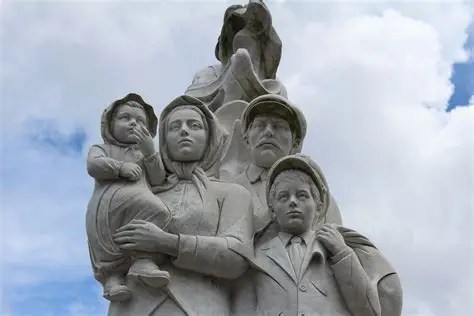
THIRD SUNDAY OF EASTER
Prayer of the Day: O God, your Son makes himself known to all his disciples in the breaking of bread. Open the eyes of our faith, that we may see him in his redeeming work, who lives and reigns with you and the Holy Spirit, one God, now and forever.
“To the exiles of the dispersion in Pontus, Galatia, Cappadocia, Asia, and Bithynia, who have been chosen and destined by God the Father and sanctified by the Spirit to be obedient to Jesus Christ and to be sprinkled with his blood” I Peter 1:1-2.
The New Testament writers frequently employ the narratives of “exile,” nomadic existence and marginalization in the life of Israel as metaphors for the church’s life in the time between Jesus’ resurrection and his return to reign over a renewed creation. The role call of saints in the Letter to the Hebrews comes to mind. See Hebrews 11. The author says concerning the heroes of the Hebrew Scriptures that they “suffered mocking and flogging and even chains and imprisonment. They were stoned to death; they were sawn in two; they were killed by the sword; they went about in skins of sheep and goats, destitute, persecuted, tormented—of whom the world was not worthy. They wandered in deserts and mountains and in caves and holes in the ground.” Hebrews 11:36-38. Jesus warns his disciples in John’s gospel that “[b]ecause you do not belong to the world, but I have chosen you out of the world, therefore the world hates you.” John 15:19. Paul reminds the church at Phillipi that “our citizenshipis in heaven, and it is from there that we are expecting a Savior, the Lord Jesus Christ.” Philippians 3:20.
Nevertheless, though not being “of” the world, disciples of Jesus are very much “in” the world and have been for the last two millennia. Consequently, the church is confronted in every generation with the same question: what does it mean for us to live in the world as “resident aliens”? How do we live and engage with the dominant culture? What is our duty with regard to the governments under which we live? What principles guide our commercial dealings with the rest of the world?
Pastor and theologian, H. Richard Niebuhr addressed this issue in his seminal book, Christ and Culture, Niebuhr, H. Richard (c. 1975 by Harper & Row). Niebuhr identifies three ways in which theologians and church communities have approached the relationship between the Body of Christ and the world. 1) discipleship as life in opposition to culture (Christ against culture);
2) discipleship lived in agreement with culture (Christ of culture; and 3) a combination that incorporates insights from both of these two views (Christ above culture). The first of these takes the view that loyalty to Christ and the church entails a rejection of culture and society. The second views Jesus as the fulfiller of society’s hopes and aspirations. He is the supreme teacher directing human culture to the attainment of wisdom, morality, and peace. In the third and more nuanced view, Christian discipleship is lived in dialogue with the world, sometimes working in and through societal structures seeing their improvement, sometimes challenging those structures and even calling for their abolition or replacement and sometimes seeking to convert them such that they serve the aims of God’s promised reign.
It should be noted that Niebuhr recognizes the artificialities of his categories. Monastic communities, though living in ways quite contrary to the ways of the rest of the world, have provided numerous services and contributions to society. So, too, many communities believing in the perfection of humanity through culture did so by forming utopian societies they hoped would inspire the rest of the world to emulate. There is, of course, no clear lines of demarcation between the third category and the prior two. Moreover, Niebuhr recognizes a degree of legitimacy in all these approaches and advises his readers against adopting any single view to the exclusion of all others. He warns us that no one single approach constitutes “the answer” for all times and places.
I think the same diversity exists within the New Testament. Both the epistles of Peter and Paul urge Christians to pray for “those in authority.” Though these authorities had names like Nero and Caligula, they were nonetheless instruments God employed to maintain a degree of order in the world, however imperfect and corrupt it might be. In the Book of Acts, Paul appeals to the justice of Rome to adjudicate the claims made against him by the religious leaders in Jerusalem. On the other hand, in the Book of Revelation Saint John of Patmos portrays the Roman empire as a “beast,” and instrument employed by the devil to oppress the saints and operate as the “destroyer of the earth.” So far from praying for the emperor, John prays for and rejoices in the empires’ downfall. He sees underneath its wealth, prosperity and power the ugly specters of slavery, oppression and violence. Following Jesus demands nothing short of faithful witness to God’s reign of justice, reconciliation and peace over against the tyranny of Rome.
Like H. Richard Niebuhr, I do not believe we are compelled to decide between Paul and John of Patmos. The circumstances of the church in Greece and Syria were different from those experienced by the churches of Asia Minor in John’s time. In both cases, however, the church was a marginal presence. Paul’s congregations lived uneasily under the shadow of an empire that was always potentially hostile to them, but largely indifferent. John’s churches experienced the full force of Rome’s cruelty and oppression. Saint Paul faced an empire to which he could appeal on grounds of a shared belief in justice and due process. Saint John dealt with an empire posing an existential threat not only to the church, but to humanity in general. For Paul, Rome was an instrument, however flawed, of justice and good order. For John, it was a ravenous beast. We can therefore say that both apostles preached faithfully to their churches within their unique respective contexts.
Both Paul and John of Patmos understood their churches to be “exiles,” a community of sojourners whose ultimate loyalty belonged to a kingdom that remains hidden. Still, they lived within the borders and under the jurisdiction of cities, towns and localities that were all finally subject to Rome. The communities in which they lived rightly expected the believers to participate in the common life, bear their share of the burden pursuing the common good and respect the cultural behavioral standards of law, courtesy and civility. The church was never intended to be a world unto itself. Nevertheless, at the end of the day the disciples were given to understand that they had but one Lord and their ultimate allegiance belonged solely to the reign of God he proclaimed. No decree of any nation or ruler is above Jesus’ command to love God with all the heart with all the soul, with all the mind and with all the strength and to love one’s neighbor as oneself. Thus, when the demands of the empire diverged from the commands of Jesus, the disciples were required to “obey God rather than any human authority.” Acts 5:29.
Jesus’ resurrection represents the repudiation of imperial overreach. Rome exercised its law to convict Jesus and its godlike power to execute Jesus. God reversed Rome’s verdict. That ruling liberates disciples of Jesus to live in and serve the world God made and aims to redeem while remaining free from the overreaching delusions of godhood held by the principalities and powers that would enslave it. It is, as Martin Luther once said, “to be a perfectly free lord of all” while at the same time being “a perfectly dutiful servant of all.”
To be an exile is to live with the pain of absence while knowing the joy of an anticipated homecoming. It is to be at home away from home.
Here is a poem by Emma Lazarus about exiles being fully and freely themselves in a foreign land.
In Exile
“Since that day till now our life is one unbroken paradise. We live a true brotherly life. Every evening after supper we take a seat under the mighty oak and sing our songs.”Extract from a letter of a Russian refugee in Texas.
Twilight is here, soft breezes bow the grass,
Day’s sounds of various toil break slowly off.
The yoke-freed oxen low, the patient ass
Dips his dry nostril in the cool, deep trough.
Up from the prairie the tanned herdsmen pass
With frothy pails, guiding with voices rough
Their udder-lightened kine. Fresh smells of earth,
The rich, black furrows of the glebe send forth.
After the Southern day of heavy toil,
How good to lie, with limbs relaxed, brows bare
To evening’s fan, and watch the smoke-wreaths coil
Up from one’s pipe-stem through the rayless air.
So deem these unused tillers of the soil,
Who stretched beneath the shadowing oak tree, stare
Peacefully on the star-unfolding skies,
And name their life unbroken paradise.
The hounded stag that has escaped the pack,
And pants at ease within a thick-leaved dell;
The unimprisoned bird that finds the track
Through sun-bathed space, to where his fellows dwell;
The martyr, granted respite from the rack,
The death-doomed victim pardoned from his cell,—
Such only know the joy these exiles gain,—
Life’s sharpest rapture is surcease of pain.
Strange faces theirs, wherethrough the Orient sun
Gleams from the eyes and glows athwart the skin.
Grave lines of studious thought and purpose run
From curl-crowned forehead to dark-bearded chin.
And over all the seal is stamped thereon
Of anguish branded by a world of sin,
In fire and blood through ages on their name,
Their seal of glory and the Gentiles’ shame.
Freedom to love the law that Moses brought,
To sing the songs of David, and to think
The thoughts Gabirol to Spinoza taught,
Freedom to dig the common earth, to drink
The universal air—for this they sought
Refuge o’er wave and continent, to link
Egypt with Texas in their mystic chain,
And truth’s perpetual lamp forbid to wane.
Hark! through the quiet evening air, their song
Floats forth with wild sweet rhythm and glad refrain.
They sing the conquest of the spirit strong,
The soul that wrests the victory from pain;
The noble joys of manhood that belong
To comrades and to brothers. In their strain
Rustle of palms and Eastern streams one hears,
And the broad prairie melts in mist of tears.
Source: Emma Lazarus: Selected Poems and Other Writings (2002). Emma Lazarus (1849-1887) is most famous for the words inscribed on the Statute of Liberty from her poem, The New Colossus:
“Give me your tired, your poor,
Your huddled masses yearning to breathe free,
The wretched refuse of your teeming shore.
Send these, the homeless, tempest-tost to me,
I lift my lamp beside the golden door!”
Lazarus was one of the first successful and publicly recognized Jewish American authors. She was born in New York City to a wealthy family. She began writing and translating poetry as a teenager and was publishing translations of German poems by the 1860s. Lazarus was moved by the fierce persecution of her people in Russia, a frequent topic of her writings, as well as their struggles to assimilate into American culture. You can sample more of Emma Lazarus’ poetry and read more about her at the Poetry Foundation website.

