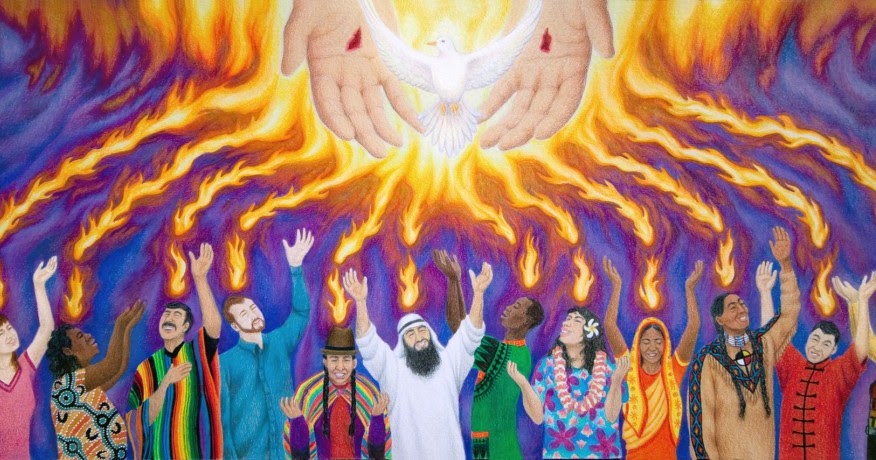
PENTECOST SUNDAY
Acts 2:1-21 or Numbers 11:24-30
1 Corinthians 12:3b-13 or Acts 2:1-21
Prayer of the Day: O God, on this day you open the hearts of your faithful people by sending into us your Holy Spirit. Direct us by the light of that Spirit, that we may have a right judgment in all things and rejoice at all times in your peace, through Jesus Christ, your Son and our Lord, who lives and reigns with you and the Holy Spirit, one God, now and forever.
“Jesus said to them again, ‘Peace be with you. As the Father has sent me, so I send you.’ When he had said this, he breathed on them and said to them, ‘Receive the Holy Spirit.’” John 20:21-22.
Here on the Outer Cape we have learned to take the weather forecasts with a grain of salt. Maybe that is because the forecasters focus exclusively on population centers on the mainland, like Boston. The Cape and Islands are often an afterthought. What happens weatherwise on the mainland is often quite different from what takes place on Cape Cod. Furthermore, what is happening down in Sandwich or up in Provincetown might be entirely different from what we experience in Wellfleet. This spit of land between the bay and the open ocean is subject to sudden and unpredictable bouts of wind, fog, rain or snow depending upon the capricious mood of the Atlantic. We have even had a couple of tornados during the years I have resided on the Cape.
One thing you can definitely say about the Holy Spirit: she is as wild and unpredictable as the weather on the Outer Cape. Jesus said as much himself. “The wind blows where it chooses, and you hear the sound of it, but you do not know where it comes from or where it goes. So it is with everyone who is born of the Spirit.”[1] John 3:8. In the Book of Acts, the church is forever scrambling to catch up with the Spirit whose power leads and sometimes drags the church kicking and screaming into an ever more diverse, inclusive community of equity, mutuality reflective of God’s intent for the whole human family. While the church is a creature of the Holy Spirit, it is not her custodian.
Lutheran theology has always emphasized the centrality of Word and Sacrament as vehicles for the outpouring of the Spirit upon believers. This is all well and good if understood to mean that the Spirit can be relied upon to be present in a redemptive way for all who receive the sacrament of Holy Baptism and partake of the Lord’s Supper. It is a mistake, however, to assume that the activity of the Holy Spirit is constrained by the church’s ministry of Word and Sacrament. In the Bible, the Spirit is frequently found to be active outside the church and its institutions. Prior to Peter’s determination to baptize the household of Cornelius, the Spirit was poured out on that household. Acts 10:44-48. When the disciples reported to Jesus that they had silenced a man outside their company who was casting out demons in Jesus’ name, he rebuked them. Mark 9:38-41. So, too, Moses had to reign in his assistant Joshua who was intent on keeping God’s Spirit safely penned within the confines of proper ecclesiastical channels. Numbers 11:26-30. Thus, while the Spirit can be relied upon to be present where the Word is preached and the Eucharist is celebrated, she will not be confined there.
How does one recognize the presence of the Holy Spirit? While I do not have a hard and fast answer to that question, I believe there are three human traits characterizing people and communities inspired by the Spirit. These are, in no particular order of importance, curiosity, imagination and courage. While there may be no proof of the existence of a creator as such, it seems to me curiosity constitutes pretty good evidence. It has been said that God is nothing but the answer to humanity’s unanswered questions. But the question hiding behind that assertion is what interests me. Why do we have questions that need to be answered? What makes us so damned curious? Why do we wonder what creeps along the ocean depths? Why do we wonder and spend good money trying to find out whether we, as sentient beings, are alone in the universe? Why are we obsessed with figuring out the origins of the cosmos? Why do we want to go to Mars?
I believe that curiosity is a driving force in human development, just as boredom and disinterest are dehumanizing. I believe the Spirit of God is the engine driving human curiosity and the power that drives the church toward becoming the Body of Christ in all of its manifest meaning and beauty. Philip appealed to the skeptical Nathaniel’s curiosity to bring him to Jesus. In Matthew’s gospel, it was curiosity that brought the women to the tomb of Jesus and the revelation of his Resurrection.[2] Curiosity brought together the pagan congregation that heard Paul expound the good news of Jesus Christ at the Areopagus. Curiosity has brought a lot of folks to the churches I served. A thriving Christian community requires a healthy dose of curiosity. It should forever be asking what the Cross and Resurrection of Jesus mean for its presence and work in its community. A healthy church is always bringing thoughtful questions to the scriptures, challenging the assumed interpretations and looking for connections between faith and the world of science, the arts and political life. Sadly, the scriptures, creeds and confessions have too often been misused to shut down questioning and extinguish curiosity. Religion without curiosity becomes stale, boring and oppressive.
That leads me to the second characteristic of inspiration, namely, imagination. By my estimate, about one third of the Hebrew Scriptures consist of poetry, narrative fiction or graphic imagery. Jesus did most of his teaching through parabolic speech. Saint Paul’s letters are rich in metaphor, simile and analogy. The frequently misunderstood Book of Revelation is rich in poetic language and graphic images designed to stimulate the imagination and challenge the beleaguered churches of Asia Minor to recognize the cosmic significance of their struggle to live faithfully under the oppressive reign of empire.
Albert Einstein famously asserted that “imagination is more important than knowledge.” Knowledge, to be sure, is important. It provides a foundation of facts and data. But knowledge is limited to what is already known. By contrast, imagination is boundless. Imagination enables one to look beyond what is and contemplate what might be. As noted by Hebrew Scripture scholar Walter Brueggemann, “The task of prophetic ministry is to nurture, nourish and evoke a consciousness and perception alternative to the consciousness and perception of the dominant culture around us.”[3] Healthy faith communities and individuals do not accept the status quo as a given. It does not resign itself to the inevitability of hunger, economic inequality, famine and war. It is sustained by the vision of a renewed earth on which the nations live in peace and all people live sustainably under the gentle reign of God. Though that vision may seem impossibly far away, we catch glimpses of it even now within communities seeking to live, however imperfectly, in the way of Jesus. The Holy Spirit inspires disciples of Jesus to pattern their lives not on the ways of the existing order, but on a bold vision of the future that only imagination can embrace.
Finally, there is courage. Courage is not the mere absence of fear. Courage is grounded in the conviction that the future God promises us is more real than what we cynically characterize as “the real world.” Professor of Christian ethics, Stanley Hauerwas once said that the life lived by disciples of Jesus makes no sense apart from the conviction that God raised Jesus from death. The teachings of the Sermon on the Mount are ill suited for life in the environments of business and politics. As one participant in a Bible Study I once led on the Sermon told me, “Pastor, if I conducted business that way in my firm, I’d be crucified.” I don’t believe he knew how prophetic he was being. The Sermon on the Mount is not to be understood as some humanly unachievable ideal. To the contrary, it is the template for the life Jesus actually did live and as a result of which he was crucified. For the disciple, the reign of God is that priceless pearl, that treasure buried in the field for which no sacrifice is too great. It is love for that gentle reign that inspired the words of Martin Luther’s celebrated hymn,
Were they to take our house,
Goods, fame, child, or spouse,
Though life be wrenched away,
They cannot win the day.
The kingdom’s ours forever.[4]
In sum, the Holy Spirit is that wild, unpredictable wind that blows where she wills. Wherever her breath falls, it evokes burning curiosity, ignites the imagination and inspires courageous acts of witness, advocacy, justice, mercy and peacemaking. This is the gift of Pentecost.
Here is a poem by Mary Oliver who speaks of a “wider world” than the “orderly house of reasons and proofs.” Such is the expanded vision I believe is evoked by curiosity, imagination and courage-the signature marks of the Holy Spirit.
The World I Live In
I have refused to live
Locked in the orderly house of
reasons and proofs.
The world I live in and believe in
is wider than that. And anyway,
what’s wrong with Maybe?
You wouldn’t believe what once or
twice I have seen. I’ll just
tell you this:
only if there are angels in your head will you
ever possibly, see one.
Source: Devotions, (c. 2017 by N.W. Orchard, L.L.C.) p. 3. Mary Oliver (1935-2019) was born in Maple Heights, Ohio. She was deeply influenced by poet, Edna St. Vincent Millay. Her work received early critical attention with the 1983 publication of a collection of poems entitled American Primitive. She is a recipient of both the Pulitzer Prize for Poetry and the National Book Award. She spent the latter years of her life in Provincetown on Cape Cod, MA before moving to Florida where she died. Many of her poems reflect the unique features, vegetation and wildlife of the Cape. You can read more about Mary Oliver and sample some of her other poems at the Poetry Foundation Website.
[1] It should be noted that the Greek word Jesus uses for “wind,” (pneuma) is the one he uses in the next sentence for “spirit.”
[2] In both Mark and Luke, the women came to the tomb to anoint Jesus’ body, no doubt convinced that he was dead. But in Matthew’s gospel, the tomb was sealed and guarded. Thus, the women could have had no such purpose as Jesus’ body would have been well out of their reach.
[3] Brueggemann, Walter, The Prophetic Imagination, Second Edition, (c. 2001 by Augsburg Fortress) p. 3.
[4] “A Mighty Fortress is Our God,” Evangelical Lutheran Worship, (c. 2006 by Evangelical Lutheran Church in America; pub. by Augsburg Fortress) Hymn #504.


The Holy Spirit keeps me writing – fiction of all things.
But fiction can be the cleanest place to see consequences and relationships, because fictional world are, by their nature, smaller than the real world.
So we can leave some of the ‘noise’ of the real world out, and that makes fiction more real than reality some times.
LikeLike