All posts by revolsen

Unknown's avatar

About revolsen

I am a retired Lutheran Pastor currently residing in Wellfleet, Massachusetts. I am married .and have three grown children.

A Response to the ELCA’s Draft Social Message on Government and Civic Engagement: Discipleship in a Democracy

May 6, 2020

Rev. Roger A. Willer, Ph.D.
Director for Theological Ethics
Office of the Presiding Bishop
8765 W. Higgins Road
Chicago, Ill 60631

Re: A Draft Social Message on Government and Civic Engagement: Discipleship in a Democracy

Dear Dr. Willer

I am afraid that what I have to say about the above draft will come across as rather harsh. Though appreciative of the careful work it represents and in substantial agreement with its content, I am convinced that, on the whole, it misses the mark. It is quite simply not the statement the church and the world need at this time.

The draft statement hangs much of its argument on the “two kingdoms” doctrine. That teaching works fine when government is more or less functional and requires only maintenance and occasional repairs. Not so much when it goes off the rails and into the ditch. Of course, I recognize and affirm the interest we all have in preserving the health of institutions, governmental and others, that promote the public good. But I believe the hostility expressed toward governmental regulations for the protection of health and safety is part and parcel of a much deeper crisis, that being the rise of race based nationalism personified in a maniacal, narcissistic megalomaniac and implemented through the agency of the Republican Party with the support of its religious surrogates. The critical problem with the document is its obsession with ‘fixing” America. What we need in this hour is a bold witness to the reign of God and its counter-cultural values that is unafraid of naming the beast and exposing its lies and oppression.

You don’t have to look far in order to see exactly what I am talking about. The nationalistic ideology of “American exceptionalism” was enshrined in the very first sentence of the 2016 GOP platform . It states specifically: “We believe that American exceptionalism — the notion that our ideas and principles as a nation give us a unique place of moral leadership in the world — requires the United States to retake its natural position as leader of the free world. Tyranny and injustice thrive when America is weakened. The oppressed have no greater ally than a confident and determined United States, backed by the strongest military on the planet.” This dangerous notion that America, as the savior and rightful defender of the free world, justifiably wields its influence carrying a huge thermonuclear stick, meshes well with the rhetoric of religious organizations such as Christian Nationalist Alliance which asserts (among other things) that  “These United States of America were founded by Christian men upon Christian tenets” and that “Islam is a heretical perversion of the Judeo-Christian doctrine and must be recognized and treated as a threat to America and Western Civilization as a whole.”

Defense of “Christian civilization” has regularly been invoked to justify harassment of and attacks against Muslim Americans and to uphold an irrational and inhumane ban against refugees fleeing to our country to escape oppression and violence. Exceptionalism is wholly consistent with ideology promoted by Focus on the Family whose “Truth Project” teaches that “America is unique in the history of the world. On these shores a people holding to a biblical worldview have had an opportunity to set up a system of government designed to keep the state within its divinely ordained boundaries.”  It provides the perfect conceptual framework supporting the claim of Rev. Franklin Graham that Donald Trump is in the Whitehouse “because God put him there.”

This toxic mix of nationalism and aberrant Christianity has created an environment favorable to the expression of racist, sexist and anti-Islamic sentiments and acts of hatred against people of color. It has mainstreamed white supremacy to the point where formerly fringe characters like white supremacist Richard Spencer are able to secure interviews on NPR and alt.right extremists like Stephen Miller have become fixtures in the Whitehouse. We should be concerned about this new American nationalism injected with the steroid of religious fervor. As observed by Blaise Pascal, “Men never do evil so completely and cheerfully as when they do it from religious conviction.”

The rise of quasi religious nationalism is not just an American phenomenon. Similar political movements have overtaken the governments of nations around the world, including Italy, Hungary, India, Brazil and the republics of the former Soviet Union. Such movements are making considerable headway in western European nations as well. Just last year, the Lutheran World Federation produced a very thorough and thoughtful collection of essays on the scope of this disease entitled Resisting Exclusion: Global Theological Responses to Populism. This is a global ideological pandemic that we ignore at our peril. We do not serve the church or the planet well when we “heal the people’s wound lightly” by treating only the symptoms while allowing the disease to spread unchecked.

The question, then, is: can we continue to remain silent while the likes of Franklin Graham, James Dobson, Jerry Falwell, Robert Jeffress, Tony Perkins and other prophets of the regime employ the name of our Lord Jesus Christ to support a ban on refugees fleeing oppression to our shores, legitimize and normalize racist rhetoric, demonize gay, lesbian and transgendered persons, promote a godless ideology of American exceptionalism that puts devotion to the nation state over God’s expressed concern for the salvation of the whole world? Are we going to go on pretending that the man who leads our nation is just another elected leader whose blatantly false, racist and hateful words and policies we must “talk around,” in the name of civility, neutrality or nonpartisanship? No, we are not yet at the point where our situation is analogous to that of the church under the Nazis. But I have to ask, how much closer do you want to get? How many more black Americans must be gunned down by police? How many more children must die in detention centers? How many more people must die of covid 19 because a president approaching an election does not want to impose or enforce regulations unpopular with his base, but required to prevent its spread?

I am aware that the ELCA has issued statements condemning specific actions of the current administration such as the discriminatory ban against refugees, restrictive and family-hostile immigration policies and environmentally destructive regulations. But like the current draft under consideration, they only scratch the surface of our country’s sickness, a global sickness that has infected the church to the depths of its soul. What we need is to name the demon of idolatry. What we need is for the American church to come together around a Barmen like confession naming and rejecting the false god of American nationalism, the America first agenda and the claim that these demonic ideologies are sanctioned by Christian faith and teaching. I would love to see my church, the ELCA, take the lead toward developing such an ecumenical confession. Sadly, though, I am beginning to doubt that American mainline protestant churches like my own possess the moral courage, the spiritual maturity and the theological depth to produce such a bold confessional document. I devoutly hope that my doubts are misplaced. Because until we address the ice berg toward which the ship is sailing, our learned theological dissertations on governance amount to little more than squabbling over arrangement of the deck chairs.

Please know that, despite my criticisms, I appreciate your work and that of your office and pray for the Holy Spirit’s continued guidance for our church in what I believe are challenging times.

Christ’s servant and yours,

SS/Peter A. Olsen

Rev. Peter A. Olsen (retired)

The Other Epidemic

See the source imageHOLY TRINITY SUNDAY

Genesis 1:1–2:4a
Psalm 8
2 Corinthians 13:11-13
Matthew 28:16-20

Prayer of the Day: Almighty Creator and ever-living God: we worship your glory, eternal Three-in-One, and we praise your power, majestic One-in-Three. Keep us steadfast in this faith, defend us in all adversity, and bring us at last into your presence, where you live in endless joy and love, Father, Son, and Holy Spirit, one God, now and forever.

For the last three months Covid-19 has been turning our lives upside down. The epidemic has forced us to change dramatically the way we shop, the way we care for our loved ones and the way we plan our day to day activities. Painful sacrifices have been made by medical caregivers on the front lines battling the disease, by essential workers daily putting their health at risk to protect ours and by the millions who have lost their jobs in the effort to slow the spread of infection. But over the last week we have been made painfully aware of another epidemic that has been raging for centuries on our continent. It is an illness that makes headlines only sporadically and one about which we would rather not be reminded. Next to nothing has been done to combat this epidemic and there is little support or enthusiasm among leaders in either of the two major political parties to address it with more than rhetoric. I am speaking, of course, about the epidemic of police violence against black Americans.

On February 23, 2020 Ahmaud Arbery, and African American man, was jogging in his Georgia neighborhood when he was chased down and shot to death by Gregory and Travis McMichael, a father and son. Gregory was a former police officer and, for reasons that are unclear, no arrest was made and the local authorities declined to prosecute-until a video of the shooting became public. Earlier this week a white woman called the police and reported that she was being threatened by Christian Cooper, a black man who was out bird watching in Central Park after he merely asked that she leash her dog as per park rules. Then on Monday of this week, the nation witnessed a video of George Floyd in hand cuffs being choked to death under the knee of Minneapolis police officer Derek Chauvin. In all of these circumstances, the victims were unarmed and were not posing any threat to the officers involved or anyone else. The fact that in Floyd’s case there were three other officers on the scene observing this horrific event without raising a whimper of protest puts the lie to the oft asserted claim that such brutality is a freak occurrence involving a “few bad apples” within an otherwise blameless police force. We cannot deny that there exists within American law enforcement a culture of pervasive hostility, fear and suspicion of black men.[1]

Lest you think my use of the term “epidemic” is a bit too hyperbolic, understand that black Americans constitute less than 12% of the United States population. Yet they constitute 26.4% of all Americans killed by police between 2015-2019. See May 26, 2020 article “Police Killings of Blacks: Do Black Lives Matter?” by Todd Beer, Ph.D. in Society Pages. This disproportionate use of lethal force against black Americans tracks with their average rate of imprisonment. African Americans are incarcerated in state prisons at a rate that is 5.1 times the imprisonment of whites. See Nellis, Ashley, Ph.D., “The Color of Justice: Racial and Ethnic Disparity in State Prisons,” published in The Sentencing Project (June 14, 2016).

Of course, the systemic oppression of black Americans in the justice system form the streets to the courthouse is symptomatic of a much deeper and more insidious level of inequality. The Covid-19 the epidemic we are all fixated on right now has magnified the systemic inequalities between white and African Americans. In Chicago, African Americans comprise a third of the city’s population, but they account for half of those who have tested positive for the coronavirus and almost three-quarters of COVID-19 deaths. Milwaukee County, Wisconsin where African Americans constitute only 26% of the total population, they make up 70% of deaths due to the Covid-19. See “Coronavirus in African Americans and Other People of Color” by Sherita Hill Golden, M.D., M.H.S. These disparities point to a chronic, widespread and historical pattern of exploitation of black Americans leading to a severe lack of access to economic, educational and political opportunities. That, in turn, has placed and continues to place black American individuals and their communities at a severe disadvantage.

I am dismayed, but not surprised by the explosive anger that has erupted into violence in cities throughout the United States. What does surprise me is that such eruptions do not occur more often. As a white American male, I can scarcely imagine what it must be like getting up every morning to face a culture filled with reminders of your secondary status. These reminders come in the form of discomfort on the faces of shop owners upon seeing you walk into their store and the eyes that watch your every step anticipating theft. They come from confederate battle flag stickers prominently displayed on bumper stickers. They come in the form of subtle (and sometimes not so subtle) allusions to racist stereotypes in the rhetoric of right wing politicians. As one young woman protesting in Minneapolis put it, “I’m just so tired of being hated.” Police brutality against black Americans is merely the extreme expression of violence in a culture of systemic oppression that exists everywhere, always at every level of daily life. How can one live in such a pressure cooker without exploding?

How, then, does a church like mine, one of the whitest in America, respond to this explosion of anger and the deep anguish it represents? I think the most important message to be sent right now can be summed up in three words: “We believe you.” Though I can honestly say that I have not seen a lot of overt racism in our churches, there is plenty of the softer, dismissive kind that denies or minimizes the realities of life as experienced by black Americans. The sentiments expressed in our eloquent social statements are oddly out of sync with comments frequently heard in the hallways of synod assemblies, seen on social media and uttered in our church parking lots. “There’s no racism in our neighborhood,”-as though those of us who have known nothing but white privilege would have any idea about that. “They wouldn’t have problems with the police if they just wouldn’t give them an attitude,”-easy enough to say when you have never been profiled. “Slavery and segregation are over, so let’s forget the past and move on”-much like saying “let’s just get on with the race and not dwell on what happened back at the starting line” after you have been given a commanding head start. My prayer is that these tumultuous days will finally open our eyes so that we can begin to see our country through the eyes of black Americans and find a genuine determination to join them in their struggle to change it.

That brings me to my final point. Remedying four hundred years of racial injustice cannot be accomplished by mere words. The task of removing the systemic legal, commercial and societal disparities that keep black persons and their communities at a severe disadvantage requires an effort as substantial as the New Deal and the Marshall Plan. At present, I don’t see much enthusiasm in either of the two major political parties for such seismic change. I expect to be deluged with all the usual reasons why this cannot happen. “It will increase the deficit,” “it will impose unreasonable restraints on business” “it will raise taxes” are sure to be raised in opposition. Additionally, there are those who will continue to insist that this isn’t necessary because the Civil Rights Movement ended segregation long ago and whatever problems black people have in modern America are their own. But like Dr. Martin Luther King, Jr., I “refuse to believe the bank of justice is bankrupt.” Speech of the Rev. Dr. Martin Luther King, Jr. at the March on Washington. A better America is achievable-if the rest of us begin to want it and are willing to sacrifice as much for it as have black Americans for the last four centuries.

Here is a poem by Langston Hughs expressing simply and powerfully what I believe so many protesters are trying so hard to make us hear.

Let America be America Again

Let America be America again.
Let it be the dream it used to be.
Let it be the pioneer on the plain
Seeking a home where he himself is free.

(America never was America to me.)

Let America be the dream the dreamers dreamed—
Let it be that great strong land of love
Where never kings connive nor tyrants scheme
That any man be crushed by one above.

(It never was America to me.)

O, let my land be a land where Liberty
Is crowned with no false patriotic wreath,
But opportunity is real, and life is free,
Equality is in the air we breathe.

(There’s never been equality for me,
Nor freedom in this “homeland of the free.”)

Say, who are you that mumbles in the dark?
And who are you that draws your veil across the stars?

I am the poor white, fooled and pushed apart,
I am the Negro bearing slavery’s scars.
I am the red man driven from the land,
I am the immigrant clutching the hope I seek—
And finding only the same old stupid plan
Of dog eat dog, of mighty crush the weak.

I am the young man, full of strength and hope,
Tangled in that ancient endless chain
Of profit, power, gain, of grab the land!
Of grab the gold! Of grab the ways of satisfying need!
Of work the men! Of take the pay!
Of owning everything for one’s own greed!

I am the farmer, bondsman to the soil.
I am the worker sold to the machine.
I am the Negro, servant to you all.
I am the people, humble, hungry, mean—
Hungry yet today despite the dream.
Beaten yet today—O, Pioneers!
I am the man who never got ahead,
The poorest worker bartered through the years.

Yet I’m the one who dreamt our basic dream
In the Old World while still a serf of kings,
Who dreamt a dream so strong, so brave, so true,
That even yet its mighty daring sings
In every brick and stone, in every furrow turned
That’s made America the land it has become.
O, I’m the man who sailed those early seas
In search of what I meant to be my home—
For I’m the one who left dark Ireland’s shore,
And Poland’s plain, and England’s grassy lea,
And torn from Black Africa’s strand I came
To build a “homeland of the free.”

The free?

Who said the free?  Not me?
Surely not me?  The millions on relief today?
The millions shot down when we strike?
The millions who have nothing for our pay?
For all the dreams we’ve dreamed
And all the songs we’ve sung
And all the hopes we’ve held
And all the flags we’ve hung,
The millions who have nothing for our pay—
Except the dream that’s almost dead today.

O, let America be America again—
The land that never has been yet—
And yet must be—the land where every man is free.
The land that’s mine—the poor man’s, Indian’s, Negro’s, ME—
Who made America,
Whose sweat and blood, whose faith and pain,
Whose hand at the foundry, whose plow in the rain,
Must bring back our mighty dream again.

Sure, call me any ugly name you choose—
The steel of freedom does not stain.
From those who live like leeches on the people’s lives,
We must take back our land again,
America!

O, yes,
I say it plain,
America never was America to me,
And yet I swear this oath—
America will be!

Out of the rack and ruin of our gangster death,
The rape and rot of graft, and stealth, and lies,
We, the people, must redeem
The land, the mines, the plants, the rivers.
The mountains and the endless plain—
All, all the stretch of these great green states—
And make America again!

Source: The Collected Poems of Langston Hughes, (c. 1926 by Alfred A. Knopf, pub. by Random House, LLC, 1990). Langston Hughes was an important African American voice in the “Harlem Renaissance” of the 1920s. Though well-educated and widely traveled, Hughes’ poetry never strayed far from his roots in the African American community. Early in his career, Hughes’ work was criticized by some African American intellectuals for portraying what they viewed as an unflattering representation of back life. In a response to these critics, Hughes replied, “I didn’t know the upper class Negroes well enough to write much about them. I knew only the people I had grown up with, and they weren’t people whose shoes were always shined, who had been to Harvard, or who had heard of Bach. But they seemed to me good people, too.”  Today Langston Hughes is recognized globally as a towering literary figure of the 20th Century. You can read more about Hughes and discover more of his poetry at the Poetry Foundation website (from which the above quote is taken).


[1] Yes, there are many police officers who serve with honor and distinction. I am not suggesting that all police officers are racist. But I think it would be more accurate to say that these officers represent “good apples” working within and often against a culture of racial profiling and oppression.

Beware the Wind and the Waters!

SUNDAY OF PENTECOST

Numbers 11:24-30
Psalm 104:24-34
Acts 2:1-21 or 1 Corinthians 12:3b
John 20:19-23 or John 7:37-39

Prayer of the Day: O God, on this day you open the hearts of your faithful people by sending into us you, through Jesus Christ, our Savior and Lord, who lives and reigns with you and the Holy Spirit, one God, now and for Holy Spirit. Direct us by the light of that Spirit, that we may have a right judgment in all things and rejoice at all times in your peace, through Jesus Christ, your Son and our Lord, who lives and reigns with you and the Holy Spirit, one God, now and forever.

“…[Jesus] breathed on them and said to them, ‘Receive the Holy Spirit…’” John 20:22.

“[Jesus said] ‘Out of the believer’s heart shall flow rivers of living water.’ Now he said this about the Spirit, which believers in him were to receive” John 7:38-39.

We have a choice between two gospel lessons this week, both from John’s gospel. The context of the first is Jesus’ first post resurrection appearance to the full body of disciples (less Thomas). There the Spirit is given through the medium of a gentle breath. By contrast, Jesus’ speech given at the Festival of Booths in Jerusalem compares the Spirit to “rivers of living water.” As the good people of Midland, Michigan can tell you, rivers of living water can wreak no end of destructive havoc when they get out of control. So, too, what is characterized by John the Evangelist as a “gentle breath” came like a hurricane wind upon the disciples in our lesson from Acts. Wind and water. You can’t live without them, but it’s often difficult to live with them.

The same could well be said of the Holy Spirit. The Spirit animates the church forming in it the mind of Christ and making it his resurrected Body sent into the world. Without the Spirit, the church is but a lifeless corpse. Nevertheless, the people of God have never been quite comfortable with the Holy Spirit. That discomfort goes all the way back to Moses. In our lesson from the Hebrew Scriptures, Moses is made to realize that he cannot lead the children of Israel through the wilderness and into the promised land on his own. He will need help. So it was that Moses selected seventy elders from among the people to assist him. The Spirit fell upon these seventy and they began to prophesy. So far, so good.

But things get tense when Eldad and Medad, two members of the community who were not among the chosen seventy, also receive the Spirit of God and begin prophesying. Joshua, alarmed by this breach of protocol, implores Moses to make them stop. Joshua would have made a good confessional Lutheran, maintaining as he does that “no one should publicly teach…unless he be regularly called.” Augsburg Confession, Art. 9. Moses takes a different view, replying to Joshua, “Are you jealous for my sake? Would that all the Lord’s people were prophets, and that the Lord would put his spirit on them!” Numbers 11:29. Jesus expressed similar sentiments when his disciples informed him that they put a stop to the work of an exorcist casting out demons in his name. “Do not stop him,” says Jesus, “for no one who does a deed of power in my name will be able soon afterwards to speak evil of me. Whoever is not against us is for us.” Mark 9:39.

The Book of Acts, from which our first lesson comes, illustrates the often fraught relationship between the Spirit and the church. The entire narrative consists of the Spirit pushing the church into places it would rather not be. Just as the little community of Galilean disciples are recovering from being inundated on Pentecost by three thousand new Jewish believers from all corners of the empire with differences in language, culture and religious practice, Philip’s preaching brings into the church believers from among the hated Samaritans. Next, Peter baptizes a gentile officer of the Roman occupation force and his family. Through Paul’s ministry the Spirit of God continues to demolish the racial, cultural and societal walls dividing people one from another. So far from leading this bold advance into the future, the church is dragged there-sometimes kicking and screaming-by the mighty current of God’s Spirit.

Yet as wild and independent as the Holy Spirit surely is, the Spirit is not an anonymous and impersonal force. The Holy Spirit is the Spirit of Jesus, that is, the resurrected Christ “abiding” with his disciples. Thus, in the 12th Chapter of I Corinthians, another alternative reading for Pentecost, Paul insists that “no one speaking by the Spirit of God ever says ‘Let Jesus be cursed!’ and no one can say ‘Jesus is Lord’ except by the Holy Spirit.” I Corinthians 12:3. This is important because there are other spirits out there that are far from holy. The spirit of nationalism would have us put the interests of our nation over Jesus’ command to love our neighbors on whatever side of the border they might be. The spirit of racism inspires fear and loathing of people who differ from us in appearance, language or culture. I don’t have to tell you that these spirits and their demonic leading have been woven into the fabric of American religion parading as Christianity. For this reason, John the Evangelist warns us, “do not believe every spirit, but test the spirits to see whether they are from God.” I John 4:1. In this age of alternative facts, conspiracy theories and hateful ideologies, we need more than ever to question the voices seeking to persuade, inspire and move us. Where are these voices coming from? For whom do they speak? Are they consistent with Jesus’ life and teaching as testified in the scriptures?

The Spirit of God works on a timetable and agenda we seldom understand or foresee in advance. We can no more control the Spirit than we can channel the wind. Nevertheless, we can make room for the Spirit to work in our lives. For some of us, that means setting aside time for reading Scripture, for prayer or for worship. These days of pandemic that keep many of us at home offer a unique opportunity for that to happen. For some of us, making room for the Spirit might require exorcism of sorts. Television, social media and virtual communities all have the potential for being channels of human connection, fellowship and inspiration. But they can also become vectors of anger, hostility and fallacious propaganda. In case of the latter, it may become necessary to our spiritual (as well as physical and psychological) health to limit or excise these sources of input.

Invoking the Holy Spirit is risky. For liturgical churches like mine with strong traditions of selecting, training and vetting ministerial candidates before ordaining them to the ministry of Word and Sacrament, the prospect of the Spirit’s inspiring ministry outside of that tradition and perhaps even outside of the church is a little unnerving. But remaining open to such manifestations of the Spirit is critical to the health of the church. More than once throughout history the church has been called to repentance, renewal and a larger sense of mission by individuals and groups that don’t fit strictly within its current understanding of ministry. Taken together, our Pentecost lessons call us to be both open and discerning: open to whatever the Spirit might be doing in our midst and in the world, but grounded in our relationship with Jesus so that it is possible for us to discern the voice of God’s Spirit speaking among the many voices that would lead us astray.

Here is a poem by Loretta Roche speaking of the spirit driving her artistic striving toward excellence. Perhaps this spirit is not so very different from the Holy Spirit animating the church and calling it to places it has never been and fears to go.

Spirit

I have no comforting to bring you;
Mine is no cold sweet balm to lend
For a wound that aches, or a mind that darkens.
I am not one to be called a friend.

For when your hands are scarred and broken
Form shaping stony words to a song,
Cutting a meaning from glossy marble,
My voice will bite like an iron prong.

And I will sting you when you falter
With a word bitter as driving snow;
I have not lost the way of twisting
That whip I used to have-you know?

No one can silence me with weeping;
You cannot hush my voice with prayers.
When you would see out a room of refuge
I shall be waiting on the stairs.

You shall not rest while I am near you-
Mine is a will that does not bend.
I have no comforting to bring you,
And you will hate me to the end.

Source: Poetry, April 1925. This poem is in the public domain. Unfortunately, I have been unable to find anything in the way of biographical information on Loretta Roche. You can sample more of her poems at the VQR Site.  If any of you reading this can share further information about this poet, I would be very appreciative.

How Small Must We Become to Be Perfectly One?

SEVENTH SUNDAY OF EASTER

Acts 1:6-14
Psalm 68:1-10, 32-35
1 Peter 4:12-14; 5:6-11
John 17:1-11

Prayer of the Day: O God of glory, your Son Jesus Christ suffered for us and ascended to your right hand. Unite us with Christ and each other in suffering and in joy, that all the world may be drawn into your bountiful presence, through Jesus Christ, our Savior and Lord, who lives and reigns with you and the Holy Spirit, one God, now and forever.

“And now I am no longer in the world, but they are in the world, and I am coming to you. Holy Father, protect them in your name that you have given me, so that they may be one, as we are one.” John 17:11

This verse is frequently cited in support of ecumenism and by all the many Christians who decry the fractured state of Christianity. The church’s lack of unity surely is a cause for dismay. I have no doubt that our divisions and the narrowness of mind and heart that perpetuate them grieve the heart of Jesus. But I also believe that the oneness for which Jesus prays far exceeds the unity of Christ’s Body-though the two are related. The oneness of the church is not an end in itself. Judas (not the one who betrayed Jesus) asked Jesus, “Lord, how is it that you will reveal yourself to us, and not to the world?” Jesus responds, “Those who love me will keep my word, and my Father will love them, and we will come to them and make our home with them.” John 14:23-24. The whole point of this indwelling of Jesus with his disciples is “so that the world may know that [God] sent me and ha[s] loved them even as [God] loved me.” John 17:23. For this reason, as the Father sent Jesus into the world to save and not condemn it, so now Jesus sends the disciples into that world as his ongoing life for the sake of the world. John 20:21. Thus, the ultimate goal is not church unity, but the healing and reconciliation of the whole cosmos. The church’s unity is to bear witness to God’s ultimate desire for the whole universe.

John’s gospel has frequently been viewed as long on Christian community and short on Christian witness. That, however, represents a failure to grasp the Evangelist’s firm belief that “being” equates with “doing.” The constant refrain throughout Jesus’ discourses in the gospel is “I am.” Yet precisely because of who Jesus is, his life and work bring him into conflict with the false values of the dominant imperial culture. His teaching, his healing, his confrontation with religious and political authority and, finally, his crucifixion flow out of who he is: God’s gracious Word incarnate and living in a sinful world.

So the question posed to us is this: are we living out of who we are as the resurrected presence of Jesus in the world? There is no question that our churches are active in feeding the hungry, sheltering the homeless and advocating for justice and peace. But does all of this flow out of who we are? In Matthew’s gospel, Jesus points out that not everyone who calls him “Lord” is actually doing the will of his heavenly Father. On the last day when these supposed disciples are revealed as “evildoers,” they protest, “did we not prophesy in your name, and cast out demons in your name, and do many mighty works in your name?” Matthew 7:22. Jesus replies in words that are truly chilling, “I never knew you.” Matthew 7:23.

It is worth pondering whether our works, however admirable and important they might be, are grounded in knowing and being known by Jesus-something that is all important for Jesus according to John’s gospel. As with most questions of this kind, the answer is probably a mix of “yes” and “no.” Clearly, there are many pastors, lay ministers and teachers whose work is deeply rooted in their faith in Jesus and their longing for his gentle reign. Too often, however, the church’s mission to be Christ for the world takes a back seat to the services expected from its members. Most protestant churches are essentially voluntary organizations. Whatever our mission statements might say about our existing for the sake of the world, membership in a church typically comes with a bundle of rights. These include the right to vote at public meetings, the right to hold office and the right to be married, baptized, confirmed and buried in the church. In short, the church exists for the sake of its members who tend to see it as “my church.” Small wonder, then, that there is often little interest in partnering in mission with other local churches which are frequently viewed as “competition.”

We have a tendency to blame the rank and file for this lack of ecumenical vision. But I believe we must all take our share of responsibility for uncritically appropriating the voluntary model of organization and the modernist assumptions that come with it. Just as the American founders are said to have sought a “government of the people, by the people and for the people,” protestants have created a “church of the people, by the people and for the people.” But is that the church Jesus wants? As children of the Enlightenment, we have an unshaken belief in democracy. We assume that in the open marketplace of ideas, the best thinking and the ablest leaders will rise to the top with the result that the wisest and most equitable public decisions will inevitably be made. But government of, by and for the people has not consistently delivered such beneficent results. As Professor Stanley Hauerwas recently pointed out, there is only one example of democratic rule in the Bible. In that one instance, the people chose Barabbas over Jesus. It was the people who put the Nazis in power and the people (with a little help from the Electoral College) who gave us Donald Trump. Why, then, should we assume that a people’s church will give us anything better than a people’s government?

It is not my purpose to undermine the government of the United States or propose a new and improved program for governing the church. As a people who confess regularly that we are in bondage to sin and cannot free ourselves, we should know full well that institutional reform, however beneficial it might be, cannot give us a church-much less a civil government-free from selfishness, lust for power and corruption. But since we find ourselves in a time when our existing ecclesiastical institutions appear to be coming apart at the seams, we have an opportunity to think in new ways about what comes next. What should a church that can no longer sustainably provide full time pastors for every congregation look like? How does a church unable to maintain a sanctuary continue to be a visible presence in its community? How do church communities experiencing decreased support from their denominational structures maintain and nurture their oneness with the one, holy, catholic and apostolic church?

Sometimes I wonder whether perhaps we don’t need to shrink before we can grow. Maybe our many congregations need to shrivel to the point where they cannot go on without one another. Maybe our churches need to become so weak and isolated that they can no longer afford to allow historical denominational divisions and mistrust to divide them from their neighbors within the Christian family. Perhaps the church needs to become so poor and marginalized that no one will be tempted rise up to a position of power and control within it. Maybe when the church becomes so small, so weak and so poor that it has nothing to offer but Jesus, Jesus will finally have the church for which he prays in our gospel lesson: a church that is perfectly one even as the Trinity is perfectly One, calling a fractured world into that same redemptive oneness.

Here is a poem by Cathy Song seeking something like the perfect oneness for which Jesus prays in our gospel.

This Wonderful Opportunity

May all beings, seen and unseen, be well, happy, and peaceful, including ourselves.
May there be peace in the world, peace in our hearts, peace in our minds.
May we use this wonderful opportunity of  human life to awaken.
May we be grateful for wisdom and compassion,
this infinite boundlessness that surrounds us,
waiting to be used by us, to open our hearts and minds
so that we may see things as they truly are,
how brief our lives, how dependent upon others we are,
and so with each act may we bring wholesomeness, humility,
and the courage to do no harm, not least of all to ourselves.
As we journey through this life may we move deeper into insight,
and see things as they truly are,
this wonderful opportunity to awaken.
May we be grateful for the teachers in all their guises who appear before us.
May we love those who are hardest to love, including ourselves.
May leaders who will work for the peace of the planet step forward,
and may we support them.
May those who have gone before us rest in peace, rest in comfort, rest in joy,
and may we remember to remember them.
May the next life be a happy one.
May we cultivate in our hearts, in our minds, here and now, here on earth,
generosity, a land of plenty for all.
May our wish for peace spread like a mother’s soothing hand
and reach the distressed, fevered places of the world
and protect each child the right to be fed, to be sheltered, to be schooled.
The right to go to sleep without fear.
May we journey safely, work contentedly, and return home to loved ones well and happy.
May the path of forgiveness and acceptance
be the path of peace,
and may we find it.
May we use this wonderful opportunity to awaken
and together find true happiness, open spaciousness without borders.

Source: Poetry (July/August 2019). Cathy Song (b. 1955) is an American poet who has won numerous awards, including the Yale Series of Younger Poets Prize and the Shelley Memorial Award from the Poetry Society of America. She was born in Hawaii to Ella Song, a Chinese-American seamstress and Andrew Song, a Korean-American airline pilot. A bright and inquisitive child, Song showed an early interest and ability in writing and literature. She wrote her first novel at eleven years of age. Song developed an interest in poetry during her high school years and subsequently graduated with a bachelor in English literature from Wellesley College. She went on to earn a masters degree at Boston University. She is currently a teacher in her homeland of Hawaii and married with three children. You can find out more about Cathy Song and sample more of her poetry at the Poetry Foundation website.

Isolated, But Never Alone

SIXTH SUNDAY OF EASTER

Acts 17:22-31
Psalm 66:8-20
1 Peter 3:13-22
John 14:15-21

Prayer of the Day: Almighty and ever-living God, you hold together all things in heaven and on earth. In your great mercy receive the prayers of all your children, and give to all the world the Spirit of your truth and peace, through Jesus Christ, our Savior and Lord, who lives and reigns with you and the Holy Spirit, one God, now and forever.

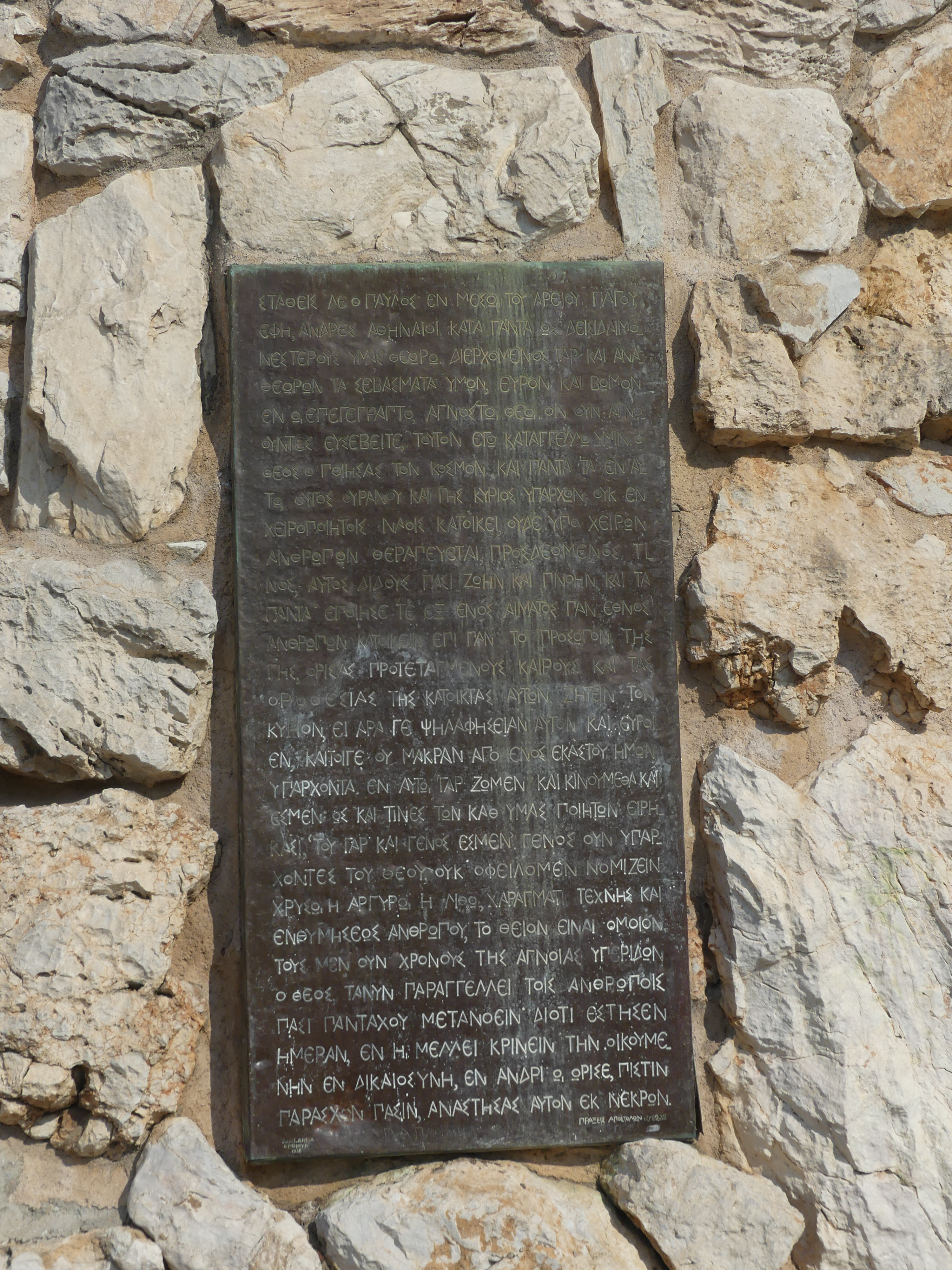
This Sunday’s lesson is Paul’s speech to the Athenians at the Areopagus. The “Areopagus” (“Ares’ Hill” or “Mars’ Hill”) is a low hill northwest of the Acropolis in Athens, Greece. The plaque pictured above markes the spot where on this hill a small amphitheater once stood. It was the seat of the earliest aristocratic council of that ancient city which tried capital cases and prosecuted claims of public corruption throughout the classical period of the Greek democracy. During the period of Roman domination in the 1st Century, the council was responsible for the discharge of significant administrative, religious, and educational functions. The atmosphere was very much like that of a modern university where teachers of various schools of philosophy, politicians and artists gathered.

As was his custom, Paul began his missionary work by visiting the synagogue where expatriate Jews gathered for worship. While the audience Paul found there was sometimes skeptical and even hostile to his preaching, they at least understood what he meant by proclaiming Jesus as Messiah. But when some Epicurean and Stoic philosophers invited Paul to address them and their colleagues in the Areopagus, Paul was suddenly confronted with an audience that had no knowledge or understanding of the Hebrew Scriptures or the God to which they testify. It will not do for Paul merely to proclaim Jesus as Messiah because his audience would immediately ask, “What is a messiah?” If Paul were to assert that Jesus is God’s Son, they would ask, “Which god?” Paul must therefore speak the gospel to the Athenians in language and imagery they will understand from within their own religious backgrounds.

Paul finds his opening in a curious monument “to and unknown god.” Vs. 28. Such a monument can only reflect a recognition on the part of the Athenians that their many temples and shrines do not capture the fullness of deity. Thus, in an attempt to ensure that their worship is complete, they must also offer worship at this shrine to such god or gods that they do not know. This “unknown god,” says Paul, “is the one I come to make known.” Paul goes on to point out the foolishness of imagining that God can be captured in an image or enclosed in a shrine. Certainly, his Epicurean and Stoic listeners would agree with him on that point. Unlike the common folk, these philosophers did not believe in the existence of the Greek gods of the pantheon. Their understanding of divinity was far more complex. Paul even cites some Greek literary figures to illustrate the paradox (Epimenides and Aratus): though God is so near that “in him we live and move and have our being,” nevertheless God seems distant and our efforts to “feel after” God prove futile. Vss. 26-28.

In verses 30-31 Paul comes right to the point. God now commands repentance which is possible because and only because God has revealed his heart and mind in a man though and by whom the world is to be judged. When push comes to shove, Paul must return to his Hebrew scriptural roots and to the life, death and resurrection of Jesus Christ through whom they are properly understood. In the final analysis, Paul does not come to the Areopagus with a competing philosophy, teaching or morality. He comes not to teach the Athenians about God, but to invite them into relationship with God through faith in Jesus Christ. In Jesus, the unknown and unknowable God becomes known. This knowledge is not theoretical, but relational. It is not principally the nature of God, but the heart of God that Jesus reveals.

This is where Paul loses his audience. The notion that the fullness of God is revealed in a crucified criminal is no less preposterous than that God should dwell in an image of stone. In fact, it is even more preposterous. In the view of antiquity, human desecration of a temple demonstrated the impotence of the god to whom it belonged. If Jesus were truly God made manifest, his death on the cross could not have occurred. Moreover, if God is understood to be the God of all human beings who are God’s “offspring” (Acts 17:28), it makes little sense to insist that he is revealed through a preacher of only parochial significance to an obscure and subjugated race in the backwaters of the empire. If God were to raise someone from death (something few in the 1st Century doubted that God/gods could do), God would surely have selected someone whose greatness stood out and was evident to the whole world. The cross proved to be an insurmountable stumbling block for Paul’s listeners-as he must have known it probably would be. For the most part, Paul’s sermon drew only mockery and indifference.

“But some joined him and believed, among them Dionysius the Areopagite and a woman named Damaris.” Acts 17:34. Though it does not appear that Paul was able to establish a functional church in Athens, he managed to make a few disciples. This is another of those many instances in which I would love to know more than what the Bible tells me. I want to know what happened to Dionysius and Damaris. Did they stay in Athens? Did they ever attempt to start a worshiping community on their own? How did they go about being and doing church in their pluralistic environment? Perhaps Luke the Evangelist left these questions unanswered because he wants us to think long and hard about them.

These questions are not merely of academic interest. The isolation I imagine Dionysius and Damaris experienced following Paul’s departure from Athens seems a lot like what many of us believers in the northeastern United States feel on a regular basis. Like these two disciples, we find ourselves in the midst of a culture that is largely indifferent to the church and often hostile to the values of God’s reign it professes. Notwithstanding decades of dedicated ministry, innovative mission initiatives and faithful witness, our numbers decline and churches are closing. On top of all this, the covid-19 pandemic is now preventing us from meeting as the resurrected Body of Christ and robbing us of the sustaining nourishment of the sacraments and the inspiring power of corporate liturgy, prayer and song. How are we to be church under these constraints?

I believe Sunday’s gospel can help us think faithfully about this challenge. “I will not leave you orphaned,” says Jesus. “I am coming to you.” These words are enormously comforting at this time of institutional decline and particularly now as we are finding it impossible to seek Jesus where we have always found him in the past. In truth, nothing has changed. In reality, we have never been the ones to find Jesus. He always finds us. It is, of course, important to understand and believe Jesus’ promise that he will always be present where two or three are gathered in his name, where the good word of the gospel is publicly proclaimed and where the sacraments are offered. But it is critical to remember, too, that the sacraments are a “means” of grace and not grace itself. That is to say, they are gifts to the church given to strengthen its faith and mission. They are not requirements that we must fulfill before God can be present to us. So misconstrued, the sacraments are transformed form gifts of grace into works of the law.

A lot of my colleagues describe our inability to celebrate the Eucharist during this time of pandemic as a “fast.” I don’t think that analogy is particularly helpful. Fasting is spiritual discipline. It is a practice I may choose to sharpen awareness of my dependence on God’s provision and deepen my compassion for those whose hunger is not temporary and is not a choice. But I do not choose to refrain from public worship and the sacraments because I believe it will bring any spiritual benefit to me. Quite the contrary! I choose to refrain because I care deeply about the health and safety of my neighbors and, in these circumstances, love requires me to put my neighbors’ welfare ahead of my own spiritual hunger for corporate worship and the nourishment of holy communion. I can do that because I believe Jesus’ promise to send the Spirit of Truth and I know that the fulfilment of that promise does not depend on my being able to worship publicly or to receive communion.

So how does a struggling church sustain its life and mission in this time of pandemic induced isolation? How do we carry on without the liturgical practices that form and define our faith, enabling us to live in a culture of unbelief? I believe the words of Bishop Alan Gates, Episcopal Diocese of Massachusetts, are instructive:

“The church defines a sacrament as ‘an outward and visible sign of an inward and spiritual grace’–something that we can see, or taste or touch, which communicates to us the ineffable grace and love of God. Through history the church has identified particular capital-S sacraments.  But those in no way limit the sacramental quality of an infinite number of other experiences we may have.”

The bishop goes on to describe a number of instances in which human encounters, though not “sacraments” strictly speaking, are “filled with the spirit of our Lord: with his priorities, his love and his ministry.”  These include meals, coffee breaks or book club discussions carried out virtually on Facetime or Zoom. You can read the letter in full at this site. So, too, Peter W. Marty describes how a young woman arranged with the activities director of an assisted living center for her children to visit with the residents. Of course, the children were not able to enter the facility, but they stood outside the residents’ windows and played tic-tac-toe with them using erasable markers on the window panes. He also relates a story about neighbors who lived for years in the same cul-de-sac but seldom spoke and never socialized. During the course of their quarantine, however, they began coming out every evening to sit at the end of their respective driveways and share a “happy hour” with cocktails and conversation. See The Christian Century, May 6, 2020, p. 5. We are not alone. Even in the midst of this isolating experience of quarantine, Jesus sends his Spirit to forge new bonds of friendship and bring new intimacy to existing relationships. There is sacramental holiness to be found everywhere-if we but have eyes to see it. We have not been left “orphaned.”

The home is one place where sacramental grace is found. To be sure, being quarantined with family twenty-four/seven can fray family relationships. But it can also give rise to experiences of healing, deepening and strengthening those bonds. In the spirit of Mother’s Day, here is a poem by Maya Angelou celebrating the nurturing bond between mother and daughter.

The Mothering Blackness

She came home running
back to the mothering blackness
deep in the smothering blackness
white tears icicle gold plains of her face
She came home running

She came down creeping
here to the black arms waiting
now to the warm heart waiting
rime of alien dreams befrosts her rich brown face
She came down creeping

She came home blameless
black yet as Hagar’s daughter
tall as was Sheba’s daughter
threats of northern winds die on the desert’s face
She came home blameless

Source: The Complete Collected Poems of Maya Angelou (c. 1971 by Maya Angelou, pub. by Random House Inc., 1994)

Maya Angelou (1928-2014) was a multi-talented American poet, author, singer, dancer and civil rights activist. She published seven autobiographies, three books of essays, several books of poetry, and was credited with a list of plays, movies, and television shows spanning over 50 years. She is perhaps best known for her well known autobiography, I Know Why the Caged Bird Sings, published in 1969. The book earned her the National Book Award. Angelou was awarded the National Medal of Arts by President Bill Clinton in 2000 and the Presidential Medal of Freedom by President Barack Obama in 2010. You can read more about Maya Angelou and sample more of her poetry at the Poetry Foundation Website.

God is Dead

FIFTH SUNDAY OF EASTER

Acts 7:55-60
Psalm 31:1-5, 15-16
1 Peter 2:2-10
John 14:1-14

Prayer of the Day: Almighty God, your Son Jesus Christ is the way, the truth, and the life. Give us grace to love one another, to follow in the way of his commandments, and to share his risen life with all the world, for he lives and reigns with you and the Holy Spirit, one God, now and forever.

“Thomas said to him, ‘Lord, we do not know where you are going. How can we know the way?’ Jesus said to him, ‘I am the way, and the truth, and the life. No one comes to the Father except through me. If you know me, you will know my Father also. From now on you do know him and have seen him.’” John 14:5-7.

Much to the consternation of my Missouri Synod Lutheran pastor, I became very much involved with a Roman Catholic youth organization in my teenage years. The program was run by a young, charismatic and deeply caring youth director who was able to connect with me in a way that no one in my congregation could. Consequently, I frequently found myself in that church’s parish hall consisting mainly of a large assembly room where most of the youth activities took place. That room was accessed by a hallway lined with offices for the church’s staff. Each office had a plaque with the favorite Bible verse of its inhabitant. Conspicuously absent from the lineup was the office of the priest, Father McMurphy. There was no direct access to his office. To reach him, you had to go through the office of the chief parish administrator, a severe, no nonsense gatekeeper whose door plaque bore the following line from the above cited verses: “No one comes to the Father except through me.”

I share that recollection because it is precisely the interpretation too often given this verse. Rather than the door through which the sheep are free to enter, Jesus is portrayed as the gate keeper restricting access to the door. Consequently, all who do not know, fail to recognize, refuse to acknowledge or lack trust in Jesus have no access to God. That, of course, led to endless consternation among young people in my circle. “What about babies that die before they can be baptized?” “What about people who never hear the gospel of Jesus Christ?” “What about people whose only exposure to Christianity has been mistreatment and exploitation?” “What about people who are warm, caring, compassionate and active in doing good but, for whatever reason, don’t believe in God?”

All of this goes to show how dangerous it is to take a single passage of scripture out of its context and treat it as an absolute proposition in itself. We should have known better. After all, John the Evangelist told us at the very beginning that Jesus is the light sent to “enlighten everyone.” John 1:9. God so loved “the world”-not just Christians-that God sent the Son, not to condemn the world but to save it. John 3:16-17. Jesus himself informs us that he has “other sheep” that have yet to be brought into the fold and that he himself will see to that. John 10:16. The whole point of Jesus’ abiding among his disciples is that, through their life and mission, “the world may believe” God’s love manifested to Jesus’ disciples in the sending of God’s Son. John 17:20-21. As we heard in last week’s gospel, Jesus is the “gate for the sheep,” not the gatekeeper. John 10:7. It is not God’s intent to rescue a few souls from the deck of a sinking ship. God means to save the ship. God is at least as faithful as the US Army Rangers whose motto is “no one left behind.”

That said, there is a scandalous particularity about the good news preached by the church. John’s gospel begins with the assertion, “no one has ever seen God.” John 1:18. Once again, context is essential. These words are not directed to outsiders. It is not as though we are saying to Muslims, Buddhists and persons of other faiths that they know nothing of God. Rather, John is reminding his audience of believers that they know nothing of God apart from what God has revealed to them through Jesus Christ. In short, this passage and the one cited above are designed to form and direct the disciples’ thinking and speaking about God. Disciples are not to begin with their notions, beliefs and metaphysical understandings of God to figure out where Jesus fits in. Rather, they begin with Jesus and, in communion with him, learn of the Father.

In verses 8-11, Jesus responds to Philip’s frustrated demand: “show us the Father.” Jesus then makes the startling assertion that he is all the God there is to be seen. In so doing, Jesus turns everything we thought we knew about God on its head. He delivers the news Friedrich Nietzsche was to bring us nineteen centuries later: God is dead. To a large extent, Nietzsche was right. The God who sits at the apex of the universe pulling the switches that make things happen does not exist. The God who manipulates everything from pandemics to the weather in order to reward good and punish evil does not exist. The God who is driving history toward the rapture, the great tribulation and a final violent divine conquest of our planet does not exist. The only God who does exist pours out God’s very life blood to reconcile the world to God’s self. God saves the world by loving the hell out of it-at great cost to God’s self and to the community of disciples formed by that love. That is all.

Such an image of God is not particularly comforting to those of us who are looking for a divine protector who will take our part and make everything turn out right. Our preference is for a “strong God,” just as it seems the world is becoming increasingly attracted to “strong men” as national leaders. We cannot rid ourselves of the primitive belief so aptly expressed by the NRA: “The only way to stop a bad guy with a gun is a good guy with a gun.” By that measure, God is the one with the biggest and most powerful gun.

St. Paul has a different view of power that I think is more in line with what our gospel is talking about. “For the message about the cross is foolishness to those who are perishing, but to us who are being saved it is the power of God,” says Paul. I Corinthians 1:18. What kind of power is revealed in the cross? To folks like the NRA, the cross is indeed foolishness. Indeed, it proves the truth of their motto. The cross is what happens to people foolhardy enough to “put away their swords.” It’s proof positive that “nice guys finish last.” Not so, argues the apostle. This so called “weakness” of our God who refuses to defend himself and responds to violence with a healing touch is actually God’s greatest exercise of power. God is too powerful to be sucked into the vortex of retributive violence in which families, tribes, nations and peoples are helplessly trapped. God’s heart is too mighty to be tempted with the use of coercive force to accomplish God’s purposes. God is too strong to be baited into retaliating against us-even when we crucify the only beloved Son-the best God had to give us. As it turns out, Jesus is God being God in the most graphic, concrete and powerful way. This God who is love is God. There is no other.

Our temptation always is to settle for a lesser god, a god who is merely a projection of ourselves on a divine scale, a god who deals with us and our world as we would deal with it if we were God. We are constantly tempted to look beyond Jesus to a god more amenable to justifying the means we think are necessary to achieve the ends we believe are good. We are enticed by the image of a god whose purposes are perfectly aligned with our patriotic instincts, our clan loyalties and our economic self interest. We seek a God who is “on our side,” rather than the God who is on the side of the stranger, the poor and, worst of all, on the side of our enemies. We look for a god with power to do what we believe must be done, but in Jesus we find a God whose loving power would transform us into the people we must become in order to show the world how deeply it is loved. This God may well appear weak and ineffectual to a world in thrall to “strong men,” military parades and firearms. The God revealed in Jesus might not appeal to a church accustomed to having the societal respect, financial support and political clout to press its agendas. But this God’s non-coercive, patient and determined love is the only force powerful enough to save us.

Here is a poem by Langston Hughes that lays bare the poverty of our metaphysical assumptions about divinity and, whether the poet intended or not, makes room for us to imagine the God who is life and love.

God

I am God—
Without one friend,
Alone in my purity
World without end.

Below me young lovers
Tread the sweet ground—
But I am God—
I cannot come down.

Spring!
Life is love!
Love is life only!
Better to be human
Than God—and lonely.

Source: The Collected Poems of Langston Hughes, (c. 1994 by the Estate of Langston Huges; pub. by Alfred A. Knopf, a division of Random House, Inc.) Langston Hughes (1902-1967) was an important African American voice in the “Harlem Renaissance” of the 1920s. Though well-educated and widely traveled, Hughes’ poetry never strayed far from his roots in the African American community. Early in his career, Hughes’ work was criticized by some African American intellectuals for portraying what they viewed as an unflattering representation of back life. In a response to these critics, Hughes replied, “I didn’t know the upper class Negroes well enough to write much about them. I knew only the people I had grown up with, and they weren’t people whose shoes were always shined, who had been to Harvard, or who had heard of Bach. But they seemed to me good people, too.”  Today Langston Hughes is recognized globally as a towering literary figure of the 20th Century. You can read more about Hughes and discover more of his poetry at the Poetry Foundation website (from which the above quote is taken).

Putting Death back into Life

FOURTH SUNDAY OF EASTER

Acts 2:42-47
Psalm 23
1 Peter 2:19-25
John 10:1-10

Prayer of the Day: O God our shepherd, you know your sheep by name and lead us to safety through the valleys of death. Guide us by your voice, that we may walk in certainty and security to the joyous feast prepared in your house, through Jesus Christ, our Savior and Lord, who lives and reigns with you and the Holy Spirit, one God, now and forever.

A late friend and former parishioner, upon learning that he had been diagnosed with a particularly aggressive form of pancreatic cancer, told me “nothing has changed. I’ve always known there were plenty of trains out there and one of them was bound to hit me sooner or later. Now I just know the number of the one with my name on it.” My friend’s words, spoken long before the coronavirus was a twinkle in anyone’s eye, have a contemporary ring to them. In a very real sense, nothing has changed for us. Even in the midst of life, we are in death. Covid-19 has simply brought that stark reality into sharper focus.

The words of the Twenty-Third Psalm also have a contemporary ring. Safety and danger, peace and conflict, light and darkness, life and death are all juxtaposed, contrasted and reconciled within this short piece of poetry. The shepherd leads the sheep to “green pastures” and “still waters.” Yet the “paths of righteousness” along which the sheep are led pass through “the valley of the shadow of death.” The shepherd “prepares a table for the sheep,” but that table is set “in the presence” of their “enemies.” To be sure, the psalm offers the assurance of God’s comforting presence. But that presence comes to us in the midst of a dicey existence.

There is one more thing to keep in mind. In the Bible, sheep are not adorable little pets. They are commodities. At some point, they will be sent to slaughter. David, the putative author of the Twenty-Third Psalm, knew that and so did Jesus when he referred to himself as the “good shepherd.” Just as the shepherd lays down his life for the sheep, so the sheep must lay down their lives for their shepherd:

“If the world hates you, be aware that it hated me before it hated you. If you belonged to the world, the world would love you as its own. Because you do not belong to the world, but I have chosen you out of the world—therefore the world hates you. Remember the word that I said to you, ‘Servants are not greater than their master.’ If they persecuted me, they will persecute you; if they kept my word, they will keep yours also. But they will do all these things to you on account of my name, because they do not know him who sent me.” John 15;18-21.

Of course, not all of Jesus’ disciples died as martyrs. It is probably safe to say that most of us will not perish under the sword of persecution. But perish we surely will. There is a train out there with our name on it, whether it be covid-19 or another number. Now that our mortality is placed for us in such sharp relief, what are we to make of it?

I believe the last episode in John’s gospel can help us with that. There Peter is told that he will be imprisoned and die for Jesus’ sake-a good word for him. Recall that Peter had promised to undergo that very fate just days before-and lost his nerve when the opportunity came. So Jesus was, in effect, giving Peter another chance to make good on his promise, an opportunity to redeem himself. But then Peter goes on to inquire about another of Jesus’ disciples identified only as “the one Jesus loved.” “What about him?” Peter asks. Jesus politely replies that it is none of Peter’s damned business. Peter is to follow Jesus and leave off with speculating about the destiny of others. John 21:18-23.

What I find particularly interesting is John’s commentary on the rationale for Jesus’ informing Peter about his ultimate destiny. “[Jesus] said this to indicate the kind of death by which [Peter] would glorify God.” John 21:19. Even what Paul calls “the final enemy,” is transformed by Jesus into a gift. Death constitutes the one last opportunity we have to glorify God, to bear witness to the hope that is within us and offer encouragement and inspiration to others. Viewing death as an opportunity is nearly impossible for a death denying culture like ours. There is no place for it in the way we live our lives. We plan our careers, we plan our retirements and we plan for the distribution of our wealth after we have died. But who plans for death? We go out of our way not to use the “D” word, employing flowery euphemisms, like “expired,” “passed on,” “entered eternal rest” and the like. We typically hide the dying process from the rest of life in hospital rooms and the hospice section of nursing homes. We need living wills and health proxies to make sure medical practitioners do not employ extreme measures to keep our hearts beating and our lungs pumping long after nearly all brain function has ceased and the prospect of recovery is nil. Our medicine is adept at prolonging life, but inept at dealing with the end of it. In medical terms, a dead patient amounts to failure.

It was not always so. During medieval times, death was at the very center of life. According to church teaching, the whole purpose of life was to prepare for death. Participation in worship and the sacraments was understood as a process of formation, readying one for a “good death.” Time was measured in saint’s days marking the death of biblical and post biblical heroes of faith. The landscape was dominated by parish churches and towering cathedrals which were the sites of local graveyards. The faithful were challenged to so live that in death their hope and confidence in the resurrection and eternal life might glorify God. Death was surrounded by familiar communal rituals and symbols of comfort and hope. It was sad, to be sure, but not terrifying and hopeless.

I am not suggesting there is any merit in morbid preoccupation with death (and yes, the church of the middle ages did go a bit overboard with that). But I do believe that our persistent denial of death robs us of much joy, comfort and hope that comes with recognizing and accepting it for what it is: the end of a mysterious and wonderful gift that we have been given, namely, life. Part of what makes life precious is the knowledge that it is finite. Much of what makes life meaningful is the recognition that it is brief and what we choose to do with each minute of it matters. It will matter in the end how compassionately we have treated one another, especially those among us regarded as “the least.” Eternal life does not begin after death, but long before it. Eternal life, it turns out, is life lived in communion with Jesus and his devotion to the gentle reign of God. So the question is, how much of the life you have lived today is “eternal”? How much of it matters from the standpoint of God’s reign? Would your death today witness to a life that has been lived eternally?

Here is a poem by George Herbert inviting us to think differently about death.

Death

Death, thou wast once an uncouth hideous thing,
Nothing but bones,
The sad effect of sadder groans:
Thy mouth was open, but thou couldst not sing.

For we considered thee as at some six
Or ten years hence,
After the loss of life and sense,
Flesh being turned to dust, and bones to sticks.

We looked on this side of thee, shooting short;
Where we did find
The shells of fledge souls left behind,
Dry dust, which sheds no tears, but may extort.

But since our Savior’s death did put some blood
Into thy face,
Thou art grown fair and full of grace,
Much in request, much sought for as a good.

For we do now behold thee gay and glad,
As at Doomsday;
When souls shall wear their new array,
And all thy bones with beauty shall be clad.

Therefore we can go die as sleep, and trust
Half that we have
Unto an honest faithful grave;
Making our pillows either down, or dust.

Source: This poem is in the public domain. George Herbert (1593 –1633) was a Welsh-born poet, orator, and priest of the Church of England. He was born into a wealthy family and raised in England. He was admitted to Trinity College, Cambridge where he went with the intention of becoming a priest. Instead, he became the University’s Public Orator. His skill attracted the attention of King James I through whose patronage he entered the Parliament of England. There he served for about a year. Following the death of King James I, Herbert gave up his secular ambitions and took holy orders in the Church of England. He spent the rest of his life as the rector of a small parish in Salisbury. You can read more about George Herbert and sample more of his poems at the Poetry Foundation website.

President Activates DPA for Production of Tanning Salons as Poisonings by Ingestion of Household Cleansers Spike

Kierkegaard’s Ghost

(News that’s fake, but credible)

See the source imageThe White House announced today that President Trump is invoking the Defense Production Act for the mass production of tanning salons to treat corona virus infection. Presidential press secretary Kayleigh McEnany told reporters today that the president is becoming increasingly impatient with the slow pace of progress toward developing treatments and vaccines for covid-19.  “The president believes we can substantially cure covid-19 patients if we simply expose them to high levels of ultraviolet radiation” said McEnany. She went on to explain that the administration has determined that far too much taxpayer money has been wasted on equipment such as respiratory ventilators, masks and field hospitals. “If we hit the body with a tremendous, whether it’s ultraviolet or just very powerful light, we can kill the virus without drugs, hospital beds, oxygen or any of the other expensive gadgets these state governors keep asking for. All we need is tanning salons.” McEnany pointed out that Florida has already put this strategy into practice merely by opening its beaches. “All they have to do now is take all the sunblock off the shelves.”

Earlier today in one of his many press briefings relative to the coronavirus pandemic, President Donald Trump advocated the use of ultraviolet light as well as common cleaning agents for the treatment of covid-19 patients. “Look,” he told reporters, “this isn’t rocket science. We know bleach kills the virus on contact. So all we need to do is get the bleach inside whoever is infected. We have the cure right under the kitchen sink. So why are we paying all these clowns in white coats?”

The president’s remarks were met with skepticism by most Democrats and outright criticism by medical experts throughout the country. Though the Ghost has reached out to acting Homeland Security Secretary Chad Wolf for comment, no reply has been received to date. We also attempted to interview NIAID Director Anthony Fauci. Our reporters pursued the doctor into the men’s lavatory of the press room but could not locate him. Our investigators reported, however, that some violent head banking was heard from within one of the stalls along with words to the effect of “I hate my f@#$ing job!”

Meanwhile, the Center for Disease Control (CDC) has reported a steep increase in cases of domestic poisoning over the last twenty-four hours that appears to have been caused by ingestion of household cleaning products. “We are monitoring the situation closely and trying to get a handle on the demographics involved,” said CDC Director Robert Ray Redfield Jr. “At this time, it appears to be primarily a “red state” phenomenon.”

Note: The CDC wishes to emphasize that it is an extremely bad idea to ingest soap, bleach and other household cleaning materials.

****************************************************************

FAKE NEWS ALERT: The above article is satirical. The events it describes didn’t happen.  “There are people who will say that this whole account is a lie, but a thing isn’t necessarily a lie even if it didn’t necessarily happen.” John Steinbeck

Meeting Jesus on the Road

THIRD SUNDAY OF EASTER

Acts 2:14a, 36-41
Psalm 116:1-4, 12-19
1 Peter 1:17-23
Luke 24:13-35

Prayer of the Day: O God, your Son makes himself known to all his disciples in the breaking of bread. Open the eyes of our faith, that we may see him in his redeeming work, who lives and reigns with you and the Holy Spirit, one God, now and forever.

“But we had hoped that he was the one to redeem Israel.” Luke 24:21.

“But we had hoped….” There are so many tragic endings to this sentence. We had hoped this treatment would finally arrest Mom’s cancer. We had hoped that this time the pregnancy would take. We had hoped that rehab would finally put our son on the path to recovery from addiction. Our gospel places us in the company of two people whose hopes for Jesus, for Israel and for the future of creation have been dashed. Though the scriptures do not tell us why these two disciples were going to Emmaus, I strongly suspect that they were on their way back home. In any event, it is obvious from their remarks that they had given up on Jesus. They were done with the reign of God Jesus proclaimed and ready to put the whole sad affair behind them.

I strongly suspect that, for Lutheran preachers anyway, the emphasis on our gospel reading will fall upon verse 35 wherein the two disciples, returning from their walk to Emmaus, tell those remaining in Jerusalem how Jesus revealed himself to them in the “breaking of the bread.” We Lutherans are pretty emphatic about the “real” presence of Christ in the elements of bread and wine. And that for good reason. For Martin Luther, the true presence of Jesus in Holy Communion was an inescapable corollary of justification by faith. The availability in the sacrament of forgiveness for sin and the promise of eternal life depends not on the worthiness, faith or understanding of the recipient, but on God’s promise to be present in a redemptive way. Faith is not a requirement for the efficacy of the sacrament. To the contrary, the sacrament generates and sustains faith.

These days, however, we are not breaking bread together as a gathered community. Our posture is more that of the disciples on the road with their dashed hopes than the disciples at the table recognizing Jesus in the breaking of the bread. That isn’t a comfortable place for Lutheran believers like me. This discomfort has led many of my colleagues to seek ways of celebrating Holy Communion “virtually” on line, live or by way of prerecorded liturgies. I don’t want to engage in arguments over the legitimacy of these efforts. But I have to wonder whether they do not reflect, at least in part, a diminished understanding of the real presence of Jesus. Jesus was no less present to the disciples on the road where they failed to recognize him than he was at the table where they did. The sacrament is not a commodity we need to get our hands on in order for Jesus to be present for us. It is rather a gift through which that saving presence is mediated in a way that nourishes and strengthens the community of believers.

“While they were talking and discussing, Jesus himself came near and went with them, but their eyes were kept from recognizing him.” Luke 24:15.

It is not my intent to minimize or discount the importance of the sacraments for the life of the church. But I think we need to be reminded that, even as we are prevented at this time from seeking Jesus through these means of grace, Jesus never stops seeking us. He meets us on the road, even when we are separated from the rest of the community, even when we have given up and are moving away from him. Jesus seeks us even when we are not looking from him. Can we recognize this time of separation from our sanctuaries as an opportunity to encounter Jesus on the road? Can we see this time of “fasting” from Holy Communion as an opportunity to sharpen our awareness of Jesus’ presence in our day to day lives? Is this a time for discovering holiness in places where it has always been, but our eyes have been kept from recognizing it? It may be that Jesus is walking with us even now-and we just haven’t seen him yet.

Here is a poem by Elizabeth Bajjalieh who met God “on the road.”

I Met God on a Train Last Week

Bumbling along
As the night sky rose like fire
And the iron angels
Stuck staccato like twigs on the ground
Propped up, reaching out to the masses

And I was on the train
With a man I’d never met
And his brother, wailing to the side

My heart was a rock
Falling through my chest
And they spoke to me
With malt liquor
Singing from their tongues

We spoke
Of God
Of writing
Of Love
And of loss

And he spoke of Hope
And he told me
To hold on
As bittersweet pills
Dissolve in the pit of my gut

He told me
To hold on

These were not the words
I was ready to hear
From slurred strangers on the train

But to speak of God
With a man
Who preached from a pulpit
Of worn plastic CTA seats
Is the closest
I have ever been
To a revelation
Amongst rocks
Amongst sand
Amongst water
Amongst twigs
And iron angels

Source: Friends journal, January 27, 2020. (c. 2020 by Elizabeth Bajjalieh) Elizabeth Bajjaleih is the Interim Advocacy Coordinator for the American Friends Service Committee. She is a graduate of Loyola University in Chicago and has a long history of social service, including advocacy for LJBTQ rights and promotion of peaceful and just resolutions to conflicts in the middle east. She currently lives in Palatine, Illinois.