All posts by revolsen

Unknown's avatar

About revolsen

I am a retired Lutheran Pastor currently residing in Wellfleet, Massachusetts. I am married .and have three grown children.

The Secret Life of Stones

PALM/PASSION SUNDAY

Luke 19:28-40
Isaiah 50:4-9a
Psalm 31:9-16
Philippians 2:5-11
Luke 22:15 — 23:56

Prayer of the Day: Everlasting God, in your endless love for the human race you sent our Lord Jesus Christ to take on our nature and to suffer death on the cross. In your mercy enable us to share in his obedience to your will and in the glorious victory of his resurrection, who lives and reigns with you and the Holy Spirit, one God, now and forever.

“As he was now approaching the path down from the Mount of Olives, the whole multitude of the disciples began to praise God joyfully with a loud voice for all the deeds of power that they had seen, saying,

‘Blessed is the king
who comes in the name of the Lord!
Peace in heaven,
and glory in the highest heaven!’


Some of the Pharisees in the crowd said to him, ‘Teacher, order your disciples to stop.’ He answered,I tell you, if these were silent, the stones would shout out.” Luke 19:37-40

I spent late Saturday afternoon walking on Cahoon Hollow beach in what has recently become my home town of Wellfeet, Massachusetts. Though the day started out rainy, the sun came out around lunch time and a gentle breeze chased the remaining clouds out of the sky. By about 3:30 p.m., there was nothing overhead but blue. The sun was low in the west when I arrived at the beach. The cliff above the shore cast its encroaching shadows over the sand drawing ever closer to the waves, swallowing up inch by inch the remaining sunshine.

It was about an hour away from low tide and the sea was about as calm and the waves as gentle as they ever get. As always, I found myself captivated by everything the ocean leaves behind on the the sand in its retreat. Perhaps because the Palm Sunday gospel was very much on my mind, the stones grabbed my attention.

There were all varieties of stone to be seen: granite, sandstone, quartz, shale, conglomerate and kinds I cannot begin to identify. All of them were worn smooth and polished by the relentless work of the sea and sand. Each had been placed by the action of the waves into its own niche. Some are purest white without a single blemish. Others have two or more distinct colors woven together like ribbon. Still others are a checkered mix yielding a shade that is more than the sum of its constituents. I could not resist photographing them.


Taking pictures of stones might sound a little quirky and perhaps it is. Nevertheless, there is a point to my madness. Photography is for me a way of seeing, a way of noticing what I am normally prone to overlook in my haste. For that reason, I have a collection of photos featuring everything from sunsets to mushrooms of interest to no one besides me.

There is nothing so seemingly inert as a stone. Stone is a metaphor for everything hard, passionless and immovable. For that reason, it is difficult to imagine a stone shouting out in praise at Jesus’ entry into Jerusalem. The few biblical commentators who bother to reflect on these words of Jesus dismiss them as hyperbole. But I’m not convinced. Jesus doesn’t waste words. When he speaks, it isn’t for dramatic effect. As is always the case with Jesus’ teachings, parables and figures of speech, there is a wealth of meaning lying beneath the surface for those with the patience to look for it. That is, with “those who have ears to hear.”

Physicists remind us that a stone is more than what it seems. Though it might appear solid and motionless, it is made up of atomic and subatomic particles seething with energy and motion. Stones are not passive objects. They are active participants with a universe in motion. If we give credence to St. Paul’s words in his letter to the church in Colossae, we understand that all of the molecular energy in that stone is held together and relationally ordered by and through Jesus Christ. Colossians 1:17. As Martin Luther observed in his lectures on Genesis, God “spoke” the universe into being. Like everything else, the stone exists in response to God’s creative Word. The natural and appropriate existential response to being spoken into being is praise.

The Scriptures are not shy about attributing praise to what we consider inanimate forces and objects. For example, Psalm 148 calls upon fire, hail, snow, frost, wind, mountains, hills and trees to give praise to God. As Professor Christoph Schwobel reminds us: “God’s work creates effects that have being and order, and God’s work has to be understood as communicative action, even when it is not expressed as divine speech. The whole of creation is an ordered network of communicative relationships in which being and meaning are intrinsically connected.” “We Are All God’s Vocabulary,” published in Knowing Creation: Perspectives from Theology, Philosophy and Science, Vol. 1, Edited by Torrance, Andrew B. and McCall, Thomas H. (c. 2018, pub. by Zondervan) p. 51. The stone carries within it the ordering principles of creation moving it toward God’s promised goal of a new heaven and earth. Wet and glistening in the afternoon sunlight, it bears testimony to the Word that spoke it into being.

Yet, just as a stone can sing praises, a stone can lament. Human violence corrupts God’s good earth. Genesis 6:11-12; Psalm 74:20. John of Patmos refers to the oppressive Roman empire and its allies as “destroyers of the earth.” Revelation 11:18. The creation “groan[s] in travail” under the weight of human sin and, therefore, our salvation is its salvation as well. Romans 8:19-23. This coming Sunday we will hear again Jesus’ cry, “My God, My God. Why has thou forsaken me?” We should hear in that cry of anguish the cry of dying coral reefs, shrinking forests, animals on the verge of extinction, rivers clogged with mining runoff and stones washed ashore by waves of contaminated water. This, too, is the consequence of our species’ unique refusal to live joyfully, thankfully and obediently within the parameters of its creaturely limitations and striving instead to “be as God.”

Nevertheless, just as the whole creation shares the consequences of our evil, we share, albeit undeservedly, in creation’s redemption. I think perhaps that is why we have on Palm Sunday this one celebratory oasis in the otherwise somber season of Lent. We know that, whatever may lie ahead, our worst day is behind us. Not even our rejection of the best God had to give us could make God reject us. Our cruelty to God’s Son could not turn God against God’s creation, could not break the love that binds the Trinity, could not break God’s resolve to have us for God’s own. The love of God in Jesus Christ, in which “all things hold together,” is stronger than all the forces of evil that would rip creation to shreds. So, even in the shadow of the cross-no, especially there, we sing.

No storm can shake my inmost calm
while to that Rock I’m clinging.
Since Christ is Lord of heaven and earth,
how can I keep from singing?

“My Life Flows On in Endless Song,” Robert Lowry published in Evangelical Lutheran Worship (c. 2006 by Evangelical Lutheran Church in America, pub. by Augsburg Fortress). Hymn # 763.

Here is a poem by Marge Percy giving expression, wittingly or no, to creation’s praise for its Creator.

More than Enough

The first lily of June opens its red mouth.
All over the sand road where we walk
multiflora rose climbs trees cascading
white or pink blossoms, simple, intense
the scene drifting like colored mist.
The arrowhead is spreading its creamy
clumps of flower and the blackberries
are blooming in the thickets. Season of
joy for the bee. The green will never
again be so green, so purely and lushly
new, grass lifting its wheaty seedheads
into the wind. Rich fresh wine
of June, we stagger into you smeared
with pollen, overcome as the turtle
laying her eggs in roadside sand.


Source: Colors Passing Through Us (c. 2003 by Marge Piercy, pub by Alfred A. Knopf). Marge Piercy (b. 1936) is an American poet, novelist, and social activist. She is perhaps best known for her New York Times best seller, Gone to Soldiers, an historical novel set during the Second World War. Piercy was born in Detroit, Michigan and was the first in her family to attend college. She studied at the University of Michigan and won a Hopwood Award for Poetry and Fiction in 1957. This, in turn, allowed her to complete her college degree. She earned a Master’s Degree from Northwestern University in 1968. Piercy was a powerful advocate for feminism in the 1960s and 70s and a member of the Students for a Democratic Society. She has written seventeen volumes of poems and fifteen novels. You can find out more about Marge Piercy and sample more of her poems at the Poetry Foundation website.
Judas and Jesus on the Economy

Image result for Mary anointing JesusFIFTH SUNDAY IN LENT

Isaiah 43:16-21
Psalm 126
Philippians 3:4b-14
John 12:1-8

Prayer of the Day: Creator God, you prepare a new way in the wilderness, and your grace waters our desert. Open our hearts to be transformed by the new thing you are doing, that our lives may proclaim the extravagance of your love given to all through your Son, Jesus Christ, our Savior and Lord, who lives and reigns with you and the Holy Spirit, one God, now and forever.

“Why was this perfume not sold for three hundred denarii and the money given to the poor?” John 12:5

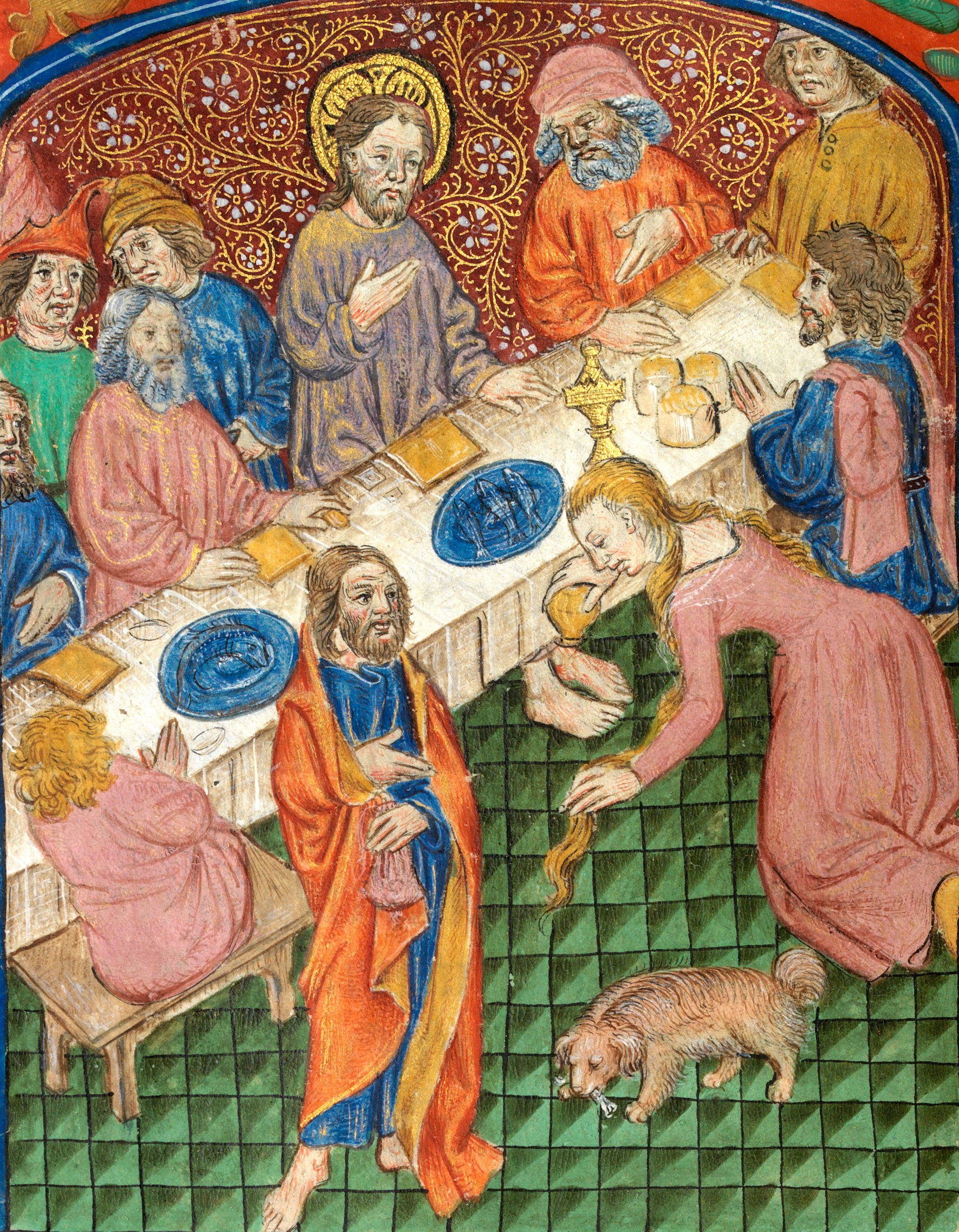
So said Judas as Mary, the sister of Martha and Lazarus, anointed Jesus’ feet with “a pound of costly perfume made of pure nard” worth more than $300 denarii. To put all of this in context, a single denarius was the measure of an average day’s labor in First Century Judea. The cash value of Mary’s perfume was not inconsequential. While Judas’ motives here were surely not pure as the driven snow, you have to admit that he makes a valid point. He could even find support for that point in scripture:

“Alas for those who lie on beds of ivory,
and lounge on their couches,
and eat lambs from the flock,
and calves from the stall;
who sing idle songs to the sound of the harp,
and like David improvise on instruments of music;
who drink wine from bowls,
and anoint themselves with the finest oils,
but are not grieved over the ruin of Joseph!” Amos 6:4-6

Then, as now, families are starving to death while Jesus is getting himself a $43,318[1] foot massage.

Of course, there are other measures of value, other aspects of what we call the “economy.” The word “economy” derives from the classical Greek word οίκος meaning “household” and νέμoμαι meaning “manage.”  As everyone knows, there is far more to running a household than simply managing the budget. A family lives by values of love, loyalty, common history and tradition having little or no financial significance. Relationships of trust, skills in parenting, religious practices and shared family stories inspire, shape and inform the way a household lives as much or more than its income and expenses. Far more important than a household’s wealth or the lack thereof is the quality of  life experienced by its members, both individually and as a family. A household (economy) in which members are treated unjustly, unequally or without regard for their needs is a disfunctional one.

Sadly, our contemporary American culture is largely blind to any value that can’t be measured in dollars and cents.  Not surprisingly, then, our discussion about economic issues seldom gets beyond “cost benefit analyses.” Like Judas, we cannot think or talk about economics apart from money. Nowhere is this more obvious than in our leaders’ recent move to defund the Special Olympics.[2] It is doubtful this event will ever turn a profit, enhance national security or stimulate the economy in any appreciable way. Its value lies in the way it empowers, encourages and inspires persons with special needs to excel, to take pride in themselves and their accomplishments. These results are invaluable, but impossible to measure in terms of money. So, it is not surprising that, in an era of perceived scarcity, the number crunchers whose job it is to balance the budget (on paper anyway) would elect to pull the plug on this program that requires funding but does not generate cash at least equal to that funding. So too, what benefit does society receive from teaching children to play musical instruments or dance or paint? We know that the vast majority will never become accomplished professionals. Wouldn’t money poured into the arts be better spent on improving science labs, purchasing computers for student use or even something as mundane as fixing the roof leaks in our school facilities? Indeed, isn’t art the plaything of a privileged class with the leisure and resources to enjoy it? What is a symphony to a starving child?

There are two fatal flaws with all of this reasoning. First, it assumes a universe of scarcity. Judas and people like him are convinced that the world is a shrinking pie. You need to grab your piece and hang on, because there is not enough for everybody. Despite his pious expression of concern for the poor, we know that Judas’ true concern is for Judas. You want to save the world? Then start with the one person you actually can save-yourself.  After all, isn’t that really what “America First” is all about? Isn’t that what our Dear Leader (a/k/a the president of the United States) has been telling us from day one? There are not enough jobs, enough food, enough room in this country even for us, and what little remains is about to be taken away from us by dark skinned immigrants who speak a different language and practice a different religion. Strong women are undermining our manhood just as the growing influence of Black, Asian and Latino persons in positions of leadership are taking away the white, Christian America we thought we knew. Donald Trump appealed precisely to these fears of scarcity and loss laced with racism, announcing: “I am your voice. I alone can fix it.”[3]

Disciples of Jesus should know, as Judas would have known had he been attentive to Jesus’ words and works, that our God is a God of abundance, not scarcity. Though it is true that there is not enough in this world (or in the entire universe) to satisfy human greed, there surely is enough to satisfy human need. One has to wonder, did Judas forget how Jesus provided enough wine to float an aircraft carrier for a little wedding at which the libations seemed to have run dry? Did Judas forget how Jesus fed that hungry crowd of over five thousand with just a few loaves and fishes? Did he so quickly erase from his mind Jesus’ filling the dead body of Lazarus with life? Did he really think the reign of God was so poor and threadbare that it could not spare time for some simple play that generates no cash, but lightens the heart and invigorates the body? Did he imagine that the business of feeding the hungry leaves no room for song or dance? Is this world God created so impoverished that it can’t afford to allow a woman’s expression of love for Jesus in offering him lavish hospitality?

Judas’ economy leaves no room for God’s generosity and provision. He would have us believe that economics is a matter of lifeless, mechanical principles that operate best when irrelevant factors such as compassion are kept out of the way. He would convince us that we must choose between meeting our bare needs for survival and showing lavish kindness to the people in our lives. Not so. Judas is wrong. And so are all those clamoring to close our borders to refugees, strip food assistance and medical care from the poor and scuttle programs like the Special Olympics. The arguments supporting such measures derive from Judas’ flawed and truncated economics-an economics too many have accepted uncritically as “the American way.” All who follow Jesus must recognize Judas’ economics for what they really are: a thinly disguised excuse for unbelief. Furthermore, although our myopic fixation on money valuation might blind us to this fact, play, song, graphic and performing arts as well as lavish hospitality with meals, entertainment and simple acts of kindness are vital to human well-being and to every viable human economy.

I think it is significant that our gospel lesson constitutes one of relatively few stories about Jesus found in all four of the gospels. Though the details differ, Jesus makes the same point here as in the other gospels. In Mark’s gospel, Jesus is heard to say of the woman who anointed him, “Truly I tell you, wherever the good news is proclaimed in the whole world, what she has done will be told in remembrance of her.” Mark 14:9. The irony here is that the woman remains anonymous in Mark’s account. But that only serves to illustrate the point: The value of this woman’s small act of kindness is incommensurate with any monetary measure.

I can only speculate as to why the story of this woman’s act, which is incidental to the over all plot, is so elevated in all four gospels. Could it be that Jesus was on the verge of giving up? Could it be that his disciples’ continued failure to understand him, the growing opposition to his ministry and the increasing probability of his death in Jerusalem had nearly convinced him his mission had failed? Is it possible that Jesus was about ready to call it quits and return to Galilee? Was Mary’s faithful act of hospitality, compassion and devotion the tipping point? Was it the simple act of love that brought everything back into focus for Jesus and reminded him what was at stake?

Nobody, myself included, can answer these questions. But perhaps it is enough to say that human actions changing the course of history do not always take the form of sweeping programmatic reforms, groundbreaking legislation or inspired political campaigns. Sometimes history is made by ordinary people showing ordinary kindness in ordinary ways to someone who desperately needs a little kindness. How many such persons were there, I wonder, in the lives of St. Paul, St. Augustine, Saint Teresa of Ávila, Dietrich Bonhoeffer and Martin Luther King, Jr.? You can’t measure compassion in dollars or cents. Yet Jesus assures us that it is of infinite and eternal worth to the economy of the Kingdom whenever and however expressed.

In the following poem, Diane Wakoski describes the gift of music given her by her mother and how this parental act of love enabled her to thrive even in a toxic family and school environment. The power of love, the power of kindness, the power of music, art, dance and poetry-they don’t have a monetary price take, but they are valuable beyond measure.

Thanking My Mother for Piano Lessons

The relief of putting your fingers on the keyboard,
as if you were walking on the beach
and found a diamond
as big as a shoe;
as if
you had just built a wooden table
and the smell of sawdust was in the air,
your hands dry and woody;
as if
you had eluded
the man in the dark hat who had been following you
all week;
the relief
of putting your fingers on the keyboard,
playing the chords of
Beethoven,
Bach,
Chopin
         in an afternoon when I had no one to talk to,
         when the magazine advertisement forms of soft sweaters
         and clean shining Republican middle-class hair
         walked into carpeted houses
         and left me alone
         with bare floors and a few books
I want to thank my mother
for working every day
in a drab office
in garages and water companies
cutting the cream out of her coffee at 40
to lose weight, her heavy body
writing its delicate bookkeeper’s ledgers
alone, with no man to look at her face,
her body, her prematurely white hair
in love
         I want to thank
my mother for working and always paying for
my piano lessons
before she paid the Bank of America loan
or bought the groceries
or had our old rattling Ford repaired.
I was a quiet child,
afraid of walking into a store alone,
afraid of the water,
the sun,
the dirty weeds in back yards,
afraid of my mother’s bad breath,
and afraid of my father’s occasional visits home,
knowing he would leave again;
afraid of not having any money,
afraid of my clumsy body,
that I knew
         no one would ever love
But I played my way
on the old upright piano
obtained for $10,
played my way through fear,
through ugliness,
through growing up in a world of dime-store purchases,
and a desire to love
a loveless world.
I played my way through an ugly face
and lonely afternoons, days, evenings, nights,
mornings even, empty
as a rusty coffee can,
played my way through the rustles of spring
and wanted everything around me to shimmer like the narrow tide
on a flat beach at sunset in Southern California,
I played my way through
an empty father’s hat in my mother’s closet
and a bed she slept on only one side of,
never wrinkling an inch of
the other side,
waiting,
waiting,
I played my way through honors in school,
the only place I could
talk
       the classroom,
       or at my piano lessons, Mrs. Hillhouse’s canary always
       singing the most for my talents,
       as if I had thrown some part of my body away upon entering
       her house
       and was now searching every ivory case
       of the keyboard, slipping my fingers over black
       ridges and around smooth rocks,
       wondering where I had lost my bloody organs,
       or my mouth which sometimes opened
       like a California poppy,
       wide and with contrasts
       beautiful in sweeping fields,
       entirely closed morning and night,
I played my way from age to age,
but they all seemed ageless
or perhaps always
old and lonely,
wanting only one thing, surrounded by the dusty bitter-smelling
leaves of orange trees,
wanting only to be touched by a man who loved me,
who would be there every night
to put his large strong hand over my shoulder,
whose hips I would wake up against in the morning,
whose mustaches might brush a face asleep,
dreaming of pianos that made the sound of Mozart
and Schubert without demanding
that life suck everything
out of you each day,
without demanding the emptiness
of a timid little life.
I want to thank my mother
for letting me wake her up sometimes at 6 in the morning
when I practiced my lessons
and for making sure I had a piano
to lay my school books down on, every afternoon.
I haven’t touched the piano in 10 years,
perhaps in fear that what little love I’ve been able to
pick, like lint, out of the corners of pockets,
will get lost,
slide away,
into the terribly empty cavern of me
if I ever open it all the way up again.
Love is a man
with a mustache
gently holding me every night,
always being there when I need to touch him;
he could not know the painfully loud
music from the past that
his loving stops from pounding, banging,
battering through my brain,
which does its best to destroy the precarious gray matter when I
am alone;
he does not hear Mrs. Hillhouse’s canary singing for me,
liking the sound of my lesson this week,
telling me,
confirming what my teacher says,
that I have a gift for the piano
few of her other pupils had.
When I touch the man
I love,
I want to thank my mother for giving me
piano lessons
all those years,
keeping the memory of Beethoven,
a deaf tortured man,
in mind;
            of the beauty that can come
from even an ugly
past.

Source: Emerald Ice: Selected Poems 1962-1987 (C. 1899 by Diane Wakoski, pub. by Black Sparrow Press) Diane Wakoski (b. 1937) is an American poet. associated with the beat poets of the 1960s. She grew up in California and studied at the University of California, Berkeley where she graduated in 1960 with a Bachelor of Arts degree. Her poems have been published in more than twenty collections. Her book, Emerald Ice: Selected Poems 1962-1987, won the William Carlos Williams Prize from the Poetry Society of America in 1989. You can learn more about Diane Wakoski and read more of her poetry at the Poetry Foundation website.

[1] Average blue collar salary in the United States for the year 2017. See Career and News Advance.

[2] To their credit, supporters of this event have pressured the government to reconsider this move and it appears, for the moment at least, that funding for the Special Olympics will remain in the national budget.

[3] See speech from Republican National Convention, 2016, Cleveland, Ohio.

The Other Prodigal Son

File:Clevelandart 1999.48.jpgFOURTH SUNDAY IN LENT

Joshua 5:9-12
Psalm 32
2 Corinthians 5:16-21
Luke 15:1-3, 11b-32

Prayer of the Day: God of compassion, you welcome the wayward, and you embrace us all with your mercy. By our baptism clothe us with garments of your grace, and feed us at the table of your love, through Jesus Christ, our Savior and Lord, who lives and reigns with you and the Holy Spirit, one God, now and forever.

The Prodigal Son is one of those biblical stories that is so well known that it rings a bell even for the most thoroughly secularized mind. The assurance that our God welcomes back those of us whose bad decisions have led us into self-destructive ways and put us in a bad place is good news. We can’t hear that message often enough. Nevertheless, truth be told, the text has become slightly shopworn for those of us who have been preaching for decades. I always find myself struggling to tell this story in fresh and creative ways.

One approach I have taken is to read the parable through the eyes of the elder son. After all, most of us church people are probably more like him than the prodigal. We are the ones who contribute the money, volunteer the time and do the work that ensures the church will be there on Christmas Eve and Easter Sunday for those who come waltzing in on those days only. Though I expect we all have a few things in our past we regret, few of us have reached the level of ruin at which the younger son in the parable found himself. Most of us church people have led relatively respectable lives despite our shortcomings. Therefore, it is worth asking ourselves: How would I feel if I were the elder son in this story? In order to help my congregation find themselves in this place, I preached the following sermon taking the form of two letters: one from the elder son to his father and the other being the father’s reply.

Dear Dad:

Since we had words yesterday, I figured it might be a good idea to take a deep breath, sit down and think a bit. I did that. Now I want to put into writing exactly how I feel about what happened between us.

Dad, you have to admit that I’ve been a good son to you. You never had to wonder where I was late at night. If I wasn’t in bed, I was out in the shop working on fixing a plow so it would be ready to go at the crack of dawn, or tending one of our cows giving birth or investigating what I thought might have been fox or a weasel sneaking into the chicken coop. During the day, I was working side by side with you under the noon day sun. When the river busted its banks and threatened to wipe out our entire wheat crop last spring, I was right there with you and the hired hands piling up sandbags until I could hardly stand. If you will recall, that other son of yours was at home sleeping off one of his many drinking binges. How many times did you have to go down to the police station or municipal court to bail that kid out of some sort of trouble? How many times did he come home so drunk he couldn’t find the front door? I’m afraid I’ve lost count.

See, here’s the thing Dad. It’s always been about him. You were always fretting about your beloved younger son: “What’s wrong with the poor boy? Why does he seem so angry? Why is he always getting into trouble?” Don’t think I haven’t noticed the tears you tried so hard to hide from the rest of us, the tears you shed for him. Well guess what, Dad. You have two sons. I guess because I never made any trouble for you, you never bothered to notice me. You never stopped to think about what might be bothering me. Yes, growing up was tough for me, too. Yet it always seemed you treated me as though I wasn’t even there. But I want to tell you Dad that I am here. I’ve always been here. I have been pouring my blood, sweat and tears into this little farm from the time I could pick up a tool. But I never heard you say, “Thanks son,” or “Good job son,” or “Why don’t you take the evening off and have a good time with your buddies-on me.” No sir! Not a single word. Not a single slap on the back.

I was hoping, praying that once that son of yours took his share of the estate and left, maybe, just maybe you would notice me and appreciate me. But no, all you did was worry and fret over that self-centered brat. You never even looked my way! You just kept your eye on the road waiting for him to come back. And sure enough, when that son of yours comes back, filthy, ragged and smelling like a pig, you can’t run fast enough to embrace him, shower him with tears, give him a new robe and-here’s the biggest slap in the face of all-you kill for him the fatted calf and throw a big party. And you wonder why I am upset? You wonder why I don’t want to join the celebration? That son of yours has given you nothing but grief, but you kill for him the fatted calf. I have given you nothing but obedience and respect, but you haven’t given me a lousy goat. Go figure.

Your son.

Dear Son:

I have read with interest your letter to me. And I have to admit, you are right about a couple of things. First off, it’s true that I never thanked you for doing your chores and behaving yourself. But I don’t recall your ever thanking me and your mother for the three meals a day you have gotten for all of your life, the cloths on your back or the roof you sleep under every night. And that’s OK. I don’t expect any thanks for that. It’s what a father owes his son-just as a son owes his father obedience and respect. No thanks due in either direction as I see it. Furthermore, as I told you yesterday, everything I have is yours. Your brother squandered his share of the inheritance and that’s gone. You are next in line to get the farm so I haven’t given to your brother anything that rightfully belongs to you.

But I have given you a lot more than just this farm. As you point out, we have spent the better part of our lives together working side by side. Don’t you remember all those afternoons we sat exhausted in the shade of the elm trees at the edge of the field sharing our lunch, swapping jokes with the hired hands and singing those old songs of Zion together? Your brother missed out on all of that. Remember the sense of satisfaction we felt every year at harvest time when we loaded sack after sack of grain on the ox cart, how we marveled at that ageless miracle of the full grain coming from those tiny seeds we planted with such care and watched over like worried mother hens? Your brother will never know that joy either. What I am trying to tell you, son, is that there is no reward for loyalty, devotion and hard work. These things are their own reward. It’s like I told you yesterday. You are always with me and everything I have is yours. We’ve shared our lives together. What more can a father give to his son?

You are also right about something else. I love your brother-yes, your brother, the one you keep referring to as “that son of yours.” I love him. But what is that to you? Do you think love is a finite quantity like land or cattle or money? Do you think love is something limited, so that if I spare any love on your brother there is less for you? No, my son. You can overspend your bank account. You can over mortgage your land and lose it. But you can never exhaust the reservoir of love for the people around you. In fact, here’s the mystery about love: the more people you love and the more deeply you love them, the more love you have share. And that’s because the source of love is not in your own heart, but in the heart of God, our heavenly Father. Because God loves us all so much, we have a bottomless well of love to draw on for each other.

You think my love is wasted on your brother. But that’s because you have somehow gotten the notion that love is a reward for obedience, for good behavior or great accomplishments. Your problem, son, is not that you are unloved. Your problem is that you have no idea how deeply loved you really are. You have been trying so hard all your life to earn my love that you never allowed me simply to give it to you. Your brother may have wasted his father’s money, but you have been wasting your father’s love. Now you tell me, which do you think is the greater loss? Who is really the prodigal one here? Make no mistake about it. You are a good kid, you work hard and that makes life easier for both of us. But that isn’t why I love you. I love you because you are my son and that is what fathers do. I’d love you just as much if you were as reckless and irresponsible as that knuckle head brother of yours.

That brings me to my final point. Just as I embraced your brother and welcomed him home, so now you need to do the same. No, he doesn’t deserve it. But I hope by now I have convinced you that love has nothing to do with deserving. Your brother did not deserve the party I gave him. But he needed it. He needed to be shown that, as much as his actions may have hurt and disappointed me, he is still my son and this is still his home. And you need to learn that, as faithful and obedient as you have been all these years, I love you not for that reason but because you are my boy. Son, as I told you before, I have given you all that I am and all that I have. Now nothing could make this old father happier than to see his two sons embrace. With my deepest love,

Your Dad.

May the peace of God which passes all understanding so reconcile us. Amen.
Here’s another take on the Prodigal Son by poet Affa Michael Weaver.

Washing the Car with My Father

It is the twilight blue Chevrolet,
four doors with no power but the engine,
whitewall tires, no padding on the dashboard,
the car I drive on dates, park on dark lanes
to ask for a kiss, now my hand goes along
the fender, wiping every spot, the suds
in the bucket, my father standing at the gate,
poor and proud, tall and stout, a wise man,
a man troubled by a son gone missing
in the head, drag racing his only car
at night, traveling with hoodlums to leave
the books for street life, naming mentors
the men who pack guns and knives, a son
gone missing from all the biblical truth,
ten talents, prophecies, burning bushes,
dirty cars washed on Saturday morning.
He tells me not to miss a spot, to open
the hood when I’m done so he can check
the oil, the vital thing like blood, blood
of kinship, blood spilled in the streets
of Baltimore, blood oozing from the soul
of a son walking prodigal paths leading
to gutters. Years later I tell him the stories
of what his brother-in-law did to me, and
he wipes a tear from the corner of his eye,
wraps it in a white handkerchief for church,
walks up the stairs with the aluminum
crutch to scream at the feet of black Jesus
and in these brittle years of his old age we
grow deeper, talk way after midnight,
peeping over the rail of his hospital bed
as we wash the twilight blue Chevrolet.
Source: The Government of Nature (c. 2013 by Affa Michael Weaver; pub. by University of Pittsburgh Press).  Affa Michael Weaver (b. 1951) is  an American poet, short story author and editor. He was born in Baltimore, Maryland and spent the first fifteen years of his adult life working along with his father and uncles as a factory worker. He graduated from Excelsior College with a bachelor’s degree and from Brown University on a fellowship with an master’s degree. He has taught at National Taiwan University and Taipei National University of the Arts as a Fulbright Scholar. He currently teaches at at Simmons College in Louisville, Kentucky.  You can find out more about Affa Michael Weaver and read more of his poems at the Poetry Foundation website

Mishaps, Massacres and Mercy

THIRD SUNDAY IN LENT

Isaiah 55:1-9
Psalm 63:1-8
1 Corinthians 10:1-13
Luke 13:1-9

Prayer of the Day: Eternal God, your kingdom has broken into our troubled world through the life, death, and resurrection of your Son. Help us to hear your word and obey it, and bring your saving love to fruition in our lives, through Jesus Christ, our Savior and Lord, who lives and reigns with you and the Holy Spirit, one God, now and forever.

Young lives tragically and undeservedly cut short. A life mercifully and undeservedly spared. This Sunday’s gospel places these very different outcomes in stark contrast. The story about the eighteen people killed in the collapse of a tower and the Galileans killed in the very act of worship both have a contemporary ring to them. This week an Ethiopian passenger jet plunged to earth killing all on board. Then we got the news of the forty-nine men, women and children shot to death while worshiping in their mosques.  Why these people? Why now? It is not clear why Pilate killed the Galileans in our reading. It is possible they were involved in an insurrection of some sort, but they could also have been innocent victims selected for slaughter at random “to send a message” to any would be insurrectionists. Maybe, like so many killed in Syria and Sudan these days, they were simply caught in the crossfire of someone else’s fight. Violence against innocent civilians is distressingly common place in our world.

Such events send chills down the spine. They bring home to us how frail and vulnerable we all are. It takes only one defective screw, a second’s inattention at the wheel, an unanticipated change in weather patterns to cut off a bright and promising future for an unsuspecting victim. It takes years of dedication, patience, sacrifice and anguish to raise a child. It takes only the pull of a trigger to erase all of that in an instant. When we read about these horrific events, we can’t help thinking, “That could have been me or someone I love!”

Blaming the victims of misfortune comes naturally. We take a perverse comfort in believing that victims of accidents and violence were somehow at fault for what befell them. “He should have known better than to hike that trail this time of year.” “She shouldn’t have gone to that party dressed so provocatively.” “They should never have traveled to a dangerous country like that.” After all, if I can identify some error, moral infraction or misjudgment on the part of the victims, it is easier for me to convince myself that I can avoid their fate. I just have to exercise more care than they did or refrain from the careless and irresponsible behavior I believe led to their cruel end. I can fool myself into thinking that I am in control of my life and safe from the randomness with which death and destruction so often strike.

Jesus dispels that notion altogether. Are the victims of accident and violence any more deserving of death than those who lived to tell about it? “I tell you, No,” says Jesus, but he goes on to say that “unless you repent you will all likewise perish.” What does Jesus mean by that? I doubt he meant that repentance shields one from a violent death. Jesus has already made it clear that repentance and faith take us on the path of the cross. Discipleship makes a violent end more rather than less likely. I believe the explanation lies hidden in Jesus’ parable of the fig tree that follows.

Unlike the seemingly hapless victims in the daily news-both in Jesus’ day and our own-the fig tree has earned the judgment of destruction passed by the owner of the vineyard. In a semi-arid climate where cultivatable land is limited, it is difficult to justify allowing an unproductive tree to go on using up valuable soil. Yet unexpected and cruel as was the fate of the victims we read about earlier, equally unexpected and undeserved is the vinedresser’s plea for mercy sparing the fig tree. It is tempting to interpret this parable allegorically with God being the owner of the vineyard and Jesus the vinedresser interceding on our behalf for mercy. But that does not work for a number of reasons. God clearly does not wish for the destruction of anyone. Even when God threatens judgment, it is with the hope that those who are so threatened will turn and repent. The owner of the vineyard is not making a threat. He has made up his mind to have the tree down. He seems to have no hope for the tree. There is no righteous indignation here. This is simply a business decision. The tree is an investment that has failed for three years to yield a return. It is time to pull the plug and invest elsewhere. The vinedresser’s motives are unclear. Perhaps he sees more potential in the tree than does the owner. In any event, the vinedresser is convinced he can get fruit out of the tree and tries to convince the owner to give him one more year.

At this point, the parable of the fig tree comes to an abrupt end leaving a lot of loose ends for us to consider. We would like to think that the owner said, “Fine. You think you can make this tree produce some figs? You have one more year. Knock yourself out.” But Jesus does not tell us so much. It is just as likely that the owner said, “You have to be kidding! For three years this tree has produced nothing. What do you think will be different about year four? Cut it down!” The parable therefor leaves us in a tenuous place. We can only conclude that we have but the present moment. Today we are alive. There is no guaranty beyond that. Yet we are to understand that the present minute is nonetheless a precious gift. We dare not allow it to languish under the illusion that there will always be more time. The tragedy of the lives lost under the fallen tower, under Pilate’s sword, in the crash of the Ethiopian jetliner and in the New Zealand mosque shootings is not merely that they were prematurely taken. The greater tragedy is our tendency to construe them as somehow the fault of the victims, something that happens to somebody else rather than recognizing in them a sobering reminder of our connection to all humanity in our frailty and vulnerability, God’s undeserved gift to us of yet another day and a call for us to use that day responding to these tragedies with the same compassion God so richly, lavishly and undeservedly pours out upon us.

Given that, undeservedly and inexplicably, we have been freely given this day, this hour, this minute-what are we going to do about it? It is tempting to begin promising to fill up our remaining days with good intentions. I will buy only Free Trade coffee; I will increase my giving to the church and to the poor; I will be more “intentional” (whatever that means) in working for justice and equality. All of those objectives are noble, but they amount to little more than New Year’s resolutions for a year we might not actually have. True discipleship begins with being rather than doing. Only a good tree is capable of bearing good fruit. Thus, before we can begin to do anything fruitful, we must be the kind of tree Jesus is looking for. We must be creatures capable of living joyfully, thankfully and obediently within the limits of our human mortality. Disciples of Jesus are called to embrace with thanksgiving life in all of its immediacy and contingency. They are challenged to receive each day as one that the Lord has made and offers as a gift. They are mindful that the number of such days is finite, that tomorrow is not a foregone conclusion and that health, strength and length of days is guaranteed to no one. But that only makes today with all of its potential and possibilities the more precious. It is out of such faithful gratitude that generosity flows. Generosity gives birth to compassion and compassion fuels zeal for justice, righteousness and reconciliation.

Here is a poem by New Hampshire poet laureate, Jane Kenyon, a woman whose struggle with depression and chronic illness taught her the art of living thankfully, generously and compassionately.

Otherwise

I got out of bed
on two strong legs.
It might have been
otherwise.  I ate
cereal, sweet
milk, ripe, flawless
peach.  It might
have been otherwise.
I took the dog uphill
to the birch wood.
All morning I did
the work I love.

At noon I lay down
with my mate.  It might
have been otherwise.
We ate dinner together
at a table with silver
candlesticks.  It might
have been otherwise.
I slept in a bed
in a room with paintings
on the walls, and
planned another day
just like this day.
But one day, I know,
it will be otherwise.

Source: Constance, Graywolf Press, 1993 (c. Jane Kenyon). Jane Kenyon was born in Ann Arbor, Michigan. She attended the University of Michigan in her hometown and completed her master’s degree there in 1972. It was there also that she met her husband, the poet Donald Hall, who taught there. Kenyon moved with Hall to Eagle Pond Farm, in New Hampshire where she lived until her untimely death in 1995 at age 47. You can read more of Jane Kenyon’s poetry and find out more about her at the Poetry Foundation Website.

Of Foxes and Hens

Image result for growling foxSECOND SUNDAY IN LENT

Genesis 15:1-12, 17-18
Psalm 27
Philippians 3:17-4:1
Luke 13:31-35

Prayer of the Day: God of the covenant, in the mystery of the cross you promise everlasting life to the world. Gather all peoples into your arms, and shelter us with your mercy, that we may rejoice in the life we share in your Son, Jesus Christ, our Savior and Lord, who lives and reigns with you and the Holy Spirit, one God, now and forever.

“O Jerusalem, Jerusalem, killing the prophets and stoning those who are sent to you! How often I would have gathered your children together as a hen gathers her brood under her wings, but you would not!” Luke 13:34.

The person that comes to mind here is Victoria Soto. If the name rings a bell, it should. Victoria was the twenty-seven-year old school teacher at Sandy Hook Elementary School killed while trying to shield her students from gunshots fired by school shooter Adam Lanza in that horrible massacre of children almost seven years ago. The image of an unarmed woman trained only in the art of teaching, nurturing and caring for children confronted by a man bent on the destruction of life and armed with an AR-15 assault rifle designed specifically for only that purpose isn’t all that different from the image of a nurturing mother hen confronted by the fox, trying to gather her panicked chicks under her wings as the predator closes in.

This is not an altogether comforting image of divine protection. Perhaps that is why the people of Jerusalem are less than enthusiastic about taking shelter with Jesus. Even if the hen could gather her chicks together under her wings, what then? The hen is no match for the fox. So, too, Jesus hardly seems a match for Herod and the empire he represents. It is not hard to understand why the people would prefer to seek protection under Herod. Tyrant, bully and amoral scoundrel that he was, Herod had the wherewithal to impose some degree of order and predictability over a people feeling vulnerable and threatened. When people are afraid, they will sacrifice their freedom, their integrity and a large measure of their wealth in exchange for a promise of security. They won’t look very carefully at the one making the promises either. Any port in a storm. But disciples of Jesus understand that the shelter he promises has nothing to do with being safe and secure. To the contrary, we have been warned that following Jesus requires daily taking up the cross, daily exposing oneself to the enemies of God’s gentle reign, daily joining him in placing his body between the weak and vulnerable on the one hand and the fox on the other.

That brings us to the bizarre story from our Genesis lesson in which Abraham slices all the animals in two. What’s that about? Why would a man take a bunch of animals, cut them in half and make a path through the two halves of each of the bloody carcasses? In order to answer this question, we need to travel back in history to the Bronze Age. Stepping out of our time capsule, we discover that mid-eastern society is made up of city states that owe their allegiance to larger kingdoms that, in time, will become the empires of the Iron Age. Obviously, such alliances were not agreements between equals. The ruler of a smaller state received a promise of non-aggression from the larger kingdom in return for payment of tribute and a pledge of military support if required. If this sounds rather like a protection racket, it is because that is essentially what these agreements were. Such lopsided alliances were sealed by covenant ceremonies in which numerous animals were slain and cut in two. The subject king would then swear absolute allegiance to the dominant king. The dominant king would then force the subject king to walk on the bloody path between the severed animal parts. This exercise was designed to produce the same effect as the horse head next to which Jack Woltz woke up in the movie, The Godfather. “See these hacked up animals little king? This is what happens to little kings that try to cross the Big King? Any questions?”

In Sunday’s lesson, God stands the whole notion of covenant making on its head. Abraham asked God “how am I to know that I shall possess [the land of Canaan]?” God’s response is to make a covenant with Abraham. Usually, it is the weaker, vassal king who seeks covenant protection from the dominant king. But here God is the one seeking a covenant with Abraham. In near eastern politics, the weaker king is the one who makes all the promises. In this case, God is the one who makes an oath to Abraham. Instead of forcing Abraham to walk between the mangled carcasses, God passes along the bloody path saying, in effect, “Abraham, if I fail to keep my promise to give you a child, a land and a blessing, may I be hacked in pieces like these animals.”

This remarkable story illustrates what one of my seminary professors, Fred Gaiser, once said: “The Old Testament tends toward incarnation.” The New Testament witness is that the Word of God became flesh, that is, God becoming vulnerable to the rending and slaughter experienced by sacrificial animals used in the covenant ceremony. In fact, we can go further and say that God’s flesh was torn apart, that God’s heart was broken and that this rending of God’s flesh was the cost of God’s faithfulness to the covenant. So understood, it is possible to recognize the cross in this strange and wonderful tale from the dawn of history.

To save us from ourselves, it takes a love that is stronger than our determination to run away from it. It requires love that is too deep ever to be revolted by our sin. This is love that is stronger than death-what St. Paul calls the “weakness of God” that is mightier than everything we think of as strength. I Corinthians 1:25.  It is the only force strong enough to hold the cosmos together against the forces trying to rip it apart. That is why, to those who tell me we need bullet proof glass, metal detectors and more armed guards in our schools to make our children safe, I say no. What we need are more teachers like Victoria Soto who love our children enough to place their own lives between them and all that would harm them. We need more disciples of Jesus who love this world as much as Jesus did and are prepared to lay down their lives for its people. We need more churches that are ready to put their finances, their property and their own personal safety on the line to stand with Jesus against the foxes of this world that know only one kind of power-the power to control, manipulate and destroy life. We need love that is prepared to die on a cross-because that’s the only thing that is going to make guns, prisons, armies, locks and border walls totally obsolete.

Here is a poem by Francis Ellen Watkins Harper graphically illustrating the fierce passion of love pitted against raw power. It reminds us that the power of God is manifested chiefly at the margins of society where cruelty, injustice and terror appear to have the upper hand. It is the foolishness and weakness of the cross that leads us to confess this seemingly helpless love as the greater power.

The Slave Mother

Heard you that shriek? It rose
So wildly on the air,
It seem’d as if a burden’d heart
Was breaking in despair.

Saw you those hands so sadly clasped—
The bowed and feeble head—
The shuddering of that fragile form—
That look of grief and dread?

Saw you the sad, imploring eye?
Its every glance was pain,
As if a storm of agony
Were sweeping through the brain.

She is a mother pale with fear,
Her boy clings to her side,
And in her kyrtle vainly tries
His trembling form to hide.

He is not hers, although she bore
For him a mother’s pains;
He is not hers, although her blood
Is coursing through his veins!

He is not hers, for cruel hands
May rudely tear apart
The only wreath of household love
That binds her breaking heart.

His love has been a joyous light
That o’er her pathway smiled,
A fountain gushing ever new,
Amid life’s desert wild.

His lightest word has been a tone
Of music round her heart,
Their lives a streamlet blent in one—
Oh, Father! must they part?

They tear him from her circling arms,
Her last and fond embrace.
Oh! never more may her sad eyes
Gaze on his mournful face.

No marvel, then, these bitter shrieks
Disturb the listening air:
She is a mother, and her heart
Is breaking in despair.

Source: American Poetry: The Nineteenth Century (The Library of America, 1993).  Francis Ellen Watkins Harper (1825 –1911) was an African-American abolitionist, suffragist, poet, teacher, public speaker, and writer. She was active in social reform and was a member of the Woman’s Christian Temperance Union. She published her first book of poetry at the age of 20, making her one of the first African-American published writers. In 1851 she worked with the Pennsylvania Abolition Society helping escaped slaves along the Underground Railroad on their way to Canada. You can read more about Francis Ellen Watkins Harper and sample more of her poetry at the Poetry Foundation website.


Fasting, Sex and Lent

See the source imageFIRST SUNDAY IN LENT

Deuteronomy 26:1-11
Psalm 91:1-2, 9-16
Romans 10:8b-13
Luke 4:1-13

Prayer of the Day: O Lord God, you led your people through the wilderness and brought them to the promised land. Guide us now, so that, following your Son, we may walk safely through the wilderness of this world toward the life you alone can give, through Jesus Christ, our Savior and Lord, who lives and reigns with you and the Holy Spirit, one God, now and forever.

“Jesus, full of the Holy Spirit, returned from the Jordan and was led by the Spirit in the wilderness, where for forty days he was tempted by the devil. He ate nothing at all during those days, and when they were over, he was famished.” Luke 4:1-2.

Fasting is altogether incomprehensible in our present day culture. Commerce is geared toward satisfying appetites as soon as they arise, whether they stem from hunger, sexual desire or a craving for the latest i-doohicky from Apple.  The very idea that a person would refrain from feeding an appetite strikes us as absurd. When you have an appetite, you feed it. That’s why we have fast food. When you want to know something, Google it. The answer is at your fingertips. Want something and can’t afford it? That’s the beauty of credit and Amazon. Punch a few keys and what you want arrives at your doorstep within hours. No more waiting for things, sacrificing for things, saving for the future. You can have it all right now.

Of course, there is something lost here. Yes, washing and peeling fresh vegetables, cooking a pork roast to perfection, mashing potatoes, setting the table, getting the whole family together, pausing for a word of thanksgiving-all of that takes time, energy and discipline. When your stomach is growling, it might seem a lot simpler just to order a pizza. But there is more to a meal than satisfying a primitive appetite. A meal is about providing nourishment that builds a healthy body; it is about togetherness with family and loved ones; it is about recognizing that food, family and community are gifts that belong together. We do not live by bread alone and when we try to live that way, we starve ourselves to death at the deepest level.

Rev. Nadia Boltz-Weber, a pastor in my own denomination (ELCA), a stand up comedian and author, recently wrote an article published in the Christian Century entitled “Talking to My Children About Sex Without Shame.” Pastor Boltz-Weber laments the church’s failure to “embrace the reality” that our teenagers are sexually active and to take the initiative in providing them with guidance and information they need to avoid STDs, unanticipated pregnancies and sexual exploitation. Those of you who follow this blog know that I am 100% on board with sex-ed for children and the availability of confidential medical advice, contraception and medical care, including abortion, for women of all ages. See my post, “What it Means to be Pro-Life.”  I also agree with the pastor wholeheartedly when she points out that rules, whether religious, societal or civil, cannot protect our children from the dangers of our highly sexualized culture or give them the guidance they need to negotiate it. But shouldn’t we have more to say about the mystery of sex than physiology, safety and sanitation?

When it comes to having “the talk” with one’s children about sex, Pastor Boltz-Weber is refreshingly honest about her own experience: “I wanted to do better [than my parents] when I had kids. …[But] when it was my turn to have the sex talk with my own, I had no idea how to do it, either. Here, have a look:

2006: I mean to have “the talk” with Harper.
2007: I mean to have “the talk” with Harper.
2008: I mean to have “the talk” with Harper and Judah.
2009: The kids’ dad and I buy them each a book, hand it to them, and tell them to come to us if they have questions.

For all my big talk now about the things we can teach our children about sex, this was the extent of the sex talk I gave my kids when they were young.”

As a parent who has “been there,” I understand the difficulty of discussing sex with one’s children. But I don’t believe that difficulty arises from any sense of shame or discomfort we have with discussing penises, vaginas, orgasms, masturbation, rubbers or whatever else. I believe the root problem is that, like food, sex has become thoroughly divorced from its communal context. With the advent of reliable and widely available birth control coupled with the growing economic independence and opportunities for women in society, sex has become increasingly untethered from reproduction and married life. What, then, does a sexual act mean? Because we don’t really have a very good answer to that question, we find it difficult to discuss whatever parameters there might be for sexual expression. Indeed, it is hard to make the argument that there ought to be parameters if, like hunger, sexual desire has become only another appetite to be appeased. Why does it matter whether you get relief in the context of a long term relationship, a short term arrangement or a casual encounter? About the only requirement for sexual expression that we still seem to agree upon is mutual consent.[1]

I recently listened to a pastor addressing a group of us clergy on the topic of “story telling.” She related to us a story about how she wound up writing a funeral sermon in a hotel room following a one night stand with someone she met online. Perhaps we were all in a state of communal shock, but no one questioned the propriety of this liaison. At the time, I was a little taken aback. Upon further reflection, however, I had to wonder whether it is any more blameworthy to satisfy one’s sexual longings in a one night stand than it is to satisfy one’s appetite in the privacy of your car on the other side of the Wendy’s drive thru? If appetite is all there is to it, why not?[2]

Because, says Jesus, we do not live by bread alone. Eating isn’t just about food. Sure, we have the ability to satisfy our hunger whenever we wish and, unlike Jesus, we don’t even have to go to the trouble of turning stones into bread. But there is something off-you might even say demonic-about eating one’s bread in isolation. However much we may have separated ourselves from the soil and toil of our neighbors who grow, harvest and bring our food to places where it is processed for our own convenience; however much we may have convinced ourselves that we have provided for ourselves out of our own work and resourcefulness; and however much we have let the gods of convenience and efficiency deter us from communal meals, the fact remains that the food sustaining our lives is a gift from the One who gave us our lives. Food is not given merely to be consumed, but to be shared. As anyone who reads the Bible knows, meals are the cornerstone of community. The church is built around the meal we call Eucharist. We are the people who “spen[d] much time together” and “break bread at home, eating with glad and generous hearts.” Acts 2:46.

I believe we fast in order to give the Holy Spirit an opportunity to teach us the critical difference between genuine hunger and mere appetite. Our hunger is so much deeper and our need so much more profound than we know. We will never come into that holy hunger that only God can fill unless we are prepared to empty ourselves. We will never find fulfillment of our deepest needs unless we free ourselves from the tyranny of our appetites. Fasting can help us rediscover the meaning of bread in the fellowship of family, in the community of faith and in the very person of Jesus who is our bread. From that vantage point, perhaps we can also begin to reflect on many of the other appetites that blind us to our deeper hunger.

I don’t believe the church has any stock answers for our current disconnect with our sexuality. The moral rules we have inherited come from a time when coital sex always carried with it the potential for pregnancy, where women had no independent legal existence apart from the men to whom they belonged and when the institution of marriage served the salutary purpose of protecting vulnerable women and children. I don’t believe anyone in their right mind would want to return to that state of things even if it were possible. Nonetheless, I believe that our sexuality needs desperately to be grounded in meaning. Until that happens, we only spin our wheels trying to frame moral rules and social conventions. What the church can offer are its tried and true disciplines through which the Spirit creates and sustains communities capable of reflecting on our sexuality (and so many other dimensions of our existence) and contextualizing it. The season of Lent lifts up those disciplines and invites us to explore together the nature of our deepest hungers, the generosity of the God who promises to satisfy them and the way forward to a new day through repentance, forgiveness and reconciliation.

Here are two poems, one by Jonathan Holden speaking to the emptiness of loveless sex and the other by Ellen Bass hinting at what sexual expression can be.

Sex Without Love

If evil had style
it might well resemble
those pointless experiments
we used to set up and run
with our legs and our hands
and our mouths between two
and four p.m. while our kids
were swimming in the public pool
and our wives, our husbands,
were somewhere else-
an hour when nobody wanted
to move, the heat
had gone breathless, slack
as if the afternoon
had been punched in the stomach,
a victim of what we’d coolly
decided to do. There might
be the nagging of a single mower.
At last even that would die
in the heat. Would catch
a rumor of thunder in the hills-
a signal, like the smirk
of swallowed amusement you’d slip
my direction by raising just
slightly your eyebrows as much
as to ask, Well, Shall we?
It’s a style might well resemble
the wholly gratuitous gear
we would then shift down to
as deliberately we would undress,
our eyes wide open without
compromise, curious to observe what
a body might be up to next
on such a hopeless afternoon,
just barely affection
enough-a pinch of salt-
to produce that sigh, when
for a lucky moment or so
curiosity can be mistaken
for enthusiasm and we learn
what we already know.

Source: Poetry, June 1985

Marriage
 
When you finally, after deep illness, lay
the length of your body on mine, isn’t it
like the strata of the earth, the pressure
of time on sand, mud, bits of shell, all
the years, uncountable wakings, sleepings,
sleepless nights, fights, ordinary mornings
talking about nothing, and the brief
fiery plummets, and the unselfconscious
silences of animals grazing, the moving
water, wind, ice that carries the minutes, leaves
behind minerals that bind the sediment into rock.
How to bear the weight, with every
flake of bone pressed in. Then, how to bear when
the weight is gone, the way a woman
whose neck has been coiled with brass
can no longer hold it up alone. Oh love,
it is balm, but also a seal. It binds us tight
as the fur of a rabbit to the rabbit.
When you strip it, grasping the edge
of the sliced skin, pulling the glossy membranes
apart, the body is warm and limp. If you could,
you’d climb inside that wet, slick skin
and carry it on your back. This is not
neat and white and lacy like a wedding,
not the bright effervescence of champagne
spilling over the throat of the bottle. This visceral
bloody union that is love, but
beyond love. Beyond charm and delight
the way you to yourself are past charm and delight.
This is the shucked meat of love, the alleys and broken
glass of love, the petals torn off the branches of love,
the dizzy hoarse cry, the stubborn hunger.

Source: Poetry, April 2018

Jonathan Holden (b. 1941) is a Professor of English at Kansas State University, Manhattan, Kansas. He was born in Morristown, New Jersey and received a bachelor’s degree in English from Oberlin College. From 1963 to 1965, he was an editorial assistant for Cambridge Book Company in Bronxville, New York. He then taught math at a high school in West Orange, New Jersey for two years. Holden received an master’s degree in creative writing from San Francisco State College and a Ph D in English from the University of Colorado. He was poet-in-residence at Stephens College in Columbia, Missouri. In 1978 he joined Kansas State University. He has served on the Pulitzer Prize poetry selection committee and was appointed poet laureate by the governor of Kansas in 2004. You can find out more about Jonathan Holden and sample more of his poetry at the Poetry Foundation Website.

Ellen Bass (b. 1947) is an American poet and co-author of The Courage to Heal. She grew up in Pleasantville, New Jersey where her parents owned a liquor store. Her family later moved to Ventnor City, New Jersey. She earned her bachelor’s degree at Goucher College and pursued a master’s degree in creative writing at Boston University where she studied with poet, Anne Sexton. Bass currently lives in Santa Cruz, California where she teaches creative writing. You can learn more about Ellen Bass and sample more of her poetry at the Poetry Foundation Website.

[1] Consent is not the clear cut standard we sometimes imagine it to be. In most states, teenagers are deemed legally incapable of consent to sexual activity. Moreover, we might rightly ask what consent even means in our sexualized and patriarchal culture where the president of the United States can assert without any loss of support that, as a celebrity male, he is entitled to grab any girl he wishes by the genitals.

[2] In fairness to the speaker, I think she was at least hoping that her encounter might blossom into a deeper relationship. Yet I still have to wonder what meaning sex has in the context of such a tenuous encounter. Is it anything more than another form of  mutual entertainment, such going to a movie or taking a walk on the beach?