FOURTH SUNDAY OF EASTER
Prayer of the Day: O God our shepherd, you know your sheep by name and lead us to safety through the valleys of death. Guide us by your voice, that we may walk in certainty and security to the joyous feast prepared in your house, through Jesus Christ, our Savior and Lord, who lives and reigns with you and the Holy Spirit, one God, now and forever.
“Even though I walk through the darkest valley, I fear no evil, for you are with me; your rod and your staff, they comfort me.” Psalm 23:4. (NRSV)
“Even though I walk through the valley of the shadow of death, I will fear no evil: for thou art with me; thy rod and thy staff they comfort me.” (RSV).
I much prefer the old Revised Standard Version (RSV) here because this is one instance in which it gets the sense of the text far better than the otherwise reliable New Revised Standard Version (NRSV). The Hebrew word used for “the shadow of death” is צַלְמָוֶת which means “death shadow,” “darkest shadow,” “deep shadow,” all of which serve as metaphors of death. Although the term can also be used to express the terror of death or “the terrors of darkness,” translating the term simply as a momentary passage through a dark valley, as does the NRSV, robs the poem of its potency. Some of my colleagues have told me they feel this translation is necessary because the psalm has too frequently been associated with funerals and death while the psalmist is chiefly concerned with the Shepherd’s leadership through the perils of hunger, thirst and the threat of enemies in this life. They make a valid point. Nevertheless, I am not convinced that the interpreters’ translation is motivated primarily by such concerns. Whether consciously or not, I think the translators were influenced by their modernist aversion to addressing death.
As I look back on my seminary education and subsequent continuing theological and pastoral training, it seems that most of the resources for ministry to the dying picked up at the eleventh hour. That is to say, death was addressed only when it was knocking at the door so loudly that it could no longer be ignored. Like the rest of American culture, the church has typically bought into the denial mentality. Or, as a fellow pastor, now with the saints in light, once said half jokingly, “I’m not in denial of death, but I got to admit that I’m procrastinating like hell!” I think that sums up our culture’s treatment of the subject.
Aging in America is not perceived as a memento mori, but portrayed as the “golden years,” “the second act,” the ‘next stage of the journey’ into…what is mostly left unsaid. We spend billions on lotions, creams and cosmetic surgery to erase wrinkles, grey hairs and other tell tale signs of old age. The realities of physical and mental decline are shouted down by the stories we keep telling each other about octogenarians who run marathons and one hundred year old business owners, as though this could be our future as well if only we could stick to a healthy diet, exercise rigorously enough and maintain a positive attitude. But, soon or late, the grim reaper catches up with us. When death can no longer be denied, it is euphemized with terms like “passing on.” Instead of funerals, we have “celebrations of life.” It seems we cannot even bring ourselves to say the “d” word.[1]
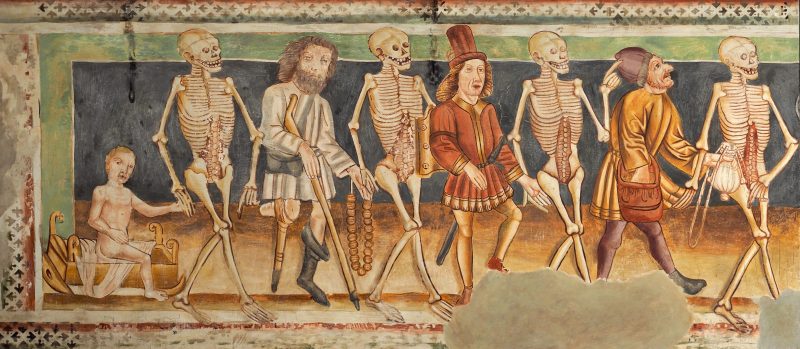
It was not always that way. In medieval Europe death was woven into the fabric of everyday life. Days were marked by the death dates of numerous saints. One had to pass through cemeteries memorializing generations of the departed to reach the entrance of the local church. Inside, the worshiper was greeted with the glow of numerous candles lit to memorialize the recently departed. Outside, the black plague hung like cloud over western Europe ready to rain death upon any town at any time. People died at home, which for common folk consisted of one or two rooms. They spent their final hours in the midst of children playing on the floor as the chores of everyday living continued around them. I am not suggesting that death was easy, pain free or less terrifying in those bygone days. But it was experienced as an ever present reality shaping the way people understood and lived their lives. More significantly, it influenced the shape of their faith. To a very large degree, life was understood as a preparation for death. Prayers were frequently made for a “good death,” one met with sins confessed and absolved, quarrels reconciled and amens made to all those one had wronged. People genuinely believed that “even in life, we are in the midst of death.” Moreover, death was not viewed as final. Beyond the grave lay judgment and the hope of eternal life. [2]
As a parish pastor, I have had the benefit of a front row seat to a great many deaths. Though death takes as many forms as there are people, there are some common threads. Many people to whom I have ministered during their last days remain in denial toward the end. They steadfastly refused even to discuss hospice care, funeral arrangements or final farewells to family members and friends. They were alternatively hyper optimistic, impatient or angry from one day to the next. Some descended into deep depression, isolating themselves from every attempt of anyone to comfort or care for them. These perspectives become particularly toxic when reinforced by the cultural expectation that death is to be resisted at all costs. Obituaries commonly report that an individual died after a lengthy “battle” with…whatever the last illness was. Persons diagnosed with terminal conditions are encouraged to “be a fighter.” Too often, people who desperately need permission to let go and rest in peace are scolded for “giving up.” To stop fighting and accept death is somehow a betrayal of our collective struggle against the limits of our existence.
There were, however, a few I have known who ended their days with a clear recognition that their lives were drawing to a close. While acknowledging the pain of letting go relationships to dear ones, the frustration that goes with leaving behind unfinished tasks and unmet goals, they expressed deep gratitude for the lives they were privileged to have had, their friends and family and the achievements that marked their lives. Often, they rejected medical treatments that might conceivably have extended their lives for a brief period choosing instead to spend their last days in conversation, prayer and fellowship with those nearest and dearest to them.
There is one characteristic shared by those few in the latter group. Each of them held a firm belief in the resurrection of the body and the life everlasting. I hasten to add that I am not suggesting one cannot die with grace, dignity and a sense of satisfaction in the absence of such faith. But within the limited scope of my own experience, I have found it to be a common denominator. I should also add that the faith sustaining these folks was not the sort found in a fox hole. Individuals I have known who have died in faith have lived in it throughout their lives. They have long recognized the good pastures and still waters that have sustained them day to day are gifts of the Good Shepherd. The Shepherd has accompanied them in their darkest hours, restoring their souls and strengthening their hope. They have known the Shepherd’s presence with them in times of danger and in the face of malice. They have known the Shepherd’s “goodness and mercy” all the days of their lives and so trust the Shepherd to accompany them on their last journey on this planet, even through it leads through the “valley of the shadow of death.”
My colleagues were right in pointing out that the twenty-third psalm is chiefly about God’s care, protection and leadership throughout one’s life. But the Good Shepherd’s leadership, protection and companionship do not end there. That is why I find the NRSV rendering of the twenty-third psalm lacking. Jesus can say, “[m]y sheep hear my voice. I know them, and they follow me. I give them eternal life, and they will never perish. No one will snatch them out of my hand.” John 10:27-28. I believe that robust faith in Jesus’ promise that God’s love is stronger than death and does not end at the grave gives one the courage to speak freely and truthfully about death, to accept thankfully a life that is abundant as well as limited and to enter one’s final days with hope and expectation.
Here are two poems by Dylan Thomas and George Herbert respectively. They represent two quite different, but common human reactions to death.
Do Not Go Gentle into That Good Night
Do not go gentle into that good night,
Old age should burn and rave at close of day;
Rage, rage against the dying of the light.
Though wise men at their end know dark is right,
Because their words had forked no lightning they
Do not go gentle into that good night.
Good men, the last wave by, crying how bright
Their frail deeds might have danced in a green bay,
Rage, rage against the dying of the light.
Wild men who caught and sang the sun in flight,
And learn, too late, they grieved it on its way,
Do not go gentle into that good night.
Grave men, near death, who see with blinding sight
Blind eyes could blaze like meteors and be gay,
Rage, rage against the dying of the light.
And you, my father, there on the sad height,
Curse, bless, me now with your fierce tears, I pray.
Do not go gentle into that good night.
Rage, rage against the dying of the light.
Source: The Collected Poems of Dylan Thomas (New Directions Publishing Corporation, 1957). Dylan Marlais Thomas (1914 –1953) was a Welsh poet and writer. He was born in Swansea in 1914, leaving school in 1932 to become a reporter for the South Wales Daily Post. Thomas produced some 200 poems between1931 and 1935. He came to be appreciated as a popular poet during his lifetime, though he found earning a living as a writer difficult. Thus, Thomas began augmenting his meager income with reading tours and radio broadcasts. His radio recordings for the BBC during the late 1940s brought him wider attention with the public. He was frequently featured by the BBC as a voice of the literary scene. Thomas travelled to the United States in the 1950s. There his readings brought him a degree of fame. Unfortunately he fell into erratic behavior and drinking that wreaked havoc on his health. During his fourth trip to New York in 1953, Thomas became gravely ill, fell into a coma and died. You can read more about Dylan Thomas and sample more of his poems at the Poetry Foundation website.
Death
Death, thou wast once an uncouth hideous thing,
Nothing but bones,
The sad effect of sadder groans:
Thy mouth was open, but thou couldst not sing.
For we considered thee as at some six
Or ten years hence,
After the loss of life and sense,
Flesh being turned to dust, and bones to sticks.
We looked on this side of thee, shooting short;
Where we did find
The shells of fledge souls left behind,
Dry dust, which sheds no tears, but may extort.
But since our Savior’s death did put some blood
Into thy face,
Thou art grown fair and full of grace,
Much in request, much sought for as a good.
For we do now behold thee gay and glad,
As at Doomsday;
When souls shall wear their new array,
And all thy bones with beauty shall be clad.
Therefore we can go die as sleep, and trust
Half that we have
Unto an honest faithful grave;
Making our pillows either down, or dust.
Source: This poem is in the public domain. George Herbert (1593 –1633) was a Welsh-born poet, orator, and priest of the Church of England. He was born into a wealthy family and raised in England. He was admitted to Trinity College, Cambridge where he went with the intention of becoming a priest. Instead, he became the University’s Public Orator. His skill attracted the attention of King James I through whose patronage he entered the Parliament of England. There he served for about a year. Following the death of King James I, Herbert gave up his secular ambitions and took holy orders in the Church of England. He spent the rest of his life as the rector of a small parish in Salisbury. You can read more about George Herbert and sample more of his poems at the Poetry Foundation website.
[1] When I was an intern minister at a church in Brooklyn, I went to visit an elderly woman hospitalized at a local facility. When I reached her room, the bed was empty. So I asked one of the floor nurses where I could find her. “Oh,” she replied, “she expired.” Thinking that she must have suffered a serious but not lethal medical incident, I asked, “so is she in the ICU?” The nurse looked a little confused, then went on to say, “she passed on.” That I understood. Though I will admit that I was being a tad dense, nonetheless, it struck me as odd then and still does that a medical professional in a hospital who deals regularly with sickness and death could be so reluctant to speak of it directly. I am not sure whether the nurse was uncomfortable with speaking directly of death or whether she thought I might be made uncomfortable with such directness.
[2] Admittedly, medieval culture’s awareness of death sometimes went to extremes. Moreover, the hope of eternal life was often overshadowed by the fear of eternal punishment, a fear that the medieval church and its patrons exploited ruthlessly. Even so, I think it’s outlook far superior to our own culture of denial.

