All posts by revolsen

Unknown's avatar

About revolsen

I am a retired Lutheran Pastor currently residing in Wellfleet, Massachusetts. I am married .and have three grown children.

When Being Church is Against the Law

THIRD SUNDAY OF EASTER

Acts 9:1-20

Psalm 30

Revelation 5:11-14

John 21:1-19

 Prayer of the Day: Eternal and all-merciful God, with all the angels and all the saints we laud your majesty and might. By the resurrection of your Son, show yourself to us and inspire us to follow Jesus Christ, our Savior and Lord, who lives and reigns with you and the Holy Spirit, one God, now and forever.

Note: For copyright reasons, the NRSV is not available to Oremus. They are working on obtaining the necessary updated licenses, but until then are offering only the Authorized King James Version. Nevertheless, the texts I cite in this article will be taken from the NRSV.

“Worthy is the Lamb that was slaughtered to receive power and wealth and wisdom and might and honor and glory and blessing!” Then I heard every creature in heaven and on earth and under the earth and in the sea, and all that is in them, singing, “To the one seated on the throne and to the Lamb be blessing and honor and glory and might forever and ever!” Revelation 5:12-13.

Last Friday the FBI arrested Milwaukee, Wisconsin circuit court Judge Hannah Dugan on allegations she helped an undocumented immigrant try to evade arrest. As I am not sure that a complete and reliable factual accounting of this incident has yet been made available, I will not comment on the legality of the act. But, legal or not, using our courts where people come for justice as a trap for arrest and deportation is immoral. Moreover, resisting immoral action, legal or not, is a moral obligation. We hear repeatedly, from both sides of the political spectrum, that “no one is above the law.” That is not quite true. One there is who is above all humanly constructed systems and institutions of authority, civil and religious. Jesus Christ alone is worthy “to receive all power and wealth and wisdom and might and honor and glory and blessing.” To him alone “every creature in heaven and on earth and under the earth and in the sea” owe ultimate allegiance. Therefore, when it comes to an unavoidable choice between honoring Jesus’ command to love God above all else and to love one’s neighbor as oneself and obeying the laws of the land, “we must obey God rather than human authority.” Acts 5:29

I do not mean to say by this that human authority can be disregarded. Generally speaking, government is one of God’s gifts to humanity. By means of it, human society is ordered. Politics, rightly understood, are the means by which we corporately love our neighbors. Obedience to civil law is therefore our default position. That holds true even for laws that seem unnecessary, burdensome or ill conceived. Where there are procedures for repealing or amending bad law, faithful discipleship requires utilizing them to correct injustice, inefficiency and unnecessary aggravation. But laws should not be casually and arbitrarily disregarded.

The 1908 law allegedly violated by Judge Dugan reads as follows:

Subsection 1324(a)(1)(A)(iii) makes it an offense for any person “knowing or in reckless disregard of the fact that an alien has come to, entered, or remains in the United States in violation of law, conceals, harbors, or shields from detection, or attempts to conceal, harbor, or shield from detection, such alien in any place, including any building or any means of transportation.”  

The reach of this law is far from clear. Does a church operating a food pantry whose members know that many of its clients are undocumented and makes no effort to contact federal authorities “shielding them from detection?” Is a social services agency operating a homeless center knowing that many of its residents are undocumented guilty of “harboring” illegal aliens? If a pastor gives a person known or suspected to be undocumented a ride to the bus station, is she shielding an illegal alien from detection by “means of transportation?” “Does “harboring” include a church’s finding shelter for an undocumented family?

The law has not been so construed in the past, though it may be open to such a broad interpretation. Prosecutors have a wide range of discretion with respect interpreting laws and determining the scope of their reach. Law enforcement officers have discretion as to whether they will enforce the law in any given circumstance. The officer that pulls you over for speeding could well give you a ticket bearing a stiff fine and points on your license. But if you are sober, respectful and a first time offender, chances are you will get off with a warning, though there is no guarantee. Up until the present time, federal and state authorities have respected the work of churches, schools, courts and social agencies by refraining from prosecutorial and enforcement action against undocumented persons that would interfere with their operations. Such restraint was based mainly on pragmatism. It is well known that undocumented persons make up about 3.3% of the population. Prior to the tidal wave of hysteria stirred up over the last decade, these folks were not regarded as a threat and the government had no interest in mass deportations.

Things have changed, however, and that is putting it mildly. We now have a government that is committed to carrying out the “greatest deportation in history.” We have a vice president who takes pride in spreading outright lies about nonwhite immigrant communities for the purpose of turning public opinion against them. Global Refuge, a ministry of my Evangelical Lutheran Church in America, which received commendations from both Republican and Democratic administrations for more than half a century, was recently labeled a criminal enterprise by the governments unofficial Department of Governmental Efficiency.

We should have seen this coming. In 2019, during Trump 101, one of our pastors in training was deported. Betty Rendón, who fled from her native Columbia in 2004 as a refugee after guerrillas threatened the school she directed there, was arrested by ICE, detained and deported. At the time of her arrest, she was studying at the Lutheran School of Theology at Chicago and commuting from the city to Racine, Wisconsin, to work part time as a lay minister in one of our churches. Her application for asylum was denied for lack of documentation leaving her with two options. She could either return to Columbia with her husband and daughter where the danger from which she fled still existed, or she could remain in the United States and hope for the best. Technically, Betty Rendón lacked legal standing to remain in the United States and was subject to deportation. But as with all statutes, enforcement is largely discretionary. Prosecutors need not prosecute and the police need not enforce every law every time against everyone under all circumstances. Indeed, they ought not to waste limited public law enforcement resources when so doing serves no public purpose.

To be clear, the government is responsible for ensuring public safety. To that end, arrest and imprisonment/deportation of persons, documented or not, posing a threat to the public is justified. But such authority must be exercised with care, pursuant to law and consistent with due process. The present administration’s fixation on deporting eleven-million people who are, to a greater degree than the general population, law abiding, tax paying and productive members of society is destined to conflict with the church’s ancient ministry of hospitality to strangers and sanctuary for refugees. It seems to me that we have reached a point at which we must decide whether we will be true to our baptismal covenant of discipleship with Jesus, or set that covenant aside and, by our silence and inaction, become complicit in our nation’s crimes against the most vulnerable among us. If, as my own church declares, walking with immigrants and refugees is a matter of faith, the church must be prepared for acts of defiance, civil disobedience-and the consequences that will surely follow.

Perhaps the greatest temptation facing us comes in the form of despair. What difference can an institutional church in decline hope make in a nation driven by big money and dirty politics? What can a small church struggling to meet its budget and take care of its own aging population do for its neighbors living in fear of violent arrest and deportation? What can one person do against systemic evil infecting all of society? These very sentiments are expressed by in the Hebrew Scriptures to the psalmist:

“Flee like a bird to the

mountains,

for look, the wicked have fitted their arrow to

the sting,

to shoot in the dark at the

upright in heart.

If the foundations are destroyed,

what can the righteous do?” Psalm 11:1-3.

The psalmist replies that “the Lord is in his holy temple,” that “His eyes behold, his gaze examines humankind,” that “his soul hates the lover of violence,” that “he loves righteous deeds” and that the “upright shall behold his face.” For this reason, despite the seeming victory of the wicked, the psalmist nevertheless declares, “In the Lord I take refuge.” Psalm 11:1.  

I believe the visions recorded by John of Patmos in the Book of Revelation have never been more relevant than they are for this day. I believe they offer a wealth of spiritual resources for a struggling church living in a hostile environment. Sadly, Revelation has been highjacked by pre-millennial sects fixated on figuring out when and how the world will end. That, however, is not John’s purpose. If you want to understand Revelation, you need to begin where it does, namely, with John’s letters to the seven churches of Asia Minor. There we are introduced to seven faith communities living in legal jeopardy on the margins of society, divided by false teachings and self-proclaimed prophets, discouraged and on the verge of disintegration. John of Patmos reminds them of their importance and assures them that their struggle to follow Jesus is of cosmic significance. His visions rip away the vail of futility shrouding his church’s spiritual vision. In graphic and lurid imagery, John shows his churches that history is not being driven by the brutal imperial regime of Caesar or Rome’s ruthless economy of greed and exploitation, all of which are symbolized by the grotesque predatory beasts described in his visions. To the contrary, the future belongs to Jesus, “the lamb who was slaughtered.” The churches’ struggle to remain faithful in their witness to Jesus through public testimony, mutual love for one another and service to their neighbors puts them on the side of the God whose determination to redeem a wounded and broken world will not be thwarted. That is as true in the twenty-first century today as it was in the first.

Faithful witness might appear to be futile. As poet Adrianne Rich points out, our resistance to evil, our efforts to protect and preserve what matters seems ineffective, weak and bound to fade with time. Still the faithful hold vigils and protests that seem to accomplish nothing, stand with refugees in danger of deportation when the law and public opinion are against them, work food pantries that cannot begin to satisfy the needs of the growing number of food insecure families. We do this because we know that the lamb who was slaughtered for doing the same has been raised and that to him belong all “blessing and honor and glory and might forever and ever!”  

A Mark of Resistance

Stone by stone I pile

this cairn of my intention

with the noon’s weight on my back,

exposed and vulnerable

across the slanting fields

which I love but cannot save

from floods that are to come;

can only fasten down

with this work of my hands,

these painfully assembled

stones, in the shape of nothing

that has ever existed before.

A pile of stones: an assertion

that this piece of country matters

for large and simple reasons.

A mark of resistance, a sign.

Source: Poetry, August 1957. Adrienne Rich (1929-2012) was born in Baltimore, Maryland. She attended Radcliffe College, graduating in 1951. She was selected by W. H. Auden for the Yale Series of Younger Poets prize that same year. Throughout the 1960s, Rich wrote several collections of poetry in which she explored such themes as women’s roles in society, racism and the Vietnam War. In 1974 Rich won the National Book Award which she accepted on behalf of all women. She went on to publish numerous other poetry collections. In addition to her poetry, Rich wrote several books of nonfiction prose, including Arts of the Possible: Essays and Conversations (W. W. Norton, 2001) and What is Found There: Notebooks on Poetry and Politics (W. W. Norton, 1993). You can read more about Adrianne Rich and sample more of her poetry at the Poetry Foundation website.

The Wounded God

SECOND SUNDAY OF EASTER

Acts 5:27-32

Psalm 118:14-29

Revelation 1:4-8

John 20:19-31

Prayer of the Day: Almighty and eternal God, the strength of those who believe and the hope of those who doubt, may we, who have not seen, have faith in you and receive the fullness of Christ’s blessing, who lives and reigns with you and the Holy Spirit, one God, now and forever.

“But [Thomas] said to them, ‘Unless I see the mark of the nails in his hands, and put my finger in the mark of the nails and my hand in his side, I will not believe.’” John 20:25.

“Then [Jesus] said to Thomas, ‘Put your finger here and see my hands. Reach out your hand and put it in my side. Do not doubt but believe.’” John 20:27.

I do not believe my eldest daughter Sarah was more than five when on Easter Sunday, after church and a busy morning of easter egg hunts, I read the Easter story to her from a children’s picture book. As is the case for books of this kind, the pictures overpowered the words. So, not surprisingly, it was the pictures that captured Sarah’s interest more than my reading. Children tend to focus on things we adults deem peripheral and unworthy of our full attention. Such was the case with Sarah. The butterfly perched on a daisy growing in the garden where Jesus was buried proved more interesting to Sarah than the angels, the surprised women and the empty tomb. When we reached the place where Jesus made his appearance, Sarah looked puzzled. “Where are those things on his hands?” she asked. It took me a few seconds to realize that she was talking about his wounds from the nails. This picture book portrayed the resurrected Christ fully healed. He was dressed in a sparking white robe and looked as though he had just had a good, hot shower, a clean change of clothes and a manicure. Sarah knew the story too well not to question this portrayal of the resurrected Christ.

At the tender age of five, Sarah detected in the picture book I was reading to her an ancient heresy that had escaped my notice. It is called “Docetism,” from the Greek word “dοκηταίa,” meaning to “seem” or “appear.” This belief developed early in the life of the church. It took several different forms among various sects, but in general, docetists denied the humanity of Jesus. They taught that Jesus only appeared to have a physical body and that his earthly life, suffering, and death were merely illusions, not real experiences. Such a Christ cannot be wounded or injured and cannot really die. If Jesus really had a body, it was nothing more than a clever disguise, a costume he wore and discarded on the cross. The real Jesus could never be touched by human suffering and so one would hardly expect the resurrected Christ to bring the wounds of his now unnecessary body into his resurrected state.

I am sure the authors of that children’s book I read to Sarah all those years ago had no intention of propagating heresy. Nevertheless, portrayal of the resurrected Christ without his wounds is just that. Both Evangelists Luke and John make a point of telling us that Jesus’ body is a wounded body. The scars from the nails remain in his hands and feet. The wound inflicted by the soldier’s spear is fresh in his side. The glorified Christ is still the wounded, broken and bleeding Jesus of Nazareth. It is important to understand that these wounds were present on Easter Sunday and remain to this day. The Resurrection did not undo the Incarnation. The Word of God is still made flesh. The wounds inflicted upon all human flesh are his own. Jesus’ wounds will never be healed until all of creation is healed. Until then, the Incarnate Word suffers the sickness, loneliness, poverty, homelessness and violence we experience and inflict on one another. That is why Jesus warns us that what we do or fail to do for the least among us, we do or fail to do for him.

Progressive Protestantism, obsessed as it is with accommodating the rationalistic assertions of modernism, has always been at pains dealing with the resurrection narratives. In a world devoid of mystery where nothing exists beyond what can be verified empirically in the lab, how can Jesus’ resurrection be made intelligible? The physicality of the resurrected Christ has ever been an intellectual embarrassment to the Church in this modern world. For that reason, the old heresy of docetism continues to have theological to appeal. It offers a conceptual tool for making the Resurrection intelligible to the modern mind. Without offending our modernist biases, the Resurrection can be and often is preached as though it were a metaphor for some worthy cause or noble aspiration. Like John Brown’s body, Jesus’ body lies “a moldering in the grave,” but his truth goes marching on.

But the gospel narratives will admit of no such reductionist accomodation. There is, after all, the matter of the empty tomb. There is the matter of Jesus being embraced, being touched and sharing a meal with his disciples. To be sure, there is something very different about the body of the resurrected Christ. Jesus appears and disappears. Sometimes he is recognized by his disciples, sometimes not. He passes through closed and locked doors. He ascends to the right hand of God and so is omnipresent in a way that the pre-resurrection Jesus could not have been. The resurrected Christ is not merely a resuscitated corpse. But neither is he a disembodied spirit, a mere idea or the symbol of some great human aspiration. The scandal of our faith is that we believe God has a body. God has become and remains vulnerable to us. We are still capable of inflicting pain on God. Not only did the “Word become flesh,” but the Word remains flesh, suffering flesh, abused flesh, persecuted flesh, imprisoned flesh, starving flesh, dying flesh. That is why the two great commandments: Love God with all the heart, with all the soul, with all the mind and with all the strength; and love the neighbor are actually one commandment. There is no disembodied God who can be served apart from our flesh and blood neighbors.

It is for this reason poet John Updike insists that “if [Jesus] rose at all it was His body…” and that in the absence of such a resurrection, “the Church will fall.” Genuine faith in Jesus, true discipleship and real evangelism always puts the wellbeing of the neighbor, Christian or non-Christian, citizen or foreigner, documented or undocumented, friend, stranger or enemy above all else, because there is no other way to love and serve God than by loving and serving the neighbor. If your faith requires you to injure your neighbor, whether for the sake of religion, family or country, it is not faith in Jesus. The good news of Easter is that, in spite of the many wounds we have inflicted upon God throughout our bloody and violent history, chief of which was the murder of God’s own Son, God continues to abide in our suffering flesh, loving, forgiving and renewing God’s good creation.  

Here is the poem by John Updike cited above.  

Seven Stanzas at Easter

Make no mistake: if He rose at all
it was as His body;
if the cells’ dissolution did not reverse, the molecules
reknit, the amino acids rekindle,
the Church will fall.

It was not as the flowers,
each soft Spring recurrent;
it was not as His Spirit in the mouths and fuddled
eyes of the eleven apostles;
it was as His flesh: ours.

The same hinged thumbs and toes,
the same valved heart
that–pierced–died, withered, paused, and then
regathered out of enduring Might
new strength to enclose.

Let us not mock God with metaphor,
analogy, sidestepping, transcendence;
making of the event a parable, a sign painted in the
faded credulity of earlier ages:
let us walk through the door.

The stone is rolled back, not papier-mâché,
not a stone in a story,
but the vast rock of materiality that in the slow
grinding of time will eclipse for each of us
the wide light of day.

And if we will have an angel at the tomb,
make it a real angel,
weighty with Max Planck’s quanta, vivid with hair,
opaque in the dawn light, robed in real linen
spun on a definite loom.

Let us not seek to make it less monstrous,
for our own convenience, our own sense of beauty,
lest, awakened in one unthinkable hour, we are
embarrassed by the miracle,
and crushed by remonstrance.

Source: Updike, John, Collected Poems, (c. 1993 by John Updike, pub. by Alfred A. Knopf, Inc.). John Updike (1932-2009) was a prolific American author and poet. He grew up in Shillington, Pennsylvania. His early poems and fiction are grounded in the gritty industrial and cultural environment of the rust belt. His awards include the Pulitzer Prize for fiction, the American Book Award for fiction and the National Book Critics Circle Award for both fiction and criticism. You can learn more about John Updike and read more of his poetry at the Poetry Foundation website.
Easter-A Women’s Tale

RESURRECTION OF OUR LORD

Acts 10:34-43

Psalm 118:1-2, 14-24

1 Corinthians 15:19-26

Luke 24:1-12

Prayer of the Day: O God, you gave your only Son to suffer death on the cross for our redemption, and by his glorious resurrection you delivered us from the power of death. Make us die every day to sin, that we may live with him forever in the joy of the resurrection, through your Son, Jesus Christ our Lord, who lives and reigns with you and the Holy Spirit, one God, now and forever.

“But these words of [Mary Magdalene, Joanna, Mary the mother of James, and the other women with them] seemed to [the twelve disciples] an idle tale, and they did not believe them.” Luke 24:11.

Nevertheless, Simon Peter got up and literally ran to the tomb of Jesus to investigate. If Peter had determined, along with the rest of the apostles, that the women’s account of the empty tomb and the words of the angels was no more than an “idle tale,” why did he go running to the tomb? One possible answer is that he didn’t. The last sentence of our gospel lesson (verse 12) telling of Peter’s sojourn to the tomb is not found in some of the oldest and most reliable Greek New Testament manuscripts we have. This has lead many biblical scholars to conclude that it was a later addition to the story. Some commentators suggest that the account of Peter’s going to the tomb was added in order to absolve the “Prince of the Apostles” from unbelief. There might also be a hint of masculine embarrassment over the fact that the news of the resurrection was given first to women, and all the more so in view of the men’s failure to receive it in faith. Peter’s going to the tomb takes the edge off the apostles’ failure somewhat.

Later on, after the two disciples who encountered Jesus on the road to Emmaus and recognized him in the “breaking of the bread” return to Jerusalem with their good news, they are told that “The Lord has risen indeed, and he has appeared to Simon!” Luke 24:34. But no mention is made of the women. The gospels are generally long on the words and deeds of the male apostles, but short on episodes involving women. Chalk that up to prejudice, cultural subordination of women or misogyny if you like. The fact remains, however, that when women do make an appearance in the gospels, they leave a powerful impression. In Luke’s gospel, it is Mary the mother of Jesus who first says “yes” to God’s redemptive purpose in her life and the life of her promised child. Mary explodes with the radical and liberating words of the Magnificat that prefigure Jesus’ life and ministry. She is the one who ponders and treasures the events of his childhood in her heart. It was the faith of a Canaanite woman that pushed Jesus to recognize God’s saving purpose and the presence of “great faith” beyond the boundaries of his own nation and people. It was an anonymous woman who anointed Jesus prior to his impending death and understood him better than his closest disciples. Moreover, all four gospels are unanimous in their testimony that the woman disciples were the first witnesses of the Resurrection and the first commissioned by Jesus to proclaim it.

Throughout most of its history the church, led principally by males, has had a propensity for ignoring women. Their voices have been left out of our teaching and theology, their unique gifts have been devalued and taken for granted and the door to full participation and leadership in the Body of Christ has remained closed to them. Nonetheless, they have persisted faithfully and forcefully supporting the church in its mission, calling it to account for its systemic patriarchal oppression and challenging it with their own unique and creative insights. This is a critical part of the Easter story that needs telling.

I am old enough to remember the days when ordination of women was first introduced in Lutheran circles. I can still recall a day during my senior year in college when one of my professors hosted a question and answer meeting for those of us considering ordained ministry. Most of us were male, but there were a couple of women present as well, one of whom posed a question to my professor: “What advice would you give to a woman considering ministry of word and sacrament?” His response was instantaneous and decisive. “Don’t,” he said. “You may graduate seminary with a Master of Divinity degree, but there is no Lutheran church that will welcome a woman pastor. That isn’t happening for a long, long time.” Sadly, the professor was more than half right. Women answering the call to ministry have had to swim upstream against currents of congregational skepticism over their capacity to lead, patronization and abuse from their male colleagues and institutional barriers to positions of leadership within the church. Yet they persisted.

The church still struggles with patriarchy. Notwithstanding profound changes in recent decades that have cleared the way for women to serve in capacities unheard of in prior centuries, resistance remains to the voices, gifts and ministry of women. The church still has a long way to go in dismantling the systemic patriarchy in its midst that has silenced the voices of women and thereby compromised its witness to the gospel. Too often, our preaching, teaching and hymnody tells a story about men for men and to men. The gospels, however much they might reflect patriarchal and hierarchical assumptions, nevertheless tell a different story. They tell the story of the first apostles commissioned to preach the resurrection and how the new creation in Christ first broke into our world through the voices of the faithful women who followed Jesus and supported his ministry. They testify to the truth articulated by St. Paul, namely, “There is no longer Jew or Greek, there is no longer slave or free, there is no longer male and female; for all of you are one in Christ Jesus.” Galatians 3:28.[1] The Easter sunrise breaks into our world from a future in which such unity, equality and mutuality is fully realized.

The church, like each one of our lives, is “like a broken bowl” says the poet. Yet we pray that God would “[melt] and remould it, till it be [a] royal cup for” God and a faithful witness to God’s reign of justice and peace. Here is a poem/prayer by Christina Rossetti seeking that very thing.

A Better Resurrection

I have no wit, no words, no tears;

My heart within me like a stone

Is numb’d too much for hopes or fears;

Look right, look left, I dwell alone;

I lift mine eyes, but dimm’d with grief

No everlasting hills I see;

My life is in the falling leaf:

O Jesus, quicken me.

My life is like a faded leaf,

My harvest dwindled to a husk:

Truly my life is void and brief

And tedious in the barren dusk;

My life is like a frozen thing,

No bud nor greenness can I see:

Yet rise it shall—the sap of Spring;

O Jesus, rise in me.

My life is like a broken bowl,

A broken bowl that cannot hold

One drop of water for my soul

Or cordial in the searching cold;

Cast in the fire the perish’d thing;

Melt and remould it, till it be

A royal cup for Him, my King:

O Jesus, drink of me.

Source: This poem is in the public domain. Christina Georgina Rossetti (1830 –1894) was an English writer of romantic, devotional and children’s poems. She is perhaps best known for her composition of two Christmas carols, “In the Bleak Midwinter” and “Love Came Down at Christmas.” Rossetti was born in London and educated at home by her mother and father through religious works, classics, fairy tales and novels. The influence of prominent Italian writers filled the home and influenced Rossetti’s later writing. The Rossetti household was open to visiting Italian scholars, artists and revolutionaries. In the 1840s Rossetti’s family faced financial troubles due to a deterioration in her father’s physical and mental health. Her mother began teaching to support the family. At age 14, Rossetti suffered a nervous breakdown and left school. Religious devotion came to play a major role in her life as she struggled with bouts of depression.

Rossetti had three suitors, each of whom she declined to marry for largely religious reasons. Rossetti worked voluntarily in 1859–1870 at the St Mary Magdalene house of charity in Highgate, England, a refuge for ex-prostitutes. She was ambivalent about women’s suffrage, but staunchly opposed slavery in the United States, cruelty to animals and exploitation of girls in under-age prostitution. Rossetti maintained a wide circle of friends, associates and correspondents throughout the remainder of her life during which she continued to write and publish. You can read more about Christina Rossetti and sample more of her poetry at the Poetry Foundation website.


[1] To be sure, Paul’s pastoral advice concerning the place of women in the church does not always reflect such an equalitarian viewpoint. Paul, it seems, did not always fully comprehend the radical implications of the gospel he proclaimed. But do any of us fully comprehend the gospel’s implications for our lives? Can any of us claim that we have never had to change our minds, never resisted having to confront our prejudices or have never held an opinion of which we are now embarrassed or ashamed? And are any of us so arrogant as to assume that we have reached the pinnacle of understanding such that our descendants will never look back and question our judgment?   

Crucifixion as Lynching

PALM/PASSION SUNDAY

Luke 19:28-40

Isaiah 50:4-9a

Psalm 31:9-16

Philippians 2:5-11

Luke 22:14-23:56

Prayer of the Day: Everlasting God, in your endless love for the human race you sent our Lord Jesus Christ to take on our nature and to suffer death on the cross. In your mercy enable us to share in his obedience to your will and in the glorious victory of his resurrection, who lives and reigns with you and the Holy Spirit, one God, now and forever.

“I gave my back to those who struck me,
   and my cheeks to those who pulled out the beard;
I did not hide my face
   from insult and spitting.” Isaiah 50:6.

“And being found in human form,
   he humbled himself
   and became obedient to the point of death—
   even death on a cross.” Philippians 2:7-8.

“When they came to the place that is called The Skull, they crucified Jesus there with the criminals, one on his right and one on his left.” Luke 23:33

“Southern trees bear strange fruit,

Blood on the leaves and blood at the root,

Black bodies swinging in the Southern breeze,

Strange fruit hanging from the poplar trees.”  Abel Meeropol a.k.a. Lewis Allen

I used to say that one ought not to preach on the Passion Narrative. The Passion Narrative preaches itself. I still believe that to be the case, all things being equal. But all things are not equal in these days of warrantless detentions of legal residents, mass deportations of persons who have lived, worked and contributed to our economy for decades, summary discharge of transgender military personnel who have served this country with distinction and the efforts through ruthless censorship to erase from our nation’s memory the struggles and contributions of black, indigenous and all other nonwhite persons under the rubric of eliminating “DEI.” This extrajudicial oppression committed by our government against vulnerable communities in the name of “making America great again” leaves no doubt that the power of the state is now at the disposal of the MAGA lynch mob.

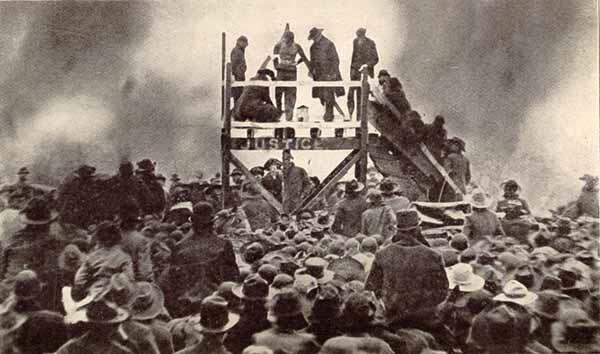
Contrary to what I was taught in school, the creed of white supremacy did not end with the Civil War. Though formal slavery ended in 1865, the creed of white supremacy that gave it moral justification lived on to be enacted into a matrix of laws robbing Black citizens of the right to vote, depriving black people of basic legal protections and blocking their access to everything from educational opportunities to access to public facilities. As Abraham Lincoln’s successor, President Andrew Johnson declared, “This is a country for white men, and by God, as long as I am president, it shall be a government for white men.”[1] Lynching was the ultimate instrument of terror employed to that end. The belief that Black men were inherently inclined toward rape, particularly of white women, was expressed by none other than President Theodore Roosevelt who said that “the greatest existing cause of lynching is the perpetration, especially by black men, of the hideous crime of rape-the most abominable in all the category of crimes, even worse than murder.”[2] The same sentiment was echoed by social reformers like Rebecca Latimer Fenton who endorsed lynching as a necessary deterrent for the protection of women.[3] The same pervasive belief in Black criminality continues to fuel disproportionately high rates of police stops, arrests and incarceration for Black folk.[4]  

Lynching, it must be emphasized, was not a rare and aberrant occurrence perpetrated only by extremists in the most backwards areas of the country. It was national policy. The United States Congress, driven largely by Southern Democrats, defeated both the Dyer Anti-Lynching Bill of 1918 and the similar Costigan-Wagner Act of 1933.[5] Such legislation was deemed an infringement on the right of states to frame their own solutions to “the race problem.” Killings of black folk based on infractions of racial etiquette, unsubstantiated allegations and simply for being at the wrong place at the wrong time were frequently inspired by the inflamed rhetoric of local leaders and carried out with no interference from and frequently with the assistance of law enforcement. The extrajudicial killings of George Floyd, Breonna Taylor, Tyre Nichols, Sonya Massey and Ahmaud Arbery make it painfully clear that lynching is not merely a grotesque artifact of the distant past. It is still deeply rooted in the American DNA.

On Passion Sunday we recall another lynching-the crucifixion of our Lord. The connection between the Cross and the lynching tree is made articulately by the late James H. Cone, professor of systematic theology at Union Theological Seminary in his book by that name.[6] In his introduction he writes:

“The cross and the lynching tree are separated by nearly 2000 years. One is the universal symbol of Christian faith; the other is the quintessential symbol of black oppression in America. Though both are symbols of death, one represents a message of hope and salvation, while the other signifies the negation of that message by white supremacy. Despite the obvious similarities between Jesus’ death on a cross and the death of thousands of black men and women strung up to die on a lamppost or tree, relatively few people, apart from black poets, novelists, and other reality-seeing artists, have explored the symbolic connections. Yet, I believe this is a challenge we must face. What is at stake is the credibility and promise of the Christian gospel and the hope that we may heal the wounds of racial violence that continue to divide our churches and our society.” Ibid, Cone, pp. viii-ix.

In the world where Jesus lived, the law, both civil and religious, served the interests of the wealthy and powerful. It was the tool of systemic oppression enforced by ruthless cruelty. The ultimate instrument and symbol of terror employed by Rome to keep the “pax Romana” in place was the cross. The sign put up on Jesus’ cross says it all: “This is what happens to people who preach a kingdom other than Caesar’s. This is what happens to people who follow a king other than Caesar.” The meaning of the derisive caption, “king of the Jews” would not have been lost on anyone passing by-just as the mutilated corpse of a lynching victim serves as a warning to every person of color: “Do not forget that we are white, you are not and what that means.”

We are witnessing the cross and the lynching tree today in the work of masked thugs in unmarked vehicles arresting and detaining American people for no apparent reason. We are seeing the cross in relentless efforts by the Trump administration to dismantle the architecture of civil rights protection under the rubrics of ridding our workplaces, schools and government of “DEI,” that is diversity, equity and inclusion. One can only conclude that the objective is homogeneity, inequality and exclusion. Make no mistake, the thinly vailed objective is to enshrine further and ensure the reign of white supremacy. We see the cross in efforts of national, state and local governments to limit access to or outright ban books found to be offensive or contrary to the moral and political agendas of right wing constituencies. These are all means by which we are warned not to “get into any good trouble,”[7] rock the boat or dare to suggest that “Caeser is not Lord. No, we do not yet see the return of state and federally approve lynchings, arrests and execution of dissenters or death camps. But if January 6, 2021 taught us anything, it is that the MAGA lynch mob is prepared to kill for what it cannot achieve through political means.

As Professor Cone points out, “[u]ntil we can see the cross and the lynching tree together, until we can identify Christ with a “recrucified” black body hanging from a lynching tree, there can be no genuine understanding of Christian identity in America and no deliverance from the brutal legacy of slavery and white supremacy.” And I would add that the cross must also be recognized in the bodies of the 36 transgender and gender-expansive people killed in an epidemic of violence in the last twelve months. The cross must be seen in the body of Matthew Shepherd, the young gay college student beaten, tortured and left hanging on a fence to die. It must be recognized among the three young women in Texas who died from lack of emergent care due to the effect of the state’s abortion ban. The cross can be seen everywhere in our culture of increasing oppression.

Of course, the cross is not the last word. Nevertheless, the Resurrection, which is God’s last word, loses its potency under a shallow, sentimental and spiritualized understanding of the cross consigned to the distant past. The miracle of the Resurrection is not simply that God raised a person from death. Nobody in the First Century doubted that God or the gods could perform such a feat. The miracle is that God raised Jesus from death, the one who not only preached but lived God’s gentle reign of justice and peace-and was put to death on the cross for his trouble. Jesus, not Caesar, not any general or political leader, not any successful entrepreneur, not any billionaire was raised from death and exalted to God’s right hand. God stands with the crucified of all times and places, and so must Jesus’ disciples.  

So I would urge preachers to break with the otherwise sound admonition not to preach the Passion. Preach the cross and the way it can still be seen in the suffering flesh of the those most vulnerable among us now being crucified under our government’s oppressive machinery. There are, I know, people in our churches who, to one degree or another, support Donald Trump and his MAGA allies. To these folks, you need to say: “We love you. You are a valued part of our community. But in supporting this man and his cruelty, you have sinned against God and the people made in God’s image. Whether by malice or mere indifference, you have closed your heart to the people nearest God’s heart and so to Jesus. You must turn away from these sins lest they devour your soul.” If you are unwilling to do that, then for the sake of the church, for the sake of the world and for your own sake, step down from the pulpit and make room for someone who will.   

Here is the complete poem of Abel Meeropol a.k.a. Lewis Allen.

Strange Fruit

Southern trees bear strange fruit,

Blood on the leaves and blood at the root,

Black bodies swinging in the Southern breeze,

Strange fruit hanging from the poplar trees.

Pastoral scene of the gallant South,

The bulging eyes and twisted mouth,

The scent of magnolias, sweet and fresh,

Then the sudden smell of burning flesh.

Here is a fruit for the crows to pluck,

For the rain to gather, for the wind to suck,

For the sun to rot, for the trees to drop,

Here is a strange and bitter crop.

Source: Music Sales Corporation (ASCAP) (c. 1939).Abel Meeropol (1903 –1986) was an American songwriter and poet. His works were published under his pseudonym Lewis Allan. His poem and musical setting of “Strange Fruit” was famously sung and recorded by the American jazz and swing singer, songwriter, and actress Billie Holiday. Meeropol was born in 1903 to Ukrainian-Jewish immigrants in the Bronx, New York. He graduated from DeWitt Clinton High School in 1921. He e earned a B.A. from City College of New York and an M.A. from Harvard University. Meeropol taught English at DeWitt Clinton for 17 years. During his tenure as a high school teacher, Meeropol taught author and racial justice advocate James Baldwin. He published his work under the pseudonym of “Lewis Allan” in memory of the names of his two stillborn children.

Billie Holiday (1915-1959) was born Eleanora Fagan. She was an American jazz and swing music singer. Nicknamed “Lady Day” by her friend and music partner, Lester Young, Holiday made significant contributions to jazz music and pop singing. Her vocal style, strongly influenced by jazz instrumentalists, inspired a new way of manipulating phrasing and tempo. She was known for her vocal delivery and improvisational skills.

After a turbulent childhood, Holiday began singing in nightclubs in Harlem. Throughout the 1930s and 1940s, Holiday had mainstream success on labels such as Columbia and Decca. Sadly, she was beset with legal troubles and drug abuse and served a short prison sentence in the 1940s. She came back following her release, however, to perform a sold-out concert at Carnegie Hall. Holiday’s success continued throughout the 1950s, with two further sold-out shows at Carnegie Hall. Her last album, Lady in Satin, was released in 1958. Holiday died of heart failure at age 44. To hear a moving recording of the Meeropol’s poem sung by Billie Holidy, click on this link.


[1] Constitutional Daily, July 31, 2019.

[2] Shapiro, Herbert, White Violence and Black Response: From Reconstruction to Montgomery (c. 1988 by Amherst: University of Massachusetts Press) p. 106

[3] “The Nature of Reform in the Early Twentieth-Century South” by Natalie J. Ring, published in A New History of the American South, (Edited by W. Fitzhugh Brundage, Laura F. Edwards & John F. Sensbach, c. 2023 by University of North Carolina Press) p. 378.

[4] Black people made up almost half of the state prison population but only about 13% of the U.S. population. “Racial Disparities Persist in Many U.S. Jails,” The Pew Charitable Trusts, May 16, 2023. According to the Philadelphia District Attorney’s Office “Racial Injustice Report, 2023,” Black individuals account for 69% of police stops and 62% of individuals arrested while white people accounted for only 18% of police stops and 21% of arrests.

[5] In 2023 Congress finally took the step of making lynching a crime by passing the The Emmett Till Antilynching Act. The law defines lynching as a federal hate crime, increasing the maximum penalty to 30 years imprisonment for several hate crime offences. Reps. Andrew Clyde, Thomas Massie, and Chip Roy voted against the Act.

[6] Cone, James H., The Cross and the Lynching Tree (c. 2011 by James H. Cone; pub. by Orbis Books).

[7] Taken from the now famous quote from the late congressman John Lewis: “Never, ever be afraid to make some noise and get in good trouble, necessary trouble.”

Christians Persecuted in America? Give me a Break!

President Donald J. Trump recently signed an Executive Order establishing a task force to end the “anti-Christian weaponization of government” and “unlawful conduct targeting Christians.” Evangelical Christians, it should be noted, have led the charge to dehumanize and deny medical treatment to transgender persons, gleefully advocated to deprive women access to life saving medical care and fought relentlessly to dismantle civil rights for minorities. Yet these bullies imagine that they are victims in need of government protection. I took this issue up with evangelical icon, Rev. Franklin Graham in an open letter seven years ago. The letter is obviously dated but the nonsensical claim of “persecution” is just as obviously as current as it is asinine. So I am re-blogging it once again.

In Search of a “New Thing”

FIFTH SUNDAY IN LENT

Isaiah 43:16-21

Psalm 126

Philippians 3:4b-14

John 12:1-8

Prayer of the Day: Creator God, you prepare a new way in the wilderness, and your grace waters our desert. Open our hearts to be transformed by the new thing you are doing, that our lives may proclaim the extravagance of your love given to all through your Son, Jesus Christ, our Savior and Lord, who lives and reigns with you and the Holy Spirit, one God, now and forever.

“I am about to do a new thing;
   now it springs forth, do you not perceive it?
I will make a way in the wilderness
   and rivers in the desert.” Isaiah 43:19

My knee jerk reaction is “no,” I do not see anything that looks like a new work of God’s redemptive intent in the world around me. What I do see is an erosion of legal and moral standards from the highest level of government, a growing lack of civility within our communities and a shocking lack of compassion and empathy in the hearts of too many who claim to be disciples of Jesus. Never could I have imagined that I would one day hear the president and vice-president of the United States threaten their neighbors with conquest and annexation in the manner of Hitler and Stalin. Our communal maturity level has dropped to the point where men and women in places of responsibility insult one another with crude language no teacher would permit on the playground. While I have sat through some pretty raucous congregational meetings in my day, never have I encountered the kinds of threats, accusations and intimidation that I see thrown about in so many churches these days. If God is at work in this mess, I cannot perceive it.

Neither could the prophet’s audience. They, too, were living in circumstances that were none too promising. Living in exile after having lost their land, their places of worship and their last shred of autonomy, the Jewish communities in Babylon did not appear to have much of a future. At this point in time, the armies of Persia under Cyrus the great were advancing on Babylon. Though this was surely a profound historical event, for the Jews it only meant that they would soon have a new master. The prophet Isaiah, however, was able to see in this clash of empires an opportunity for his people. Though the waring kingdoms were doubtlessly driven exclusively by their own nationalist agendas, God was also involved in the mix, turning their cruel and self centered designs to God’s own redemptive purpose. Through Persia’s conquest of Babylon, God was making a way out of captivity, through the wilderness and back to the land of promise where there would be opportunities for new beginnings.

I do not mean to say that God is orchestrating events such that, as one bumper sticker has it, “God is in Control.” John the Evangelist tells us that “God so loved the world.” Control is not something you do to one you love. It seems to me the scriptures are clear in ascribing meaningful agency to creation and all of its creatures, particularly its human creatures. The course of human history is not foreordained. The decisions we make have real consequences for good or ill. But our decisions do not have the last word. That belongs to the One whose Word brought creation into being and stubbornly remains mercifully and redemptively engaged with it no matter how often and how far it goes off the rails. God patiently, creatively and compassionately takes up whatever mess we throw at God and makes of it something new, something beautiful, something that opens the way forward where it seems there is no way.

I have experienced something of that divine salvage and repurposing in my own life. As those of you who follow me know, my wife suffered a severe and crippling spinal cord injury four years ago. It was a life altering event in all the ways you might expect. Many of the things Sesle loves to do, many of the things we loved doing together were suddenly ripped away from us. Severe disability is a drain both on the disabled one and the caregiver. But what was truly life altering for us had little to do with all that. Through Sesle’s journey of recovery, we found ourselves in the company of many fellow travelers with whom we found a caring community. We developed lasting friendships with sisters and brothers recovering from accidents, strokes and the effects of birth trauma. At this point, I can hardly imagine life without this community and the love, support and wisdom it imparts. Understand, I do not mean to imply that God caused Sesle’s injury in order to bring about some higher good. What I do believe is that God meets us in the worst of times, when it seems as though all is lost, to open up windows of new opportunity.

Unfortunately, I am not a prophet like Isaiah. Unlike him, I cannot see any “new thing” that God might be doing in the midst of all this Trumpian chaos. And I am certainly not searching the Book of Revelation or any other apocalyptic passage of scripture to find clues that might uncover some divine historical timetable. That is a fool’s game that has made fools of all who have ever tried their hand at it.   Nevertheless, I believe the “new thing” is there somewhere. I believe that because I have been indoctrinated with stories of God’s revealing a way forward just when it appears we have reached a dead end. God introduced the promise of blessing through Abraham and Sarah to a world mired in violence and division. God blessed them with a child when it seemed as though the fertility train had left the station. To a people who knew nothing but slavery for four hundred years, God broke the grip of empire to set them free. And let’s face it, no dead end is deader than death. Yet that is precisely where God worked God’s greatest redemptive work of all. God does some of God’s best work in the dark.

So what do we do until the “new thing” God is doing becomes clear? The prophet makes that crystal clear to us. We are to “do justice, love kindness and walk humbly with []our God.” Micah 6:8. Speak good news to the poor; speak truth to power; feed the hungry; care for the sick; stand with the oppressed; shelter the refugee; welcome the stranger; encourage one another; sing, dance and pray as we wait for the dawn. In the meantime, God can be trusted to make a way in the wilderness and quench our thirst as we make our way through this desert.

Here is a poem by Thomas Centolella about hope that survives even when its object is not in view. Perhaps that is the sort of hope we need as we await the revelation of the “new thing” God is up to.

The Hope I know

doesn’t come with feathers.

It lives in flip-flops and, in cold weather,

a hooded sweatshirt, like a heavyweight

in training, or a monk who has taken

a half-hearted vow of perseverance.

It only has half a heart, the hope I know.

The other half it flings to every stalking hurt.

It wears a poker face, quietly reciting

the laws of probability, and gladly

takes a back seat to faith and love,

it’s that many times removed

from when it had youth on its side

and beauty. Half the world wishes

to stay as it is, half to become

whatever it can dream,

while the hope I know struggles

to keep its eyes open and its mind

from combing an unpeopled beach.

Congregations sway and croon,

constituents vote across their party line,

rescue parties wait for a break

in the weather. And who goes to sleep

with a prayer on the lips or half a smile

knows some kind of hope.

Though not the hope I know,

which slinks from dream to dream

without ID or ally, traveling best at night,

keeping to the back roads and the shadows,

approaching the radiant city

without ever quite arriving.

Source: Almost Human (c. 2017 by Thomas Centolella; pub. by Tupelo Press). Thomas Centolella is an American poet and author of four books of poetry.  He is a recipient of the Lannan Literary Award, the American Book Award, the California Book Award and the Northern California Book Award. He is also Wallace Stegner Fellow in poetry at Stanford University and lives in the San Francisco Bay area. You can read more about Thomas Centolella and sample more of his poetry at the Poetry Foundation website.

America First-A Human Point of View

FOURTH SUNDAY IN LENT

Joshua 5:9-12

Psalm 32

2 Corinthians 5:16-21

Luke 15:1-3, 11b-32

Prayer of the Day: God of compassion, you welcome the wayward, and you embrace us all with your mercy. By our baptism clothe us with garments of your grace, and feed us at the table of your love, through Jesus Christ, our Savior and Lord, who lives and reigns with you and the Holy Spirit, one God, now and forever.

“From now on, therefore, we regard no one from a human point of view; even though we once knew Christ from a human point of view, we know him no longer in that way. So if anyone is in Christ, there is a new creation: everything old has passed away; see, everything has become new!” II Corinthians 5:16-17.

From a human point of view, I stand alone and all others surround me in concentric circles on an ever expanding continuum of relatedness. To begin with, there is my small circle of family and intimate friends. A little further out are the members of my church, my hiking group and my coworkers. After that come the neighbors I do not know well, but whom I recognize, greet and exchange pleasantries. Beyond these are the are people I have never met, but with whom I share a common bond of faith, political affiliation or hobby. The further out I go on these circles of relatedness, the weaker my interest and concern. At some point, indifference kicks in. People who live far away, speak a different language and practice a different religion are too far removed and their problems too abstract to move me. Then there is the enemy, people I believe, rightly or wrongly, are a threat to me. These are people I prefer to keep at a distance.   

Saint Paul turns this “human point of view” on its head. “We once knew Christ from a human point of view,” says Paul. From a human point of view, Jesus was just another starry eyed idealist who refused to accept the duality of “us” versus “them.” He dared to cross over the established social, political and religious boundries to touch people consigned to the margins, those on the last concentric circle of relatedness. He did not recognize Ceasar’s godhood. He ignored the distinctions of lineage, class, moral and ritual cleanliness that defined who was who and how they were related. Quite predictably, the imperial powers that be crushed him like a bug. That is what always happens to people like Jesus. Nice guys finish last. But then God raised him from death-as if to say “this,” not Caesar, not religious purity or cultural pedigree, not the claims upon us of blood, nation, soil or race.

Jesus’ resurrection changes everything. God is not who we thought God was. Power is not what we imagined power to be. Glory is nothing like what we formerly called glorious. The concentric circles of relatedness are now dissolved. We can no longer view anyone from a human point of view, that is, in terms of their affinity, association or kinship with us-or lack of the same. All people, whatever their familial, geographical, cultural or national designation, are people for whom Jesus died, people to whom God desires to be reconciled, people to be woven into the fabric of the new creation.

From a human point of view, the cry of “America First” has some appeal. So does cancelation of funding of USAID in support of nutrition, health care and education worldwide. Yes, there is a lot of suffering around the globe. But there is plenty of suffering here within our own borders. Should we not rather take care of our own first? Sorry about the horn of Africa and Gaza, but let’s face it: there is only so much to go around. It is only natural that I consider my struggling fellow Americans to be my first priority.

But from a human point of view, I could just as easily make an argument for “Massachusetts First.” The Commonwealth of Massachusetts is one of the highest contributors to the federal coffers. Our taxpayers bring in far more than most other states in the Union. Why should any of that money go anywhere other than Massachusetts? I am sorry about California’s wildfires and the flooding down south, but we have two aging bridges over the canal to Cape Cod that are now long past their expiration date. Let us take care of our own back yard before worrying about the house next door.

Equally as well, I could make a pretty good argument for “Cape Cod First.” Those of us here in Barnstable county encompassing the Cape contribute a lot to the Commonwealth of Massachusetts-maybe more than our share. We maintain a lot of parks, forests and beaches that entertain millions of tourists frequenting us in the summer months. That generates a lot of revenue for us. So if we are going to be taxed on it, why should our dollars be spent repairing the tunnels in Boston? As noted above, we have two bridges in need of replacement. Pull yourself up by your bootstraps and fix your own tunnels Boston!

From a human point of view, I could easily argue for “Wellfleet First.” There are few of us full time residents up on the Outer Cape, but we still need police and fire protection. We also have a school to support. For that we need every penny collected from us. Why should our tax dollars be dolled out to larger towns and villages of the upper, mid and lower Cape, all of which have much larger tax bases? To be sure, they have some expensive problems to address in terms of water quality, transportation and traffic. But why should that be our problem? Just because we happen to be in the same county, does that make us responsible for them?

Perhaps the strongest argument to be made from a human point of view is “Me First.” As I drive through my town, I notice the playgrounds, the programs for youth and our elementary school. Should I have to pay for all that? I don’t have any school age children and I am sure not swinging on the monkey bars. I say let the people who use these amenities pay for them and I’ll keep my money for the things I need-like a new driveway. “Me First” is the clearest and most honest expression of the “human point of view” that Paul insists cannot stand in the presence of the new creation God brings about through Jesus.  

Paul reminds us that our task as disciples of Jesus is reconciliation. That involves crossing over the concentric circles of relatedness, rejecting all religion, politics and ideology that put us at the center of the universe and push others out to the margins. As Dr. Martin Luther King, Jr. observed in his now well known Letter from a Birmingham Jail, “We are caught in an inescapable network of mutuality, tied in a single garment of destiny. Whatever affects one directly, affects all indirectly.” In God’s new creation, God is placed at the center with all God’s children held together as one in God’s heart. There is no room in this new order for any “First.”  

Here is a poem by Joy Harjo articulating what sounds very much like the new creation in Christ of which Saint Paul speaks.

Once The World Was Perfect

Once the world was perfect, and we were happy in that world.

Then we took it for granted.

Discontent began a small rumble in the earthly mind.

Then Doubt pushed through with its spiked head.

And once Doubt ruptured the web,

All manner of demon thoughts

Jumped through—

We destroyed the world we had been given

For inspiration, for life—

Each stone of jealousy, each stone

Of fear, greed, envy, and hatred, put out the light.

No one was without a stone in his or her hand.

There we were,

Right back where we had started.

We were bumping into each other

In the dark.

And now we had no place to live, since we didn’t know

How to live with each other.

Then one of the stumbling ones took pity on another

And shared a blanket.

A spark of kindness made a light.

The light made an opening in the darkness.

Everyone worked together to make a ladder.

A Wind Clan person climbed out first into the next world,

And then the other clans, the children of those clans, their children,

And their children, all the way through time—

To now, into this morning light to you.

Source: Conflict Resolution for Holy Beings, (c. 2015 by Joy Harjo; pub. by W. W. Norton & Company, Inc..) Joy Harjo (b. 1951) is an American poet, musician, playwright, and author. She served as the 23rd United States Poet Laureate, the first Native American to hold that honor. She was also only the second Poet Laureate Consultant in Poetry to have served three terms. Harjo is a member of the Muscogee Nation. In addition to writing books and other publications, Harjo has taught in numerous United States universities, performed internationally at poetry readings and music events and released seven albums of her original music. Harjo is the author of nine books of poetry, and two award-winning children’s books. You can learn more about Joy Harjo and sample more of her poetry at the Poetry Foundation website.

In the Shadow of Ancestors

THIRD SUNDAY IN LENT

Isaiah 55:1-9

Psalm 63:1-8

1 Corinthians 10:1-13

Luke 13:1-9

Prayer of the Day: Eternal God, your kingdom has broken into our troubled world through the life, death, and resurrection of your Son. Help us to hear your word and obey it, and bring your saving love to fruition in our lives, through Jesus Christ, our Savior and Lord, who lives and reigns with you and the Holy Spirit, one God, now and forever.

“I do not want you to be unaware, brothers and sisters, that our ancestors were all under the cloud, and all passed through the sea, and all were baptized into Moses in the cloud and in the sea, and all ate the same spiritual food, and all drank the same spiritual drink. For they drank from the spiritual rock that followed them, and the rock was Christ.” I Corinthians 10:1-3.

By ancestors, Saint Paul means the children of Israel. Of course, as the church in Corinth was made up of both Jews and gentiles, the analogy was at least for some metaphorical-as it is for all us non-Jewish disciples of Jesus. We have been incorporated into a story that was not ours to begin with and becomes ours only by the grace of God in Jesus Christ who brings those of us who were “far off” into the commonwealth of Israel. Ephesians 2:13. We are the adopted children of Sarah and Abraham and the siblings of Jacob’s descendants who were delivered by God from slavery in Egypt, led through the wilderness for forty years and finally brought to the frontier of the promised land. Paul insists that there is much we can learn from these, our spiritual ancestors and their experiences.

Other cultures and religions recognize, perhaps better than us Christians, that we live in the shadow of our ancestors. Reverence for the departed and the recognition of their ongoing influence in our lives is very much a part of traditional African religion as well as American indigenous faith. Rituals invoking the memories of the dead give recognition to the reality that our parents, teachers and leaders shape who we have become-for better or worse. For better or worse, we live in the world they have made for us and are constrained by the consequences of their actions. The wise neither blame their ancestors for all that is wrong with their lives, nor worship them as infallible heroes. Instead, they accept their ancestors for who they were and seek to understand and grow from their wisdom while learning from their poor decisions and mistakes. We are both the proud legacy and the shameful product of those who have gone before us or, to put it in the language of Martin Luther, “at once both saint and sinner.”  

Saint Paul tends to focus on Israel’s failures and shortcomings.[1] He warns the Corinthian church about the dangers of idolatry, immoral conduct, faithlessness and ingratitude. These sins are not merely matters of personal morality-though they are that too. They are beliefs, attitudes and conduct that undermine the common good, poison relationships and breed mistrust. Just as the community of Israel was plagued with sins that impeded its progress and sometimes came close to destroying it altogether, so the infighting, partisanship, jealousy, divisiveness and moral laxity within the church of Corinth were hindering the Spirit of God from forming the mind of Christ within it. These sins stood in the way of the church’s becoming all that God would have it be and hindering God’s purpose of uniting all the world such that God might finally be “all in all.”

The church is a pilgrim people. Our problem is that we have forgotten that. We have become too much at home in the Americana landscape where our churches grace the skyline of every city. We have become emotionally attached to ancient buildings and institutions that have long outlived their usefulness. Like the children of Israel, we long for the fleshpots of Egypt, forgetting that the past we long for was actually a land of bondage and oppression. We tend to look upon the past decades when sanctuaries were packed on Sunday, when Sunday school classes were overflowing and membership was on the rise as a golden age. We forget that these same churches existed quite comfortably with racial segregation, judged harshly single parents, condemned persons in love with another of the same sex and silenced anyone who dared question the morality of America’s wars and acts of oppression. I can remember enough about this supposed “golden age” of American Protestantism to know that however large, prosperous and institutionally vigorous we might have been, our faithfulness left much to be desired.

That leads me to Paul’s point. It is important to learn from the past, but not to idolize it. I am currently reading a book entitled A New History of the American South.[2] It consists of several articles by various authors covering the history of the American south from the indigenous civilizations that inhabited the land prior to European colonization up to the present. Unlike the sanitized version of American history I leaned in elementary and middle school, the authors tell the full story of our government’s ruthless removal of indigenous peoples from their ancestral lands, the brutality of the slave trade, the betrayal of Black Americans with the failure of reconstruction following the civil war and the pervasiveness of systemic racism throughout the Jim Crow era that was no less prevalent in the northern states. The authors also reflect on how this history continues to shape our country today.  

What I find most interesting is the church’s role in this history. The church can be found on the wrong side of every issue, justifying the institution of slavery, participating in the cultural genocide of indigenous peoples, siding with corporate bosses ruthlessly exploiting child labor and providing a religious framework for segregation. But the church can also be found following the way of Jesus. The Black church built and sustained lively communities of faith under the clouds of discrimination, economic exploitation and the constant threat of lynching. Faith communities like the Society of Friends regularly assisted enslaved persons seeking to escape bondage and find freedom in the northern states and Canada. Some pastors and their congregations fought to educate child laborers who would otherwise lack the opportunity for obtaining basic literacy. Like the history of ancient Israel, that of the church is a mixed bag. Our past can be a source of inspiration and encouragement, but equally as well it can serve as a warning against blindness, arrogance and prejudice capable of derailing our discipleship.

It is well to remember during this season of Lent that Disciples of Jesus are a people on the move. Jesus’ call to “follow me” would not make much sense if he were not going somewhere. When you are going somewhere new, however, you do not leave the old behind. You carry it with you. Disciples of Jesus carry the past in their liturgy, prayers, hymns and preaching. Their spiritual ancestors speak through the medium of worship, sometimes encouraging, sometimes instructing and sometimes warning them. You can think of the faith we confess as a snowball that gathers mass as it rolls downhill. It gathers meaning, significance and nuance through each generation’s efforts to understand, follow and testify to Jesus’ way of the cross. As I have often said before, we never read the Bible alone. Even when reading it privately, we read in the company of the Biblical saints, the teachers of the early church, Saints Athanasius, Augustine, Aquinas, Teresa of Avila, Julian of Norwich, Thomas a Kempis, Martin Luther, John Calvin, Karl Barth, Paul Tillich, Gustavo Gutierrez, John Cobb, Phyllis Trible, Douglas John Hall, parents, mentors, numerous Sunday school teachers, pastors, colleagues and friends. We recognize their triumphs, failures, wisdom and temptations as our own. In that sense, those of us who follow Jesus today have a much richer and diverse treasury of learning and wisdom to guide us. We still do not know where we are in our journey to God’s future reign or what the path in front of us holds. Nevertheless, our ancestors have left behind a wealth of spiritual resources for the journey.

Here is a poem by Rena Pries illustrating how a now landless, oppressed and dispossessed people continues to live and anticipate a better day through song, dance and memory.

Welcome to Indian Country

Where is Indian Country?

It’s everywhere we stand.

It’s anywhere we dance.

It’s where the earth loves

the feel of our feet.

Welcome to Indian Country.

What does that mean?

It means this is where

we lift our voice in song

and make a joyful drumbeat

so our hearts can sing along.

Welcome to Indian Country.

This beloved country here,

where we honor our ancestors

by growing stronger every year,

by making laughter the answer

that wipes away our tears.

Welcome to Indian Country.

What does the future hold?

In uncertain times like these

we reach for words like hope

and things we can be sure of—

sunrises, beauty, and love.

Welcome to Indian Country.

It’s everywhere we dance and

where the feast is truly grand.

Welcome to Indian Country.

Now give us back our land!

Source: Poetry (September 2022). Rena Priest is the Washington State Poet Laureate and a citizen of the Lhaq’temish [Lummi] Nation. She earned an MFA from Sarah Lawrence College. She is the recipient of an Allied Arts Foundation Professional Poets Award and of fellowships from Indigenous Nations Poets and the Vadon Foundation. She currently resides near her tribal community in Bellingham, Washington, where she was born and raised. You can read more about Rena Priest at the Academy of American Poets website and sample more of her poetry at the Poetry Foundation Website.


[1] This and other passages taken out of context have lent support to the supercessionist fallacy, namely, that the Hebrew Scriptures portray the story of Israel as one of failure and faithlessness. The church, according to this misguided belief, is the “new” Israel that replaces the “old” Israel. Faith in Jesus is the “new” covenant that displaces the “old.” In fact, however, Paul views the gospel not as the invalidation of Israel’s covenant with its God, but the opening up of that covenant to the gentiles. We are actually invitees, though we often act as if we were the masters of the house! As the sordid details of the Corinthian church spelled out in Paul’s letters make clear, the church is no more successful in its pilgrimage of faith than was Israel. For both communities, the sojourn of faith is a story of both courageous faith and spell of unbelief; moments of triumph and instances of failure. Both communities are sustained, not by their own faithfulness to God, but by God’s faithfulness to them.

[2] A New History of the American South, (Edited by W. Fitzhugh Brundage, Laura F. Edwards & Jon F. Sensbach; c. 2023 by The University of North Carolina Press).

The Trouble with Men

SECOND SUNDAY IN LENT

Genesis 15:1-12, 17-18

Psalm 27

Philippians 3:17—4:1

Luke 13:31-35

Prayer of the Day: God of the covenant, in the mystery of the cross you promise everlasting life to the world. Gather all peoples into your arms, and shelter us with your mercy, that we may rejoice in the life we share in your Son, Jesus Christ, our Savior and Lord, who lives and reigns with you and the Holy Spirit, one God, now and forever.

“How often have I desired to gather your children together as a hen gathers her brood under her wings, and you were not willing!” Luke 13:34.

Stephen Paddock  

Omar Mateen

Seung-Hui Cho

Adam Lanza

Aaron Alexis

Nikolas Cruz

Patrick Wood Crusius

Salvador Ramos

Robert Card

Ahmad Al Aliwi Al-Issa

This racially, culturally, religiously and politically diverse group of people have just two things in common. They are all perpetrators of mass shootings in which upwards of ten people were killed and many more wounded. They are also all men. Yes, I know that there are also women who commit violent acts. But they are the exception that proves the rule. Since 1982, 145 mass shootings have been carried out in the United States by men. By contrast, only four mass shootings have been carried out by women.[1] You cannot stare these statistics in the face without asking yourself, what the hell is wrong with men?

Manhood in America has always been linked to violence and the measure of a man is his capacity to employ it when necessary. That sentiment is graphically captured in the lyrics of a country western song by Kenny Rogers, Coward of the County. If you are inclined to listen to it, you can find it on YouTube at the above link. In short, the song narrates the tale of Tommy, the son of a violent outlaw who, in his dying words, warns his son not to follow the path of his own violent life. He urges Tommy, “not to do the things I’ve done” and to “walk away from trouble when you can.” Tommy does his best to heed his father’s advice and live peaceably. But his efforts only earn him the reputation of a coward. Then one day, while Tommy is out working, “the Gatlin boys come calling.” They gang rape Tommy’s wife. Tommy comes home to find his ravaged wife bruised and crying. This causes Tommy to snap. He goes to the local watering hole to confront the Gatlin boys who mock him-until he beats the living crap out of them. The song ends with Tommy singing to his departed father:

“I promised you, Dad,
Not to do the things you’ve done.
I walk away from trouble when I can.
Now please don’t think I’m weak.
I didn’t turn the other cheek.
And, Papa, I sure hope you understand:
Sometimes you gotta fight when you’re a man.”

That message has been reinforced for decades by Westerns in which gunslinging cowboys bring law and order to the lawless frontier, police dramas in which irredeemable criminals are brought to heel by highly armed law enforcement officers and Marvel Comics in which superheroes wielding super powers subdue super villains in cosmic battles for control of the universe. Evil is overcome by strong men employing violence.[2]  As famously observed by former NRA leader Wayne LaPierre, “The only way to stop a bad guy with a gun is with a good guy with a gun.” This is the creed of American manhood: “Sometimes you gatta fight when you’re a man.”

Against this backdrop comes Sunday’s gospel in which Jesus laments the violence of his people and their city, Jerusalem, pleading with them to come to him for shelter. The image Jesus employes is striking. For one thing, it is starkly feminine. The love Jesus has is very much like the maternal instinct of every creature to protect its young. Secondly, this image speaks not of coercive power, but of vulnerability. Jesus has just been told that Harod Antipas, the “fox” is out to kill him. Just what sort of shelter can a mother hen provide against a fox? The person that comes to mind here is Victoria Soto, the twenty-seven-year old school teacher at Sandy Hook Elementary School killed while trying to shield her students from gunshots fired by school shooter Adam Lanza in that horrible massacre of children almost a decade ago. The image of an unarmed woman trained only in the art of teaching, nurturing and caring for children confronted by a man bent on the destruction of life and armed with an AR-15 assault rifle designed specifically for only that purpose isn’t all that different from the image of a nurturing mother hen confronted by the fox, trying to gather her panicked chicks under her wings as the predator closes in. So I can imagine Jesus longing to take in his hands the heads of his beloved people and speak the words of the poet, “son be mine…this i give you.”

We might prefer a protector more like John Wayne than Jesus. Jesus does not promise us safety and security. To the contrary, he calls his disciples to bear witness to God’s kingdom by living God’s gentle reign of justice, reconciliation and peace in the midst of a violent world that is hostile to it. He does not vanquish our enemies for us. Instead, he calls us to love them. Jesus warns his disciples that his cross is their cross and that they can expect no better treatment than he himself receives. Jesus teaches us by his faithful life, obedient death and glorious resurrection that God’s strength is God’s patience, God’s might is God’s refusal to be drawn into the cycle of retribution and revenge that too often characterizes our relationships with one another, even in response to the murder of God’s beloved Son. God does not need to punish the world to establish godhood and Jesus did not need to fight to prove his manhood. God has no desire to reign over the world through conquest and Jesus has no interest in winning fights. God will reign through suffering love or not at all.  

The notion of American manhood has suffered erosion from several angles, not the least of which is the steady push of women into the workplace, into the halls of higher education, into places of ecclesiastical leadership, into the armed forces and into politics. The ground of uncontested manhood has been shrinking for decades and continues to disappear as women occupy more roles formerly monopolized by men. The role of the man as master of his household, protector of his spouse and uncontested ruler over his children no longer holds. Men find themselves in a world where brut strength is no longer met with awe, jokes that demean women are no longer funny and clever pickup lines no longer work. It is disorienting, to say the least and, to a large degree, threatening. When J.D. Vance ridicules “childless cat women” and complains that men find themselves unable to express themselves by telling a joke or holding the door for a woman, one cannot help but hear the frantic undertone of a disenfranchised man-boy crying “respect my penis, goddamit!”

In a recent New York Times article, three editorial staff members discussed the appeal of Donald Trump with twelve male Trump supporters. All felt that Donald Trump represented a sense of “manliness” that had been lost. They also felt that his re-election could “turn things around” for men. Now bear in mind that this is a man who bragged about kissing women without their consent and grabbing them by the privates. This is a man who routinely mocks the appearance of women he does not like and refers to them as “dogs” and “pigs.” This is a man who has been accused by several women of sexual harassment and assault. This is a man who was found liable for sexually abusing a woman by a federal jury of five men and three women. This “manliness” so admired by Trump’s supporters, is no mere revival of antique chivalry. It represents a toxic antipathy and resentment against strong and independent women and a perceived attack upon manhood.  

The effects of toxic manhood on women runs the gambit from condescension and harassment to outright violence. One in four women will be sexually assaulted before she reaches eighteen. One in five American college women are sexually assaulted during their time on campus. The chief threat of violence to women comes from fragile, insecure men struggling to assert their manhood. This same anxiety helps to fuel the American epidemic of gun violence. A gun represents the final tool of a man’s resistance against a world he feels is leaving him behind. A gun in the hands of an angry man child is the last shred of masculine power left after his girlfriend dumps him, after his female employer fires him and after his son comes out as gay. A gun gives a man the ultimate manly power, namely, the power to kill. It is for that reason the man child insists the only way his gun will be taken from him is by force from “his cold dead fingers.” “You gotta fight to be a man.” When you can’t fight anymore, it follows that you are not a man.

We Americans have serious problem with our men and boys whose expectations and self image have been distorted with our culture’s toxic images of manhood. We who belong to Christ’s church have, in addition, a serious problem with theology that has consistently projected that same toxic male image on God. Sunday’s gospel liberates us from the poisonous effects of toxic manhood. It offers us the picture of a God whose maternal love embraces us in the midst of the terror, confusion and violence that threaten our very existence. Jesus exemplifies a manhood strong enough to weep over the self inflicted suffering of his people and take them in his arms even as they drive nails into his hands. Jesus offers us an alternative to the spiral of despair and violence into which our misguided notions of manhood have plunged so many of us. That lifegiving journey is perhaps the shape repentance takes for us guys this Lenten season.

Here is the poem by Nate Marshall to which I alluded above.    

my mother’s hands

 would moisturize

my face from jaw inward

the days she had too

much on her hands

when what needed

to come through

did or didn’t show.

she still shone, still made

smooth her every rough

edge, heel to brow.

hugged my temples

with slick hands,

as if to say son be mine

as if to say this i give you

as if to say we are people

color of good oak but we

will not burn, we survive

every fire without becoming

ash.

Source: Finna (c. 2020 by Nate Marshall, pub. by Penguin Random House.) Nate Marshall is an American author, poet, rapper and educator. He currently teaches creative writing and literature at Colorado College. He was raised in the West Pullman neighborhood of Chicago where he attended public schools. He holds a BA in English and African American diaspora studies from Vanderbilt University and an MFA in creative writing from the University of Michigan. Marshall is the recipient of the Chicago Public Library Foundation’s 21st Century Award and a member of the Dark Noise Collective. He is the recipient of fellowships from Cave Canem and the Poetry Foundation as well as the University of Michigan. In addition to his teaching at Colorado College, Marshall currently serves as director of national programs for Young Chicago Authors and the Louder Than a Bomb Youth Poetry Festival. He teaches creative writing and literature at Colorado College. You can read more about Nate Marshall and sample more of his poetry at the Poetry Foundation website.


[1] Statista, December 9, 2024. A mass shooting is defined as one that occurs in a public place and takes the lives of four or more people.

[2] In recent years, Hollywood has increasingly included women as heroic violent enforcers. One example is CBS’s Equalizer in which vigilante Robyn McCall (played by Queen Latifah) and her team obtain justice for hapless clients for whom the justice system has failed. I suppose this represents an advance for women-if demonstrating that women are as capable as men when it comes to killing people and breaking things can be called an advance.  

Danger of Doing The Right Thing with the Wrong Kind of Power

FIRST SUNDAY IN LENT

Deuteronomy 26:1-11

Psalm 91:1-2, 9-16

Romans 10:8b-13

Luke 4:1-13

Prayer of the Day: O Lord God, you led your people through the wilderness and brought them to the promised land. Guide us now, so that, following your Son, we may walk safely through the wilderness of this world toward the life you alone can give, through Jesus Christ, our Savior and Lord, who lives and reigns with you and the Holy Spirit, one God, now and forever.

“Then the devil led him up and showed him in an instant all the kingdoms of the world. And the devil said to him, ‘To you I will give their glory and all this authority; for it has been given over to me, and I give it to anyone I please. If you, then, will worship me, it will all be yours.” Luke 4:5-7.

Some time ago I was conversing with a colleague online about the horrific violence in Gaza and the West Bank and all the related issues. Though sympathetic to the suffering of the Palestinians, she was clearly partial to the people of the state of Israel and supportive of its military actions in response to the massacres of October 7th of last year. She asked me point blank, “Do you believe the state of Israel has the right to exist?” I responded, “As much, I suppose, as any nation state has the right to exist.” It was an off the cuff answer to which I had not given much forethought. But I think this might have been one of those rare instances where an unpremeditated response turns out to be more insightful than intended.

I wonder where we got the idea that nation states have the right to control an area of land. I wonder where we got the idea that nations do or should have rights. How did we come by a world order built on the assumption that an existing constellation of nations have rights that supersede those of individual persons? How did we arrive at the absurdity that a person not recognized as a citizen by any state is without rights and without protection, other than some toothless UN conventions. On what grounds can nations claim their right to exist? There are few left on the face of this earth who are not living on land their ancestors took from somebody else. Theft is, to say the very least, a thin reed on which to hang a moral claim of right. And for those few who can claim to be “original” inhabitants of the land they occupy, I wonder whether “getting there first” entitles them to exclude all newcomers and deny them rights?

These ruminations are a lead into our gospel lesson for this coming first Sunday in Lent where the devil offers Jesus “all the kingdoms of the world” and “their glory and all th[eir] authority” in exchange for his worship and devotion. We have all heard (and many of us have preached) sermons pointing out that the reign of God cannot be implemented by military or political might. That is true enough. But I believe there is a stronger point to be made here. The devil emphasizes that the glory of the kingdoms of the world and their authority belong to him. Thus, they are not to be regarded as neutral implements, like a shovel that can be a useful tool or a murder weapon, depending upon whose hands wield it. The glory and authority of the nations are by nature demonic. They amplify the evil of those who seize them with ill intent and corrupt the morals and integrity of those who take hold of them for noble ends.

A good deal of the world’s violence springs from disputes over territory, efforts of one kind or another to defend land we consider our own. Witness the carnage in Gaza and the West Bank; the bloody war between Russia and Ukraine; the tragic destructiveness in Sudan and the cruelty inflicted on refugees at our southern border in the name of “national security” and “defending American culture.” The world is a dangerous place in large part because it is dominated by nation states defending and/or expanding their territory at the expense even of their own people.

The United Nations was formed following the Second Word War to prevent similar conflicts and manage international hostilities. To its credit, the UN is responsible for doing a great deal of good in the world. Many faithful, courageous and dedicated people have and continue to do great humanitarian work through its many agencies. Yet, for all that, I would argue that its chief function is to maintain a ruthlessly unjust status quo. Though made up of six organizational divisions, the National Security Council is by far the dominant center of power, being responsible for recommending the admission of new UN members to the General Assembly. It is also the body holding final authority to approve any changes to the UN Charter. Its powers also include establishing “peacekeeping operations,” enacting international sanctions and authorizing military action. The Security Council is the only UN body with the authority to issue binding resolutions on member states.

Tellingly, the Security Council is made up of the following nation states: China, France, Russia, United Kingdom and the United States. The common denominator here is a military with overwhelming nuclear capability that cannot be matched by anyone outside “the club.” At the same time, it is tacitly admitted that members of “the club” cannot afford to fight an all out war with each other. To do so would amount to mutual annihilation. So they engage each other through carefully managed “proxy wars,” such as the one currently raging in Ukraine. Throughout the years of the Cold War, such conflicts were waged in Africa as well as South and Central America. World wars have thus never been eliminated. They have simply been managed such that their carnage takes place in some distant corner of the world allowing citizens of Security Council members and their close allies to “live in peace.”

Of course, there is more to all of this than military dominance. The Security Council members are also home to the most powerful economies on the planet. The vast disparity in wealth between the northern and southern hemispheres mirrors representation in the UN hierarchy. With their national fates under the military and economic control of Western Europe, North America and China, the countries of Central America, South America, Southern Asia and sub-Saharan Africa, still struggling with the ruinous effects of centuries of colonialism, find themselves still at the mercy of the military strategic and economic interests of the National Security club and its allies.

On the lowest rung of hell are those who have no nation. I speak of refugees whose countries of origin offer nothing but death by starvation or violence. These folks find themselves eking out a miserable hand to mouth existence in refugee camps or traveling long distances over sea and land hoping against hope to find a decent life in one of the many countries that don’t want them. They have absolutely no voice or vote in the global order and no rights of citizenship to invoke. They are, in effect, non persons. These people, so hated and feared that we are prepared to spend billions sealing our border against them, are paying the price for the peace and security we enjoy. World peace in our day is, as it was under the Roman Empire in Jesus’ day, maintained through organized, systemic brutality for the privileged few at the expense of the many.

Against the backdrop of this inhumane world order, Christians confess belief in the one holy, catholic and apostolic church, the Body of Christ that transcends all humanly drawn borders and embraces peoples of every nation, tribe and tongue. Yet, despite that confession on our lips, we are prepared to kill fellow Christians whose lives stand in the way of military operations defending our national interests and bar them when they flee to our land from poverty and violence. That is because, as I have noted before, the religion of America is America. I suspect that, to a large degree, this is true of other nation states as well. Nationalism is the new faith animating the world. Make no mistake about it. The wars being fought today are as much wars of religion as was the Thirty Years War.

I am not advocating anarchy. Government is a gift of God given for the purpose of ensuring peace, security and protection for all people, especially those among us who are most vulnerable. This is the sole reason for any nation to exist and the criteria upon which all nations great and small are judged. A righteous nation is one in which the hungry are fed, the naked clothed, the sick cared for, the prisoners treated with dignity and the alien welcomed. See Matthew 25:31-46. Moreover, nations, like individual people, are mortal. They have no inherent right to exist, nor are they intended to last forever. “Crowns and thrones shall perish, kingdoms wax and wane” as the old hymn says. Or, in the words of the prophet Isaiah, the nations are but “a drop in the bucket.” Isaiah 40:15. A nation focused solely on its own survival, greatness and power has no place in God’s future. However great its wealth and however mighty its armies, its power is illusory. The devil is aware of this. That is why the devil is quite willing to relinquish such power and why Jesus has no interest in taking it.   

It is not for the church to prescribe a new world order. But the church must speak out where any governing body exceeds its authority and usurps power over people belonging to God alone. The church must speak out when governments call upon their people to discriminate, persecute and denigrate their neighbors, especially those who lack the ability to defend themselves. The church must speak and act when a nation’s economy enhances the wealth of the rich at the expense of the poor. When the glory of the nation, its supporting mythologies and self defined destiny rise higher in the hearts of believers than Jesus’ call to embrace the neighbor across national, class and tribal boundaries, the church is in dire need of repentance.  

Though we mainline churches tend to criticize the Christian right for its unabashed nationalism, our own complicity with the oppressive machinery of the state is not insignificant. Our churches enjoy highly favorable treatment under our tax system. When selective service was in force, clergy were automatically exempt from military service, regardless the position their churches took on the morality of warfare. These privileges do not come without strings attached. Pastors are routinely called upon to offer prayers, blessings, invocations and benedictions at civil ceremonies that glorify our nation rather than the God and Father of Jesus Christ. Our clergy are embedded in all branches of the armed forces with the implicit understanding that they are not to criticize American policy or use of armed force, no matter how morally dubious these may be. Our leaders seem overly fond of national recognition and places of honor. Who can forget the sad parade of clergy at the recent inauguration of Donald Trump offering prayers, blessings and well wishes for a man who makes no secret of his hatred for refugees, contempt for women and discrimination against sexual minorities?

Proximity to power breeds a particularly strong and dangerous temptations. This is particularly true for good people who long to accomplish worthy tasks and are impatient to see them completed. How much might be accomplished if all that power could be harnessed for good! Are a few compromises, a couple of white lies, turning a blind eye to a few abuses too high a price to pay for the ability to make substantial gains for the public good? Do not the ends justify the means? So the devil would argue. But Jesus understood that, rather than the means justifying the ends, the ends are always tainted by the means used to achieve them. The good one seeks to do by aligning oneself with coercive power always becomes distorted in the end.   

Over the history of our nation, the church in its misguided do gooding has been quick to assume the role of moral enforcer, enshrining in our teachings and action, not the teachings of the Sermon on the Mount, but the precepts of white middle class morality. We have sided with the supporters of bloody and unjust wars, the proponents of Jim Crow and the persecution of LGBQT+ folk. Our liturgy, hymnody and preaching have too often conflated the reign of God with the American Dream. We have often remained silent and uncritical when biblical images, narratives and language are woven into the fabric of American patriotic mythology. For too long we have criticized only tepidly the systemic injustice imbedded in our schools, workplaces and justice system. Unlike Jesus, we have been too eager to accept the devil’s invitation to seize the levers of power in the name of all that is good, only to find that we have been coopted into supporting a cruel and unjust order, nationally and globally.

Lent is the season of repentance, a word that literally means “changing direction.” We should not look upon repentance as a burden, but as an opportunity. We do not have to repent. We get to repent. The good news is that we do not have to allow the past to define our present existence or cloud our future. There has never been a better time for the church to be the diverse, inclusive and radically catholic community it is called to be. There is no better time to build bridges even as our government is seeking to build walls. There is no better time to hang out banners proclaiming welcome to immigrants and refugees even as the howling MAGA lynch mob calls for their exclusion. Our witness to God’s love for all people and the unity of the human family in one flesh has never been more relevant and critical. As Saint Paul would say, “See, now is the acceptable time; see, now is the day of salvation!” II Corinthians 6:2.

The future is not fixed in stone. On Ash Wednesday the prophet Joel will remind us that, however deserving we might be of the destruction our sins bring upon us and however late the hour,

“Yet even now, says the Lord,
   return to me with all your heart,
with fasting, with weeping, and with mourning;
   rend your hearts and not your clothing.
Return to the Lord, your God,
   for he is gracious and merciful,
slow to anger, and abounding in steadfast love,
   and relents from punishing.
Who knows whether he will not turn and relent,
   and leave a blessing behind him…” Joel 2:12-14.

Perhaps this year repentance for the church takes the shape of disengaging from our position of societal privilege, refusing to play the role our society has placed upon us, saying a polite “no” to invitations extended for us to bless our nation’s machinery of oppression. Perhaps for us clergy types repentance takes the shape of speaking uncomfortable truths to our congregations and putting the just peace of God ahead of our natural desire to keep peace within the ecclesiastical household. We may have been dupped, hoodwinked and taken to the cleaners by the devil in the past. But today is a new day. Jesus calls us to follow him in the way of the cross-the way of truth, compassion, empathy, justice and reconciliation. Though the powers that be might mock this way as weak, ineffective and foolish, disciples of Jesus know that it is the only way to life. As for the devil and his promises of power, glory and dominion, he can take a hike.

Here is a poem by Haki Madhubuti that poignantly illustrates the tragic futility arising from the exercise of power by nations, tribes and gangs seeking to assert authority over what they regard as their territory. This is, I believe, the power the devil would sell us and the power Jesus categorically calls us to reject.

Rwanda: Where Tears Have No Power

Who has the moral high ground?

Fifteen blocks from the whitehouse

on small corners in northwest, d.c.

boys disguised as me rip each other’s hearts out

with weapons made in china. they fight for territory.

across the planet in a land where civilization was born

the boys of d.c. know nothing about their distant relatives

in Rwanda. they have never heard of the hutu or tutsi people.

their eyes draw blanks at the mention of kigali, byumba

or butare. all they know are the streets of d.c., and do not

cry at funerals anymore. numbers and frequency have a way

of making murder commonplace and not news

unless it spreads outside of our house, block, territory.

modern massacres are intraethnic. bosnia, sri lanka, burundi,

nagorno-karabakh, iraq, laos, angola, liberia, and rwanda are

small foreign names on a map made in europe. when bodies

by the tens of thousands float down a river turning the water

the color of blood, as a quarter of a million people flee barefoot

into tanzania and zaire, somehow we notice. we do not smile,

we have no more tears. we hold our thoughts. In deeply

muted silence looking south and thinking that today

nelson mandela seems much larger

than he is.

Source: Heartlove: Wedding and Love Poems (c. 1969 by Haki R. Madhubuti; pub. by Third World Press, Chicago, IL.) Haki R. Madhubuti (born Don Luther Lee in 1942) is an African-American author, educator and poet. He is also well known as the publisher and operator of a black-themed bookstore. Madhubuti was instrumental in the founding of Third World Press, the oldest independent black publishing house in the United States. He has published twenty-eight books and co-edited two volumes of literary works. Madhubuti has received the Distinguished Writers Award and the American Book Award. He has been honored by the Middle Atlantic Writers Association, African-American Arts Alliance and awarded fellowships from the National Endowment for the Arts and the National Endowment for the Humanities. You can read more about Haki Madhubuti and sample more of his poetry at the Poetry Foundation website.