HOLY TRINITY SUNDAY
Prayer of the Day: Almighty Creator and ever-living God: we worship your glory, eternal Three-in-One, and we praise your power, majestic One-in-Three. Keep us steadfast in this faith, defend us in all adversity, and bring us at last into your presence, where you live in endless joy and love, Father, Son, and Holy Spirit, one God, now and forever.
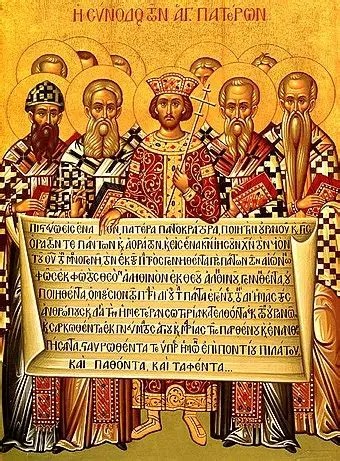
On this coming Sunday of the Holy Trinity, it is customary to elevate the ecumenical creeds[1] subscribed to by the Roman Catholic and Orthodox communities as well as by most protestants. Our American Churches, even the liturgical ones, are often ambivalent about creeds. There is something deeply anti American about expecting individuals to subordinate their individual beliefs and convictions to a communal statement of belief. Individualism and the jealous protection of individual freedoms runs deep among us. One church I visited during my teenage years proudly proclaimed on its marque that it had “no creed but the Bible.” Once inside, however, I was given a worship bulletin with a list of bullet points on the front cover stating, among other things, that the church held the Bible to be verbally inspired, forbade women to teach or serve as elders and insisted that intimate sexual relations were forbidden outside of marriage. One wonders why, if the Bible is sufficient, the congregation found it necessary to articulate these positions that were obviously important to it.
It seems that if we are going to live in intentional community, there is no getting around creeds of some sort. To be fair, I have also encountered progressive protestant churches that avoid the use of the creeds in the spirit of being inclusive. Yet I have no doubt that there are beliefs and behaviors, the expression of which, could result in excommunication-though I doubt these churches would use such arcane ecclesiastical language to describe it. Every community, religious or otherwise, has core beliefs and norms governing its day to day life. That being the case, I believe it is best to be aware of and honest about what those beliefs and norms are. In short, I like churches that keep their creeds out in the open where I can see them.
The biblical cannon we have today consists in large part of texts interpreting and re-interpreting prior texts as well as songs, stories and liturgies from oral tradition predating the written word. As the diverse array of protestant sects amply demonstrates, the biblical interpretation has given rise to numerous conflicting and sometimes bizarre forms of religion. Each claims the Bible as the source of its faith and life. Fundamentalism, a term now applied more broadly to a wide variety of religious movements, was coined in 1920 to describe conservative Evangelical Protestants who supported the principles expounded in The Fundamentals: A Testimony to the Truth, a collection of 90 essays published between 1910 and 1915, designed to affirm the core doctrines of Christianity. These consisted in the main of 1) the inerrancy and inspiration of the Bible; 2) the deity of Jesus Christ; 3) the virgin birth of Jesus; 4) the substitutionary atonement; and 5) the resurrection and second coming of Christ. These fundamentals, defined with a strict literalism hard to reconcile with the science of the 19th century so many evangelicals viewed as a threat to Christianity, were deemed the “fundamentals” and amounted to a de facto creed.
The truth is, we are all fundamentalists in the sense that there are convictions we hold to be fundamental to who we are and what we live for. Though we Americans are loath to admit it, we do not come upon these fundamentals autonomously. For better or worse, we are influenced by our upbringing, our education, our peers, our life experiences and by the media through which we view the world at large. When I worked as an intern at a church in Brooklyn, I never understood why several members of the church urged me not to take the subway until I saw the local paper they read on a daily basis. That publication featured crime stories almost exclusively, many of which took place in the subway. Of course, millions of people ride the subway every day and have done so all their lives without encountering any danger. But if your window into the outside world is skewed toward the violent exception, your view of the whole is bound to be distorted. Your fundamental beliefs about your city and your neighbors are similarly influenced.
We cannot escape being shaped and influenced by the world around us. But we do have some choice over the communities to which belong, the individuals with whom we associate and the literature and media through which we view the larger world. The church is the people who associate with Jesus. We are shaped, many of us from childhood, by teaching, hymns, liturgy and preaching through which the mind of Christ is formed in us. The creeds are a central part of that process. As I have said before, the creeds need to be recited liturgically and understood as God’s lyrical narrative. They tell the story of a God who, though fully blessed in love within God’s triune self, nevertheless made room for something other than God to be. By speaking the words, “Let there be,” God made room for a universe to explode into being. God’s’ love for that universe was so deep, so passionate and so enduring that God fused God’s self with the flesh of God’s human creatures and remains incarnate despite our cruel rejection. God’s fleshly existence in the midst of the world God made and loves continues in the community of people God’s Spirit calls together to witness, serve and testify to that love. Love, as the glue cementing the Trinity, pre-existed the universe and continues to hold it together against all that would rip it apart. These creedal fundamentals are the ones by which I long to be formed.
It matters what you believe about God. I don’t have to tell you that there is plenty of religion out there, much of it nominally Christian, that proclaims a very different sort of god than we meet in the creeds. The crackpot Christianity of nationalists like Pete Hegseth who insists that God is at work in the weapons of death rained by the United States and Israel upon civilian populations is but one example. There are plenty more that come out regularly in the tragic stories of people who have been grievously injured by the teachings and practices of churches who worship an angry god who hates what he has made and seems to love his precious commandments more than the people they are supposed to serve and protect. Toxic religion built on a depraved understanding of who God is and what God desires kills. It is important, therefore, that we be crystal clear about the nature of the God we worship and God’s gracious purpose for the cosmos conceived and birthed in God’s trinitarian heart.
Here is a poem by Haki R. Madhubuti who makes a conscious choice about what he will be shaped and influenced. He reflects the spirit in which I believe one ought to approach the scriptures, liturgy, preaching and, yes, the creeds.
So Many Books, So Little Time
(For independent booksellers & librarians, especially Nichelle Hayes)
Frequently during my mornings of pain & reflection
when I can’t write
or articulate my thoughts
or locate the mindmusic needed
to complete the poems & essays
that are weeks plus days overdue
forcing me to stop, I cease
answering my phone, eating right, running my miles,
reading my mail, and making love.
(Also, this is when my children do not seek me out
because I do not seek them out.)
I escape north, to the nearest library or used bookstore.
They are my retreats, my quiet energy-givers, my intellectual refuge.
For me it is not bluewater beaches, theme parks,
or silent chapels hidden among forest greens.
Not multi-stored American malls, corporate book
supermarkets, mountain trails, or Caribbean hideaways.
My sanctuaries are liberated lighthouses of shelved books,
featuring forgotten poets, unread anthropologists of tenure-
seeking assistant professors, self-published geniuses, remaindered
first novelists, highlighting speed-written bestsellers,
wise historians & theologians, nobel, pulitzer prize, and american book
award winners, poets & fiction writers, overcertain political commentators,
small press wunderkinds & learned academics.
All are vitamins for my slow brain & sidetracked spirit in this
winter of creating.
I do not believe in smiling politicians, AMA doctors,
zebra-faced bankers, red-jacketed real estate or automobile
salespeople, or singing preachers.
I believe in books.
It can be conveniently argued that knowledge,
not that which is condensed or computer packaged, but
pages of hard-fought words, dancing language
meticulously & contemplatively written by the likes of me & others,
shelved imperfectly at the level of open hearts & minds,
is preventive medicine strengthening me for the return to my
clear pages of incomplete ideas to be reworked, revised &
written as new worlds and words in all of their subjective
configurations to eventually be processed into books that
will hopefully be placed on the shelves of libraries, bookstores, homes,
& other sanctuaries of learning to be found & browsed over by receptive
booklovers, readers & writers looking for a retreat,
looking for departure & yes spaces,
looking for open heart surgery without the knife.
Source: Poetry (April 2023). Haki R. Madhubuti (born Don Luther Lee in 1942) is an African-American author, educator and poet. He is also well known as the publisher and operator of a black-themed bookstore. Madhubuti was instrumental in the founding of Third World Press, the oldest independent black publishing house in the United States. He has published twenty-eight books and co-edited two volumes of literary works. Madhubuti has received the Distinguished Writers Award and the American Book Award. He has been honored by the Middle Atlantic Writers Association, African-American Arts Alliance and awarded fellowships from the National Endowment for the Arts and the National Endowment for the Humanities. You can read more about Haki Madhubuti and sample more of his poetry at the Poetry Foundation website.
[1] These include the Apostles Creed, the Nicene Creed and the Athanasian Creed, though it is debatable whether the last of these three should be considered truly ecumenical. The Athanasian Creed is product of the western church written in Latin rather than Greek and has never been given creedal status by the Orthodox churches. It also includes numerous anathemas which are problematic to say the least. Thus, I would prefer to see it given the status of a document that is informative but not deemed creedal.


I WRITE books. About people, love relationships, integrity, deceit, and betrayal for a higher purpose. Pride’s Children: PURGATORY, NETHERWORLD, and LIMBO (under construction) tells the story of a writer who discovers she’s not dead yet, the rising Irish movie actor of his generation, and America’s Sweetheart – who has plans.
Let me know if you’d like an ARC of the first two: religion is a big theme – and what it asks of those who listen.
LikeLike