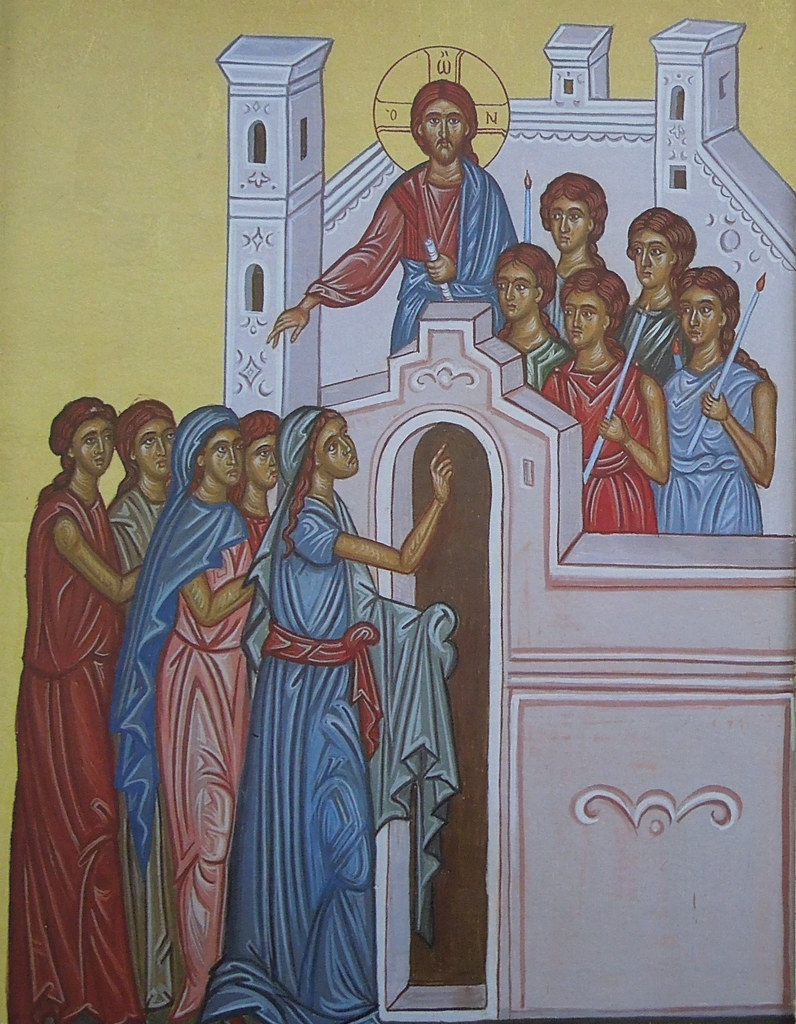
TWENTY-FIFTH SUNDAY AFTER PENTECOST
Prayer of the Day: Righteous God, our merciful master, you own the earth and all its peoples, and you give us all that we have. Inspire us to serve you with justice and wisdom, and prepare us for the joy of the day of your coming, through Jesus Christ, our Savior and Lord.
“For God has destined us not for wrath but for obtaining salvation through our Lord Jesus Christ, who died for us, so that whether we are awake or asleep we may live with him. Therefore encourage one another and build up each other, as indeed you are doing.” I Thessalonians 5:9-11.
In Marilynne Robinson’s Pulitzer Prize winning novel, Gilead, John Ames, an ill an aged pastor pours out in his diary the matters he knows he will never be able to share with the nine year old son of his old age. In one particular entry, he relates a conversation growing out of a question posed by Jack Boughton, the ne’er‑do‑well son of his friend and colleague and fellow pastor. “So, Reverend,” says Jack, “I would like to hear your views on the doctrine of predestination.” What follows is an awkward verbal game of ‘cat and mouse’ in which Ames does his best to uphold the tenants of his Calvinist heritage while articulating the primacy of God’s grace:
“….certain attributes of our faith assigns to God omniscience, omnipotence, justice and grace. We human beings have such a slight acquaintance with power and knowledge, so little conception of justice, and so slight capacity for grace, that the workings of these great attributes together is a mystery we cannot hope to penetrate.”
[Jack] laughed. “You say it in those very words.”
“Yes, I do. More or less those very words. It’s a fraught question, and I’m careful with it.”
He nodded. “I take you to mean that you do believe in predestination.”
“I dislike that word. It’s been put to crude uses.”
“Can you propose a better word?”
“Not offhand.”
“I would like your help, Reverend,” he said, so seriously that I began to think he might be serious. “This is a grave issue, isn’t it? We’re not really dealing here with a mere word, a mere abstraction.”
“You’re right,” I said. “That’s true.”
“I assume predestination does not, in your understanding, mean that a good person will go to hell simply because he was consigned to hell from the beginning….I’m an amateur here. I suppose if I had your history with the question I’d sick of it too. Well, actually I believe I do have a history with it. I have had reason to wonder fairly often about it. I hoped you would instruct me a little.”
Upon further reading, we discover that Jack, though an unbeliever, is nevertheless plagued by the suspicion that his character might be irredeemably corrupt. He wonders whether there are people “who are simply born evil” and so “live evil lives.” Ames continues attempting to affirm the ancient doctrine while salvaging a degree of human agency. Finally, in exasperation, Jack remarks, “For a man of the cloth, you’re pretty cagey.”[1]
The doctrine of predestination has engaged the minds of great theologians from Augustine to Karl Barth. Martin Luther famously championed the doctrine against the theologian and scholar, Desiderius Erasmus in his Bondage of the Will. Disputes over predestination constituted a principal cause of schism between the Lutheran Church-Missouri Synod and other Lutheran bodies in the United States during the nineteenth century. As recently as forty five years ago, it was a hot topic of debate on the pages of the campus newspaper at my alma Mator, Luther Seminary in St. Paul, Minnesota. We seem always to be left with the same dilemma: Hold firm to predestination so as to preserve the sole agency of God’s grace in working salvation and sanctification in the believer or reject the doctrine and leave the final determinative factor to human will, effort and decision. A binary choice for either position against the other has the potential for creating doubt and uncertainty. Consequently, we try to have the best of both worlds and come out sounding, well, “cagey.”
I do not pretend to have thoroughly resolved this issue, but I think there are some observations to be made that might lead us to a better place. I think it is important to point out that, while the term “predestined” is scriptural, the terms “omniscient,” “omnipotent” and “omnipresent” are not. The last three words are metaphysical concepts foreign to the scriptural writers. They do not fit well into the biblical narratives where we find events and human activities running contrary to God’s desires and where we witness God changing God’s mind, lamenting the actions of God’s creatures and responding to a world in constant motion. Perhaps it is possible to speak of God as omniscient, omnipotent and omnipresent from the perspective of eternity. But as soon as God spoke the words, “Let there be,” God made space for something other than God. God made something that, like God, could create, decide and move in directions even God could not have predicted.
God’s act of creation was in some ways like one’s decision to become a parent. Bringing a child into one’s life results in a loss of autonomy, the assumption of responsibilities and a change of lifestyle. It also introduces the potential both for unimaginable delight and inexplicable pain. Pride, disappointment, anxiety, satisfaction and perhaps even an occasional bit of regret go with entering into parenthood. So, too, for God. God delights in God’s creation, takes joy in the earth and its creatures and loves it enough to put God’s own “skin in the game,” so to speak. God is likewise deeply wounded by the injury done to creation by its human creatures and the brokenness of that one creature capable of bearing God’s image. God might have regained the “omnis” by erasing creation, but God rejected that temptation following the great flood narrated in Genesis. This is the context, I think, in which we can rightly understand the biblical meaning of predestination. God has destined God’s creation for redemption and perfection. God is determined not to let anything, even humanity’s rejection of God’s intent, to stand in the way of that goal.
I think also that Rev. John Ames’ difficulty was in part due to his understanding of God’s redemptive activity as a matter of individual human salvation. John 3:16 does not say that God so loved the church or that God so loved Christians or that God so loved religious people or that God so loved good people or that God so loved humans exclusively that God sent the only Son. John’s gospel tells us that Jesus was sent for the salvation of the entire cosmos. The church is not a lifeboat rescuing a select group of human souls from a sinking ship. It is a community living aboard this spaceship earth witnessing in word and deed, however imperfectly, to God’s love for this ship with all of its inhabitants and God’s promise to bring it finally into the harbor of a new heaven and earth. God takes no delight in the punishment of the wicked but desires the redemption of all. No one is predestined for eternal punishment.
So are all destined to be saved? I think it is probably as presumptuous to assume the salvation of all as it is to dogmatically insist on the damnation of some. Is it possible that a person can become so thoroughly twisted and distorted with evil that the image of God is altogether lost such that one’s Maker can only say, “I never knew you. Depart from me.”? As Jesus raises this possibility, we would be foolish to dismiss it. Nevertheless, that is a call none of us mortals are competent to make. As far as we are concerned, all people are neighbors to be loved and cared for. That goes even, perhaps especially, for those who we view or who view us as enemies. From our perspective, they are and must always remain persons who, like us, are predestined for salvation.
Human life is a mixture of the predestined and the contingent. Much is, in fact, predestined. We do not choose the timing, location, ethnic group, class, gender or family into which we are born. We do not choose the factors in our genetic makeup that can influence our health, capabilities and length of life. Yet within these predetermined parameters there remains a wide range of possibilities for independent agency. The decisions we make within the limited scope of our freedom matter. They can influence profoundly our own lives, the lives of others around us and, in some cases, the course of history. Beyond that, there is in all of these transactions what I like to call a “God factor.” The Word that at the dawn of time said, “Let there be,” the Word that became flesh and still dwells among us, that Word still holds creation together against the powers of evil that would rip it apart. The Spirit of God which at the beginning of creation moved the primordial waters from chaos to harmony still blows over the face of the earth to thaw hardened hearts, work reconciliation and inspire hope. God’s parental providence continues to move all creation toward a new heaven and earth on which God will be “all in all.”
Here is a poem by Robert Frost exploring the complex relationship between fate and free agency.
The Trial by Existence
Even the bravest that are slain
Shall not dissemble their surprise
On waking to find valor reign,
Even as on earth, in paradise;
And where they sought without the sword
Wide fields of asphodel fore’er,
To find that the utmost reward
Of daring should be still to dare.
The light of heaven falls whole and white
And is not shattered into dyes,
The light for ever is morning light;
The hills are verdured pasture-wise;
The angel hosts with freshness go,
And seek with laughter what to brave; —
And binding all is the hushed snow
Of the far-distant breaking wave.
And from a cliff-top is proclaimed
The gathering of the souls for birth,
The trial by existence named,
The obscuration upon earth.
And the slant spirits trooping by
In streams and cross- and counter-streams
Can but give ear to that sweet cry
For its suggestion of what dreams!
And the more loitering are turned
To view once more the sacrifice
Of those who for some good discerned
Will gladly give up paradise.
And a white shimmering concourse rolls
Toward the throne to witness there
The speeding of devoted souls
Which God makes his especial care.
And none are taken but who will,
Having first heard the life read out
That opens earthward, good and ill,
Beyond the shadow of a doubt;
And very beautifully God limns,
And tenderly, life’s little dream,
But naught extenuates or dims,
Setting the thing that is supreme.
Nor is there wanting in the press
Some spirit to stand simply forth,
Heroic in its nakedness,
Against the uttermost of earth.
The tale of earth’s unhonored things
Sounds nobler there than ’neath the sun;
And the mind whirls and the heart sings,
And a shout greets the daring one.
But always God speaks at the end:
’One thought in agony of strife
The bravest would have by for friend,
The memory that he chose the life;
But the pure fate to which you go
Admits no memory of choice,
Or the woe were not earthly woe
To which you give the assenting voice.’
And so the choice must be again,
But the last choice is still the same;
And the awe passes wonder then,
And a hush falls for all acclaim.
And God has taken a flower of gold
And broken it, and used therefrom
The mystic link to bind and hold
Spirit to matter till death come.
‘Tis of the essence of life here,
Though we choose greatly, still to lack
The lasting memory at all clear,
That life has for us on the wrack
Nothing but what we somehow chose;
Thus are we wholly stripped of pride
In the pain that has but one close,
Bearing it crushed and mystified.
Source: The Poetry of Robert Frost, (c. 1969 by Holt, Rinehart and Winston, Inc.) pp.19-23. Robert Frost (1874-1963) was born in San Francisco but moved following his father’s death to Lawrence, Massachusetts. Frost held various jobs throughout his college years. He was a worker at a Massachusetts mill, a cobbler, an editor of a small town newspaper, a schoolteacher and a farmer. By 1915, Frost’s literary acclaim was firmly established. On his seventy-fifth birthday, the U.S. Senate passed a resolution in his honor. The State of Vermont named a mountain after him and he was given the unprecedented honor of being asked to read a poem at the inauguration of John F. Kennedy in 1961. Through the lens of rural life in New England, Frost’s poetry ponders the metaphysical depths. His poems paint lyrical portraits of natural beauty, though ever haunted by shadow and decay. You can learn more about Robert Frost and sample more of his poetry at the Poetry Foundation website.
[1] Robinson, Marilynne, Gilead (c. 2004 by Marilynne Robinson; pub. by Farrar, Straus and Giroux) pp. 149-151.