ALL SAINTS SUNDAY
Prayer of the Day: Almighty God, you have knit your people together in one communion in the mystical body of your Son, Jesus Christ our Lord. Grant us grace to follow your blessed saints in lives of faith and commitment, and to know the inexpressible joys you have prepared for those who love you, through Jesus Christ, our Savior and Lord, who lives and reigns with you and the Holy Spirit, one God, now and forever.
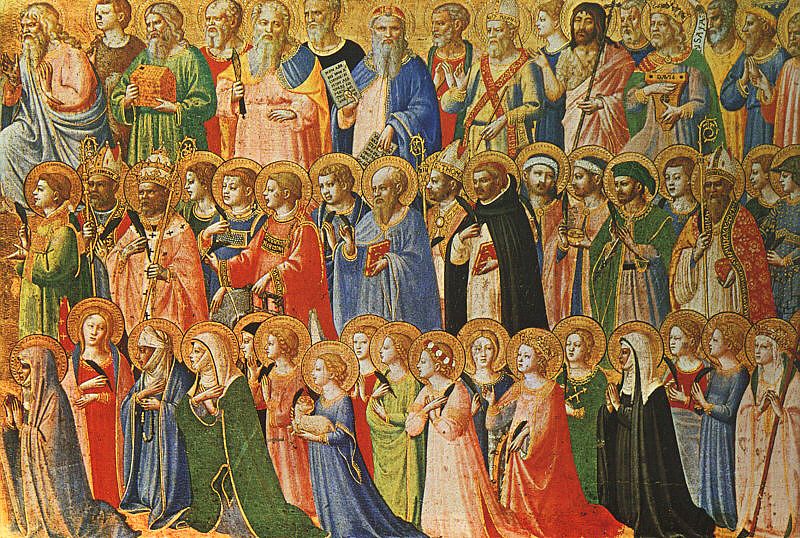
“After this I looked, and there was a great multitude that no one could count, from every nation, from all tribes and peoples and languages, standing before the throne and before the Lamb, robed in white, with palm branches in their hands.” Revelation 7:9.
“We believe in one holy catholic and apostolic church.” Nicene Creed, Third Article.
“‘why is it we only take people from shithole countries,’ right? Why can’t we have some people from Norway, Sweden — just a few — let us have a few, from Denmark. Do you mind sending us a few people? Send us some nice people, do you mind? But we always take people from Somalia, places that are a disaster, right? Filthy, dirty, disgusting, ridden with crime.” Donald J. Trump, President of the United States.
Heresy is a dirty word among us so-called progressive American protestants. Shaped as we are by extreme individualism and postmodern skepticism, we are loath to suggest or even imply that the values of inclusiveness and diversity know any limits. In common parlance these days, it is not unusual to hear people speak of “their truth,” as though truth were little more than a personal opinion. While such jargon might appear at first blush as open minded and accepting, it is actually nothing of the kind. Unbridled skepticism finally leads into the world of conspiracy theories, junk science and “alternative facts.” An open mind without filters is like a drain without strainer. It is bound eventually to become so thoroughly clogged with gunk that nothing can get through any longer. Rejecting falsehood is merely the flipside of acknowledging the truth.
As our friend Augustine of Hippo reminds us, truth is objective and eternal. Though it may be found in human philosophy, science or literature, all truth finally belongs to God. No human being or religious community (the church included) can claim to know and understand all truth fully and completely, anymore than they can claim to know God fully and completely. It does not follow, however, that nothing of the truth can be known or that all truth claims are relative. We confess that, as good creatures of God living in God’s good creation, our senses by which we perceive the world and our minds with which we contemplate it are reliable receptors of what is true, beautiful and good.
Of course, our perceptions of truth are not infallible. In science, history, philosophy, politics and all other fields of human endeavor, we continue to discover that the conclusions we thought were well founded are actually incomplete or altogether inaccurate. The same is true for the church. Assumptions held for centuries about the nature of the cosmos, human physiology and psychology have been shown to be false. Our understanding of the scriptures, their message and application have grown and changed over the years in response to the truth we have learned from other sources. Heresy, though usually associated with novel teachings, has just as often manifested as a once traditional belief held with tenacity long after it has proven to be misleading and inconsistent with Jesus and the reign of God he proclaims. Therefore, our search for truth must always be undertaken with openness, humility and a readiness to be surprised.
Not every disagreement within the church suggests the presence of heresy. Different Christian traditions differ in their understandings of ministry, the sacraments and doctrine. While important and worthy of serious discussion and debate, these disagreements do not amount to heresy. So, too, believers may disagree over how faithfully to address important societal issues without rupturing the unity, holiness or apostolic authority of the church. Nevertheless, there are truths we confess that are not negotiable. One of these is the biblical and creedal confession of the unity of the human family. Paul’s assertion in his speech to the Athenians that “[f]rom one ancestor [God] made all peoples to inhabit the whole earth” (Acts 17:26) is grounded in the Genesis creation accounts. It is affirmed in God’s promise to make of Abram a nation of blessing (not privilege) to all peoples. Genesis 12:1-3. That God’s reign is intended for the whole human family in all of its diversity is affirmed by the prophet Isaiah. Isaiah 49:6. It is illustrated in our lesson from Revelation in which John of Patmos sees in a vision the consummation of God’s reign in the Holy City embracing peoples of every nation, tribe and tongue.
The City of God, according to Augustine, consists of all human and celestial beings united in their love for God and their seeking to glorify Him. To be a disciple of Jesus is to owe one’s ultimate allegiance to that city and to the one holy, catholic and apostolic church, the existence of which testifies, however imperfectly, to the inbreaking of that reign into human history. Nationalism, whether “Christian” or otherwise, is therefore heresy. The words “America first” can never be on the lips of a disciple. Obedience to any form of human government or any governmental leader can never rise higher than Jesus’ command to love all our neighbors, including those declared enemies of the state. Faith that puts nation, blood or soil above the welfare of any other people; religion that permits humanly drawn borders or boundaries to separate ourselves from any of our human siblings; doctrine that sanctifies segregation, justifies inequality and promotes exclusiveness is heretical. All Saints Sunday affords preachers the opportunity to remind us once again that God’s redemptive intent for creation embraces the whole human family.
Here is a poem by Berthod Brecht speaking of the unity of the human family and issuing a call to solidarity echoing the biblical witness to that unity.
All of us or none
Slave, who is it that shall free you?
Those in deepest darkness lying.
Comrade, only these can see you
Only they can hear you crying.
Comrade, only slaves can free you.
Everything or nothing. All of us or none.
One alone his lot can’t better.
Either gun or fetter.
Everything or nothing. All of us or none.
You who hunger, who shall feed you?
If it’s bread you would be carving,
Come to us, we too are starving.
Come to us and let us lead you.
Only hungry men can feed you.
Everything or nothing. All of us or none.
One alone his lot can’t better.
Either gun or fetter.
Everything or nothing. All of us or none.
Beaten man, who shall avenge you?
You, on whom the blows are falling,
Hear your wounded brothers calling.
Weakness gives us strength to lend you.
Come to us, we shall avenge you.
Everything or nothing. All of us or none.
One alone his lot can’t better.
Either gun or fetter.
Everything or nothing. All of us or none.
Who, oh wretched one, shall dare it?
He who can no longer bear it.
Counts the blows that arm his spirit.
Taught the time by need and sorrow,
Strikes today and not tomorrow.
Everything or nothing. All of us or none.
One alone his lot can’t better.
Either gun or fetter.
Everything or nothing. All of us or none.
Eugen Berthold Friedrich Brecht (1898-1956) was a German theatre practitioner, playwright, and poet. He grew up during the Weimar Republic and had his first successes as a playwright in Munich. In 1924 he moved to Berlin where he wrote The Threepenny Opera with Elisabeth Hauptmann and Kurt Weill. There he also began a lifelong collaboration with the composer Hanns Eisler. Immersed in Marxist thought during this period, Brecht became a leading theoretician of epic theatre.
When the Nazis came to power in Germany in 1933, Brecht fled to Scandinavia. During World War II he moved to Southern California. There he established himself as a screenwriter while being surveilled by the FBI. In 1947, he was part of the first group of Hollywood film artists to be subpoenaed by the House Un-American Activities Committee for alleged Communist Party affiliations. The day after testifying, he returned to Europe, eventually settling in East Berlin. There he co-founded the theatre company Berliner Ensemble with his wife and long-time collaborator, actress Helene Weigel. You can read more about Berthod Brecht and sample more of his poetry at the Poetry Foundation website.

