SEVENTEENTH SUNDAY AFTER PENTECOST
Prayer of the Day: Almighty and eternal God, you show perpetual lovingkindness to us your servants. Because we cannot rely on our own abilities, grant us your merciful judgment, and train us to embody the generosity of your Son, Jesus Christ, our Savior and Lord.
Jesus’ parable of the workers in the vineyard is, like so many of the parables in Matthew’s gospel, highly improbable. The description of the workers waiting to be hired is true enough to fact. The life of a day laborer was a brutal one of day to day survival. Work was never guaranteed and depended upon seasonal fluctuation, the success of the growing season and the labor market. Landowners would naturally hire early in the day so as to get the most out of their workers and select the people that appeared healthy, strong and fit for work. The rest would be left to hope that perhaps a landowner might have underestimated the need for labor and return to hire a few more hands. Persons so hired could hardly expect to receive a day’s wage for less than a day’s work. But even half a day’s wage or less is better than nothing.
Remarkably, the landowner in Jesus’ parable does the unthinkable. Not only does he pay the wages of the late comers first, but he also pays then a full day’s wage. Most sermons I have heard (and preached!) on this text focus on grace, and that specifically for the individuals involved. As a dyed in the wool Lutheran, I have always heard this text as an echo of Saint Paul’s assurance that we are recipients of God’s redemptive love not on the basis of our works, but solely by virtue of God’s free grace. As Jesus points out in the Sermon on the Mount, God causes the sun to shine and the rain to fall upon the righteous and the wicked. Matthew 5:45. Each of the workers in the vineyard received a day’s wage, but only those who recognized it as grace could rightly receive and appreciate it. While that message is surely consistent with Jesus’ proclamation, I am not convinced that it captures exactly what the parable is all about.
Note well that Jesus’ parable begins with these words: “For the kingdom of heaven is like…” Thus, the parable is not about the landowner or any of the laborers. It is about the reign of God and, more specifically, the economy of that just and gentle reign. To understand this analysis, it is important to recall that the word, “economy” comes from the Greek word “οἶκος.” Broadly speaking, the meaning of the word encompasses a physical dwelling place, the people living in it, and by extension, a family or lineage. In classical Greek, οἶκος could denote the entire household establishment, including property, servants, and family members. See A Greek-English Lexicon of the New Testament and Other Early Christian Literature, Edited by W.F. Arndt and F.W. Gingrich (c. 1957 by University of
Chicago Press) pp 562-563. The New Testament frequently speaks of the church as the οἶκος of God I Timothy 3:15; I Peter 2:5. The heads of the household were thus tasked with ensuring the wellbeing of all members of the household. Only so can the household continue functioning as a home and sanctuary for all. The household of faith takes concrete form in the Book of Acts where we read:
“Now the whole group of those who believed were of one heart and soul, and no one claimed private ownership of any possessions, but everything they owned was held in common. With great power the apostles gave their testimony to the resurrection of the Lord Jesus, and great grace was upon them all. There was not a needy person among them, for as many as owned lands or houses sold them and brought the proceeds of what was sold. They laid it at the apostles’ feet, and it was distributed to each as any had need.” Acts 4:32-35.
The church, as first fruits of God’s desire for the whole world, testifies in its practices to what economies should look like. Economic arrangements are to function as households in which goods are employed not for the personal enrichment of any individual, but for the wellbeing of all members. Of course, the practices of the church in Acts are hardly unique within the scriptural witness. Moses instructs the people of Israel as they are about to enter the land of promise, “there shall be no poor among you.” Deuteronomy 15:4. The reason for this being that “If there is among you anyone in need, a member of your community in any of your towns within the land that the Lord your God is giving you, do not be hard-hearted or tight-fisted toward your needy neighbor. You should rather open your hand, willingly lending enough to meet the need, whatever it may be.” Deuteronomy 15:7-8. In so doing, Israel would become a light of economic justice to a world of nations whose economies benefited emperors and kings though exploitation of the rest and ignored the weakest, poorest and most vulnerable in the land.
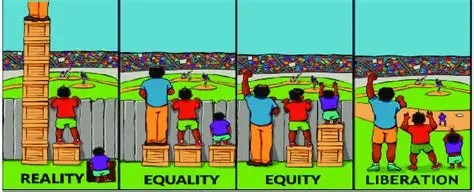
These scriptures generally, and our gospel lesson in particular, challenge us to think differently about economic issues. Rather than asking how we can provide a “safety net” for the poor, we ought to be asking why we have poor among us at all. Rather than regarding those we deem physically or mentally “disabled” as social problems to be solved, we should be asking why our society is so narrowminded, unimaginative and heard hearted that it cannot see these same people as uniquely gifted with much that we need to become a wise, compassionate and sustainable people. Our colleges and universities ought not to be obsessed with turning out students with skills necessary to serve the economic machinery of the wealthy, but rather with shaping the character, ethics and understanding of their students, enabling them to build an economy that serves all people.
In her triumphant song of praise, Mary the Mother of our Lord declares that God “has filled the hungry with good things and sent the rich away empty.” Luke 1:53. That does not necessarily mean that the rich will starve. The laborers in Jesus’ parable who worked a full day received a full day’s wage. That is all one is promised. Jesus taught us to pray for our daily bread, something which God provides and which the faithful receive with thanksgiving. But those for whom daily bread is not enough, who are accustomed to privilege and have developed a sense of entitlement to more than daily bread, for such people daily bread alone leaves them feeling “empty.” They grumble, “I deserve more than this!” “I worked hard for what I make,” “Nobody has the right to what I produced with my own hands,” “I should be able to do whatever I want with what belongs to me.” They complain that generosity like that expressed by the landowner in the parable is “unfair.” For the rich, the powerful and the privileged, the promise of daily bread sounds like a curse rather than a blessing.
In sum, Jesus’ parable gives us a glimpse of the economy God desires for all creation. It is an economy of service, not exploitation. It is an economy that is shaped to embrace all people, not an economy into which people must be shaped in order to survive. It is an economy that provides for the need of all people, not the greed of the few. And in these days in which the powers of government are falling ever more into the hands of oligarch billionaires, the need for a strong witness to the economy of Jesus has never been more necessary.
Here is a poem by Vachel Lindsay calling out for the kind of economy envisioned in Jesus’ parable.
Why I Voted the Socialist Ticket
I am unjust, but I can strive for justice.
My life’s unkind, but I can vote for kindness.
I, the unloving, say life should be lovely.
I, that am blind, cry out against my blindness.
Man is a curious brute—he pets his fancies—
Fighting mankind, to win sweet luxury.
So he will be, though law be clear as crystal,
Tho’ all men plan to live in harmony.
Come, let us vote against our human nature,
Crying to God in all the polling places
To heal our everlasting sinfulness
And make us sages with transfigured faces.
Source: Collected Poems of Vachel Lindsay (c. 2005 by Vachel Lindsay; pub. by Kessinger). Vachel Lindsay (1879 –1931) was an American poet. He was born in Springfield, Illinois to a medical doctor of considerable financial means. With the encouragement of his parents, Lindsay studied medicine at Ohio’s Hiram College from 1897 to 1900. He soon discovered, however, that he did not want to be a doctor and so left Hiram for Chicago to study at the Art Institute of Chicago from 1900 to 1903. In 1904, he left to attend the New York School of Art (now The New School) to study pen and ink. Lindsay remained interested in art for the rest of his life, drawing illustrations for some of his poetry. While in New York in 1905, Lindsay turned to poetry. He tried to sell his poems on the streets and took walking tours throughout the United States, attempting to trade his poems for food and shelter. On his return from one of these forays, Harriet Monroe, then editor of Poetry Magazine, published Lindsay’s poem, “General William Booth Enters into Heaven.” In the final twenty years of his life, Lindsay was one of the best known poets in the U.S. His reputation enabled him to befriend, encourage, and mentor other poets, such as Langston Hughes and Sara Teasdale. You can read more about Vachel Lindsay and sample more of his poetry at the Poetry Foundation website.

