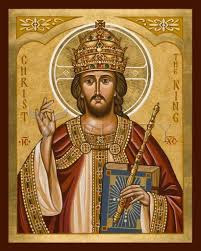
SUNDAY OF CHRIST THE KING
Prayer of the Day: O God of power and might, your Son shows us the way of service, and in him we inherit the riches of your grace. Give us the wisdom to know what is right and the strength to serve the world you have made, through Jesus Christ, our Savior and Lord, who lives and reigns with you and the Holy Spirit, one God, now and forever.
“When the Son of Man comes in his glory and all the angels with him, then he will sit on the throne of his glory. All the nations will be gathered before him, and he will separate people one from another as a shepherd separates the sheep from the goats….” Matthew 25:31-32.
So begins Jesus’ parable of the last judgment of the nations in which the righteous are separated from the wicked. It comes as no surprise that the nations are to be judged on the basis of how they treated the most vulnerable among them. Jesus has made clear that God’s preferential option is for these “least” among us. What should strike most of us American Christians as remarkable is all that is not included. Note well that the King does not criticize anyone for who they love, whether they have honored their purity pledges, whether they are divorced, remarried or simply cohabiting, how often they worship, where they worship or whether they worship, how patriotic they are, whether they have a criminal record, whether they are legal residents, whether they are gainfully employed or whether they have ever had an abortion.[1] None of that culture war crap is given so much as a nod. Furthermore, nobody is asked whether they have committed their lives to Jesus or subscribed to any religious doctrine or creed. The one and only question that matters here is whether they have treated with compassion the hungry, the thirsty, the naked, the sick, the stranger and the imprisoned. Empathy, compassion and active service to the oppressed, neglected and despise neighbor is God’s sole priority.
It is important to recognize that Jesus is giving us a parable here. I do not believe he is inviting us to draw any metaphysical conclusions from it. This parable is less about what will happen at the end of the world than it is about what is happening in the world here and now. Jesus tells us in no uncertain terms that everyone faces a stark choice between identifying with those at the margins of society or enjoying the privilege and benefits that come from serving the interests of the movers and shakers at its center. He leaves no doubt whatsoever about where God stands and what human activities and accomplishments matter from the standpoint of eternity.
The objective, then, is not to frighten people into doing the right thing. Though the parable is about the judgment of the nations, it is not directed to the nations. Jesus is speaking here to his disciples. To them it is “given to know the secrets of the kingdom of heaven.” Matthew 13:11. And that secret consists in knowing that “the first shall be last and the last shall be first.” The wall builders, the America firsters, masked goons in black SUVs terrorizing our brown and black skinned neighbors, billionaires living lives of luxury on the backs of the impoverished are not to be feared, admired or imitated. They are all on the wrong side of history. The Resurrection will prove decisively that God is on the side of the marginalized, that God stands against the exploitive powers of empire, however manifested, and that the service rendered in support of those deemed least among us will not be wasted. The parable is therefore not to be understood as a threat to the nations-though if the nations were paying attention, they might rightly feel threatened. It is rather a word of encouragement to the disciples of Jesus.
Encouragement is what disciples need. They will be sent to make communities of disciples under the shadow of an empire built upon the pillars of military power, slave labor and religious justification for all of this. The upside down reign of the God who favors persons at the bottom of Rome’s hierarchy put the church in direct conflict with its surrounding culture. The stark contrast between the values of the empire and the way of life to which Jesus called his disciples is spelled out in one of the earliest post New Testament writings, the Didache:
“There are two ways, one of life and one of death, and there is a great difference between the two ways. The way of life is this. First of all, thou shalt love the God that made thee; secondly, thy neighbor as thyself. And all things whatsoever thou wouldst not have befall thyself, neither do thou unto another. Now of these words the doctrine is this. Bless them that curse you, and pray for your enemies and fast for them that persecute you; for what thank is it, if ye love them that love you? Do not even the Gentiles the same? But do ye love them that hate you, and ye shall not have an enemy.”
The way of life described in the Didache, which simply echoes Jesus’ Sermon on the Mount, cannot be reconciled with Rome’s deification of the emperor and its insistence that the empire had been divinely established. It runs counter to the hierarchical structure of Rome placing all wealth, power and privilege among the few at the apex while subjecting the many at the base to poverty, oppression and slavery. The politics of God’s reign challenged the legitimacy of the empire and its claims to divine sanction. Small wonder, then, that it frequently ran afoul of the Roman authorities. Small wonder that the church was deemed an illegal entity. To be a disciple of Jesus was to be an illegal alien in a hostile land.
Disciples of Jesus in this time and place face the same challenge, namely, discerning the way of life from our culture’s false and death dealing values and ideologies of wealth, militarism, American exceptionalism, white supremacy, misogyny and capitalism. We are witnessing the greatest accumulation of wealth among the fewest individuals the world has ever seen even as the cost of living and, for some, survival is increasingly beyond the reach of more people each day. A deranged dictator builds monuments of gold to himself while the nation’s health care infrastructure disintegrates and lifesaving resources for the most vulnerable among us are defunded. Our circumstance is further complicated by the rise of a twisted and degenerate caricature of Christianity that justifies, sanctifies and blesses our American version of empire
The Sunday of Christ the King offers an opportunity to lift up, encourage and thank all those aligned with the reign of God, whether inside or outside of the church. We should be lifting up in prayer social workers, school counselors and addiction therapists whose funding has been cut and whose programs have been terminated. We need to be encouraging teachers working in depressed communities with overcrowded classrooms, outdated curriculum and that lack critical lab, athletic and library equipment. We need to be offering financial and other support to cash strapped churches offering food, clothing and emergency funding for families in crisis. We need to affirm and support the work of community organizers working to assist people in taking charge of and renewing their neighborhoods. All who engage in this good work, whether they realize it or not, serve the reign of God Jesus proclaims.
God knows it is easy enough to become discouraged by all that has transpired in our nation over the last decade. It often appears that our works of justice, mercy and peace are thimbles full of water thrown at a wildfire. That is why it is critical to remember that ours is not the task of establishing the reign of God. The church is called only to witness to it in word and deed, even when that witness does not appear to be accomplishing anything. As Martin Luther reminds us, God’s reign comes without any effort on our part. But God graciously invites us to take part in that coming. Jesus assures us that God’s reign is not a distant hope. In fact, it is no further away than the nearest hungry mouth.
Here is one of my favorite poems by Sonia Sanchez that I have shared previously. It speaks of the kind of struggle that aligns with God’s promised reign and sounds hauntingly similar to Jesus’s call to live under God’s reign in a world hostile to it.
Morning Song and Evening Walk
1.
Tonite in need of you
and God
I move imperfect
through this ancient city.
Quiet. No one hears
No one feels the tears
of multitudes.
The silence thickens
I have lost the shore
of your kind seasons
who will hear my voice
nasal against distinguished
actors
O I am tired
of voices without sound
I will rest on this ground
full of mass hymns.
2.
You have been here since I can remember Martin
from Selma to Montgomery from Watts to Chicago
from Nobel Peace Prize to Memphis, Tennessee.
Unmoved among the angles and corners
of aristocratic confusion.
It was a time to be born
forced forward a time
to wander inside drums
the good times with eyes like stars
and soldiers without medals or weapons
but honor, yes.
And you told us: the storm is rising against the
privileged minority of the earth, from which there is no
shelter in isolation or armament
and you told us: the storm will
not abate until a just distribution of the fruits of
the earth enables men (and women) everywhere to live
in dignity and human decency.
3.
All summerlong it has rained
and the water rises in our throats
and all that we sing is rumored
forgotten.
Whom shall we call when this song comes of age?
And they came into the city carrying their fastings
in their eyes and the young 9-year-old Sudanese
boy said, “I want something to eat at nite a
place to sleep.”
And they came into the city hands salivating guns,
and the young 9-year-old words snapped red
with vowels:
Mama mama Auntie auntie I dead I dead I deaddddd.
4.
In our city of lost alphabets
where only our eyes strengthen the children
you spoke like Peter like John
you fisherman of tongues
untangling our wings
you inaugurated iron for our masks
exiled no one with your touch
and we felt the thunder in your hands.
We are soldiers in the army
we have to fight, although we have to cry.
We have to hold up the freedom banners
we have to hold it up until we die.
And you said we must keep going and we became
small miracles, pushed the wind down, entered
the slow bloodstream of America
surrounded streets and “reconcentradas,” tuned
our legs against Olympic politicians elaborate cadavers
growing fat underneath western hats.
And we scraped the rust from old laws
went floor by floor window by window
and clean faces rose from the dust
became new brides and bridegrooms among change
men and women coming for their inheritance.
And you challenged us to catch up with our
own breaths to breathe in Latinos Asians Native Americans
Whites Blacks Gays Lesbians Muslims and Jews, to gather
up our rainbow-colored skins in peace and racial justice
as we try to answer your long-ago question: Is there
a nonviolent peacemaking army that can shut down
the Pentagon?
And you challenged us to breathe in Bernard Haring’s words:
the materialistic growth—mania for
more and more production and more
and more markets for selling unnecessary
and even damaging products is a
sin against the generation to come
what shall we leave to them:
rubbish, atomic weapons numerous
enough to make the earth
uninhabitable, a poisoned
atmosphere, polluted water?
5.
“Love in practice is a harsh and dreadful
thing compared to love in dreams,” said a Russian writer.
Now I know at great cost Martin that as we burn
something moves out of the flames
(call it spirit or apparition)
till no fire or body or ash remain
we breathe out and smell the world again
Aye-Aye-Aye Ayo-Ayo-Ayo Ayeee-Ayeee-Ayeee
Amen men men men Awoman woman woman woman
Men men men Woman woman woman
Men men Woman woman
Men Woman
Womanmen.
Source: Shake Loose My Skin: New and Selected Poems (Beacon Press, 1999) Sonia Sanchez (born Wilsonia Benita Driver in 1934) is an American poet, writer and professor. She is a leading figure in the Black Arts Movement. Sanchez has written several books of poetry. She has also authored short stories, critical essays, plays and children’s books. She received Pew Fellowship in the Arts in 1993. In 2001 she was awarded the Robert Frost Medal for her contributions to American poetry. You can read more about Sonia Sanchez and sample more of her poetry at the Poetry Foundation website.
[1] Yes, I do regard the unborn as among the least among us. I also regard women burdened with the moral stigma that goes with ending a pregnancy among that number. My pro-life sentiments (which is quite out of step with most folks claiming that title) are set forth in my article “A Pro-Life Manifesto.” Suffice to say, if you favor criminalizing abortion while you are against comprehensive sex education, easy access to birth control for all women and girls of child bearing age, no cost pre and post-natal care for women, nutritional support for unemployed and low income families and universal access to affordable healthcare, you are not pro-life. You are just a damn hypocrite.

