All posts by revolsen

Unknown's avatar

About revolsen

I am a retired Lutheran Pastor currently residing in Wellfleet, Massachusetts. I am married .and have three grown children.

President Trump’s Spiritual Advisor Calls upon Evangelicals to “Pray Donald Trump into Another Term”

Kierkegaard’s Ghost

(News that’s fake, but credible)

Today Rev. Paula White, spiritual advisor to President Donald Trump, called upon evangelicals to join together and “pray Donald Trump to victory” on January 6, 2021. On that day a joint session of Congress will certify President Elect, Joe Biden’s victory in the 2020 presidential election. A number of Republican senators and representatives have vowed to object to the certification of the electoral college vote in a last ditch effort to keep Trump in office for another term.

“The press and the Democrats say it’s a done deal,” said White. “But they don’t know the power of prayer.” Rev. White is calling upon believers everywhere to join in prayer throughout the day. “I want all born again believers in this country to get down on their knees, fold their hands, close their eyes and repeat again and again for as long as it takes:

“I do believe in Donald
I do, I do, I do!
I do believe in Donald
I do, I do, I do!
I do believe in Donald
I do, I do, I do!”

Rev. White insisted that the election is not legitimate “and I don’t give a hoot about what a bunch of pressies, liberals and eggheads say about the so-called facts.” She went on to say that, “there is too much emphasis on facts and truth these days. What we need is faith-strong faith, blind faith, unwavering faith. That’s why I’m calling on all the faithful to believe: believe, believe and believe.”

**************************************************************

FAKE NEWS ALERT: The above article is satirical. The events it describes didn’t happen.  “There are people who will say that this whole account is a lie, but a thing isn’t necessarily a lie even if it didn’t necessarily happen.” John Steinbeck

The Perils of Going Down into the Water

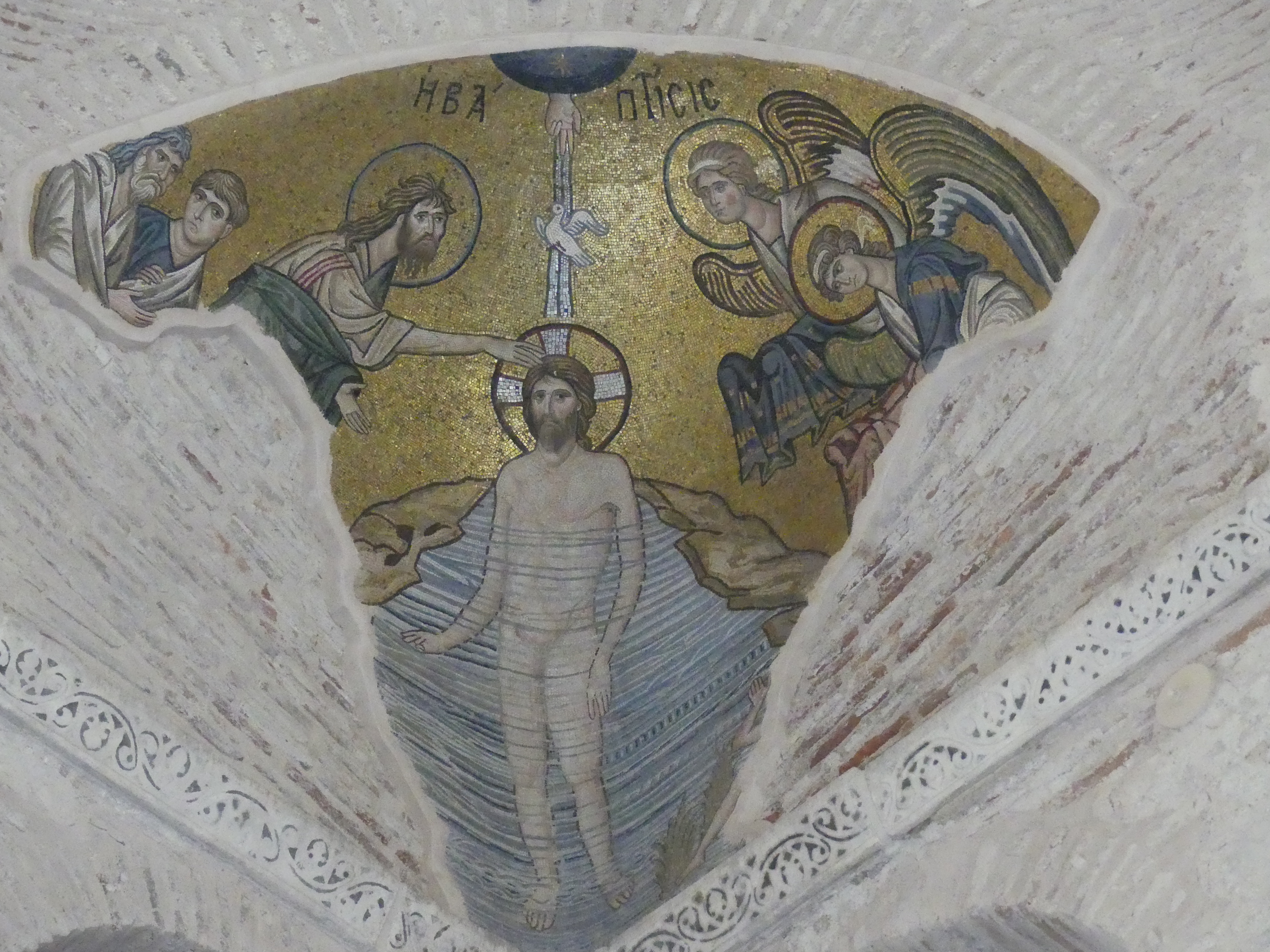
BAPTISM OF OUR LORD

Genesis 1:1-5
Psalm 29
Acts 19:1-7
Mark 1:4-11

Prayer of the Day: Holy God, creator of light and giver of goodness, your voice moves over the waters. Immerse us in your grace, and transform us by your Spirit, that we may follow after your Son, Jesus Christ, our Savior and Lord, who lives and reigns with you and the Holy Spirit, one God, now and forever.

“In the beginning when God created the heavens and the earth, the earth was a formless void and darkness covered the face of the deep, while a wind from God swept over the face of the waters.” Genesis 1:1-2.

Life had its primordial beginnings in the ocean. So evolutionary biologists tell us. The ancients knew this instinctively. There are countless legends recounting the earth’s creation arising out of epic battles in which divine heroes defeated great sea monsters, forming the land from the heart of the sea. So, too, the biblical account in our lesson from the Hebrew Scriptures has God’s breath sweeping over the waters, breathing into them what will soon yield light, land, fish, vegetation, animals and finally human beings in God’s own image.

Water is life. You can’t get away from that reality when you live in close proximity to the ocean. Every morning little boats leave our harbor here in Wellfleet seeking, fish, clams, scallops and the rest of the ocean’s bounty. Though the tourist industry is by far the biggest contributor to our economy, the fishing industry remains an important piece of our common livelihood. It has always been so. In centuries past, the marshes with their wealth of shellfish provided sustenance for the Nauset tribes inhabiting Cape Cod long before the coming of European settlers. Their culture and society revolved around the rhythms of the tide and the changing seasons bringing with them varieties of sea mammals and shore birds. They understood, as should we, that our very lives depend upon the waters.

But as necessary as water is to life, it is also an agent of death and destruction. You can appreciate the beauty of the ocean from the shore, but, as one mariner once told me, “if you venture out into the ocean, you better respect it.” The ocean bottom is littered with ships great and small caught in storms and wrecked on shoals. The ocean has claimed the life of many an experienced skipper who made but one dangerous miscalculation. The cemetery down the road from where I live contains the remains of some.  One of them was Elisha Higgins, Jr., son of Elisha and Rebecca Higgins. He died at sea in 1836. His epitaph reads:

“My body on the wreck was found
And now lies buried underground.
From the raging sea my spirit did fly
To reign with God above the sky.”

The biblical witnesses knew all too well the dangers of the ocean, the haunt of the great monster “Leviathan.” Psalm 104:25-26. The terror it held for Israel is reflected in the 107th Psalm:

Some went down to the sea in ships,
doing business on the mighty waters;
they saw the deeds of the Lord,
his wondrous works in the deep.
For he commanded and raised the stormy wind,
which lifted up the waves of the sea.
They mounted up to heaven, they went down to the depths;
their courage melted away in their calamity;
they reeled and staggered like drunkards,
and were at their wits’ end.
Then they cried to the Lord in their trouble,
and he brought them out from their distress;
he made the storm be still,
and the waves of the sea were hushed.
Then they were glad because they had quiet,
and he brought them to their desired haven.
Let them thank the Lord for his steadfast love,
for his wonderful works to humankind.
Let them extol him in the congregation of the people,
and praise him in the assembly of the elders. Psalm 107:23-32.

Again, we who live on the Cape are painfully aware of this reality.  The ocean is literally taking the ground from under our feet. Cape Cod is being eaten away by the ocean at an average rate of three feet per year-and that is without the aid of global warming. There are not a few summer homes and cottages, once a safe distance from the ocean’s edge, that are not long for this world-like the one pictured. The Cape is only about twenty-thousand years old. While that precedes all recorded human history, it constitutes a mere second in terms of geological time. Another ten thousand years and the land I am living on will be under the ocean.

So it should not surprise us that Jesus’ ministry begins with immersion in water, the bearer of both life and death. Just as the waters of the Jordan bringing life to the promised land should summon up the image of creation, so too we should hear in the words “this is my beloved son” an echo of words spoken to Abraham centuries before: “After these things God tested Abraham. He said to him, ‘Abraham!’ And he said, ‘Here I am.’ He said, ‘Take your son, your only son Isaac, whom you love, and go to the land of Moriah, and offer him there as a burnt-offering on one of the mountains that I shall show you.’” Genesis 22:1-2.

Without mincing words, the Sacrament of Baptism is a human sacrifice. It plunges us into the darkness of death. In it we place upon the altar a human life and tie it to the destiny of a man who poured out his own life proclaiming the reign of God under the shadow of an empire that ultimately crucified him. And among us Lutherans, that life most often belongs to an infant who has no more say in the matter than did poor Isaac. Let that sink in and think about how often you may have heard people say to their children, “I only want you to be happy.” Actually, I don’t believe I have ever said that to my children. Of course, I would prefer that they be happy rather than unhappy. But I want more for them than happiness. I want for them to be faithful disciples of Jesus. I want them to be good, compassionate and courageous. If the price of that is the loss of their happiness, so be it.

Reflecting on Jesus’ baptism, as well as our own, is a good way to begin the secular new year. A good plunge into the waters of life and death might be exactly what we need. It could be a long time before limitations on the accoutrements of happiness imposed by the Covid-19 pandemic are lifted. But opportunities for doing justice, exercising compassion and caring for our neighbors abound. Those of us engaged in this good work often discover that the rewards of friendship and community, whether cultivated within our households, built from behind masks at a socially safe distance or developed in cyberspace, bring us a depth of joy worth more than that elusive thing called “happiness.” With any luck, this horrible pandemic will at least have taught us that happiness is highly overrated.

Here is a poem reflecting on the ocean and its life giving yet death dealing power over all souls that encounter it.

On the Beach

The oceans of the world are one.
One great commonwealth
Teaming with protoplasm
In every conceivable form,
Yet one being is she,
One heart and one soul.
Though she rules the better part
Of this planet, still she rages,
Throwing herself against
Rocks, seawalls and dams
Designed to keep her at bay.
She stretches her body to cover
The sandy shore as a lover strains
And struggles in the embrace,
Then withdraws to her place,
Exhausted, satisfied yet
Even so planning her next encounter.
Her appetite knows no limits,
Hungering forever and always
For more sailors and ships
To devour and hide forever
In the depths of her icy bowls.
She is so deep, so dark and so blue
That being in her presence empties you,
Draws all memory out of your soul
And leaves nothing but sound
Of breakers crashing over sand,
Fragments of stone and shell
Tumbling head over heel
Winds capping the dark blue
Waters with frothy white,
The roar of churching tides,
But above all, the deafening silence.
They say that in the womb of that silence,
A man can lose his pain.

Source: Anonymous

Real Presence in a Virtual World

SECOND SUNDAY OF CHRISTMAS

Jeremiah 31:7-14
Psalm 147:12-20
Ephesians 1:3-14
John 1:1-18

Prayer of the Day: Almighty God, you have filled all the earth with the light of your incarnate Word. By your grace empower us to reflect your light in all that we do, through Jesus Christ, our Savior and Lord, who lives and reigns with you and the Holy Spirit, one God, now and forever.

“And the Word became flesh and lived among us, and we have seen his glory, the glory as of a father’s only son, full of grace and truth.” John 1:14.

This has been a good Christmas for my family. All of us have remained healthy and Covid free thus far. All of us are retired or able to work from home and so spared from the anxiety faced by so many who are either out of work or working under conditions that expose them daily to infection. Though we have remained separated from one another, we are in touch by way of Facetime, Zoom and constant texts. Still, I miss having bodily contact. Sure, I can tell stories and joke with my grandkids during video chats. But that is no substitute for their warm bodies snuggling up to me as I read to them from an old fashioned book. Or, as the poet Marion Strobel says, “singing on my beast/ warm as a colored light,/ your head is at rest.”

Christmas this year has made me painfully aware of how bodily our faith is. No one knew this as well as Martin Luther. One story has it that, when Luther sat down to debate the theology of the Lord’s Supper with fellow reformer, Ulrich Zwingli, he wrote in chalk on the table in front of him “this is my body.” So determined was Luther not to betray this central affirmation: the bread and wine in the Lord’s supper does not merely symbolize but is the Body and blood of Christ. So, too, when Saint Paul refers to the church as the “Body of Christ,” he is not speaking metaphorically. For Paul, the church, with all its faults, is the resurrected Christ in and for the world.

There is no spirit/body dualism in biblical Christianity. While we might distinguish between body and spirit or soul and body, the two can never be separated. Just as a body without a soul is only a corpse, so, too, a soul without a body is a mere phantom. We confess in our creeds, not that the soul somehow survives death, but that God raises the body, soul and whatever other part of us there might be from death. Salvation through Jesus Christ is not a purely spiritual measure designed to “save souls.” It is a life and death struggle for the whole cosmos in which Jesus invites us to participate here and now in our present bodily existence, assuring us that the outcome will be a new creation in which we will also participate bodily-whatever that might mean.

Aside from the gospel witnesses, I don’t think there is a narrative better illustrating the mystery of Incarnation than one particular incident related by author and Holocaust survivor, Elie Wiesel, in his book, Night. This short book is an autobiographical account of his incarceration at the Buna concentration camp. There Wiesel relates a story about the gruesome hanging of a young boy by the SS guards. He and all the other prisoners were marched out into the commons to witness this event. As the child hung, struggling for some time in the noose, someone near Wiesel kept muttering, “Where is God?” Wiesel tells of how a voice within him answered, “Where is He? Here he is-he is hanging here on the gallows.” Wiesel, Elie, Night, (c. 1958 by Les Editions De Minuit; pub. by The Hearst Corporation, New York, NY) p. 74-76. Though not a Christian, Elie Wiesel comes much closer to understanding incarnational theology than a good many of us who are!

The Incarnation, it must be understood, was not God’s temporary foray into human affairs. The Word both became and continues to be flesh. The stench of God’s flesh rises up from the ovens of Auschwitz; it is scarred by the lash of the whip; it is starved and frozen just across our southern border; it struggles for one last breath under the knee of a cop; it fights for one more moment of life on a ventilator. When John tells us that the Word became flesh, he is telling us that the glory and grace of God cannot be seen apart from the crucified Jesus who, even when raised from the dead, still bears the scars of torture. God cannot be blasphemed by the desecration of any temple save the temple of the human body, the flesh made sacred by God’s indwelling.

It should further be understood that the Incarnation was not an unpleasant duty that the Word underwent as a result of our sinfulness. According to John’s gospel, the Word’s becoming flesh was God’s intent from the beginning. The cross was the price God paid for following through with that intent, notwithstanding our sinfulness. In Jesus, God becomes human-more human than any of us have ever been. In so doing, God exposes both God’s dogged determination to “form the mind of Christ” within the human family and the depth of human resistance to God’s merciful intent.

This second Sunday of Christmas is a good time to double down on the miracle of the Incarnation. With the manger set back up in the attic, the Christmas tree out on the curb and the toys broken, out of batteries or their novelty spent, we are no longer competing with the sentimental overtones of the holiday season. With Santa in the rear view mirror and some very dark and frightening months ahead, we could use a Christmas story that enters into our anxious and stormy lives-and stays there. That good news is Emmanuel, God with us. Not just for the holidays, but always.

Here is the poem by Marion Strobel quoted above.

On Christmas

Often, on Christmas,
I listen to a chant
Float from a colored window
Softly sibilant.

Often, on Christmas,
I wait until a glow
From a colored pane of glass
Slides across the snow.

Yet though I hear songs,
And listen from without,
I never quite know what
Christmas is about.

In never quite know-
Till, singing on my breast
And warm as a colored light,
Your head is at rest.

Source: Poetry Vol. XXV, No. 111 (December 1924). Marion Strobel (1895-1967) was a poet, fiction, writer, critic and editor. In 1922 she married dermatologist James Herbert Mitchell and settled with him in Chicago. The couple had two daughters, including abstract expressionist painter Joan Mitchell. Strobel was an associate editor of Poetry from 1920 to 1925 and from 1940-1949. She published two collections of poetry in the 1920s and published five novels in the 1930s and 1940s. Strobel established the Harriet Monroe Poetry Prize in memory of the Poetry founder in 1936. You can read more about Marion Strobel at the Poetry Foundation website.

Draft of Trump Concession Statement Leaked to Press

Kierkegaard’s Ghost

(News that’s fake, but credible)

It appears that, at long last, President Trump is prepared to concede the 2020 election to President Elect Joe Biden. The Ghost recently obtained what appears to be a draft of the president’s concession statement  from an employee of the Mara Lago resort where the president is currently staying. Our source, who prefers to remain anonymous, told us that the document evidently fell off the president’s golf cart. The text is as follows:

I, Donald J. Trump, hereby conceed the 2020 elexion to Joe Biden. Melania made me say it. I didn’t reely lose. It was a stupid elexion and Joe won because he cheeted. Joe and his cruked son Hunter snuck in with loser Hugo Chavez and made all the voting mashines in the swing states say Biden and not Trump. I wud still be president exept Mich McConnill and all the other republican seneters terned agest me and sed Joe was president when they shud have sed it was me. Even Mike Pence is terning agenst me. My family turned agenst me. Only Sidney Powell and Mike Flynn still luv me. Everybody else hates me. I hate them too and I wont forget how mean they were to me.

Everyone was mean to me. I win a landslide against Hilary and everybody says oh Trump cheeted with Rusha. Then they told Robert Muler to invsto investa envest luk into me. He said mean things and untrue things about me. Then I made a perfekt fone call, a butiful fone call. And even tho it was a perfekt and butiful fone call, I got impeeched for it. That was very unfair. Adam Shiff and Nansy Pilosi were mean to me, but then the senate acwited me. They said I cud still be president. They acted like they were my frends.

But they were not reely my frends. Now they are saying Joe Biden won the elexion-even tho he cheeted and even tho millions of peeple know I won. After all I did for them they are treeting me very bad. Ever sinse I was president everyone is mean to me. They call me names. They make fun of my hair and my ties. They don’t give me muny for my border wall. The supreem cort keeps on telling me I cant do anything even tho I am president and the boss of them. They dont lisen to my loyers and their butiful, perfekt lawsutes. Even tho I gave them their jobs they dont help me. They just say go away Donald. Joe Biden won.

Joe Biden Joe Biden Joe Biden. Everything is Joe Biden. Everybody luvs Joe Biden. But did he bild a butiful border wall? Did he make a perfekt fone call? Did he yell at the sientists and make them hurry up and make a vaxine for covid 19 even tho it was a stupid hox like the rushan hox? No. He didn’t. But I did. But nobody says thank you. No nobody says you did a good job. They just keep saying oh Donald is bad, bad, bad. I do all wunderful things for America. But America says go away Donald. We want Joe Biden not you.

I am tired of being president of this stupid cuntry that is mean to me and never does what I say. I was a grate president. The gratest president sinse Aberham Linkon. Maybe even grater then him. But the press and the democrats and the liberals just make up lies and say I am bad. And the repubikans tern their bak on me and wont stik up for me when I won the elexion. America wont stik up for me. So I wont stik up for you either. I am going to florida to play golf and I dont care what happens to this stupid cuntry anymore. I wont let you have any releef from Covid or any muny to pay your soljers or any muny to run your stupid goverment. I hate all you stupid people. Poop and buggars on you.

Your president (even tho you say I am not)

Donald J. Trump      P.S. This is You:

**************************************************************

FAKE NEWS ALERT: The above article is satirical. The events it describes didn’t happen.  “There are people who will say that this whole account is a lie, but a thing isn’t necessarily a lie even if it didn’t necessarily happen.” John Steinbeck


Merry Christmas-From a Bleeding Heart Liberal to the MAGA Hat Guy Standing In line in front of the Emergency Room

Hey you in the MAGA hat. I saw you on the news the other night standing in line before the entrance to a hospital emergency room somewhere deep down in Trumpland. You had your four year-old little girl with you. She was having a lot of trouble breathing, wheezing badly. You had been waiting in that line a long time. Lot’s of space and medical attention was being taken up by Covid-19 victims. Your state was a little late with masks and social distancing. So were most other states. But what can you expect when your president insists that this pandemic will simply go away if you just ignore it? Anyway, I just wanted to wish you a merry Christmas and say that I hope everything worked out for you and your girl.

I mean that, though I happen to be one of those Biden voters that make you crazy. Now that might surprise you. If anyone should be a supporter of Donald Trump, it’s me. I’m an old white guy who has had a successful professional career ending in a relatively early retirement. I could do that because I had a healthy retirement savings account and a few investments that, I am happy to say, have done phenomenally under Donald Trump. I have always had great medical insurance through my own and my wife’s employers, so it matters not a fig to me whether Obamacare is gutted by the legislature, voted out of existence or struck down by the Supreme Court. Donald Trump has gotten rid of environmental, safety and regulatory rules allowing the corporate world to do pretty much whatever it wants. That, in turn, produced a strong stock market, all to my benefit. So, if I were to vote my pocketbook, I’d be wearing a MAGA hat like you.

But I voted for Joe Biden instead. Why, you ask, would I do that? Don’t I understand that he will raise my taxes? Yes, I understand that my taxes probably will go up under the incoming Democratic administration. Still, I voted Democratic. I did it because I care about you and your little girl. Guess that makes me what you would call a “bleeding heart.” Oh well. I’ve been called worse. And yes, my heart did bleed as I watched you standing in the cold, holding your daughter’s hand and looking anxiously toward the hospital entrance. I voted for Biden because he favors raising the federal minimum wage, expanding Obamacare, strengthening regulations on the banking and investment industries, making pre-K education universally available and making college accessible for the children of ordinary working people-like your daughter. Believe it or not, I want an economy that works for all of us and not just for me. My American dream is a country where nobody has to stand in line waiting for their sick child to receive emergency medical care and wondering if they will get it in time. If that means I have to pay more taxes, so be it.

I know, I know. All of this sounds like socialism to you. But let me ask you this: how many of us old guys who get Social Security on top of our more than adequate retirements are agitating to overturn that “socialist” program? Why is providing government sponsored Medicare benefits to old guys like me not socialism while providing medical benefits to your daughter is? Why is it that huge subsidies and tax breaks for the gas, oil and coal industries is not socialism, but government financing of health care for children is? Why is it socialism when our government extends your unemployment benefits a few weeks so that you can put food on your table, but “incentive” when a state gives tax free status to companies agreeing to locate their businesses within their borders? Why are there perfectly legal “tax avoidance” rules allowing billionaires, such as Donald Trump, to pay nothing in taxes that are unavailable to you? Truth is, government benefits are “socialism” and “entitlements” only when they meet the needs of people like you.

I’ll let you in on a little secret: terms like socialism and communism-they’re like the F word. They don’t really mean anything. They are political cuss words people like me use to shame you away from demanding for your little girl the same educational opportunities, access to good health care and affordable housing that my children have always enjoyed. We keep telling you that “a rising tide lifts all boats” and that if you are just patient and work hard, all those benefits we keep giving to the top 1% will come trickling down to you. We have been promising that since the 1980s. How much longer are you going to wait for it to come true? How long will it take for you to figure out that every time you give liberals the finger, you just poke yourself in the eye?

In a way, I can understand your attraction to Donald Trump. His railing against a government that doesn’t care about you and your family strikes a chord. You look around at your dying town, your empty factory buildings and struggling farms that continue to languish even as the stock market soars-and it makes you mad as hell. You have a right to be. Trouble is, you are mad at all the wrong people for all the wrong reasons. Immigrants, minorities, gay and lesbian people-they didn’t take your jobs away, kill your town or shut down your local hospitals. Capitalism did that. The companies that employed your community found they could get things made cheeper overseas by people who were willing to work longer hours for less. That is what capitalism is all about-making things cheeper and more efficiently to increase profit margines. And if that means your community gets left flat in the dust, too bad. The market has spoken.

The confidence you put in Donald Trump and the Republican party has been cruelly betrayed. Ask yourself, how much has Donald Trump really done for you? He promised a “wonderful health care program” to replace Obamacare. Well, he did all he could to gut Obamacare. But that “wonderful health care program?” If he had kept his promise on that score, you wouldn’t have been standing in that line. Donald Trump inherited a growing economy and promised to make it even better. And he did-for people like me. But what about you? When was the last time you saw a raise? Do you even have a job at this point? And what about your little girl? Do you think Donald Trump gives a rat’s petunia whether she ever gets the treatment she needs? Fat chance. He’s out on the golf course now, even as more Americans like you are dying each day than died on September 11, 2001. That’s how little you and your daughter mean to Donald Trump. The sad truth is that you’ve been had; hoodwinked; bamboozled; taken to the cleaners.

Donald Trump will soon be history. But you can be sure that the politics of anger, resentment and selfishness that put you in that long line of people in front of the hospital will live long after him in the new Republican party he made. I hope you can see through all of that. I hope you will come to understand that supporting the party of the 1% only keeps you at the bottom of the other 99%. I hope your love for your little girl and your desire to give her a better future prove stronger than your hatred of us “liberals,” immigrants, minorities and everyone else you blame for ruining your life. I hope you will finally figure out that I’m not your enemy and work with me for the kind of country I think we both want. Not that it should make any difference to me. I am well enough off and I will do just fine under the Republicans. But for the sake of your little girl, I am willing to be a little less well off. Donald Trump and his Republican supporters might call that socialism. But where I come from, it’s just called being a good neighbor.

Anyway, here’s wishing you a merry Christmas and a better new year. Give your little girl a hug for me.

Bleeding Heart Liberal.

A Heart Piercing Sign

FIRST SUNDAY OF CHRISTMAS

Isaiah 61:10-62:3
Psalm 148
Galatians 4:4-7
Luke 2:22-40

Prayer of the Day: Almighty God, you wonderfully created the dignity of human nature and yet more wonderfully restored it. In your mercy, let us share the divine life of the one who came to share our humanity, Jesus Christ, your Son, our Lord, who lives and reigns with you and the Holy Spirit, one God, now and forever.

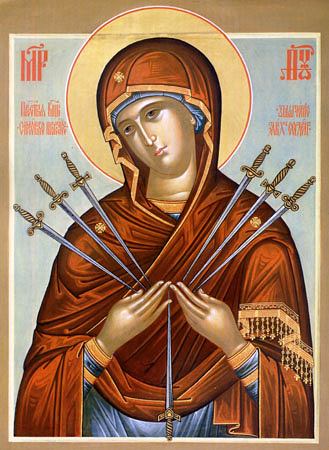
“This child is destined for the falling and the rising of many in Israel, and to be a sign that will be opposed so that the inner thoughts of many will be revealed—and a sword will pierce your own soul too.” Luke 2:34-35.

I was only nine or ten at the height of the civil rights movement in the 1960s and only vaguely aware of what it was all about. After all, I was growing up in Bremerton, Washington. That is a long way from Selma, Alabama. Unlike those backwards southerners, we had no Jim Crow laws, no segregated schools and we got on just fine with people of color-or so we thought. Ours was a fully integrated and enlightened town without a hint of racism.

But as Martin Luther King, Jr. started to make headlines, I began to see another side of our community. There was much discussion about King among the adults in my home, church and neighborhood. “He’s got some good points, but he has to tone it down,” said some. “Discrimination down south is a terrible thing,” said others. “But King is pushing for too much change too fast. He’s only making things worse for his own people.” Our pastor expressed the view that, while segregation is clearly unjust, no Christian, much less a pastor, should be breaking the law in order address it. “One unjust act cannot justify another.” Some in our community were awakened for the first time to the depth of racial injustice in our midst and spoke out boldly in defense of Dr. King. Others spoke of him in disparaging terms it would serve no purpose to repeat. Suffice to say that Dr. Martin Luther King, Jr. was in our community “a sign that [was] opposed so that the inner thoughts of many [were] revealed.”

Being a “sign” is a hazardous occupation. For both Jesus and Dr. King it ended with a violent death. And there was collateral damage also. As Simeon foretold, the sword of grief did indeed pierce the heart of Mary, Mother of our Lord. So also, I am sure, it pierced the soul of Coretta Scott King. We cannot allow the terrible cost of the Incarnation to get lost in the sentimentality that so often surrounds our celebration of the Nativity. The song of the angels, the wonder of the shepherds and the worship of the magi bear witness to the marvelous sign of God’s generosity in the birth of this child, Jesus. But so also does the gut wrenching cry of Rachel weeping for her children. Matthew 2:16-18.

The naked truth is that the best God had to give, God’s very self, is destined to be rejected cruelly by each of us in our own way. If we can find the courage to enter into the divine drama of Jesus’ obedient life and faithful death, our inner thoughts will surely be revealed. If we are honest, we will find ourselves with the crowds that came to Jesus for what he could give them with no thought of following him. We will find ourselves among the disciples who are consumed with rivalry, self promotion and power, but often show little interest or understanding of the reign of God Jesus proclaims. We will find ourselves among those who feared that Jesus was a dangerous and destabilizing influence and among those who would silence him when he challenges our grip on power and privilege. A prophetic sign lances a boil, revealing sickness of which we are unaware. It is painful and unpleasant, but essential for healing.

Over this last year we have encountered many signs that have “revealed the inner thoughts of many.” They have names like George Floyd, Brianna Taylor and Ahmaud Arbery. Let me say from the outset that there is nothing good, nothing redemptive, nothing meaningful in the senseless murders of these innocents. Nevertheless, if we can view them through the prism of the sign that is Mary’s child, they can become for us signs that lay bare our wounded souls, the prejudice holding us in bondage and the grievous injuries they inflict on our neighbors. That, in itself, is not the healing and reconciliation for which God yearns. But it is a necessary first step. And, of course, we have to begin somewhere.

Here is an anonymous poem reflecting Mary’s realization of the sign that will be her son’s destiny and the “sword” that will one day pierce her through.

Jesus Comforts His Mother

A baby is borne us blis to bring;
A maidden, I hard, “Loullay,” sing:
“Dere son, now leive thy wepping,

Thy fadere is the King of Blis.”

“Nay! Dere modere, for you weppe I noght,
But for thinges that shall be wroght,
Or that I have mankind iboght.

Was ther never pain like it, iwis.”

“Pes! dere sone, say thou me not so.
Thou art my child, I have no mo.
Alas! That I shuld see this wo:

It were to me gret heivynis.”

“My hondes, modere, that ye now see,
Thay shall be nailed one a tree;
My feit, also, fastned shall be:

Full mony shall wepe that it shall see.”

“Alas! dere son, sorrow now is my happe
To see my child that soukes my pappe
So ruthfully taken out of my lappe.

It were to me gret heivynis.”

“Also, modere, ther shall a speire
My tendere hert all to-teire:
The blud shall kevere my body there.

Gret ruthe it shall be to see.”

“A! dere sone, that is a heivy cas.
When Gabrell knelled before my face
And said, ‘Heille! Lady, full of grace,’

He never told me nothing of this.

“Dere modere, pes! Nowe I you pray,
And take no sorrow for that I say,
But singe this song, ‘By, by, loullay,’

To drive away all heivynis.”

Have a Holy Disruptive Christmas!

FOURTH SUNDAY OF ADVENT

2 Samuel 7:1-11, 16
Luke 1:46b-55 or Psalm 89:1-4, 19-26
Romans 16:25-27
Luke 1:26-38

Prayer of the Day: Stir up your power, Lord Christ, and come. With your abundant grace and might, free us from the sin that would obstruct your mercy, that willingly we may bear your redeeming love to all the world, for you live and reign with the Father and the Holy Spirit, one God, now and forever.

“Do not be afraid, Mary, for you have found favor with God. And now, you will conceive in your womb and bear a son…” Luke 1:30.

Nothing is quite so disruptive as pregnancy. The news that you are about to be a parent alters your outlook on the future, reshapes your expectations and forces you to re-evaluate the direction of your life. The baby’s arrival wreaks havoc on life. For first time parents, gone are the days when you can decide serendipitously after arriving home from work to grab a pizza and go out to see the new movie everyone is talking about. Your social life changes. You find you can no longer keep up with your childless friends and the activities you shared with them. Those boring individuals who used to make your eyes roll with their fixation on Legos, play dates and where to get the best deal on Pampers are suddenly your new best friends. For established families, a new baby upsets the existing constellation of familial relationships, depriving older siblings of attention, changing sleeping arrangements and aggravating further sibling rivalry. And this is all under optimal conditions when a pregnancy is welcome and expected. Where, as in our gospel lesson, pregnancy is unplanned and unanticipated, its disruptive effects are multiplied exponentially.

Mary is not unaware of the disruption her pregnancy has unleashed, disruption that goes far beyond her and her family. In our psalmody from Luke’s gospel she sings:

“[God] has shown strength with his arm;
he has scattered the proud in the thoughts of their hearts.
He has brought down the powerful from their thrones,
and lifted up the lowly;
he has filled the hungry with good things,
and sent the rich away empty.
He has helped his servant Israel,
in remembrance of his mercy,
according to the promise he made to our ancestors,
to Abraham and to his descendants forever.” Luke 1:51-55.

At Jesus’ circumcision, the prophet Simeon tells Mary that “This child is destined for the falling and the rising of many in Israel, and to be a sign that will be opposed so that the inner thoughts of many will be revealed—and a sword will pierce your own soul too.” Luke 2:34-35. Mary is very much aware, as is the poet Yehuda Amichai, that a child-her child-is “a missile into the coming generations.” Like the poet, she “trembles” with wonder at what she has launched into the world.

It has always struck me as ironic that this story, which for Mary, for Israel and the world is so very jarring and disruptive, has managed to weave itself into a holiday so steeped in tradition and sameness. Nothing is as rock solid and resistant to change as Christmas. Every pastor knows that the annual Christmas Candle Light Service is not the place to introduce new hymns and experiment with novel liturgical forms. Every nominally Christian family has its own traditions and practices for celebrating Christmas without which “it just isn’t Christmas.”  Those traditions might be overtly religious, secular or a mix of both. But whatever they are, they constitute a set of cherished expectations we have come to take for granted. Whatever else might be changing in the world around us, Christmas is still Christmas.

Of course, I hardly need to tell you that this year of pandemic is different. It has disrupted so many aspects of our lives, not the least of which is the way we celebrate holidays like Christmas. Sesle and I were not together with our children and grandchildren for Thanksgiving and will not be together with them for Christmas either. We will not be celebrating the Eucharist on Christmas or anytime in the near future. Our town’s community Christmas tree lighting celebration will not be happening this year, nor will many other cultural and religious public events. All of our expectations have been shattered, our routines have been disrupted. We are feeling our way into an uncertain future-much as Mary must have been upon learning that, unmarried though she was, she was about to bear a child.

So perhaps this will be the most Christmas like Christmas we have ever experienced. Maybe God is brewing something holy and redemptively disruptive in the midst of all this darkness and uncertainty. Maybe we are finding ourselves in a place where we can finally hear the story of the Nativity. Perhaps we are finally positioned to encounter the terrible, fearful and wonderful miracle of the Incarnation, God’s missile of healing launched into a wounded and hurting world. That is bound to disrupt our established ways of thinking and acting. But, of course, that is the whole point.

Here is the poem by Yehuda Amichai I cited above.

A Child is Something Else Again

A child is something else again. Wakes up
in the afternoon and in an instant he’s full of words,
in an instant he’s humming, in an instant warm,
instant light, instant darkness.

A child is Job. They’ve already placed their bets on him
but he doesn’t know it. He scratches his body
for pleasure. Nothing hurts yet.
They’re training him to be a polite Job,
to say “Thank you” when the Lord has given,
to say “You’re welcome” when the Lord has taken away.

A child is vengeance.
A child is a missile into the coming generations.
I launched him: I’m still trembling.

A child is something else again: on a rainy spring day
glimpsing the Garden of Eden through the fence,
kissing him in his sleep,
hearing footsteps in the wet pine needles.
A child delivers you from death.
Child, Garden, Rain, Fate.

Source: The Poetry of Yehuda Amichai. (c. 2015 by Yehuda Amichai, Translated By Chana Bloch and published by Farrar, Strauss & Giroux). Yehuda Amichai is one of Israel’s most prominent poets. He was born in Germany in 1924 but left with his family for Palestine in 1935. He fought in the 1948 Arab/Israeli war. His poems have been translated into English, French, German and Swedish. You can read more about Amichai and his poetry on the Poetry Foundation Website.


The Advent of the Spirit upon a Dispirited Church

THIRD SUNDAY OF ADVENT

Isaiah 61:1-4, 8-11
Psalm 126 or Luke 1:46b-55
1 Thessalonians 5:16-24
John 1:6-8, 19-28

Prayer of the Day: Stir up the wills of your faithful people, Lord God, and open our ears to the words of your prophets, that, anointed by your Spirit, we may testify to your light; through Jesus Christ, our Savior and Lord, who lives and reigns with you and the Holy Spirit, one God, now and forever.

“And John testified, ‘I saw the Spirit descending from heaven like a dove, and it remained on him.’” John 1:32.

Though the outpouring of God’s Spirit is always an extraordinary event, this is not the first instance of it in the Bible. The Spirit of the Lord fell mightily upon the judges of Israel giving them strength to perform superhuman feats in their battles for Israel’s liberation. e.g., Samuel at Judges 15:14-15. God’s Spirit fell upon Saul shortly after he was anointed king of Israel. I Samuel 10:6-10. In our lesson from the Hebrew scriptures, the prophet declares, “The Spirit of God is upon me, because the Lord has anointed me to bring good tidings to the afflicted.” Isaiah 61:1. Of course, there is the marvelous story in the second chapter of Acts about God’s outpouring of the Spirit upon the disciples at Pentecost. Acts 2:1-21. So, too, the Spirit of God descended from heaven upon Jesus, says John. But John goes on to say one thing more. “[The Spirit] remained on him.”

The Greek verb translated here as “remained” is “meno.” This verb can be translated as “live,” “dwell” or “lodge.” One who “remains” in this sense is one who does not leave the realm of the sphere in which one finds oneself. “meno.” can also mean to “continue” or “persist.” Indeed, it is used in all these senses throughout John’s gospel. The first disciples Jesus called followed him home and “stayed” with him. John 1:38-39. The Samaritans brought to Jesus by the woman he met at the well invite Jesus to “stay” with them and Jesus does just that-for two days. John 4:39-40. The bread of heaven Jesus promises to all who believe in him “endures” for eternal life. Jesus “remains” in Galilee rather than going up to Jerusalem with his brothers for the Feast of Tabernacles. John 7:1-9. Jesus tells his audience that those who “’continue’ in my word…will know the truth and the truth will make you free.” John 8:31-32. Rather than going immediately to the bed side of Lazarus upon hearing that he was ill, Jesus “stayed” two days longer in the place where he was. John 11:1-6. Jesus tells his people that whoever believes in him does not “remain” in darkness. John 12:46. During his last hours together with his disciples, Jesus tells them that God the Father “dwells” in him (John 14:10) and that the Spirit “dwells” within them. John 14:17. Jesus admonishes his disciples to “abide” in him just as a branch clings to the vine (John 15:4) and to “abide” in his love. John 15:9. All of these verses employ that same word, “meno,” variously translated in the English text.

The import is clear. God’s Spirit remains on, continues with, abides in, dwells with and persists with Jesus. In the same way, Jesus’ disciples remain, continue, abide, dwell and persist with Jesus, just as Jesus remains, continues, abides, dwells and persists in the Father. In the seventeenth chapter of John’s gospel, Jesus prays that his disciples may be one even as he and the Father are one so that “the love with which you have loved me may be in them, and I in them.” John 17:26. The love which is the glue binding the unity of the Trinity is to be reflected in the community of faith grounded in Jesus. This is the testimony of John the Baptizer.

John’s good news comes to us during a time when most of us find it hard to keep our congregations, families and communities glued together. Pandemic has robbed us of so much that once mediated the Spirit’s binding power: the gathered community; the Sacraments; singing together; greeting one another with the peace of God; simple gestures like hand shakes, hugs and back slaps. Yes, I am thankful for the technology allowing us to be together virtually. We are better off with it than we would be without. Still, for me, it serves as much to remind me of our separation as it does to connect us.

Despite all this, John’s testimony is good news. It is good because it reminds us that our unity, like all of God’s good gifts, is a gift of grace. Once given, the Spirit cannot be taken away from us. She remains, continues, abides, dwells and persists with the church. Though physically distanced from one another, we are neither distanced from Jesus nor abandoned by the Holy Spirit. John’s testimony assures us that the Spirit travels through the prayers arising our homes, telephone calls, cards, letters, texts, emails, U tube worship services, Zoom meetings and whatever other channels she might make use of in this time of our physical separation. The Spirit is nothing if not innovative.

I am hopeful that the church will come out of this time of pandemic with an enriched sense of the ways in which the Spirit works among us. It is my prayer that we will begin to recognize how deeply we need and depend on one another. I hope that the time we spend apart will strengthen our prayer life, remind us of our frailty and deepen our compassion for our neighbors. I hope that we will emerge from this dreadful epidemic with a deeper appreciation for the people whose faithful work maintains the network of health care, food distribution, sanitation and safety that we are so prone to take for granted and undervalue in times of relative peace and prosperity. I hope that the events of the past year have opened our eyes to the vast disparity in resources between those of us who identify as white and people of color. More so, that having had our eyes open, we will be driven by God’s Spirit to pursue justice. Though much ecclesiastical activity seems to have ground to a halt, rest assured that the Spirit remains at work in Christ’s church.

Here is a poem by Emma Lazarus reflecting on the synagogue in Newport, Rhode Island, the oldest in the United States. It was built in 1763. At the time Lazarus wrote her poem, the building was abandoned. It has since become the home of a worshiping Jewish congregation once again. Lazarus reflects on the lively faith that sustained so many generations to which the synagogue testifies in much the same way as John the Baptizer testifies to the Spirit he witnessed remaining upon Jesus.

In the Jewish Synagogue at Newport

Here, where the noises of the busy town,
The ocean’s plunge and roar can enter not,
We stand and gaze around with tearful awe,
And muse upon the consecrated spot.

No signs of life are here: the very prayers
Inscribed around are in a language dead;
The light of the “perpetual lamp” is spent
That an undying radiance was to shed.

What prayers were in this temple offered up,
Wrung from sad hearts that knew no joy on earth,
By these lone exiles of a thousand years,
From the fair sunrise land that gave them birth!

How as we gaze, in this new world of light,
Upon this relic of the days of old,
The present vanishes, and tropic bloom
And Eastern towns and temples we behold.

Again we see the patriarch with his flocks,
The purple seas, the hot blue sky o’erhead,
The slaves of Egypt,—omens, mysteries,—
Dark fleeing hosts by flaming angels led.

A wondrous light upon a sky-kissed mount,
A man who reads Jehovah’s written law,
‘Midst blinding glory and effulgence rare,
Unto a people prone with reverent awe.

The pride of luxury’s barbaric pomp,
In the rich court of royal Solomon—
Alas! we wake: one scene alone remains,—
The exiles by the streams of Babylon.

Our softened voices send us back again
But mournful echoes through the empty hall:
Our footsteps have a strange unnatural sound,
And with unwonted gentleness they fall.

The weary ones, the sad, the suffering,
All found their comfort in the holy place,
And children’s gladness and men’s gratitude
‘Took voice and mingled in the chant of praise.

The funeral and the marriage, now, alas!
We know not which is sadder to recall;
For youth and happiness have followed age,
And green grass lieth gently over all.

Nathless the sacred shrine is holy yet,
With its lone floors where reverent feet once trod.
Take off your shoes as by the burning bush,
Before the mystery of death and God.

Source: Emma Lazarus: Selected Poems and Other Writings, (c. 2002 by Broadview Press) Emma Lazarus (1849-1887) is most famous for the words of her poem, The New Colossus, inscribed on the base of the Statute of Liberty.

“Give me your tired, your poor,
Your huddled masses yearning to breathe free,
The wretched refuse of your teeming shore.
Send these, the homeless, tempest-tost to me,
I lift my lamp beside the golden door!”

She was one of the first successful and publicly recognized Jewish American authors. Lazarus was born in New York City to a wealthy family. She began writing and translating poetry as a teenager and was publishing translations of German poems by the 1860s. Lazarus was moved by the fierce persecution of her people in Russia, a frequent topic of her writings, as well as their struggles to assimilate into American culture. You can sample more of Emma Lazarus’ poetry and read more about her at the Poetry Foundation website.

Hidden Beginnings

SECOND SUNDAY OF ADVENT

Isaiah 40:1-11
Psalm 85:1-2, 8-13
2 Peter 3:8-15a
Mark 1:1-8

Prayer of the Day: Stir up our hearts, Lord God, to prepare the way of your only Son. By his coming strengthen us to serve you with purified lives; through Jesus Christ, our Savior and Lord, who lives and reigns with you and the Holy Spirit, one God, now and forever.

“The beginning of the good news of Jesus Christ, the Son of God.” Mark 1:1.

Beginnings are seldom noticed as such when they occur. Seemingly inconsequential happenings can set in motion a string of unforeseen consequences radiating their effects like ripples over the face of a pond generated by the impact of a small stone. There is no way I could have known that a fleeting glance and exchange of smiles with a young women I met passing through the church basement thirty eight years ago was the beginning of anything. It might have led to nothing at all. Or it may perhaps have flowered briefly into one of those relationships that, for whatever reason, fades into one of the many “roads not taken” along the winding paths of our lives. Indeed, if either of us had been engaged in conversation with someone else or if the timing of my entrance had been delayed or accelerated by any number of potential distractions, our brief encounter might never have happened. Yet from this vantage point in the autumn years of my life, I can recognize that meeting of our eyes as a critical turning point, the beginning of a relationship that has nurtured, sustained, transformed us-and generated three children and five grandchildren.

So, too, the appearance of a preacher in the wilderness of a backwater province on the fringes of the Roman Empire might well have gone unnoticed-but for the fact that there was a young man from the town of Nazareth coming forward with many more to be baptized by this preacher. Reading forward to the account of Jesus’ baptism, it isn’t clear whether John the Baptizer or anyone else saw the heavens rent asunder and the Spirit descending upon Jesus. For all we know, this might have been for John just another day’s work. From our standpoint as recipients of the good news about Jesus, we recognize this moment as a profound new beginning.

Of course, there have been other “beginnings” in the scriptural narrative. The words spoken by John in our gospel lesson were first pronounced by the prophet Isaiah declaring a new beginning for the people of Judah languishing in exile. Both of these beginnings harken back to “the beginning” where God speaks the cosmos into existence and quickens it with God’s divine breath. Genesis 1:1-5. In truth, eternity intersects with every nanosecond of time and God’s being sustains every molecule in the universe. Thus, every occurrence, however seemingly insignificant, involves a “God factor” making it at least potentially the beginning of something big.

Knowing this to be so, can we dare hope that any of the events within this last dark year of political chaos, pandemic and racial violence is the beginning of something beautiful? Do we dare imagine that one day George Floyd’s murder will be remembered as the spark igniting a national effort comparable to the New Deal and the Marshall Plan to dismantle systemic racism and reverse its centuries of insidious effects? Do we dare hope that the Covid-19 pandemic will be remembered as the event that finally convinced us universal healthcare is both a human right and essential to the common good? Will the Trump presidency finally awaken the American Church to the dangers of nationalist idolatry and move us to a deeper appreciation of the church’s catholicity?

Farfetched? Maybe. But Advent is, after all, the season of hope. If we believe that God spoke light and being out of darkness and nothingness, birthed the people of Israel from the chains of slavery and worked the miracle of resurrection in the darkness of a tomb, is it such a stretch to believe that God has been at work redemptively in what we all know to have been a bleak year?

Here is a poem by Mary Ellen Edge contemplating the hiddenness of beginnings and their concealed potential.

Beginnings

Dawns are always wonder-dawns
Of perfect untouched hours;
Buds are perfect promises
Of unseen perfect flowers.

Youth is life unlimited,
Not yet defined and small-
Not yet poured out in queer-shaped jugs
That cannot hold it all.

Source: Poetry, June 1923. I have been unable to find any information about this poet or any of her other works. I would appreciate any information anyone else might be able to provide.

Developing a Holy Squint

FIRST SUNDAY OF ADVENT

Isaiah 64:1-9
Psalm 80:1-7, 17-19
1 Corinthians 1:3-9
Mark 13:24-37

Prayer of the Day: Stir up your power, Lord Christ, and come. By your merciful protection waken us to the threatening dangers of our sins, and keep us blameless until the coming of your new day, for you live and reign with the Father and the Holy Spirit, one God, now and forever.

“Beware, keep alert; for you do not know when the time will come.” Mark 13:33.

Rev. Kyle Childress, a pastor and teacher I greatly admire, grew up and ministered most of his life in the state of Texas. He tells a story about an old rancher whose face was permanently sunburned and lined from decades of living outside. He had developed a “perpetual squint,” so that, daylight or dark, indoors or out, he always looked like he was squinting, looking across some pasture for a stray cow in the face of glaring sun and blowing wind. Squinting, looking into the distance for so many years had shaped his face. Indeed, it had shaped the way he looked at everything.

Pastor Childress goes on to reflect on how we are shaped by where our gaze is fixed and how the course of our lives is determined by who and by what we love, hope for and expect. Seems to me that is a good thought with which to start the new church year. It is a great parable through which to view the season of Advent. Truth is, we are shaped by our longings and what we desire determines how we live and how we treat each other.

In our gospel lesson for this Sunday, Jesus encourages his disciples to keep their gaze, their perpetual squint, on his coming. That is easier said than done. There is plenty out there to distract us. There will be wars and rumors of war, says Jesus, earthquakes and famines. Mark 13:8. Of course, we don’t need Jesus to tell us that. But then Jesus goes on to tell us about things we have not yet experienced; things that are not simply part and parcel of human history. The sun will cease to give its light. The moon will turn dark. The stars will fall from the sky. All those things we thought where constant; all those things we imagined would never change suddenly do. And then, they will see the Son of man coming in the clouds with great power and glory.

The Greek word “erchomi” that we translate as “coming” frequently means rather “to appear.” So we might better translate this verse “then they will see the Son of Man ‘appearing’ in the clouds.” That is an important distinction because it is not as though Jesus left us alone two millennia ago only to return at some point in the distant future. He is here now. He has always been here for eyes that can see him; for eyes that have been trained to search for signs of his appearing and the unfolding of God’s reign. For those whose perpetual squint is formed by Jesus and the reign of God he promises, those signs are everywhere.

On election day in Warren, Michigan a group of Donald Trump supporters and backers of Joe Biden started shouting slogans and insults at each other through bullhorns-a none too common occurrence. But then Matthew Woods, a 59-year-old Trump supporter and travelling musician, challenged the Biden supporters to a “sing off.” The opposing groups soon started singing together and even posed for photos. “We shook hands, hugged each other and apologized for saying bad words to one another,” Wood said. “’Let’s forget about politics. Let’s hug each other and be friends.’” Harmony: Opposing “Trump and Biden groups make music together,” CityNews, November 3, 2020.

Like the tender shoots of the fig tree, this fragile moment, during which two groups of bitterly opposed people were able to see through the hateful rhetoric, stereotypical thinking and rigid ideology dividing them to their common humanity, gives us a glimpse, however fleeting, into what God desires and promises for all people. Disciples understand that moments of compassion and reconciliation like these are not just islands of tenderness in an ocean of hatred and indifference. They are God’s future pressing in upon our present. They remind us that the grip of evil is not unbreakable. They are a foretaste of God’s salvation poised to break over all creation like a cosmic tsunami.

Nevertheless, disciples of Jesus also understand that the reign of God does not come without struggle, suffering and loss. The cross is the shape of God’s reign as it takes hold of a world in bondage to sin. Thus, Jesus warns us not to be led astray by promises that the end is at hand when, in fact, there remains much work to do. Mark 13:5-7. Discipleship requires that we recognize the evils of systemic racism, economic injustice and entrenched patriarchy and know that baptism into Christ Jesus is a call to struggle against these and all other powers of sin, death and the devil. We would be naïve to expect this struggle to be short lived. We would be foolish to believe God’s reign will come without suffering, sacrifice and loss. But Jesus would have us know that, even in this, we are witnessing not merely the death throws of the old creation, but the birth pangs of the new.

It is not in vain that Jesus taught us to pray first and foremost that God’s name be hallowed, that God’s kingdom come and that God’s will be done on earth as in heaven. Praying these petitions, meditating on them and allowing them to shape the contours of our souls transforms us just as surely as gazing into the rugged outdoor elements transformed the expression of that old rancher’s face. So keep awake. Keep your eye peeled for signs of the kingdom. Keep your squint focused on Jesus and on what he is doing, so that when he is revealed to all the world and God’s gentle reign of peace breaks in, your eyes will have been trained to recognize it, your heart will have been shaped to love it and you will have formed the habits required for living in it joyfully, thankfully and obediently.

The above story from Warren, Michigan illustrates how music can both be and affect signs of the advent of God’s reign. Here is a poem by Francis Ellen Watkins Harper making a similar observation.

Songs for the People

Let me make the songs for the people,
   Songs for the old and young;
Songs to stir like a battle-cry
   Wherever they are sung.
Not for the clashing of sabres,
   For carnage nor for strife;
But songs to thrill the hearts of men
   With more abundant life.
Let me make the songs for the weary,
   Amid life’s fever and fret,
Till hearts shall relax their tension,
   And careworn brows forget.
Let me sing for little children,
   Before their footsteps stray,
Sweet anthems of love and duty,
   To float o’er life’s highway.
I would sing for the poor and aged,
   When shadows dim their sight;
Of the bright and restful mansions,
   Where there shall be no night.
Our world, so worn and weary,
   Needs music, pure and strong,
To hush the jangle and discords
   Of sorrow, pain, and wrong.
Music to soothe all its sorrow,
   Till war and crime shall cease;
And the hearts of men grown tender

   Girdle the world with peace.

Source: A Brighter Day Coming, (c. 1990 by Francis Smith Foster, pub. Feminist Press by City University of New York) p. 371. Frances Ellen Watkins Harper (1825 – 1911) was an abolitionist, suffragist, poet, teacher and writer born in Baltimore, Maryland. She was also one of the first African American women to be published in the United States. Watkins Harper had a long and productive career, publishing her first book of poetry at the age of 20.  As a young woman, she taught sewing at Union Seminary in Columbus, Ohio, a school affiliated with the African Methodist Episcopal Church. During that time,  Watkins Harper also worked with the Pennsylvania Abolition Society helping refugee slaves make their way along the Underground Railroad to Canada. She helped found the National Association of Colored Women in  1894 and served as its vice president. Harper died in 1911, just nine years before women gained the right to vote. You can read more about Francis Ellen Watkins Harper and sample more of her poetry at the Poetry Foundation website.