All posts by revolsen

Unknown's avatar

About revolsen

I am a retired Lutheran Pastor currently residing in Wellfleet, Massachusetts. I am married .and have three grown children.

Covid-19 Pandemic-No, It’s Not a War

covid19Thus far, we have been informed by at least two world leaders, many more lesser politicians, several prominent newscasters and a host of other talking heads that “we are at war” with the coronavirus. I have often questioned the aptness of this “war” metaphor we employ so liberally. In my own life time, I have seen war declared on poverty, drugs, crime, terror and a host of other abstract nouns. To be sure, the coronavirus is anything but abstract. Nonetheless, characterizing the virus, which bears us no malice and seeks no more than what we seek, namely, to live and thrive, seems a little off. The virus is no more our enemy than earthquakes, tornados and tsunamis. All of these phenomena are highly inconvenient for human civilization, but they are not out to destroy us. So I think we need to reconsider our use of “war” terminology if we are going to think clearly about what is happening to us and why.

From a purely homocentric point of view, the covid-19 pandemic represents a huge disruption in our lives and a threat to our wellbeing. But the homocentric point of view is not the only one. The BBC reports that, as a result of reduced travel and industrial activity following pandemic induced restrictions, New York City is experiencing a notable decrease in carbon dioxide, methane, and carbon monoxide emissions and air pollution generally. These reductions in carbon emissions and improvements in air quality mirror similar changes occurring in China, which largely shut down during its own coronavirus outbreak. For the non-human inhabitants of planet earth, the covid-19 pandemic looks more like liberation than invasion. So if we are going to continue using the war metaphor, I think we need to ask ourselves whether we are fighting on the right side.

I am not suggesting for one minute that we should halt our efforts to stop the spread of covid-19 or end our search for vaccines and treatments so that “nature can take its course.” What I am saying is that we need to take a broader view of what is happening to us. Many scientists are doing just that. A number of researchers today think that it is actually humanity’s destruction of biodiversity that creates the conditions for new viruses and diseases such as Covid-19. See “‘Tip of the iceberg’: is our destruction of nature responsible for Covid-19?” The Guardian, March 18, 2020. “We invade tropical forests and other wild landscapes, which harbour so many species of animals and plants – and within those creatures, so many unknown viruses,” David Quammen, author of Spillover: Animal Infections and the Next Pandemic, recently wrote in the New York Times. “We cut the trees; we kill the animals or cage them and send them to markets. We disrupt ecosystems, and we shake viruses loose from their natural hosts. When that happens, they need a new host. Often, we are it.” Ibid. In the immortal words of the comic figure Pogo, “We have met the enemy and he is us.” That being the case, the “war” metaphor is not particularly helpful.

Our best hope of protecting human health lies not solely in stemming this particular pandemic. Nor does the solution lie with ensuring that, next time around, we have enough hospital beds, ventilators and masks. The quality of human health and wellbeing finally depend on our learning to live sustainably in a way that promotes overall planetary health. Preventing pandemics, as well as reducing other threats to human health and wellbeing, cannot be divorced from consideration of global warming, deforestation, water pollution and soil contamination. Neither can we intelligently address the threat of global pandemics without addressing the poverty, inequality and injustice keeping so many of us living in conditions that breed illness and disease.

The scriptures have a word for all this: Shalom. Our English Bibles translate this Hebrew word as “peace,” but it carriers a lot more freight than that. Shalom peace is not simply the absence of conflict. It connotes a state of wellbeing, harmony and working relationships of interdependence. Shalom is reflected in God’s declaration that the created cosmos is “good.” In the first biblical creation narrative, human beings are commanded to “fill the earth and subdue it.” Genesis 1:28. This verse has given rise to a good deal of mischief. For that reason, we need to recall that the Hebrew word “CABASH” translated in Genesis 1:28 as “subdue,” is the same word employed in God’s command for Israel to subdue the land of Canaan. Numbers 32:22; Numbers 32:29; Joshua 18:1. The subjugation of the land meant more than merely driving out Israel’s enemies. Very specific commands were given to Israel directing the people to care for the land and its non-human inhabitants. For example, trees were to be spared from the ravages of war. Deuteronomy 20:19-20. Egg producing birds were to be spared from slaughter. Deuteronomy 22:6-7. The sabbath rest mandated for all human beings, from king to servant, extended also to animals. Exodus 23:12. Moreover, the land itself was to be given a year’s sabbath rest from cultivation every seven years. Exodus 23:10-11. God was worshiped not only as the provider for human beings, but for all living creatures. Psalm 104:10-23.

In Genesis’ second creation narrative, the human creature is placed in the Garden of Eden with a simple mandate: till and keep the Garden. Genesis 2:15. This helps to put everything in perspective. It’s not all about us human beings. It’s about the earth. We don’t own the place. We’re just the grounds keepers. As such, we are responsible to see to it that the garden flourishes and to that end we are given plenty of discretion. Still, our authority to act is not unlimited. If I had enough disposable income to hire a gardener, I would give her a free reign to make decisions, such as what to plant where, how often things need watering and how often the grass is cut. But if I came home one day to find her brother-in-law’s car up on blocks in my front yard, or if I saw her building a jungle gym for her children in the back, I think I would need to have a pointed discussion about the scope of her exercise of control over my property. So, too, centuries of ruthless exploitation of our planet, that in contemplation of capitalism is nothing more than a ball of resources to be exploited for profit, cries out for judgment. This is not how gardeners attend to their proper task.

Can we say that the pandemic is God’s judgment upon us? Not in the sense that God deliberately designed this virus to punish us for our failings. We do not worship a vindictive God. Nevertheless, the scriptures teach us that God created a cosmos with hundreds of interactive elements and interdependent life forms designed to live in the harmony of shalom. When shalom is disrupted, all of life is threatened. Moses solemnly warned the people of Israel that, should they defile the land of Canaan they were about to inherit, “the land will vomit you out for defiling it.” Leviticus 18:28. By any standard imaginable, our earth has been defiled by its human inhabitants. Right now, our planet is struggling to right the terrible imbalance we have inflicted upon it. The covid19 epidemic is only our world’s latest convulsion as it writhes in its sickbed. We can choose to war against the earth and pound it back into submission, or we can take this opportunity to release our death grip on its throat, allow it to breath again and begin attending to its wounds-because that is the only way to find healing for our own.

When Jesus Arrives too Late

FIFTH SUNDAY IN LENT

Ezekiel 37:1-14
Psalm 130
Romans 8:6-11
John 11:1-45

Prayer of the Day: Almighty God, your Son came into the world to free us all from sin and death. Breathe upon us the power of your Spirit, that we may be raised to new life in Christ and serve you in righteousness all our days, through Jesus Christ, our Savior and Lord, who lives and reigns with you and the Holy Spirit, one God, now and forever.

“Martha said to Jesus, ‘Lord, if you had been here, my brother would not have died. But even now I know that God will give you whatever you ask of him.’” John 11:21-22.

“But even now…” Those are perhaps the three most profound words in our gospel reading. It seems clear to me that Martha is deeply disappointed in Jesus. I don’t know whether she knew that Jesus deliberately delayed two days before answering hers and Mary’s call for him to come, knowing full well about Lazarus’ critical illness. But she is convinced that Jesus could have saved Lazarus if only he had been present. Now, of course, he is present- but too late.

Martha’s expression of disappointment with Jesus might not comport with our protestant traditions of piety, but it is quite consistent with the prayer traditions of Israel as we find them in the Psalms. “How long, O Lord? Will you forget me forever? How long will you hide your face from me? How long must I bear pain in my soul, and have sorrow in my heart all day long?” Psalm 13:1-2. “O Lord, why do you cast me off? Why do you hide your face from me? Wretched and close to death from my youth up, I suffer your terrors; I am desperate.” Psalm 88:14-15. Sometimes the psalmists were near ready to be done with God altogether, pleading “turn your gaze away from me, that I may smile again, before I depart and am no more.” Psalm 39:13. Though the psalmists frequently acknowledged Israel’s failures under its covenant with its Lord, they were not shy about letting God know in no uncertain terms when they felt God was being less than faithful to that covenant.

Remarkably, the psalmists-and Martha-continue to persevere in their covenant faith, even when it seems to them that God has failed to hold up God’s end of it. Even the psalms most critical of God’s lack of responsiveness testify to robust faith simply by virtue of the fact that they are addressed to this seemingly unresponsive God! However fierce the argument, God and God’s people are still on speaking terms. “But even now,” says Martha, “I know that God will give you whatever you ask.” What did Martha mean by that? Obviously, she had no expectation that Jesus would revive Lazarus. When Jesus told her that her brother would rise again, she probably took it as a comforting platitude, the kind we often hear at the funeral of a loved one. A well meaning friend says to you, “She’s in a better place-” that sort of thing. But although Jesus had arrived long after he might have prevented Lazarus from dying and although Martha cannot imagine how Jesus can make a difference at this juncture, she can’t help but remain open to the possibility that Jesus might have in store something beyond her ability to imagine. That is the shape of Martha’s faith.

That is finally the shape all genuine faith takes in the end. It is hard to imagine myself being “inwardly renewed,” to use St. Paul’s term, when my “outer nature is wasting away,” a fact about which I am reminded every time my mind suggests a good long jog in the crisp winter air and my body informs me that I will be doing no such thing. II Corinthians 4:16. How can one possibly imagine life beyond the grave, that ultimate dead end for us all? Paul knew full well the limits of our imaginative capacities. That is why he reminds us that we “walk by faith and not by sight.” II Corinthians 5:7. It is the only way to walk through troubling and uncertain times where there is no sign of God’s salvation on the horizon and, in any event, the hurt already done seems beyond even God’s ability to heal.

Here is a poem by Amy Gerstler with a lyric description of the dark landscapes we often seem to inhabit. Yet can you sense in the poet’s “once in a blue moon” scent of “the future’s purgatorial breath” the shadow of Martha’s faith?

Doomsday

The dark that’s gathering strength
these days is submissive,
kinky, silken, willing;
stretched taut as a trampoline.
World events rattle by like circus
trains we wave at occasionally,
as striped, homed and spotted
heads poke out their windows.
Feels like I’m wearing a corset,
though I haven’t a stitch on.
Burn the place setting I ate from,
OK? and destroy the easy chair
I languished in. Let birds
unravel my lingerie
for nesting materials.
Fingers poised on the piano keys,
I can’t think what to play.
A dirge, a fugue?
What, exactly, are crimes
against nature? How many
calories are consumed while
lolling in this dimness,
mentally lamenting the lack
of anything to indicate
some faint mirage of right-
mindedness has been sighted
on the horizon? The world
is full of morbid thinkers,
miserable workers and compulsive
doodlers. Darling, my mother
used to croon, you were a happy
accident, like the discovery
of penicillin. When I sense
the zillions of cells in my body
laboring together, such grand
fatigue sweeps over me.
Once in a blue moon I smell
the future’s breath,
that purgatorial whiff
shot through with the scent
of burnt hair, like when sailors
have been drifting at sea
for a long time and suddenly
they see gulls circling
and the ripe composty odor
of land unfurls in the air,
but they’ve no idea whether
an oasis of breadfruit
and pineapple awaits them
or an enclave of cannibals.

Source: Nerve Storm, Gerstler, Amy (c. 1993 by Amy Gerstler, pub. by Penguin Books). Amy Gerstler (b. 1956) is a graduate of Pitzer College. She holds an M.F.A. from Bennington College and is currently a professor of writing at the University of California, Irvine. Previously, she taught in the Bennington Writing Seminars program, at Art Center College of Design in Pasadena, California and the University of Southern California’s Master of Professional Writing Program. Gerstler has authored over a dozen poetry collections and two works of fiction. She has also produced numerous articles, reviews, and collaborations with visual artists. You can read more about Amy Gerstler and sample more of her poetry at the Poetry Foundation website.

Is the Lord Among Us, or Not?

FOURTH SUNDAY IN LENT

1 Samuel 16:1-13
Psalm 23
Ephesians 5:8-14
John 9:1-41

Prayer of the Day: Bend your ear to our prayers, Lord Christ, and come among us. By your gracious life and death for us, bring light into the darkness of our hearts, and anoint us with your Spirit, for you live and reign with the Father and the Holy Spirit, one God, now and forever.

Though we are now three weeks into Lent, I am still stuck on last Sunday’s lesson from Exodus. The Israelites were exasperated with Moses, a man who led them out of Egypt with promises of a fertile land flowing with milk and honey, but now has them bogged down in a waterless wilderness. “Is the Lord among us or not?” they ask. Exodus 17:7. A lot of us are asking that question these days, but an affirmative response doesn’t take us anywhere near far enough. There is no shortage of preachers these days telling us that God is indeed among us-but not in a redemptive way. The Rev. Steven Andrew named March “Repent of LGBT Sin Month,” asserting that the coronavirus pandemic is God’s outpouring of wrath upon us for tolerating LGBTQ persons. “The Bible teaches homosexuals lose their souls and God destroys LGBT societies,”[1] he said in a recent press release. However, “Obeying God protects the USA from diseases, such as the Coronavirus.” New York Daily News, March 7, 2020.

Rev. Andrew and his ilk are not alone in their assessment of human tragedies. Jesus’ disciples appear to have had much the same view. “Who sinned,” they asked Jesus, “this man or his parents, that he was born blind?” John 9:2. The assumption here is that somebody must have sinned in order for such a terrible thing as blindness to befall a person. But Jesus puts them straight in no uncertain terms: “Neither this man nor his parents sinned.” John 9:3. The stark truth is that blindness, like pandemics, just happen. Tornados are as likely to wreck churches as porn shops. Drunk drivers kill children in school zone crosswalks guided by crossing guards and walk away without a scratch. Viruses don’t discriminate between the righteous and the wicked.

Whether we find it comforting or not, God didn’t create a still life universe. God created a universe with moving parts and an element of randomness. Though we often identify the serpent in the Garden of Eden with the devil, that isn’t the way the Bible tells the story. In fact, the serpent was one of God’s good creatures. It was “subtle” or “crafty,” but these qualities are not evil in and of themselves. As St. Augustine reminds us, character qualities become evil only as they are misdirected from their divinely created ends toward self-serving ways. That is always a possibility where randomness exists. Yet an element of randomness is necessary if creation is to grow in beauty, goodness and into a truthful reflection of its Maker such that “God may be all in all.” I Corinthians 15:28.

Jesus goes on to say that the man was “born blind so that God’s works might be revealed in him.” Then he goes on to restore the blind man’s sight, thereby demonstrating that God’s mightiest works consist in acts of mercy and compassion. This is not to say that God deliberately blinds people so that God can get good PR from restoring their sight. Rather, Jesus would have his disciples know that, instead of speculating about the cause of any particular instance of suffering, they should recognize in it an opportunity to exercise compassion and thereby demonstrate to the world that “God is among us,” not as an avenging punisher of wrongs, but as a God who is “merciful, slow to anger and abounding in steadfast love.”

As of this time, I am under a self imposed quarantine along with much of the rest of the country. I have no reason to believe that I have been infected with coronavirus, but in the absence of testing there is not way for me to be certain. Being retired, there is no compelling reason for me to be out and about in places where I am bound to come into close contact with others. So, it appears that the kindest thing I can do for my neighbors at this point is to steer clear of them! Moreover, though I am a relatively healthy sixty-four year old with no complicating health concerns, I live with a spouse who is immune compromised. For that reason, I am exercising what is probably a larger degree of caution than most others in my position. Fortunately, I am blessed to be living in a part of the country that is sparsely populated this time of year. There are many outdoor places I can go without exposing myself or anyone else to infection. The above shot is taken on the tide flats of South Lieutenant Island where I am harvesting oysters and practicing extreme “social distancing.” Yesterday I spent the first Sunday morning I can remember away from my worshiping community. But I have received numerous calls from family members, concern and prayers from my church and messages from a supportive network of neighbors who are always looking out for one another. It is clear to me that “God is among us” in a merciful, compassionate and redemptive way.

Here is a poem by Robert Frost speaking to human isolation in a way illustrating the deeper truth that “Men work together…whether they work together or apart.”

The Tuft of Flowers

I went to turn the grass once after one
Who mowed it in the dew before the sun.

The dew was gone that made his blade so keen
Before I came to view the levelled scene.

I looked for him behind an isle of trees;
I listened for his whetstone on the breeze.

But he had gone his way, the grass all mown,
And I must be, as he had been,—alone,

‘As all must be,’ I said within my heart,
‘Whether they work together or apart.’

But as I said it, swift there passed me by
On noiseless wing a ‘wildered butterfly,

Seeking with memories grown dim o’er night
Some resting flower of yesterday’s delight.

And once I marked his flight go round and round,
As where some flower lay withering on the ground.

And then he flew as far as eye could see,
And then on tremulous wing came back to me.

I thought of questions that have no reply,
And would have turned to toss the grass to dry;

But he turned first, and led my eye to look
At a tall tuft of flowers beside a brook,

A leaping tongue of bloom the scythe had spared
Beside a reedy brook the scythe had bared.

I left my place to know them by their name,
Finding them butterfly weed when I came.

The mower in the dew had loved them thus,
By leaving them to flourish, not for us,

Nor yet to draw one thought of ours to him.
But from sheer morning gladness at the brim.

The butterfly and I had lit upon,
Nevertheless, a message from the dawn,

That made me hear the wakening birds around,
And hear his long scythe whispering to the ground,

And feel a spirit kindred to my own;
So that henceforth I worked no more alone;

But glad with him, I worked as with his aid,
And weary, sought at noon with him the shade;

And dreaming, as it were, held brotherly speech
With one whose thought I had not hoped to reach.

‘Men work together,’ I told him from the heart,
‘Whether they work together or apart.’
 
Source: The Poetry of Robert Frost, (c. 1969 by Holt, Rinehart and Winston, Inc.) p. 22. Robert Frost (1874-1963) was born in San Francisco, but moved to Lawrence, Massachusetts at the age of ten with his mother following his father’ death. He held various jobs throughout his college years. He was a worker at a Massachusetts mill, a cobbler, an editor of a small town newspaper, a schoolteacher and a farmer. By 1915, Frost’s literary acclaim was firmly established. On his seventy-fifth birthday, the U.S. Senate passed a resolution in his honor. The State of Vermont named a mountain after him and he was given the unprecedented honor of being asked to read a poem at the inauguration of John F. Kennedy in 1961. Through the lens of rural life in New England, Frost’s poetry ponders the metaphysical depths. His poems paint lyrical portraits of natural beauty, though ever haunted by shadow and decay. You can learn more about Robert Frost and sample more of his poetry at the Poetry Foundation website.

[1] Those who follow me with regularity know that I have pointed out time and time again that the Bible does not say anything remotely like that.

Jesus Finds Himself in the Wrong Neighborhood

THIRD SUNDAY IN LENT

Exodus 17:1-7
Psalm 95
Romans 5:1-11
John 4:5-42

Prayer of the Day: Merciful God, the fountain of living water, you quench our thirst and wash away our sin. Give us this water always. Bring us to drink from the well that flows with the beauty of your truth through Jesus Christ, our Savior and Lord, who lives and reigns with you and the Holy Spirit, one God, now and forever.

“Our ancestors worshipped on this mountain, but you say that the place where people must worship is in Jerusalem.” John 4:20.

Disputes over how, where and by whom God is to be worshipped are as old as they are heated and bloody. The first murder recorded in the Bible grew out of a dispute about the right worship of God. See Genesis 4:1-16. That is what the Samaritan woman’s question is all about and it reflects animosity going back for almost one thousand years. Recall that the Israelite kingdom built up under the leadership of David split following the death of his son, Solomon. The Southern Kingdom of Judah continued to be ruled by descendants of David and worshipped in Jerusalem at the Temple built by Solomon. The Northern Kingdom of Israel ultimately established its capital in Samaria and was under the control of several successive dynasties. In 722 B.C.E. the Northern Kingdom of Israel was invaded and destroyed by the Assyrians. Judah fell to the Babylonians more than a century later in 587 B.C.E.

Though many Israelites were displaced as a result of these conquests, a substantial number remained in the land. Among them was an ethnic group claiming descent from the Northern Israelite tribes of Ephraim and Manasseh as well as from the priestly tribe of Levi. These  “Samaritans” had their own temple on Mount Gerizim. They believed this mountain, rather than Jerusalem’s Temple Mount, to be the location chosen by God for worship. When some of the exiles from Judah (now properly called “Jews”) returned from Babylon to Palestine in order to rebuild Jerusalem and the temple, they met with hostility and resistance from the Samaritans and other inhabitants of the land. Both Jews and Samaritans regarded themselves exclusively as the one true Israel. Thus, the very existence of each represented an existential threat to the other.  The depth of Jewish animosity toward Samaritans is reflected in at least one daily prayer used in some synagogues pleading for God to ensure that Samaritans not enter into eternal life. Ellis, E. Earle, The Gospel of Luke, The New Century Bible Commentary, (c. 1974 Marshall, Morgan & Scott) p. 151 citing Oesterley, W.O.E., The Gospel Parallels in the Light of their Jewish Background, New York, 1936, p. 162. Of course, the Samaritans were equally ill disposed toward Jews.

Our gospel tells the story of a meeting between Jesus, the Jew, and a woman of Samaria. The tale is rife with elements of blood, soil, patriarchy, privilege and religious animosity. We are told from the start that Jesus was on his way from the Jewish land of Judea to the Jewish territory of Galilee. In the course of that journey, “he had to go through Samaria.” John 4:4. Samaria was not his destination nor, it seems, a place he necessarily wanted to be. But there he was, too weary to continue and thirsty besides. So he sat himself down in the shade of a very ancient well that belonged-well, that’s part of the problem. The well was in Samaritan territory, but it was just as sacred to the Jews. Everything is contested here, even the patch of ground on which these two antagonists stand.

Jesus and the woman are both vulnerable in many respects. The woman is alone, unaccompanied-which makes her suspect in first century Palestinian culture. But Jesus is also alone, in hostile territory and thirsty besides. For that reason, the woman is at an advantage. She has a bucket, without which the well is useless to Jesus. The woman is prepared to press her advantage to the max. “A drink you want? Sure! Oh, but wait. My filthy Samaritan bucket is surely too vulgar for a nice Jewish boy like you. Too bad!” When Jesus begins to speak to her about the living water he has to give her, the woman persists. “Only water around here, living or otherwise, is at the bottom of this well. Just how do you think you are going to get to it without a bucket?”

The conversation takes a new turn when Jesus tells the woman to bring her husband. We learn that she has no husband, legally speaking, but that she has been married five times before. There could have been any number of reasons for that and for the fact that she is now evidently living with a man who is not her husband. But Jesus doesn’t seem interested in any of that. The woman remarks how Jesus appears to be a prophet. Whether that was a sincere response to his knowing so well her life situation or whether it was said tongue in cheek, Jesus takes seriously her question about the correct place of worship. Perhaps the woman expected Jesus to reiterate the Jewish position with all of the supporting scriptural citations. Maybe she was already formulating a defense of the Samaritan position in her own mind. But if she was expecting the usual theological debate from the usual entrenched doctrinal positions, she was mistaken. Jesus will not respond within the parameters of the binary thinking dictated by centuries of conflict between his own people and the Samaritans. This is not an issue of either/or. For true worship is grounded neither at the temple in Jerusalem nor the one on Mount Gerizim. True worshipers of God, Jesus tells us, worship “in spirit and truth.”

We are told that as the Samaritan woman was leaving to return to her village, she left her water bucket behind. An unimportant detail? In John’s gospel there are no unimportant details. It is clear that the woman has responded to Jesus’ vulnerability toward her by practicing a little of her own. As an act of compassion, she leaves behind her “ace in the hole,” that is, the bucket Jesus may now use to quench his thirst. Upon her arrival home, she invites her neighbors to come and meet this odd, remarkable rabbi.

After meeting Jesus and spending a couple of days with him, the Samaritan villagers say something quite remarkable. “We know,” they say, “that this Jesus is the Savior of the world.” Now it would be remarkable enough for them to say, “hey, you might be a Jew, but deep down inside you’re one of us. You can be our messiah.” It would have been even more remarkable for the Samaritans to say, “Look, it’s time to put this animosity to rest. Samaritan, Jew, we are all Israel together and you, Jesus, are our messiah.” But more astounding than that, the Samaritans recognize Jesus as the Savior of the entire world-as we were told in last week’s gospel.

In the gospel of John, everything always comes right back to Jesus and nothing fits together without him. “You search the scriptures,” says Jesus. “But it is they that bear witness to me.” John 5:39. After Jesus enters the temple and turns over the tables of the money changers, chases all the sacrificial animals out of the temple precincts and brings the nation’s worship to a screeching halt, the religious authorities ask him, “What sign have you to show us for doing this?” John 2:18. Jesus let them know that there is a new temple in town and it’s him. Tear this temple down if you will, but God will raise it up again. John 2:13-22. Philip says to Jesus, “Hey, you keep talking about God the Father. The Father this; the Father that. Show us the Father!” Jesus replies, “Philip, how long have we been together? How long have you been with me, learning from me? Don’t you understand yet that you have seen the Father? Don’t you get it yet? I am all of God there is to see.” John 14:8-11. To worship the Father in spirit and in truth is to be a community of faith built around Jesus. It is to seek Jesus together through the diligent study of the scriptures; it is to join with Jesus at the Lord’s Table; it is to unite our prayers for the world, the church and for one another so that we can become a sign of the salvation God desires for the whole world.

Lest all of this become a mere abstraction, John the Evangelist paints us a picture of God’s reign in Jesus Christ. It begins with two antagonists, Jew and Samaritan, asserting competing claims to God’s election and sharing a history drenched in blood meeting on hotly contested soil. It ends with a community of Samaritans showing hospitality to a Jewish rabbi and his disciples, welcoming them to their city, opening their homes and sharing their table. This story is the best news possible for a world spinning dangerously toward the brink of bloodletting over racial hatred, nationalistic divisions and ancient feuds. It is a reminder that the love holding the Trinity together and the Word through which, according to St. Paul, “all things hold together” is stronger than the forces bent on tearing them apart.

The lyrics from country singer Garth Brooks’ hit, Belleau Wood, tell a similar tale of mercy, compassion and love breaking through the bonds of hatred and testifies to a better hope for the future of our world.

Belleau Wood

Oh, the snowflakes fell in silence
Over Belleau Wood that night
For a Christmas truce had been declared
By both sides of the fight

As we lay there in our trenches
The silence broke in two
By a German soldier singing
A song that we all knew

Though I did not know the language
The song was “Silent Night”
Then I heard my buddy whisper
“All is calm and all is bright”

Then the fear and doubt surrounded me
Because I’d die if I was wrong
But I stood up in my trench
And I began to sing along

Then across the frozen battlefield
Another’s voice joined in
Until one by one each man became
A singer of the hymn

Then I thought that I was dreaming
For right there in my sight
Stood the German soldier
‘Neath the falling flakes of white

And he raised his hand and smiled at me
As if he seemed to say
Here’s hoping we both live to see us
Find a better way

Then the devil’s clock struck midnight
And the skies lit up again
And the battlefield where heaven stood
Was blown to hell again

But for just one fleeting moment
The answer seemed so clear
Heaven’s not beyond the clouds
It’s just beyond the fear

No, heaven’s not beyond the clouds
It’s for us, to find it, here

Source: Garth Brooks & Joe Henry (c. Kobalt Music Publishing, Ltd.) Garth Brooks is an American singer and songwriter. His integration of rock and pop elements into the country genre has earned him popularity, particularly in the United States with success on the country single and album charts, multi-platinum recordings and record-breaking live performances, while also crossing over into the mainstream pop arena. Brooks was inducted into the Country Music Hall of Fame on October 21, 2012, having been inducted into the Songwriters Hall of Fame the year before. Brooks was also inducted into the Musicians Hall of Fame and Museum in 2016 with his studio musicians, The G-Men. The above song is based on events that occurred during an “unofficial” Christmas ceasefire along the western front during the First World War.

Birth Trauma!

SECOND SUNDAY IN LENT

Genesis 12:1-4a
Psalm 121
Romans 4:1-5, 13-17
John 3:1-17

Prayer of the Day: O God, our leader and guide, in the waters of baptism you bring us to new birth to live as your children. Strengthen our faith in your promises, that by your Spirit we may lift up your life to all the world through your Son, Jesus Christ, our Savior and Lord, who lives and reigns with you and the Holy Spirit, one God, now and forever.

“Jesus answered [Nicodemus], ‘Very truly, I tell you, no one can see the kingdom of God without being born from above.’ Nicodemus said to him, ‘How can anyone be born after having grown old? Can one enter a second time into the mother’s womb and be born?’” John 3:3-4.

It is probably a good thing none of us can recall the experience of birth. I cannot imagine the terror of being thrust out of the warm, dark and safe environment of the womb into a cold world saturated with piercing light, thunderous noise and monstrous images. It’s all raw experience with no context and no meaning. If we were cursed with the ability to remember this jaring experience at the beginning of our lives, we would probably be spending the rest of them in therapy trying to recover!

For this reason, I don’t think Nicodemus was simply being dense when he asked Jesus how it was possible to be “born anew” or “born from above.” Who would even want that? How is it possible for us to unknow everything we think we know, let go of everything we believe to be true and start life all over again as new born babies needing to be re-taught, re-instructed and re-educated? Or, in the words of Nicodemus, “How can anyone be born after having grown old?”

As impossible as it might seem, rebirth is required before anyone can see the kingdom of God. But unlike our original birth, in which we come instantly into this world with no prior experience, birth from above is a long slow process into which we enter with a lot of baggage. It takes time to unlearn the prejudicial stereotypes that have been bred into us without our even being conscious of them. It takes time for those of us who have benefited from systemic racism and patriarchy to gain an understanding of our complicity in oppression and be led out of this “bondage to sin from which we cannot free ourselves.” For those of us disciples who live in the United States, we struggle to disentangle our identity as Americans from our identity as followers of Jesus. We need this rebirth because the kingdom of God is not someplace at the other end of the universe or situated in the distant future. The kingdom of God is a present reality. As Jesus said in Luke’s gospel, “The kingdom of God is not coming with signs to be observed…for behold, the Kingdom of God is in the midst of you.” Luke 17:20-21. But we need a brand new set of eyes if we are to see it.

What is it like to be “born from above”? It might be like my seeing for the first time the interior of a Greek Orthodox basilica and recognizing icons I had seen before in museums, coffee table books and theological texts for decades. But the experience of seeing them within their context, within a worship space where together they testified to the biblical vision of life, a life emanating from Jesus Christ at the pinnacle and passing through Mary and the apostles beneath him manifesting itself in the biblical saga portrayed on the surrounding walls and pouring itself out into the hearts and minds of those gathered for worship-that’s a different thing entirely. Now these icons were no longer dead works of art from the distant past. They were living testaments giving light, hope and strength to worshiping members of a vibrant faith community. Let’s just say I recognized these icons for the first times as windows into the mystery of God.

Or it might be like the experience of astronaut Frederick Hauck who, when asked what it was like to be in outer space, responded that it was like the terror, exhilaration and excitement of being a kid again riding your bicycle for the first time without training wheels. See full story on the Moth Radio Hour-Portland, Maine. It is like seeing the world from space, seeing the smallness and vulnerability of our planet and recognizing that our survival and wellbeing are dependent on our willingness and ability to work together for the common good.

Or perhaps birth from above is seeing our country for the first time through the eyes of people of color as they tell their stories of systemic discrimination, exclusion and police violence. Being “born of the Spirit,” like being “born of the flesh,” thrusts one into unprecedented experiences that can be highly disorienting. It is rather like having someone switch on a light after you have been sitting for hours in a dark room. Your natural inclination is to close your eyes and shut out the flood of sensations bombarding you. Perhaps that is one reason Nicodemus sought Jesus out by night. It may well be that he was more than a little afraid of what he was seeking-as well he should be. It is a terrible and wonderful thing to be born from above! Terrible because it requires a radical reorientation of everything. Wonderful because it is the one and only way of entering into life.

Here is a poem by Edward Hirsch that might just capture in some small part what it is like to be “born from above.”

The Widening Sky

I am so small walking on the beach
at night under the widening sky.
The wet sand quickens beneath my feet
and the waves thunder against the shore.

I am moving away from the boardwalk
with its colorful streamers of people
and the hotels with their blinking lights.
The wind sighs for hundreds of miles.

I am disappearing so far into the dark
I have vanished from sight.
I am a tiny seashell
that has secretly drifted ashore

and carries the sound of the ocean
surging through its body.
I am so small now no one can see me.
How can I be filled with such a vast love?

Source: Lay Back the Darkness (c. 2003 by Edward Hirsch, pub. by Knopf Doubleday Publishing Group). Edward Hirsch (b. 1950) is an American poet and critic. He is the author of the national bestseller, How to Read a Poem and Fall in Love with Poetry (1999), a book about reading and appreciating poetry. He has also published nine books of his own poems as well as five other prose books about poetry.  Hirsch has been awarded fellowships from the National Endowment for the Arts, the Guggenheim Foundation, and received a MacArthur “genius” award in 1997. He currently lives in Brooklyn, New York and is president of the John Simon Guggenheim Memorial Foundation in New York City. You can read more about Edward Hirsch and sample more of his poetry at the Poetry Foundation website.

Beware the Short Cut!

Mount of TemptationFIRST SUNDAY IN LENT

Genesis 2:15-17; 3:1-7
Psalm 32
Romans 5:12-19
Matthew 4:1-11

Prayer of the Day: Lord God, our strength, the struggle between good and evil rages within and around us, and the devil and all the forces that defy you tempt us with empty promises. Keep us steadfast in your word, and when we fall, raise us again and restore us through your Son, Jesus Christ, our Savior and Lord, who lives and reigns with you and the Holy Spirit, one God, now and forever.

Temptation comes in many forms. There is the primal temptation confronting Adam and Eve, that is, the temptation to grasp at godhood rather than to live thankfully, joyfully and obediently within one’s created limits. There are the temptations Jesus faced, first to allow his conduct to be driven by his survival instincts rather than confident trust in his Heavenly Father. Second, the temptation to put God’s promises to the test in a pointless suicide mission and, finally, to grab at the reigns of political power to accomplish his messianic mission. The season of Lent begins with acknowledging the reality of temptation in our lives and renewing our baptismal vow to resist it.

It seems to me that the condition underlying all temptation is impatience. The serpent promises a shortcut around mortality and creaturely limitations to immortality and divine power. Satan’s temptations offer Jesus an end run around the cross. The devil always appeals to our impatient lust for quick and easy solutions to complex and difficult problems. Hungry? Raid the refrigerator. Want to change the world? Conquer it-by military or electoral means. Then you can make whatever changes are necessary and nobody can stand in your way. Want understanding and certainty? No need to trouble yourself with prayer, learning and study. Blind faith is the answer. If the Bible says it, I believe it and that settles it-even if the Bible (or the one I trust to interpret the Bible) tells me to jump off the pinnacle of the temple, shoot up a Mosque or strap on an explosive vest and detonate in the middle of a shopping center.

I can understand the allure of the devil’s empty promises, having been tempted with them time and again throughout my life and ministry. Seldom does temptation come in the form of an inducement to do evil. To the contrary, it usually rears its ugly head when we are intent on doing something good, honorable and worthwhile. When something important needs to be done-such as renovating worship space to make it barrier free, safe and welcoming to all people-the temptation for pastors is always to “push it through.” That involves talking to the “movers and shakers” in the congregation first and getting them on board. With their support, you can often get a proposal approved by the church council, through a congregational vote and on the way to implementation without much push back- until the project us under way and it’s too late for push back. More risky, laborious, frustrating and time consuming is the process of bringing all members together to talk about problems posed by the current sanctuary, making the effort to include people at the margins of congregational life and hearing their ideas, concerns and priorities. At one point during this process, one of my congregational leaders remarked, “Pastor, if we go on this way nothing will ever get done.”

My congregational leader had a valid concern. At some point, a decision would have to be made on a plan that probably would not meet with everyone’s approval. But at the very least, everyone would have had the opportunity to participate in the process and hopefully have a sense of ownership. At the end of the day, we approved and completed a plan with which nobody was entirely happy, but that we could all live with and, most importantly, met the needs for safety and accessibility we wanted to address. It wasn’t a perfect solution, but it was ours. That was in large part because we resisted the temptation to do it the “quick and easy” way.

Our lessons for this Sunday warn us to beware of those peddling quick, painless and easy solutions, like border walls, to solve the complex challenges posed by global migration and the increasing number of persons seeking refuge from terror and persecution. Beware of those who promise health care for all without discussing the cost all of us must be willing to bear in order to make that happen. Beware of political candidates who promise that systemic racism and patriarchy can be erased in a single election. What my grandfather told me on numerous occasions still rings true: “If it sounds too good to be true, it probably is.”

Disciples of Jesus know that redemptive change, or what we call “sanctification,” is a long, slow and painful process. Transformation, whether individual or systemic, requires tireless effort and a stubborn refusal to take shortcuts. The reign of God happens not through conquest but through reconciliation. That means the final goal is not the defeat of our enemies, but their inclusion in the fabric of the new creation. Few among us have the patience for that long, slow work. Most of us would prefer to take the short and easy path. The devil is only too willing to accommodate us in that regard. He is an expert when it comes to finding short cuts. After all, what is war but a short cut to peace? What is democracy these days other than an effort to amass a large enough majority on our side to impose our will upon everyone else without the necessity of persuading them? What is genocide but a desperate effort to bypass the hard work of being reconciled to our enemies by simply getting rid of them?

Our Lenten disciplines are designed to shine a light exposing the emptiness of the devil’s promises and illuminating the hard but blessed way to which Jesus calls us. Fasting reminds us that our greatest hunger can never truly be satisfied until all our sisters and brothers throughout the world are fed, clothed and nourished. Prayer unites us with “the hopes and dreams of all,” especially those hungering and thirsting for justice. Alms giving reminds us that we have been blessed in order to be a blessing to our neighbors in the same measure God has blessed us. Our journey to the cross with Jesus reminds us that Easter comes at a terrible price our loving, merciful and persistent God was willing to pay. In the end, God’s reign is God’s gift to us. It is not cheap; it is not easy. But it is infinitely better than any lesser vision of the good life we might cobble together for ourselves by cutting corners, taking short cuts and building on the foundation of the devil’s empty promises.

Here is a poem/prayer by Michel Quoist addressing his struggle with temptation-and God’s response.

Temptation

I’m at the end of my rope, Lord.
I am shattered,
I am broken.
Since this morning I have been struggling to escape temptation,
which, now wary, now persuasive, now tender, now sensuous,
dances before me like a seductive girl at a fair.
I don’t know what to do.
I don’t know where to go.
It spies on me, follows me, engulfs me.
When I leave a room I find it seated and waiting for me in the
next.
When I seize a newspaper, there it is, hidden in the words of
some innocuous article.
I go out, and see it smiling at me on an unknown face.
I turn away and look at the wall, and it leaps at me from a poster.
I return to work, to find it dozing on my files, and when I gather
my papers, it wakes up.
In despair, I take my poor head in my hands, I shut my eyes, to
see nothing.
But I discover that it is more lively than ever, comfortably settled
within me.
For it has broken my door open, it has slipped into my body,
my veins,
to the very tips of my fingers.
It has seeped into the crevices of my memory
And sings into the ear of my imagination.
It plays on my nerves as on the strings of a guitar.
I no longer know whether or not I want this sin that beckons to
me.
I no longer know whether I pursue it or am pursued.
I am dizzy, and the void draws me to the way a chasm draws the rash
Mountaineer who can no longer either advance or retreat.
Lord, Lord, help me.

*

Son, I am here.
I haven’t left you.
How weak your faith is!

You are too proud.
You still rely on yourself.
If you want to surmount all temptations, without falling or
weakening, came and serene,
You must surrender yourself to me.
You must realize that you are neither big enough nor strong
enough;
You must let yourself be guided like a child,
My little child.

Come, give me your hand, and do not fear.
If there is mire, I will carry you in my arms.
But you must be very, very little,
For the Father carries only little children.

Source: Quoist, Michel, Prayers (c. 1963 Sheed & Ward, Inc.) Translated by Agnes M. Forsyth and Anne Marie de Cammaille. Michel Quoist (1921-1997) was ordained a priest in1947. A French Catholic of the working-class, Quoist reveled in presenting Christianity as part of gritty daily reality, rather than in forms of traditional piety. He was for many years pastor to a busy city parish in Le Havre, France serving a working class neighborhood and developing ministries to young people through Catholic Action groups. Prayers, the book from which the above poem was taken, has been translated from the original French into several languages including Hungarian, Polish, Chinese, Portuguese, Swedish and English.


Read the Bible, but Listen to Jesus

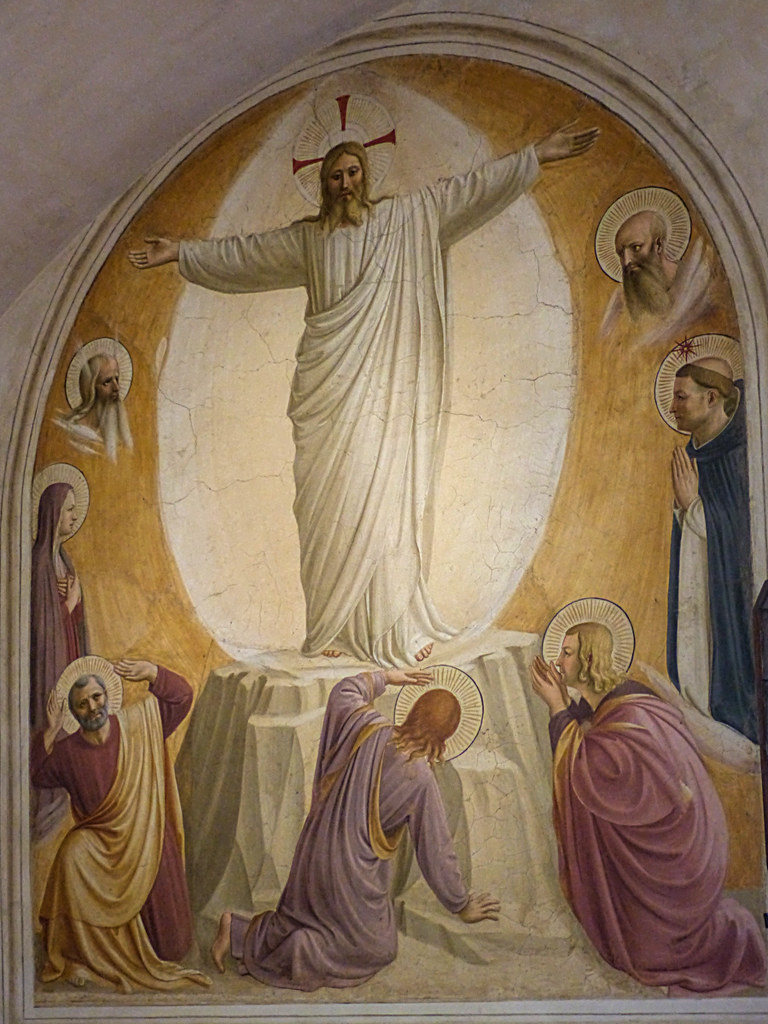
san marco florence 269TRANSFIGURATION OF OUR LORD

Exodus 24:12-18
Psalm 2
2 Peter 1:16-21
Matthew 17:1-9

Prayer of the Day: O God, in the transfiguration of your Son you confirmed the mysteries of the faith by the witness of Moses and Elijah, and in the voice from the bright cloud declaring Jesus your beloved Son, you foreshadowed our adoption as your children. Make us heirs with Christ of your glory, and bring us to enjoy its fullness, through Jesus Christ, our Savior and Lord, who lives and reigns with you and the Holy Spirit, one God, now and forever.

“Then Peter said to Jesus, ‘Lord, it is good for us to be here; if you wish, I will make three dwellings here, one for you, one for Moses, and one for Elijah.’ While he was still speaking, suddenly a bright cloud overshadowed them, and from the cloud a voice said, ‘This is my Son, the Beloved; with him I am well pleased; listen to him!’ When the disciples heard this, they fell to the ground and were overcome by fear. But Jesus came and touched them, saying, ‘Get up and do not be afraid.’ And when they looked up, they saw no one except Jesus himself alone.” Matthew 17:4-8.

This account of the Transfiguration is a powerful reminder that disciples of Jesus are not a people of the book. Our faith is relational, meaning that it is finally grounded not in obedience to precepts recorded in a written document, but in relationship to a person. Saint Peter makes that clear when he reminds his readers that he and his fellow apostles did not base their preaching and teaching on “cleverly devised myths,” but upon their own eye witness testimony to Jesus and God’s acclamation of his Sonship. This testimony is a “lamp shining in a dark place” illuminating God’s reign in the person of Jesus.

That same hermeneutic ought to govern the church’s reading and interpretation of scripture. “First of all,” says Peter, “you must understand this, that no prophecy of scripture is a matter of one’s own interpretation, because no prophecy ever came by human will, but men and women moved by the Holy Spirit spoke from God.” II Peter 1:20-21. Of course, ecclesiastical history reveals that scripture is very much a matter of interpretation. Diverse interpretations of the Bible among and within the many manifestations of Christianity, to say nothing of that diversity within the New Testament itself, testify to its rich, layered and contrasting tapestry of voices. The Bible cries out for interpretation. But Saint Peter would have us know that it is never a matter “of one’s own interpretation.” Just as the Holy Spirit was essential to the production of our scriptures, so the Spirit’s assistance is required for a faithful interpretation of scripture.

But that begs the question. How and through whom does the Spirit work to give us an understanding of scripture upon which we can rely with confidence? Different Christian traditions have answered this question in various ways, none of them entirely satisfactorily. For reasons discussed in my post of Sunday, March 25, 2018, we cannot simply assume that the Bible is self explanatory and that if we can just manage to get people to read it, they will be able to interpret it for themselves. We all know that Bibles in the hands of ignorant, misguided or deranged people have given rise to some ghastly religious movements. On the other hand, history has demonstrated that church leaders and learned theologians are not always reliable interpreters either. There is a reason why we had the Reformation!

I don’t claim to have the final word (or even a preliminary one) on what shape scriptural authority should take in our churches. But I believe that our gospel lesson has a thing or two to say about how disciples of Jesus read the Bible. Peter, James and John see Jesus up on the mountain top speaking with Moses and Elijah. Moses, the giver of the law and the covenant; Elijah, the greatest of the prophets. The whole Bible, the law and the prophets, is right there with Jesus. Peter was probably trying to pay Jesus a complement by suggesting that the disciples make three booths, one for Moses, one for Elijah and one for Jesus. What greater honor can you give to your teacher than to elevate him to the level of Moses and Elijah? But that’s when the cloud comes over them all and the voice: “This is my Son, the beloved. With him I am pleased. Listen to him.” When the disciples pick themselves up off the ground and look up, they see Jesus only. And that’s the whole point. Jesus is the voice to which we listen when we want to know God’s direction in our lives, God’s word to us. To be sure, we can and should listen to Moses, to Elijah and all the other voices in scripture. But we are not disciples of Moses or Joshua or Ezra or Peter or Paul. We are disciples of Jesus.

This means we read the Bible with Jesus colored glasses. As we know from our readings in the Sermon on the Mount, Jesus takes great liberties with the Bible. Yes, the Bible does say and eye for an eye and a tooth for a tooth. “But,” says Jesus, “I am telling you something different.” Jesus tells us that the Bible, the law and the prophets, revolve around two great commandments, “Love the Lord your God with all your heart, with all your soul, with all your mind and with all your strength. And love your neighbor as yourself.” Matthew 22:34-40. Therefore, if your reading of the Bible leads you to judge, condemn, discriminate against, hurt or insult anybody at all, you have it all wrong-no matter what the literal text says. A loveless reading of the scriptures is not a testament to Jesus and the gentle reign of God he proclaims. Any such reading distorts the biblical witness to Jesus in the interest of a cruel, selfish and hateful agenda. That, in my humble opinion, is how a lot of religion purporting to be Christian misuses the scriptures. So whenever someone says in an authoritative tone, “The Bible says…” We must always respond with, “Yes, but how would Jesus have us read and apply that text?”

This coming Wednesday we begin our journey into Lent. This time, may we catch the urgency in that voice from heaven: “This is my Son…Listen to him!” Let us listen for Jesus’ words to us as intently as the poet in the heart of Winter listens for tell tale signs of Spring.

Winter’s Song

I could have sworn I heard a songbird,
What type I cannot guess.
Her music came from so far away
I scarcely could tell whether
It was indeed a song I heard
Rather than the pipes, radiators
Or someone turning on NPR.
I stood still in the bathroom,
Staring out the window into darkness,
As if the intensity of my gaze
Might induce her to give me another bar.
She must have sensed my interest
Or perhaps my senses coming to life
Snuffed her music the way an
Acolyte extinguishes an altar candle.
I still don’t know if what I heard
Really was the song of a bird
Or just my restless imagination
Reaching out to embrace
A friendlier season.

Source: anonymous


The Cost of Truthfulness and the Toll of Lies

SIXTH SUNDAY AFTER EPIPHANY

Deuteronomy 30:15-20
Psalm 119:1-8
1 Corinthians 3:1-9
Matthew 5:21-37

Prayer of the Day: O God, strength of all who hope in you, because we are weak mortals we accomplish nothing good without you.  Help us to see and understand the things we ought to do, and give us grace and power to do them, through Jesus Christ, our Savior and Lord.  Amen.

“Again, you have heard that it was said to those of ancient times, ‘You shall not swear falsely, but carry out the vows you have made to the Lord.’ But I say to you, Do not swear at all, either by heaven, for it is the throne of God, or by the earth, for it is his footstool, or by Jerusalem, for it is the city of the great King. And do not swear by your head, for you cannot make one hair white or black. Let your word be ‘Yes, Yes’ or ‘No, No’; anything more than this comes from the evil one.” Matthew 5:33-37.

“The allegations made in the articles of impeachment are very serious. As a Senator-juror, I swore an oath, before God, to exercise “impartial justice.” I am a profoundly religious person. I take an oath before God as enormously consequential. I knew from the outset that being tasked with judging the President, the leader of my own party, would be the most difficult decision I have ever faced. I was not wrong.” Senator Mitt Romney of Utah explaining his decision to vote for the removal of President Donald Trump from office.

As I said last week, it is critical to remember that the Sermon on the Mount is not directed to the general public. It was not designed for personal application to “everyday life.” Nor is it a template for governance in a utopian society. The Sermon is directed to the disciples of Jesus. It describes the shape of a shared life of repentance, forgiveness and witness to a better way of being human. Within the Body of Christ, Paul instructs us to “put[]” away falsehood” and “let everyone speak the truth with their neighbor, for we are members one of another.” Ephesians 4:25. Truth is all that we should be speaking to one another. Every word that comes out of our mouths ought to be spoken as though in the presence of God-because it is. Oaths are therefore superfluous.

But the Body of Christ exists in a world where, to use the words of presidential adviser and personal attorney Rudy Giuliani, “truth isn’t truth.” I suspect most avid Trump supporters know that their president lies-not inadvertently, occasionally or in peripheral matters, but that he lies knowingly, consistently and in matters of grave importance. It isn’t that they are deceived. They just don’t care. Truth doesn’t matter. In fact, some of the president’s apologists have gone so far as to say that his lying is a form of authenticity! “Trump is a liar, but since he doesn’t have a filter, he manages to lie authentically.” So said Commentator Eve Peyser in explaining what Joe Walsh meant when he said, “Trump is at least open & honest about his lying.” Seriously, you can’t make this stuff up. In such a topsy turvy moral universe, an oath serves to remind people of what St. Augustine affirmed centuries ago: that truth exists, that it is knowable and our testimony must always be in conformity therewith.

In the biblical context, an oath is promissory in nature. It is meant to guarantee that what is undertaken will be brought to completion. Such oaths must not be taken frivolously because we cannot know in advance the cost of fulfilling them. When my friend Rodney married Melissa, I am sure he was mindful of the gravity of his vow “to join with her and share all that is to come.” I am sure he was aware of the difficulties involved with learning to live in an intimate relationship with another, the arguments bound to occur, the differences that would need to be ironed out and the challenge of raising children. What he was not prepared for, however, was spending the next fifteen years of his life caring for his ailing spouse as a ravishing chronic illness rendered her an invalid and slowly took her life. Rodney would be the first to tell you that, notwithstanding the unanticipated course of his marriage, it was nonetheless blessed. Be that as it may, the terrible cost of keeping the vow he made to Melissa was not even on his radar the day that vow was made. Still, he kept it faithfully.

People of faith understand that a promise made in the presence of God is not a thing to be taken lightly. In describing the character of one worthy to enter into God’s sanctuary, the psalmist says of such persons that they “stand by their oath even to their hurt.” Psalm 15:4. That means when you undertake the obligation to testify truthfully, you tell the truth-even when it is personally embarrassing, even when it can get you fired, even when it hurts your political ambitions, even when it costs you your life. It means that when you undertake the obligation of a juror, you render a just decision-even when it disappoints your constituents, hurts your party and dooms your political career. Contrary to the prevailing belief in at least one of America’s two major parties, truth exists and it matters.

You don’t have to like Senator Mitt Romney’s politics to respect and admire his recognition that the solemn duty imposed upon us by our Maker to speak the truth ranks before party loyalty which, these days, amounts to total obeisance to Donald J. Trump. Mr. Romney is an example of those who “stand by their oath even to their hurt.” If the fate of other Republican politicians who have had the temerity to cross the president is any reliable indicator, Romney’s decision to vote in favor of the president’s removal from office almost surely doomed his future in the party. More severe still was the consequence of truthfulness for Purple Heart recipient Lt. Col. Alexander Vindman who was fired for giving his courageous testimony before the House of Representatives. [1] It is no exaggeration to say that the truth is under attack in our day and those who would defend it are paying a steep price.

Yet as high a price as you might pay for telling the truth, the toll taken on the soul for betraying it is higher still. I have to wonder what kind of lies all of the Republican senators who voted to acquit Donald Trump had to tell themselves to justify that action in their own minds as they watched a man who put his life on the line to defend theirs escorted out of the office he served faithfully for years as though he were a criminal. I wonder what kind of  fabricated stories they have to tell themselves about themselves in order to live with themselves. I wonder whether, in the depths of their souls there is not yet a still small voice crying out to them, “How can you not speak out against this man’s cruel words and actions, how can you not offer even a whimper of protest when he vilifies men like John McCain and Alexander Vindman, slandering them and devaluing their service? I pity these near empty shells of what once were men and women moved to give their life to public service and who took an oath to defend the Constitution and defend the people it was written to protect. It must be hell living in their skins. It must be agonizing to be reminded of all the promises betrayed, all the ideals left behind and the fearful toadies they have become under the reign of Trump each time they look in the mirror. The words of William Shakespeare come to mind: “Cowards die many times before their deaths; The valiant never taste of death but once.” Julius Caesar, Act II, Scene II.

Truth is worth whatever price must be paid for its defense. Nowhere does that become more evident than in the cross. After all, the greatest truth is God’s oath to bless God’s creation and the highest expression of that truth is the terrible price of God’s faithfulness to that oath-the life of God’s only beloved Son. Again, Saint Augustine teaches us that all truth is finally grounded in God’s Triune self and is therefore holy-whether it pertains to the highest doctrinal assertions or the merest of human transactions. Lies, however seemingly trivial, are always an affront to our Creator and a blemish on our souls.

Truth telling and promise keeping is heroic work. Here is a poem about heroism that is grounded in faith and personal integrity. This is the kind of heroism our time needs so desperately.

Heroism

An heroic act is an individual act.
It is performed in utter solitude.
The hero knows that he acts alone,
is aware that his efforts may well be wasted
and embraces the likelihood that his sacrifice
will never be known, appreciated or understood
by any, save God alone.
History’s judgment neither adds anything,
nor takes anything away.

Source: Anonymous

[1]  The simultaneous firing of Vindman’s twin brother who played absolutely no part in the impeachment proceedings demonstrates the absolute childish ruthlessness of the Trump regime and further exposes the cringeworthy cowardice of the Republican leadership in turning a blind eye to this outrage.